


In this blog post

The research done by InVision showed that website design increases sales. A well-designed store can have more sales when compared to a store that doesn’t care about UX and UI. Let’s see what you can do with Shopify to edit a theme.
When you create a new Shopify store, one of the steps you need to go through is choosing the right store theme. You have a couple of options there. You can pick a free theme from the Shopify Theme Store, buy one online, or you can design it by yourself.
A theme made from scratch is best for those kinds of stores that have an unusual customer journey or when they need bespoke solutions. We went over that in our article about Shopify Design, so head on over there to find out if you need to invest in a custom theme design: Should you build your own Shopify Design?
What to consider when choosing your Shopify store theme?
Shopify’s themes have different built-in features. When picking a store’s design, consider what you need in your store. To narrow it down, you can pick the one that fits your industry. Fashion stores have slightly different needs than food-selling sites, don’t they?
Choosing the design based on features is a compelling option. It goes like this. Make a list of all the things you want your store to have, then look for a theme that has it. Maybe you want to have an Instagram feed built into your homepage, or maybe you want a “Frequently bought items” section in the PLP. Don’t worry if a theme you like doesn’t have those functions. You can always search for them in the Shopify App Store. But remember – too many apps can slow down your store. You may need to work on Shopify store optimization when you go overboard with the apps.
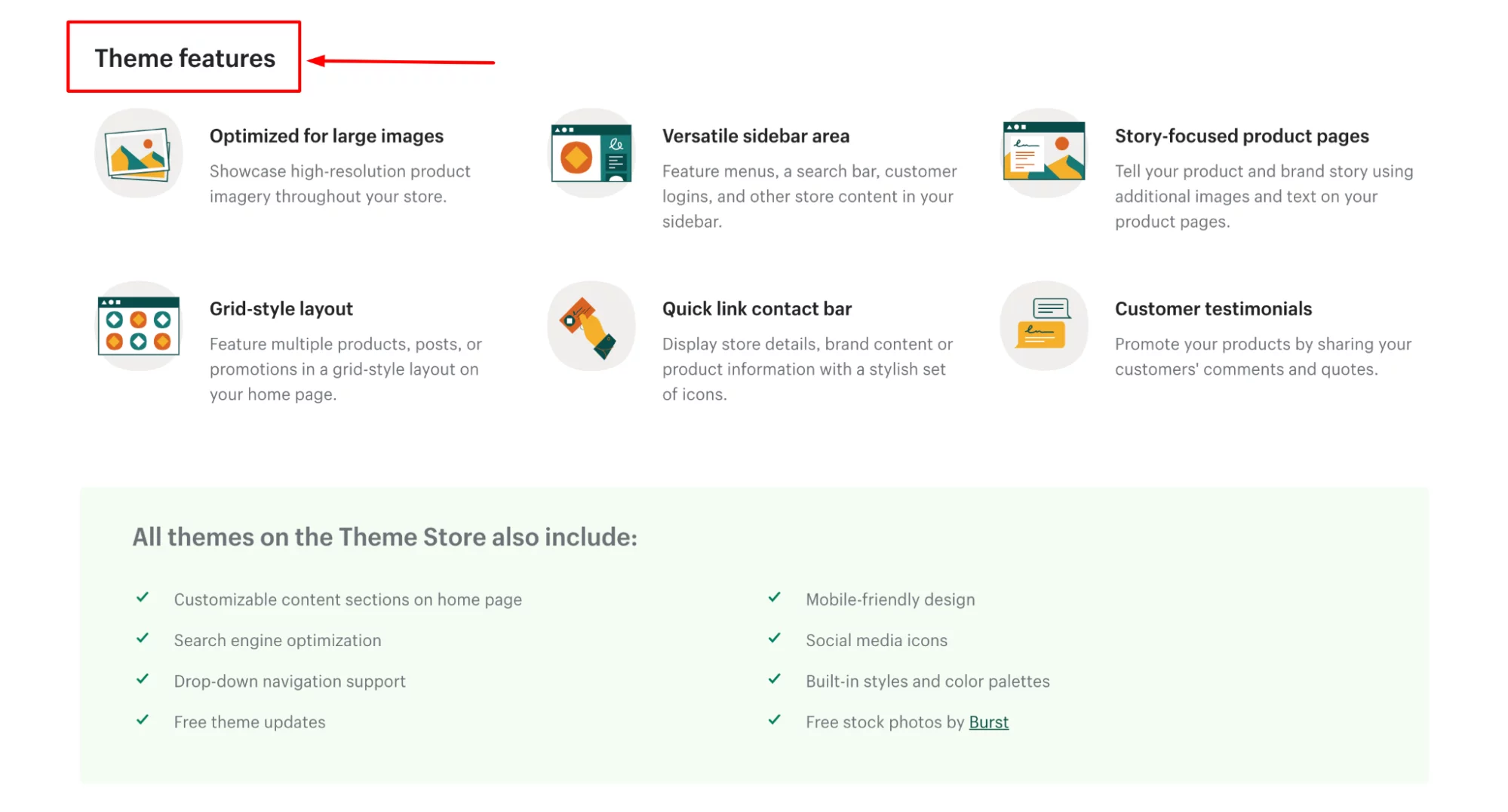
You can switch your Shopify theme anytime, if you don’t want to pick a theme based on features, you can also use Shopify’s classification of themes and pick one using the Shopify Theme Store filters:
- price (free or paid)
- industry
- catalog size
- features (e.g. mega menu, color swatches, quick view)
- newest themes
Shopify used to treat Debut as a store’s default theme. Today Debut is a “vintage” theme that can’t be installed in a new store. It was replaced by Dawn, the free reference theme released with Online Store 2.0, and Shopify’s newest free themes now belong to the Horizon family, which adds theme blocks on top of everything Online Store 2.0 offers. Dawn is still available for free. You can change your Shopify’s look and feel anytime you want.
How to install a Shopify theme?
It’s easy to install a theme in Shopify. The steps you need to take differ if you want to install a free theme, the one you bought or you have on your drive (it may be because you downloaded it from a site that’s different from Shopify Theme Store).
If you don’t have a Shopify account yet, use a trial period to check if it’s the right platform for you. Start your Shopify free trial (the trial length and the low-cost intro offer that follows depend on your region).
Step by step guide to install a free Shopify theme
The majority of merchants who are new to Shopify choose a free theme. It’s a great starting point, because every theme is responsive, easy to edit, and built with UX in mind.
To install a free theme, go to “Online Store” in the left-side menu of your Shopify admin, where you can access Shopify themes. In the “Discover themes” section, click “Visit Theme Store” and filter the list to free themes.
On a theme’s page, you can read its description, get to know its features and pick a style (preset). Once you find the right one, click “Add” to add it to your Shopify. The theme lands in the “Draft themes” section of your admin.
You’re not finished. Now you need to activate it. Once it is in your shop, publish it. Then it becomes your store’s design. Find the theme in “Draft themes” and click “Publish”. You can also publish it from the theme editor, using the “Publish” button in the top bar.
Instructions to install a paid Shopify theme
Paid themes are installed pretty much the same. After visiting the admin panel, go to “Online Store”, click “Visit Theme Store” and, instead of free themes, browse the paid ones.
In the Shopify Theme Store, we can see every theme. Paid themes are a one-time purchase and currently cost roughly between 100 and 450 dollars. Prior to buying, we can click “Try theme” to preview it in our store – it appears in “Draft themes”. Once we have the winner, let’s click “Buy” on the theme card in “Draft themes” and pay for the theme we fell in love with.
How to install a Shopify theme from your drive?
We described two most popular cases for installing Shopify themes – installing a free theme and a paid theme directly from Shopify. Now it’s time to talk about the third scenario in which you want to install a theme that you got elsewhere. It may be a design that we got from popular web design services or built upon request by a Shopify agency. It doesn’t matter because the steps are the same. To install a theme outside of Shopify, we need a ZIP file with designs on our computer’s drive or connect with GitHub (developers can also push a theme with Shopify CLI). Let’s go through all the steps once again. Log in to the Shopify Admin Panel and go to “Online Store” in the left-side menu. In the “Draft themes” section, select “Import theme” > “Upload zip file”, choose the file and click “Upload”. A theme stored on GitHub is connected through the Shopify GitHub integration.
Be careful: Downloading themes from unauthorized sites comes with a risk. They may not be compatible with Shopify. Check reviews before spending money.
Looking to get inspired? See our Top Shopify store examples until now
Detailed guide: How to edit a Shopify theme?
Besides editing the look, adding images and videos, or modifying the layout, you can introduce more advanced changes into your store, be it adding new subpages, apps, newsletter signup sections, chat box, etc. How should you go about it?
How to make basic design tweaks in your Shopify editor?
The customization level depends mainly on your theme – each theme comes with its own sections, blocks and settings. Nonetheless, any Shopify merchant can change fonts and colors, upload the logo and favicon, add social media profiles, edit the footer, adjust the menu and add, remove or rearrange sections on the homepage and other pages. The editor makes it easy to see how your website looks on desktop and mobile.
How to get inside the Shopify editor? Go to “Online Store” and click “Edit theme” next to the theme you want to change. Now, you’re inside the editor.
Editing theme’s HTML/CSS code
More advanced users, who know how to code, can make changes to the frontend to modify the theme even more. How to access the code? Go to “Online Store”, click the “…” menu next to the theme’s name and choose “Edit code”.
You will find all the theme files inside this editor. You can also add your own theme sections, for example, a section with featured products or newsletter signup.
Be careful: Before you change anything in the code, create a store backup by duplicating the theme. You can duplicate the theme in the same “…” menu where you find the “Edit code” option. Keep in mind that code changes that aren’t compatible with a theme update are removed from the updated copy.
Is building an original Shopify design worth it?
It’s not complicated to modify Shopify themes. But it starts to get tough when you want to create a theme from the ground up. Then, you need the help of an experienced Shopify developer, who can help you build the theme. You may also need a designer who can create a beautiful and easy-to-navigate store design. We’re ready to help you. Use the form below to contact us about creating a beautiful Shopify store for you.