


Build and run your Shopify store with AI
Building Shopify storefronts for the AI era
The old model — waiting for a developer to update a layout, paying $300/month in apps you could replace with a component, re-explaining your store every time something needs to change — doesn't have to be how you work.
We build Shopify Hydrogen storefronts using AI-assisted engineering and set them up so you can run them with AI. Faster to build. Cheaper to maintain. Yours to control.



The old Shopify workflow wasn't built for this
For most Shopify brands, the stack looked something like this:
- Design mockups in Figma
- Rebuild them manually in Liquid
- Add another app whenever Shopify couldn't do something cleanly
- Spend hours inside admin panels, theme settings, and SaaS dashboards
- Slowly accumulate hundreds of dollars per month in tools — and a dependency on developers for anything that matters
AI changes this. Not because Shopify flipped a switch, but because the engineering workflow itself has changed. The brands moving first aren't waiting for someone to give them permission.
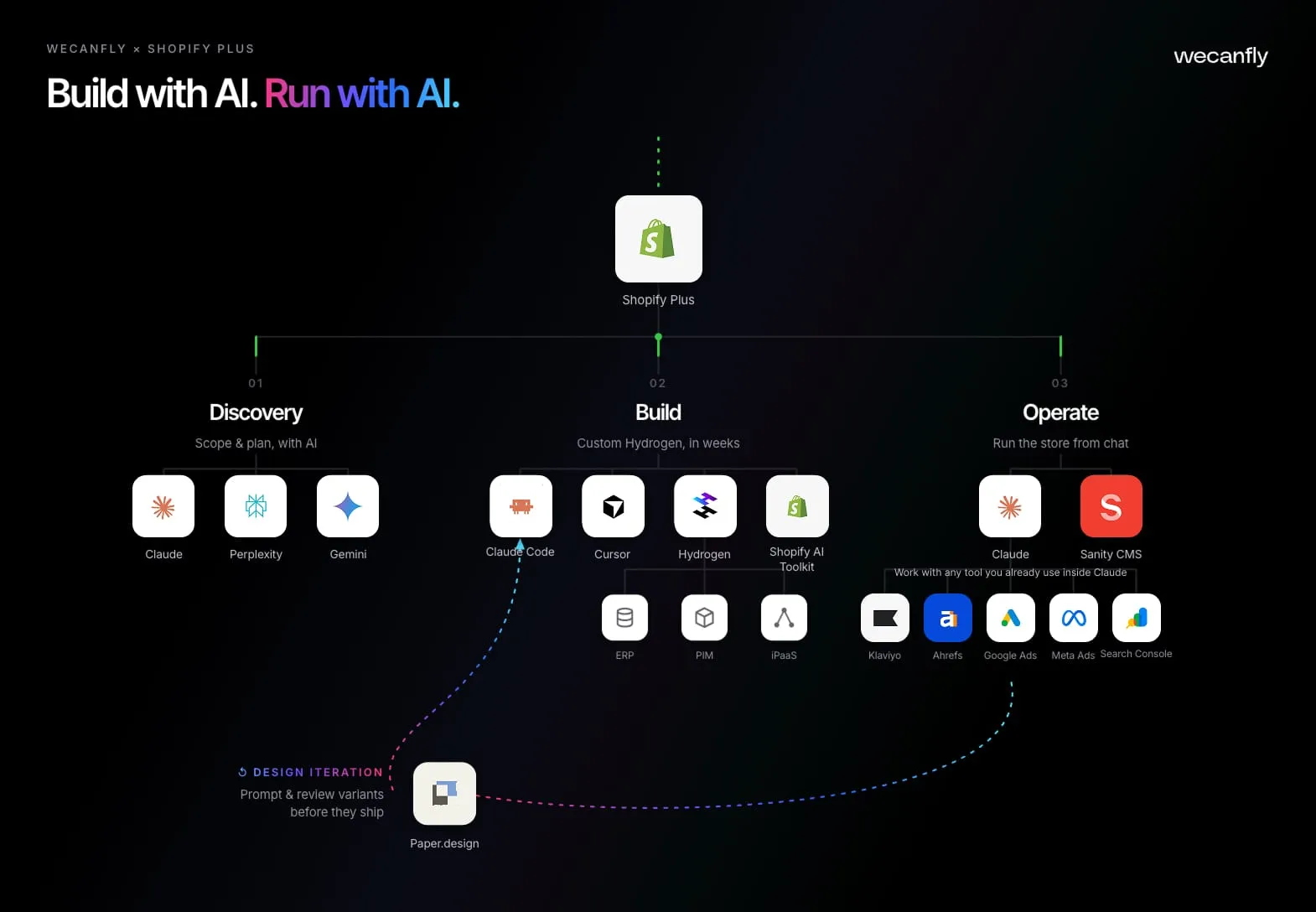
Build it with AI. Run it with AI
Check out our new modern AI workflow for brands that want to move fast and work with tools you already use.
Discover
We start the project with AI supported research that takes hours instead of weeks and discovery workshops that bring results instead of more questions.
Build
We build custom Hydrogen storefronts using Claude Code, Cursor, and Shopify's AI Toolkit. What used to take months takes weeks. Every component is versioned in GitHub — not scattered across SaaS dashboards. You can iterate on layouts, PDPs, and landing pages fast, without a full dev cycle each time.
We rip out the app subscriptions you don't need and replace them with components you own. Less overhead, more control.Operate
Once the storefront is built, we set up the workflow that lets you run it from Claude. Add products, update descriptions, launch a collection, pull a report — from your AI chat, without opening Shopify admin. Your team works the way they already want to work.
For teams that need shared content access, we connect a headless CMS — Strapi or Sanity — so editors can work independently without touching the codebase.Iterate
Want to explore component variants before shipping? We integrate design tools like Paper.design so you can prompt new components visually, review them before they hit the codebase, and iterate without a design-to-dev handoff cycle.
AI with guardrails, not chaos
Giving an AI agent access to your store — or your PIM, or your ERP — is only worth doing if it can't break things. We provide guardrails that make AI-assisted operations production-safe:
Controlled access:
Agents can read and update within defined boundaries, not roam freely
Spec driven
Changes go through structured prompts and validation, not freeform generation
Review before production:
Nothing ships without a gate
Rollback ready:
When something goes wrong (and eventually something does), recovery is fast
Talk to our Expert

Matt Czerniak
Co-founder at wecanfly | E-commerce & Shopify expert
For Shopify brands who want control
This setup is for a specific kind of team — one that's outgrown the default Shopify workflow and wants to operate differently:
The power user brand
You want to manage your store from Claude. You don't want to log into Shopify admin to change a hero banner. You want to own your component library and iterate it yourself.
The DTC brand cutting overhead
You're paying too much for apps that solve problems custom components would handle better. You want a leaner stack you actually understand.
The enterprise team going AI-native
You want AI in your operations — product data, content, orders — but you need the safety layer to do it without risk. You need to know your team (and your agents) won't break production.
Tech driven brands
You understand benefits of composable commerce and AI assisted engineering. Want to build and run your store with AI agents.
Ready to build differently?

Adam Choromański
New Business Manager