

Summarize with AI
Launching a beauty store on Shopify is easy. Building one that customers trust, reorder from and find fast on a phone takes more planning. This guide covers what we set up for cosmetics brands in 2026, from ingredient lists and shade selectors to subscriptions, bundles, reviews, several markets and Core Web Vitals.
Opening a beauty store on Shopify takes an afternoon. Building one that shoppers trust with their skin, come back to every few months and can use comfortably on a phone takes a few deliberate decisions.
Cosmetics have their own set of questions. What's in it? Which shade is mine? Does it suit my skin type? When will I run out? Can I believe the "after" photo? A good beauty store answers them on the product page, before anyone has to ask.
This guide covers the decisions we make when we build Shopify stores for beauty and cosmetics brands in 2026. The examples come from our own projects: Eveline Cosmetics, Phytoceutics, L'Occitane and Naturopathica are wecanfly clients, and for each one we say what our part of the work was. Shopify features and EU rules were checked against Shopify's Help Center and official EU sources in November 2026.
In short: what a beauty store on Shopify needs in 2026
- Clean product data: a product category from Shopify's taxonomy, shades as variants, and attributes such as skin type and finish as metafields, not only in the description.
- Product pages that answer beauty questions: the full ingredient list, how to use, who it's for, a clear shade selector and verified reviews.
- Claims you can back up: in the EU, product claims and before/after images must not suggest effects the product doesn't have.
- Reasons to come back: subscriptions or replenishment reminders timed to how fast a product runs out, plus sets, samples and gifts.
- Several markets from one admin: Shopify Markets for currencies, languages and prices, instead of a separate store per country.
- Fast mobile pages: Core Web Vitals checked in Shopify's own web performance report.
Start with product data, not with the theme
Most problems we see in beauty stores start in the catalogue: one shade per product, ingredients pasted as an image, skin types mentioned only in marketing copy. Fix the data first and the theme, filters, Google Shopping and AI search all get better information.
- Pick a product category. Shopify's Standard Product Taxonomy unlocks category metafields for each category. For a foundation, the taxonomy includes attributes such as makeup shade, skin tone, skin undertone, coverage level, cosmetic finish and suitable for skin type. For a moisturiser it includes active ingredient, skin care effect and texture.
- Keep shades as variants of one product. A product can have up to 2,048 variants and three options, which is plenty for shades and sizes. When colour entries are linked to a category metafield, they can be displayed as swatches on product pages.
- Group separate products when you have to. If each shade must stay a separate product (for example for SEO or stock reasons), the Combined Listings app shows them as one listing with variants. It is available only on Shopify Plus and enterprise plans.
Eveline Cosmetics shows how far this goes in a large beauty catalogue: some of its products have more than 100 variants. When we consolidated Eveline's stores on Shopify Plus, the architecture had to handle those variants together with prices in several currencies.
Product pages that answer beauty questions
A beauty product page does the job of a shop assistant. Besides good photos and video, make sure it covers:
- The full ingredient list. On the Eveline Cosmetics store, the foundation page shows the complete list (starting "Aqua, Dimethicone, Isododecane…") next to the description of active ingredients. Shoppers with allergies or ingredient preferences look for it, and it should match the packaging word for word.
- Who it's for and how to use it. Skin type, hair type or concern, the routine step, how much to apply and how often. If the effect depends on using it with another product, say so.
- Shades that are easy to choose. Swatches, the number of shades visible already on collection pages ("6 shades, Select shade" on Eveline's listings), and photos of each shade on different skin tones where you have them.
- Price per unit. Unit prices are a legal requirement in some regions and help shoppers compare sizes. All Online Store 2.0 themes support unit prices, which then appear on product, collection, cart and checkout pages.
- Reviews from verified buyers, close to the price and the add-to-cart button (more on reviews below).
- Answers to common questions: a short FAQ on the product page, plus store-wide pages for shipping, returns of opened products and ingredients.
The more of this sits in structured fields (metafields) rather than one long description, the easier it is to reuse in filters, comparison tables, feeds and translations.
For a wider look at product page UX, see our guide to UI/UX features your Shopify product page needs.
Claims, ingredients and before/after photos: EU basics
This is not legal advice, but every beauty brand selling in the EU should know three rules from the Cosmetics Regulation and the Commission's guidance:
- Claims must be true and supported. Article 20 of Regulation (EC) No 1223/2009 says that in labelling, making available and advertising cosmetics, "text, names, trade marks, pictures and figurative or other signs" must not imply characteristics or functions the product doesn't have. That covers your product pages, banners and emails, not only the box. Regulation (EU) No 655/2013 sets six common criteria for claims: legal compliance, truthfulness, evidential support, honesty, fairness and informed decision-making.
- Before/after images must not mislead. The Commission's technical document on cosmetic claims (2017, not legally binding) gives the example that claims should not rely on electronically manipulated before/after images if the display misleads about the product's performance. The same document says "free from parabens" should not be accepted, because it denigrates a group of authorised ingredients, and that "hypoallergenic" may only be used when the product was designed to minimise its allergenic potential and there's evidence for it.
- The ingredient list follows set rules. On the packaging, the list is preceded by the word "ingredients", uses the common ingredient names (the INCI names), runs in descending order of weight (ingredients below 1% may follow in any order), and marks nanomaterials with "(nano)". Copy the same list to the product page, so the website and the box never disagree.
In practice: keep the substantiation for each claim with the product data, avoid retouched results, and let someone responsible for regulatory compliance sign off claims before a campaign goes live.
Subscriptions and replenishment
Cosmetics run out, which makes them a natural fit for repeat purchases. Two ways to use that:
- Subscriptions. Shopify's own Shopify Subscriptions app is free in the Shopify App Store. It creates auto-billed subscriptions that renew weekly, monthly or yearly, supports several plans and discounts, and lets customers skip, resume or cancel from their account. Check its eligibility requirements for your store before you plan around it. Brands that need more (gifting, build-a-box, loyalty tie-ins) use third-party subscription apps.
- Replenishment timing. Even without subscriptions, time your emails to how long a product lasts.
Jędrzej Przeździęk, CMO of OpenGift, put it simply in our podcast episode on retention: if a customer buys "a cream they use up once every six months, why would they need an offer every two weeks?" (translated from Polish). Sending six "buy, buy, buy" emails in that window mostly earns an unsubscribe.
From our projects: Phytoceutics, a science-driven wellness brand from South Africa, moved from WooCommerce to Shopify with our team (discovery workshops, a custom design from scratch, development and migration). It offers subscriptions as an option right on the product page, with flexible delivery and discount options, so regular buyers don't have to remember to reorder.
Read more about choosing a model in our guide to e-commerce subscription models, and about the numbers behind repeat purchases in how to increase customer lifetime value.
Sets, bundles, samples and gifts
Beauty shoppers buy routines, not single products. Sets raise order value and let people try more of the range.
- Bundles. Shopify's free Shopify Bundles app works on all plans and creates fixed bundles (up to 30 components) and multipacks. Bundles track inventory by overall stock, not by location, and can have at most 3 options and 100 variants. For customised mix-and-match sets, Shopify points to its Cart Transform function or other bundle apps.
- Gifts with purchase. For Eveline Cosmetics we built custom gift-with-purchase logic with three spending thresholds directly in Shopify's checkout. It adds gifts and premium packaging automatically, without extra clicks for the shopper.
- Cross-sells and upsells. On the Phytoceutics store we built recommendation modules that show related or higher-end products. According to the case study, they raised the average basket value.
- Samples and minis. Treat a free sample or travel size as a product of its own, with stock and tracking, so you can see whether it leads to a full-size purchase.
Professional beauty works the same way. For Naturopathica, which supplies spas and other businesses, we built a B2B store on Shopify Plus with a "Protocols" section that groups products for specific face and body treatments, and order rules that require packs of 3, 6, 9 or 12.
Quizzes and personalisation
Choosing skincare is hard, so a short quiz often converts better than a long menu. On the Phytoceutics store, the "Take the quiz" link leads to a health assessment with yes/no questions. We built the quiz with a full Klaviyo integration, so the answers drive personalised recommendations, automated emails and remarketing.
The data matters as much as the quiz. Marton Kosdi-Kovacs from Love Loyalty described it in our podcast: beauty brands "know your skin type", so they "can give you creams that will be the best for this month for your skin type." Save quiz answers to the customer profile (for example in Klaviyo) and use them in emails, not only on the results page. Our Klaviyo for Shopify guide shows how.
Reviews, UGC and loyalty
Beauty shoppers rely on other people's experience more than in most categories.
- Reviews need an app. Shopify's old free Product Reviews app was retired, so reviews come from third-party apps or from Shop product reviews in the Shop app. Show the number of reviews on collection pages and mark verified purchases.
- Translate reviews for every market. Eveline's product pages show reviews with "Verified purchase" and a "Translated by: Google Translate" label. Standard apps couldn't handle Eveline's multi-store setup, so we built a dedicated app that synchronises reviews and translates them automatically between language versions from one interface.
- Show real customers. Photos and short videos from buyers, shared with their permission, show texture, shade and results on real skin better than a studio shot.
- Make loyalty more than points. Status, early access and personal advice often matter more than discounts. Our guide to loyalty programmes on Shopify covers design and measurement.
Selling in several markets from one store
Many beauty brands sell across Europe early. You no longer need a separate Shopify store for each country:
- Shopify Markets is available on all plans, with no limit on country or region markets. Each market can have its own currency, language, prices, product availability, domain or subfolder and theme content. Local currencies and local payment methods require Shopify Payments.
- Languages: up to 20 languages on Basic, Grow and Advanced, and 30 on Shopify Plus. Shopify's free Translate & Adapt app handles translations.
- Expansion stores on Shopify Plus still make sense when markets need very different operations.
Eveline Cosmetics, a cosmetics brand present in more than 80 countries, shows both sides. We worked with the brand in two stages. First we migrated its stores from Magento to Shopify. That left five stores (Poland, Germany, Ukraine, the Czech Republic and a pan-European store) on four separate Shopify instances, with no central management of prices, content and promotions. In the second stage we consolidated them into a single Shopify Plus instance on Shopify Markets: the rollout took four months, with zero downtime, and in May 2026 all operations moved to one instance under evelinecosmetics.com. We also integrated Shopify with BASE, which connects the store with Eveline's ERP, WMS and marketplaces and automates order processing. According to the case study, subscription and integration costs fell up to fourfold, and a price import module we built cut the time needed to update price lists by about 67%. Dominika Puk, E-commerce Director at Eveline, summed it up: managing several markets "is now much more efficient and convenient."
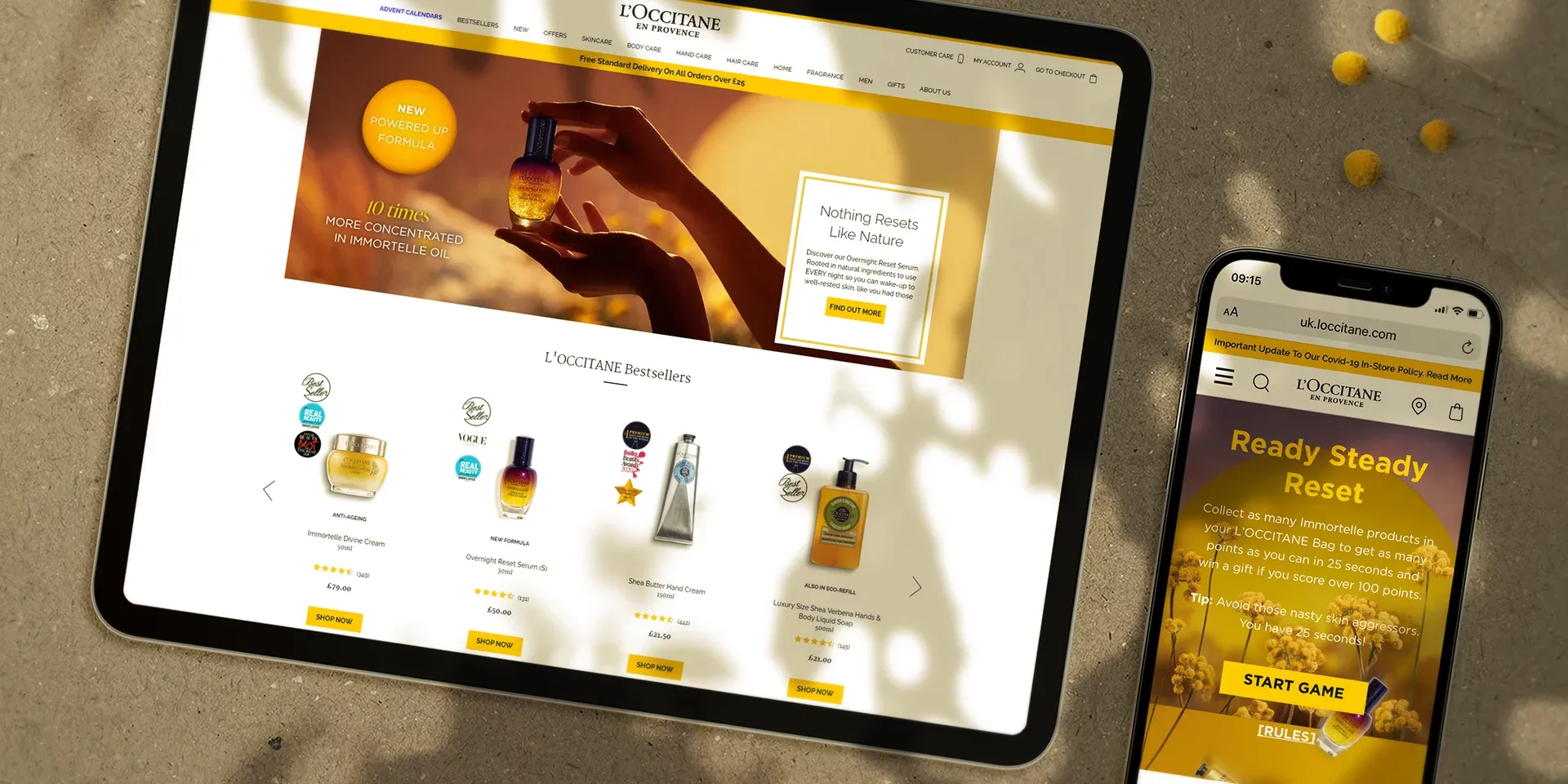
L'Occitane chose a different route. Poland was the first market where the brand tried Shopify, and we migrated it to Shopify Plus with a custom app for data exchange between its Cegid ERP, the enterprise service bus and Shopify, plus ERP and POS integrations and click & collect. The project grew into a migration of 8 markets, with separate storefronts per region, so each local team gained more autonomy.
For currency settings in detail, see how to sell in multiple currencies on Shopify.
Speed and Core Web Vitals
Beauty pages are heavy: many shade photos, video, review widgets, quiz and loyalty scripts. Each app adds code, so measure before and after you install one.
Shopify's web performance reports show the three Core Web Vitals from real visitor data over the past 30 days, ranked at the 75th percentile:
- Largest Contentful Paint (LCP), loading speed: good at 2,500 ms or less.
- Interaction to Next Paint (INP), responsiveness: good at 200 ms or less.
- Cumulative Layout Shift (CLS), visual stability: good at 0.1 or less.
For Eveline Cosmetics we built a custom theme based on Blockshop, and all five stores reached a CLS of 0 and an LCP under 3 seconds on mobile. The usual causes of layout shift in beauty stores are review stars and badges that load late, cookie and promo banners, and swatch images without fixed dimensions, so reserve space for them.
What we learned from our beauty and cosmetics projects
- Structure decides more than decoration. On Naturopathica's B2B store, many collections held only a few products or none at all. Removing them and adding sections such as bestsellers, treatment protocols and an FAQ made the store easier to navigate for professional buyers.
- Promotions belong in the platform, not in spreadsheets. Gift thresholds in Eveline's checkout and a scheduled CSV price import let the marketing team run campaigns across time zones without a developer.
- Analytics needs a plan before migration. On Eveline, Shopify's Customer Events sandbox limited access to data for third-party tools. We kept full tracking with a custom Google Tag Manager setup, so the team didn't lose campaign data on day one.
- Personalisation starts with one good question. The Phytoceutics quiz works because its answers flow into Klaviyo and into later emails. James Gilmour, Head of Marketing at Phytoceutics, wrote in his review that our work "increased sales, improved conversion rates, and increased the average basket size."
More strategies for growing a beauty brand once the store is live, such as social media, influencers and trust signals, are in our article on Shopify beauty store strategies.
Building or migrating a beauty store?
wecanfly is a Shopify Premier Partner. For beauty and cosmetics brands we run discovery workshops, design and develop Shopify and Shopify Plus stores, migrate stores from other platforms, and look after them after launch. See how we work with beauty and cosmetics brands or contact us to talk about your store.