
Maksymilian Kobus: The Role of an E-commerce Director
What truly lies behind the title of E-commerce Director?
Episode in Polish, English subtitles available. Below: an edited English translation of the full conversation.
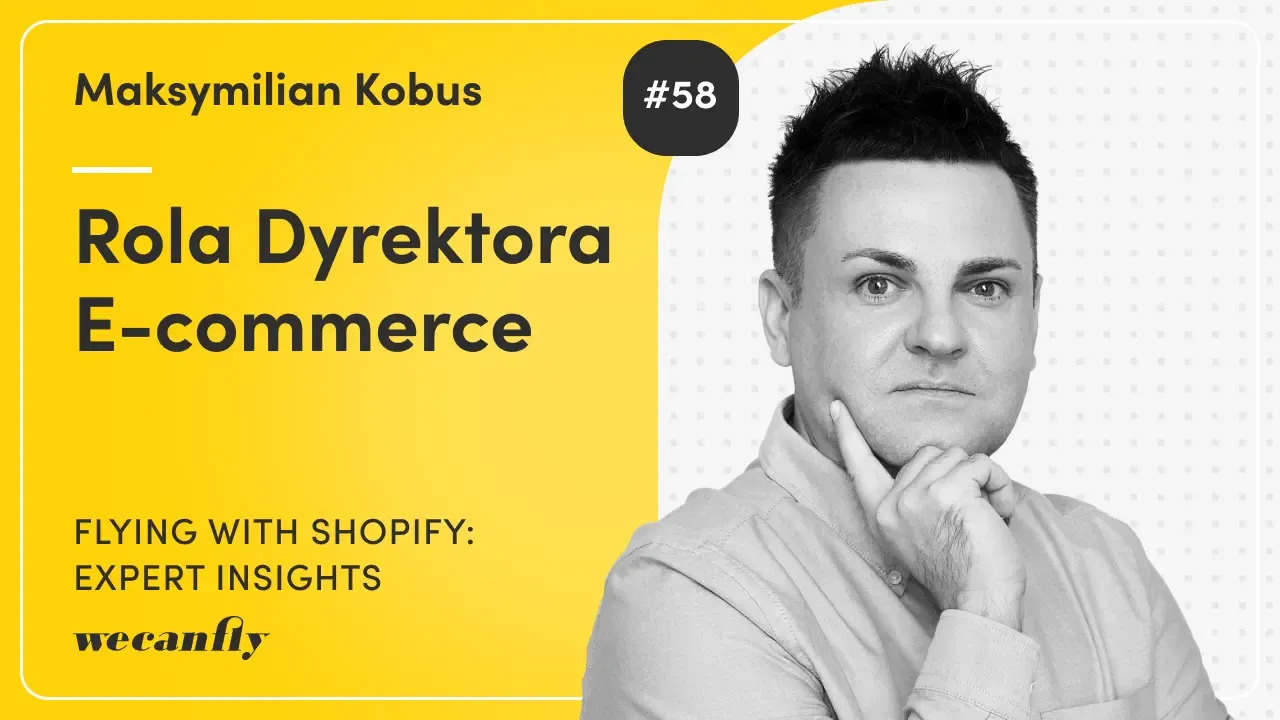
Maksymilian Kobus, who at the time of recording was COO of Trena and Gabona and before that spent four years as e-commerce director at Eveline Cosmetics, talks to Tomek Runowicz and Maciek Czerniak about what an e-commerce director actually does. He explains how the role differs from an e-commerce manager and at what company size it makes sense, what he is held accountable for, how he checks channel profitability all the way down to the cost of picking an order, and how his company uses AI to analyze supplier offers and build individual offers for customers. He also covers who to hire first for an e-commerce team, how he builds relationships and feedback, where the beauty industry is heading, and why Eveline Cosmetics moved its store from Magento to Shopify. The episode was published in July 2025 and is for owners, directors and e-commerce managers at mid-size and large brands.
Key takeaways
- What an e-commerce director does depends on the company. An e-commerce manager often reports to the marketing or sales director, and in a company that is just starting online they do everything: Maks says that at Blue Dot he could have filled 11 or 12 positions he covered himself, from the Allegro account and the online store to warehouse processes and the ERP integration. (4:48, 5:38)
- According to Maks, an e-commerce director connects marketing and sales, looks wider than one or two marketplaces and the brand's own store, finds new routes to sales, and acts as an advisor who reports directly to the owner. Before a decision he logs into the tool himself: before he convinced anyone else to choose Shopify, he tried the platform from the inside, with no tender. (11:56)
- Whether a company needs an e-commerce director depends on its structure, not its revenue. With a dozen or so office staff, plus warehouse and logistics, the role usually isn't key, because the director won't have the resources to work with. (11:56)
- For e-commerce managers who want to move up, Maks's advice is courage and consistency: a plan A, B and C, and looking beyond e-commerce at offline, Q-commerce and traditional trade, which is moving online fast. (16:05, 17:48)
- Calculate channel profitability deeper than the first margin. A channel can look fine on the first or second margin and turn negative once you add the operational cost of picking the order. Maks closed two channels this way. On Amazon, the ERP pointed to 15 of about 80 brands as the Pareto group on first margin, but after Amazon's costs the picture changed completely. (20:07, 23:22, 31:20)
- AI supports wholesale customer retention. In the GAIA project, the sales module looks at what a customer has bought and prepares an individual offer: a better price on products whose purchases have slowed down, and a special offer on the range they haven't bought yet. Another module analyzes about 200 supplier offers a day and creates a purchase order at the best prices; a third plans Amazon stock for 30, 60 or 90 days and checks whether selling there pays off at the current purchase price. (25:25, 30:38)
- Maks combines scaling with cost optimization: payment gateways, fees, tools and courier contracts. Cheaper delivery let him lower the free shipping threshold from 300 to 200 złoty, and customers were more willing to buy. Ad budgets have a ceiling too: if a brand targets a specific audience, you can't spend more, because "that group isn't made of rubber". (37:00, 40:35)
- Buyer personas should come from data, not assumptions. If an anti-aging cream for 70+ skin is mostly bought by young women, they may be buying it for older relatives because the site doesn't suit older shoppers, for example it doesn't offer cash on delivery. (35:20, 36:10)
- Maks's e-commerce team: graphic designers, performance marketing, an e-commerce specialist for the CMS, promotions and banners, then social media and influencer marketing. In-house or agency depends on the budget and on whether the company knows how to work with an agency. Feedback: one-on-ones every two weeks, weekly team meetings and quarterly talent assessments. (42:16, 47:43)
- Beauty, according to Maks, needs courage because categories are merging: devices (Foreo, Dyson), salon equipment sold in the mass market, a much wider men's grooming range, and supplements such as collagen. (53:39, 56:43)
- Choosing Shopify for Eveline Cosmetics came down to platform running costs, using the platform fully rather than for "a logo in the portfolio", and a calm migration from Magento, planned minute by minute for the cutover night and the seven days after it. (1:02:07)
Guest
Maksymilian Kobus was, at the time of recording (2025), COO of Trena and Gabona, responsible for every department except accounting and finance. Before that he spent four years as e-commerce director at Eveline Cosmetics, and as an e-commerce manager he built online sales from scratch at Blue Dot, a distributor of Korean cosmetics. Eveline Cosmetics is our client: we first moved the brand's stores from Magento to Shopify, and in 2026 we merged them into one Shopify Plus store (Eveline Cosmetics case study).
Hosts
Tomek Runowicz and Maciek Czerniak run wecanfly, a Shopify Premier Partner agency that helps established brands with complex migrations to Shopify Plus. Today our projects run with AI agents built into processes and guardrails we developed from experience across many builds, and an experienced person on the team signs off every change. We plan moves like Eveline's as part of our Magento to Shopify migration service.
If you're weighing the same platform decision, read Magento vs Shopify in 2026: Features, Costs and When to Migrate. For the reports Shopify gives you out of the box, see Shopify Analytics and Reports in 2026: What Every Plan Gets and How to Use Them, and for what we built for beauty brands, Top Shopify Beauty Store Strategies. Retention programs are covered in Loyalty Programs on Shopify: How to Design, Measure, and Scale Them.
Transcript
This transcript is based on the recording of this episode. We edited it for readability: we corrected transcription errors, punctuation, and merged sentences that were cut off mid-flow. We did not change the content, order, or meaning of anything said. Any errors or inaccuracies are our responsibility alone — not our guests'. If you spot something that needs correcting, email us.
Recorded in Polish and published on July 17, 2025; below is an edited English translation. The guest's roles and companies are described as they were at the time of recording. We leave out the teaser at the start of the video, a promo for the GetCommerce conference in September 2025 and a few off-topic jokes.
Who is Maksymilian Kobus?
Tomek: Hi, and welcome to another episode of Flying with Shopify. Today we'll start with a bold claim. In our view, Polish e-commerce suffers from a shortage of good e-commerce directors. Why is that? As it happens, we have one of the best e-commerce directors in Poland with us, Maksymilian Kobus. Maksymilian, we're really glad you came by today. I hope we'll clear up some doubts about what's behind the role you hold, what skills it takes and why it's so hard to find people this good.
Maks: Hi, thanks for having me. With claims like that, it's going to be tough.
Maciek: The bar is set nice and high.
Tomek: Before we start, could you introduce yourself to a wider audience? Maciek and I already know you a bit, but it would be great for everyone else to hear about your experience and how you got to the position you hold today.
Maks: My name is Maksymilian Kobus, and I'm now the chief operating officer at Trena and Gabona. For the past four years, until the end of February, I was e-commerce director at Eveline Cosmetics, the largest cosmetics company in Poland. Before that, as an e-commerce manager, I built an e-commerce strategy from scratch at Blue Dot, a company that distributes Korean cosmetics.
How is the e-commerce director role changing?
Maciek: So let's talk about it. It would be good to start with your path. My question is: over the years, and we won't point out how many, has the role of e-commerce director, and before that e-commerce manager, evolved?
Maks: Definitely, yes. The role depends a lot on the company. Even an e-commerce manager is responsible for one thing in one company and something completely different in another. It's exactly the same with an e-commerce director, and my current job shows it best: after a month it evolved from e-commerce director into chief operating officer. My scope is completely different from what I had at Eveline Cosmetics, because it depends on the nature of the company.
Maciek: Could you say more about those differences? How does the role of an e-commerce manager differ from an e-commerce director and from a COO?
Maks: First of all, in the hierarchy an e-commerce manager is probably a bit below an e-commerce director, but they often report to the marketing director or the sales director. It depends on the size of the company. In smaller companies, owners are often afraid of having directors. That's probably a fear left over from a previous era. When I was an e-commerce manager at Blue Dot, I think I could easily have filled 11 or 12 positions if I named the roles. I was responsible for opening the Allegro account, answering emails, picking up the phone, building the online store, adding content and making the store work with the ERP. I built the integration by setting up warehouse processes, for example, or how a parcel should be packed, because B2C processes simply didn't exist.
It's a key role for the whole division, because in many companies e-commerce is an add-on to sales. If a company is offline, it doesn't cope very well with online. A lot of people will probably hate me for saying this, but in Poland e-commerce is very often not treated as an equal, just as an extra channel, an extra source of income. And e-commerce is a huge range of sales: marketplaces, your own channels, working with pure players, which I've done too. It's a great field because it combines marketing and sales, it sits somewhere in between. I don't think you can say exactly what percentage is sales and what percentage is marketing. It's one organism that runs on the same rules.
Back to your question about how it evolved: at Blue Dot I built everything from scratch. On my first day even my computer wasn't ready, let alone online sales. At Eveline Cosmetics I started as a KAM, responsible for working with a few pure players. Then the role evolved and I took on Allegro, among other things, because of my earlier experience. Over time I added other sales channels, the online store and opening new stores, and later the whole marketing department, performance and the media team. That shows marketing can't exist without e-commerce.
Both companies I'm in now are fully e-commerce. We don't sell offline, or rather, we're only starting to build that. We're entering modern trade: drugstore chains, discounters, hypermarkets and supermarkets. We have a B2B platform where our customers buy wholesale. That's Gabona: sales by the pallet and by the carton, so large scale. Trena handles B2C sales, but it also supplies hair salons in Poland and a lot of them abroad. We don't have reps driving around to salons. We have our own sales team, in Sicily and in Poland, and we take orders by phone, by email and through the website. The whole company is an e-commerce company.
At Eveline Cosmetics I was responsible for one branch of sales. I partly connected the modern trade team with the media team, so we could properly look after customers like Rossmann and Hebe in terms of marketing communication and how to talk about the products. Trade marketing, modern trade, accounting, operations and warehouses were handled by completely different people. In the new organization I'm responsible for every department except accounting and finance: purchasing, analytics, administration, HR and payroll, domestic and international sales, marketing, warehouse and logistics, and of course e-commerce. All of them report directly to me, so it's quite a jump. But that's exactly where you see the best synergy: the teams have to talk to each other and work together, otherwise none of them will deliver what it's there for.
At what company size do you need an e-commerce director?
Tomek: Absolutely. There are two things in what you said that I'd like to ask about. You said small companies are a bit afraid of directors. Let's stop there and try to define what you mean by a small business, or from what size you think a director becomes an important part of the company.
Maks: I don't think revenue is the measure here, because there are relatively small companies with huge revenue, dropshipping businesses or wholesalers, for example. A lot depends on the structure of the organization. In a company with a dozen or so people in the office in total, plus warehouse and logistics, an e-commerce director probably won't be a key role. That person may not find their feet because they won't have the right resources.
Many of my peers, and again I'll be hated for this, are more strategists, people who set the direction. Personally, I really like to get inside, click around, set things up myself, test, and only then hand it over to the people who report to me. I think an e-commerce director is closest to the product and the process when they physically touch them. We work together, so it's no secret: before I decided on the platform, I went in, logged in to see what it was all about, and only then went to convince others that the tool was right for us and had the features we needed. It wasn't a case of opening a tender and letting the best one win. I like to go into Google, Facebook, Shopify or any other platform to see what works with what and where I might run into problems. I warn my people about this, because they often carry out my crazy ideas and don't know those technologies or tools. I have to walk that path with them and show that if they're going to trust me, I need to know what I'm "selling" them, because they're a customer too.
In small companies an e-commerce director is sometimes a bit like a sales director. For now I think that's more form than substance. But an e-commerce director often plays a very important role in a company. That's my case, because I report directly to the owner and I'm responsible for key areas. An e-commerce director should above all be an advisor who brings something new to the whole organization through technology, processes and improvements, and builds authority, because that's key too.
I think there are still few young e-commerce directors in Poland from the millennial generation. They're mostly e-commerce managers, and they're often afraid to take a step forward and get promoted within the structure. They do their thing and don't leave their comfort zone. Besides, an e-commerce manager is often limited to a few sales points, usually one or two marketplaces and the brand's own store. I think an e-commerce director should look wider: bring marketing together, among other things, and point to new routes to sales and to scaling the business.
What do e-commerce managers lack to get promoted?
Maciek: What do you think is the turning point, or the missing link, that young e-commerce managers lack to jump to the next level?
Maks: My first association is courage and consistency, because we're responsible for a big part of the company's revenue. E-commerce managers often work at companies that are scaling e-commerce, and it really brings in serious money. And the word "director" alone means much more responsibility. For me, the career goal was to reach a stage where the position carries experience but also responsibility, and to show: I'm a director and I'm not afraid of that responsibility or of making decisions that are sometimes even risky. I like to have a plan A, B and C, so that's the consistency, determination and planning what we want to do. To young people I'd say: be brave, but in a positive way, not blindly. Listen to yourself, but also listen to what the people around you say.
Tomek: We have a saying at our company: every day is an adventure when you're incompetent. Maciek, you asked the question I wanted to ask Maks, about which skills e-commerce managers lack to move up a level. I think we've partly answered it already.
Maks: To those skills I'd add thinking outside the box about what's happening in other sales channels. People inside e-commerce very often wear blinkers and see nothing else. It's worth looking at what's happening offline. It's worth looking at Q-commerce, a relatively young sales division. Traditional trade is also pushing hard into e-commerce. For those who don't know: traditional trade means drugstores and shops that aren't part of a chain or belong to very small, almost franchise networks. Because traditional trade is shrinking, they're trying to get onto Allegro and set up small online stores. A lot of those stores appeared during the pandemic. They're going onto Amazon.
You need to look at what's happening there and what drives those people's sales, so you know how to respond, or why an e-commerce customer abandons my cart. Why don't they come at all? They see an ad, click, come in and leave the store. What's going on? Maybe they go offline and only browse online. But we can also have customers who come in and literally buy in a few seconds. Why? Because they've already come across the product somewhere.
What is a COO responsible and accountable for?
Tomek: Right. Now that we've more or less shown the differences between an e-commerce manager and an e-commerce director, let's focus on your role. Give us a look behind the scenes: what are you really responsible for in the company, and what are you held accountable for? What goals does the board set for you, since you report directly to the owners, or what goals do you agree on together?
Maks: I'd say I'm now responsible for transforming the company. Restructuring would probably be too strong a word. Gabona was a trading company that bought various products, a multi-brand platform. Now we're moving from a trading model to a distributor model, a distributor of the future. We go to trade fairs and look for brands that want to enter the Polish market or are relatively young and want to grow. Inside the company we're building structures that will, for example, supply modern trade, and I'm responsible for making that effective and efficient. We're at a point where we're both a trader and already becoming a distributor, so the two paths have started to cross.
Being a trader means we buy, sell and do marketing only for our own company. We want to make our mark, for example in B2B, and show: here we are, we have almost 80 brands, 8,000 SKUs, we trade with 74 countries. So why not more countries? Or why not a wider portfolio? A distributor, on the other hand, has to do what a manufacturer does, because a manufacturer looks for a distributor when it can't sell in a given market or channel on its own. So we have to promote the brand, know the products, train our team, adapt the marketing tools to the brand's communication and get the products listed in retail chains. Which ones? Not every product fits every chain. For Rossmann a product will be too expensive, but for Hebe it'll be right. We won't put a 300-złoty cream into a discounter, because nobody will buy it. Unless it originally cost 1,200 złoty. I've seen premium brands like that in discounters too.
On top of that there's changing practically every process in the company, scaling the business and bringing more traffic, to Trena for example. Separating B2B sales to salons from sales to end customers. Optimizing sales channels, because not all of them are profitable. They can look fine in percentage terms on the first or second margin, but when we go deeper, to the third, and see what it costs operationally to pick an order like that, it turns out we're losing money.
Tomek: So where's the business in that?
Maks: Exactly. I've already closed two channels. I created and changed the company structure, the reporting formats and the communication tools. There was nothing like Trello, for example. We had Planner in Teams, but it didn't pass the test. And nobody said, "Maybe something else then", just, "Let's stop using it". Those are teething problems in a very mature organization that has been on the market for many years. We have many people who have worked there since the company started, and we need to shift their mindset a bit and show them it's time to learn something new, that you can work differently and earn really good money.
A lot is changing, and what am I held accountable for? By their deeds you shall know them, not by their intentions, so by the results we achieve. I started, for example, by setting targets for the sales teams: where we are and where we'd like to be. Showing year-over-year data, building proper reporting. For now, that's what I'm held accountable for.
Which data tools does Maks use, and how does the GAIA AI project work?
Tomek: Maciek, do you want to ask something?
Maciek: I can see you wanted to.
Tomek: I just wanted a quick follow-up. Could you share which tools you use for analytics and reporting? Is it a setup you've worked out in recent years and that works well for you?
Maks: The analyst I hired is a new role for us. We still use an ERP called Navireo, software from InsERT. It has built-in reports, but it turned out not all of them show the right data, so we started implementing Power BI, which uses the right queries to show the data I care about. Especially since we have several companies: one Navireo module shows data but won't put it next to the other company's, so we had to connect them. After just one month of Ola's work I saw the first reports, and they're really "wow". I get goosebumps even talking about it, because I knew what I wanted to see and I'd worked with that data before. After briefing Ola, I handed the reports to other people in the company and I'm showing them: "You haven't seen this before, but look how you can work now." I also pointed out what data I'd like them to see, meaning what should be useful in their work.
The basic tools like Meta or Analytics reports too, of course. But, horror of horrors, it turned out I didn't see everything I wanted, because the analytics wasn't set up properly, so I was waiting to change agencies. Now I'm onboarding a new agency to sort out the analytics. Because do you know where I'll see abandoned carts? Not in Navireo, but in analytics. For an e-commerce manager or director, those are the basics.
Then there's a very hot topic, AI. We have a very big AI implementation project in the company. I joined it, inherited it, and now we're optimizing it. Imagine you're a big company that gets about 200 offers a day from different manufacturers and wholesalers. How do you analyze that? How do you choose the best offer? We built a project called GAIA that analyzes those offers, picks out the best ones and immediately creates a purchase order to the supplier at the best prices. It also analyzes our company's sales from the last 30 and 90 days, it will work across several companies, and it outputs the data straight away as an order.
The second module, the sales module, prepares individual offers for our customers. It analyzes what a customer has bought, and we generate a better price for them, for example on those products, because we've seen their purchases slow down. We also look at what they haven't bought and offer them a special deal on that range. The third module is the Amazon module, which analyzes sales on a given listing across all the offers on it and plans stock for the next 30, 60 or 90 days, depending on what we want to achieve. It also checks whether to stock up at all, meaning whether our purchase price is OK. It may turn out that the purchase price is too high and it doesn't pay to send the goods to Amazon, because after Amazon's costs I'll be in the red.
For now it's more of a database that brings the data together. Eventually I'd like the app to show trends too, and not only analyze our own company's sales. If it sees that a supplier has a good price and good stock, but we don't have that product listed, it should say: "Buy this product. Great price, you can make a nice margin on it, and it's trending on TikTok, or there are lots of Google searches for it and few sales from Google Shopping." I'd like the AI to go deeper into these analyses and recommend purchasing and then sales actions.
Tomek: A great example of using AI in an organization where working with numbers matters so much. A bit of a digression, but it really caught my attention: when those offers come in, does someone have to enter them into GAIA by hand?
Maks: No. It's connected to the inbox where the offers arrive and analyzes them itself. It sees, for example, that 50 offers for brand X came in today, and checks which one was the best, because we happen to need to buy brand X.
What do you do when the data says one thing and your gut another?
Tomek: Very interesting. Since we're on data, I'm curious: have you had a situation in your career where the data said one thing and your intuition said something else?
Maks: Often. Worse, and I say this with regret, many companies can't read data at all. We have the data in some form, but it's good to analyze it afterwards and learn to read it. Yes, there were cases where you could conclude that something was wrong with the store, or that sales were dropping because our prices weren't good. And then it turns out, and a few people in e-commerce will smile and nod here, that the weather affects online sales. The long May weekend, everyone knows, is the slow season. If it rains, we can count on fairly high sales. If the weather is nice, sales will be very low.
A recent case: optimizing the brands we sell on Amazon. According to the ERP, I should keep 15 of the roughly 80 brands I sell on Amazon, because they're the Pareto group. But that's on first margin, meaning sale price minus purchase price and how much profit is left. When we go deeper and see how much Amazon eats, the data changes completely.
You also have to ask yourself what you want to see in the data. I really like to look at both unit sales and sales value. An example from cosmetics: would we rather sell relatively small mascaras or big body lotions? The answer is simple. On the lotion we'll definitely have a lower margin than on the mascara, because there's more weight, bigger packaging, higher picking and packing costs. On mascara we can earn more. Greetings to Hubert from Cocolita, who never wanted to list my face masks, because if he had to choose between masks and mascara, he preferred mascara: it's more expensive and takes up less space. And masks we can sell, say Korean ones, where the margin is relatively higher.
That's not a direct answer to your question, but I think it's worth asking first what we want to see in the data and what conclusions to draw. They say your first thought is always the best, but I'd go deeper. Back to plan A, B and C: look at different scenarios on the same data, because unit sales and sales value can upset your plans.
Tomek: Definitely. On this channel we're big fans of data analysis, and what we see on the market is brutal. You say some people don't read data at all. There are also those who don't even collect it and don't know it exists. We strongly encourage it, because without data it's hard to make any decisions. Although from what you're saying, even hard data and numbers are sometimes worth a second look before you decide, because those decisions won't always be right.
How to build buyer personas from data
Maks: There's one more good example. We build buyer personas and compare the data. Say I sell a cream for 70+ skin, and I see that my main customer is a young woman. I wouldn't assume a teenager wants to look after her skin and buys a 70+ cream. Maybe the site isn't suited to people I'd call "adults", and they have to ask the younger generation to place the order. So let's stop and analyze the data more deeply.
Tomek: Above all, correlate it rather than just reading the demographics. I have 30-year-olds buying from me, but let's correlate...
Maks: They're already stocking up.
Tomek: Stocking up, maybe because the price is good.
Maks: And it turns out the product isn't aimed at them at all. Maybe the communication was wrong, or the site isn't suited to the real buyers because, for example, it doesn't offer cash on delivery.
Maciek: You build buyer personas based on that data, right? They're not some imaginary...
Maks: Yes.
Maciek: Proto-personas.
Maks: I don't like them. I know there are models where you create a buyer persona while you're creating the product, because someone decided the product will be for this group and not another. Then the market often evolves and it turns out you have to change that persona. So data first.
Maciek: Exactly.
How do you scale e-commerce and cut costs at the same time?
Tomek: One last question about the financial side of your work. You mentioned that one of the reasons you're at Trena and Gabona is to scale the company. Do you understand that mainly as revenue growth, or while keeping EBITDA healthy? You've already hinted that you cut some channels because they weren't profitable. But have you ever, as they say, scaled without restraint? Sometimes it makes sense or serves a further goal: we want to grow, we want to be seen as big enough. Were your decisions ever focused on just one of those metrics, or are you in favor of scaling in good health?
Maks: I don't like doing just one thing, so I married the two: scaling and optimizing at the same time. I don't like being bored. I could do pure optimization, analyzing contracts, costs and the cost structure, but I already knew where the skeletons in the closet were, so I started opening the closets one by one and optimizing at the same time. Payment gateways, fees, the tools we use and how much we pay for them. Courier companies. It turned out you can optimize prices and scale at the same time, because a lower delivery cost makes customers more willing to choose that delivery method. Then free shipping above a threshold. With a high delivery cost I can offer free shipping from 300 złoty, but if I lower the delivery price, I can offer it from 200 złoty. The customer is then more willing to buy. So it's optimization alongside scaling, and a review of what we have and what we don't.
It may turn out, for example, that I'm still responsible for the marketing calendar, I come up with promotional campaigns, and I get to a point where I have an idea for a promotion but I can't set it up, because the store engine doesn't allow it. And what do I do then? I call Tomek and say: "Tomek, help, we need to migrate the store."
But you also have to know how to scale, because Google will always tell you: not enough money, add more. And I had a situation where I knew I had a great margin on a brand, I wanted to add budget to grow sales, and Google said: "Don't add more, there's no point, you won't spend it." That was absurd. I think few people come across it, but there are brands where you can't push your visibility any further, because Google won't let you.
Maciek: You've hit the ceiling.
Tomek: Because the market is saturated, right? In the specific audience you've chosen for that product or brand, you're spending the optimum, and even if you want to spend more, you won't, because the group won't get bigger.
Maks: Of course I could spend more. If the campaign targeted women aged 18 to 35 in big cities, I could spend more by adding men or smaller towns. But if the product or brand is aimed at a specific audience, you won't spend more, because that group isn't made of rubber.
Who should you hire first for an e-commerce team?
Maciek: OK. Tomek said that was the last question in this part, so let's move on to the next. A director is there for directoring, so he needs people to direct.
Tomek: Although, as Maks said today, he's happy to roll up his sleeves for any job.
Maciek: Absolutely. I don't mean a director who holds his suspenders with one finger and points at what to do with the other. Obviously you have to get your hands dirty too. But building and managing an e-commerce team is a really interesting area. I'd like to talk about your approach to building a team and what guides you. Let's start with who you'd hire first. What are the key roles, and what do you look for when choosing people?
Maks: I don't like directoring, just to respond to that. If my colleagues think otherwise, let them come and say so. For one thing, I sit in the open space with my people, and building relationships and being close to them is key for me.
There are areas in e-commerce you can't exist without. The order is random. You definitely need graphic designers, and you definitely need a performance team. You definitely need someone who handles the CMS on the back end, sets up promotions and uploads banners, so an e-commerce specialist is also nice to have. Then, once we have something to work with, a platform and social media accounts, it would be good to have someone for social media. After that, probably someone for influencer marketing.
Then the next question naturally comes up: in-house or outsourced? And the favorite saying: it depends. First, on the budget. If it turns out we don't have one, we'll have to rely on an agency. But you also have to accept that an agency won't always look after you the way you'd like. A few months ago I'd have told you I was completely against agencies, because at Eveline Cosmetics everything was in-house and I really did build those teams internally. Today, where you stand depends on where you sit: if you manage an agency well and have a really good one, the partnership can work well too. That's it for teams. Then there are departments not directly related to e-commerce: purchasing, logistics of course, accounting, IT. All of that can probably be outsourced. It also depends on whether we know how to work with agencies, because that's very important. There's no point in both sides suffering.
Tomek: You know, I have a small window here to squeeze a compliment out of you for us. What do you think? Let's wait a moment, give Maks...
Maks: Sometimes there's something we want to implement that I can't do in-house, and I need an agency for it. But you're a good example of a case where the relationship tipped the scales, and who had what charm. Let me remind you that Tomek was the first person I had a meeting with, and I was really impressed by what we could do together. I've told Tomek that directly before.
How does Maks build relationships and feedback in his team?
Tomek: And there it is, now we have it better than in writing. But let's go back to relationships. You say you don't like directoring, but managing a team understood as building relationships is the foundation, and not only in your role. Personally, I think in any company that's the only thing you can build a good, long-term plan for a project on. What ways of working with your people do you use, and what kind of relationships do you like to build with them? How do you approach giving them feedback and getting it from them? I ask because we come from the previous era, when those methods were pretty crude.
Maks: God, how old we are.
Tomek: But somewhere in our heads there's still that image of the old-school director. So it would be good to hear how you approach this in a modern way.
Maks: There are three areas that are key for me. First, a colleague, because I don't like the word "employee", to me everyone is a colleague, is also a customer. An internal customer. Believe it or not, I talk to my people exactly the way I talk to you, and to you exactly the way I talk to them. Whether it's a big chain customer or a smaller one, everyone deserves to be looked after, and I talk to everyone the same way. I'm very relationship-driven and I bet on relationships. Anyone who knows me and has tried to negotiate with me knows you don't negotiate with me, because it's a waste of time for both sides.
Tomek: We've heard something about that.
Maks: Yes, it may even have come up in an email. What I can give, I give right away. Let's really not play at negotiating. Why? Because we often dress up something as mundane as haggling as a negotiation process. So I don't negotiate. I give what I can, and I expect the same from the other side.
When I came to Gabona and Trena, I set out the rules of working together very clearly. I said how I work and what people can expect from me. For example, when I write emails at the weekend or at 11 p.m., and I do it a lot, it's not because I expect a reply at that hour, but to give someone something to work on first thing in the morning. We have flexible start times: some people come in at 7:00, others at 9:00. Whoever comes in at 7:00 already knows what to work on.
With my colleagues I have regular one-on-ones every two weeks, weekly team meetings and quarterly assessments where we give each other feedback. To be clear, the one-on-ones and team meetings are also for feedback. I've also said: if something in my work bothers you, gets in your way or annoys you, come and tell me, because I don't want to frustrate you. And it works, it really works. The talent assessments I run every quarter, and again I get goosebumps talking about it, have triggered wildly different emotions in the teams where I ran them: from euphoria to tears to anger. But they show it's really worth doing, because they often clear the air or build even deeper, better relationships. That's my secret to building relationships.
Tomek: When we last had a chance to talk at our event in Warsaw, you said something that stuck with me. You mentioned that when working with your team, you never insist that you're the final oracle and that your opinion is...
Maks: That I hire people I can learn from. That's what I said.
Tomek: Exactly. That's one. And two, you said you're a fan of a battle of arguments. I think that was your phrase.
Maks: Exactly. Let's argue it out. I love it, but not to prove to the other side that I'm on top. We go into this directoring business only to show people that I'm not the alpha and omega either. That's why I have specialists in each area: to learn something from them, and so that people start thinking outside the box and aren't just executing my ideas. I'd like to be able to say: I agree with you, let's do it your way, because maybe I didn't think you could work completely differently.
Today I had an exchange with Andrzej, our marketing team leader, about linking something. I gave him my reasons, and Andrzej replied that he'd still stick with his idea. I wrote back: "Andrzej, I can live with your idea. Let's do it your way and see. Let it work. Let's test it." Let's not be afraid to test at all. Back to the start of our conversation: let's be bold in making decisions and let's test. This will work, that won't, but at least we'll know what to avoid in future. If it doesn't cost us a million złoty, why not try?
Where is beauty e-commerce heading?
Tomek: That's a very apt point. I feel that sometimes people and companies hesitate over a decision for a long time based only on theoretical assumptions: we'll do something that definitely won't work, probably won't work, or maybe will. And the next step, as you say, takes courage. Especially now, and here we can move on to your industry. E-commerce is extremely crowded and competitive, in practically every industry, and the pandemic contributed to that, because many brands that never even thought about these channels suddenly appeared in them. A few years have passed since the pandemic, so they've had time to learn and reach a decent level. Without bold decisions, and sometimes without making mistakes, which is completely human and normal because that's when we learn much faster, it's hard to stay competitive today. Without that courage we slide into sameness and mediocrity, so this approach is very close to my heart. Since we're talking about competition, let's step away from your role for a moment. This is an e-commerce channel after all, and you represent the beauty industry in the broad sense. Could you share a few observations: what shape is beauty e-commerce in today, what challenges does it face, and where will online sales move?
Maks: Let me pick up on what you just said. The pain point at Trena and Gabona was that the company and the people working there knew what the problems were, but despite 120 people in the company there were areas where someone was afraid to decide which way to go. Or they knew something didn't work, but someone had to take on the risk and responsibility to change it. And then someone like Maks comes along and takes that risk.
That's a smooth transition to where beauty e-commerce is heading: in beauty you have to be very bold. What used to be forbidden, or even taboo, is becoming normal today. Look at Zara's campaign, for example: it launched a cosmetics line and the photos showed male models instead of female ones. That used to be unthinkable, and yet it's possible. Estée Lauder's lead makeup artist in Poland is a man. At Kontigo it also used to be a man. Beauty today isn't a basic face cream in a blue metal tin, it's a very high level of awareness. I talked about this recently on a podcast with Adam Chudzik, where we discussed beauty and electronics.
Look at how those two worlds have started to merge. There's the big international brand Foreo, which made its name with sonic toothbrushes. It has sonic facial cleansing brushes, which are already part of beauty, and it has launched its own cosmetics line. Dyson, which we know for vacuum cleaners and increasingly advanced hair care devices, has launched a line of hair cosmetics. There are cavitation peeling devices that came out of beauty salons and are now available to every consumer because they've reached the mass market. The beauty market is very unpredictable, and it may turn out that when we get into a car, a mist will moisturize our face during the trip. Or aromatherapy, which sits on the border of wellbeing, spa and beauty. You can already use aromatherapy in cars, there are devices for it.
Tomek: I thought you meant those little trees we hang on the mirror.
Maks: You can read it that way. But it shows that beauty today isn't only about the face. Women increasingly feel that their face ends at the neckline, so they apply face cream to the neck and décolleté too. Men's cosmetics: Tołpa was probably one of the first to bring men's cosmetics into Rossmann, years ago, and they were really expensive. I remember being able to buy that kind of thing as a teenager, Garnier had a teen line, then Dermika and many other brands. Today it's a whole barber category. A man's toiletry bag is no longer a razor, foam or gel and a blue cream, but beard oil, pre-shave and after-shave softening oil, a proper beard brush, hair brushes and shampoos for men, because the cause of hair loss is a bit different in men than in women. Women are also taking care of themselves more and more consciously.
The last category that has started to merge strongly with beauty is supplements. Luckily I can talk about it now: Małgorzata Rozenek-Majdan has launched her own supplement line, and we've secured distribution of the brand. It shows the approach: take care of your skin not only from the outside with cream, but also from the inside with the right supplements. Go to Notino, for example, and see how strong the supplements category is, how many products there are and how increasingly aware shoppers are. I talked to SFD, one of the largest supplement makers in Poland. They say: "Maks, do you know who buys protein? Women." The big one-kilo or five-kilo tubs of protein are mostly bought by women, not men.
Tomek: Sorry, I have to interrupt. Why do they buy it?
Maks: Because they're very aware of supplementation. Protein used to be only for people who went to the gym, and now women take supplements too. Look at what's happening with collagen. Collagen is a hot search on Google and Allegro. Mostly collagen to drink, but it comes in many forms, powder and liquid, and it complements looking after your beauty from the inside. Not only cream, but a few other products too.
Tomek: So to sum up the beauty market: from what you're saying, what stands out most is a certain unpredictability, but even more an openness to merging with other industries and the courage of the whole market.
Maks: Unpredictability, of course, but when something surprises us, we don't keep it at arm's length, we think: "Actually, why not combine one with the other?"
Why did Eveline Cosmetics move to Shopify?
Tomek: I completely agree. You're the happy owner, and in Trena's case you soon will be, of a Shopify store that we have the pleasure of delivering for you. You mentioned at the start that you're the type who wants to get to know something before recommending it or going further. In your subjective view, what's the advantage of this technology for the business you're responsible for? You're a large organization, Eveline was a very large organization in its industry, and yet you didn't look for classic enterprise solutions but went for a SaaS solution like Shopify. What convinced you personally the most?
Maks: It convinced me first, and then I went around convincing others. First, I'd worked on a custom CMS before, so I know what that involves. If someone likes it, I'm not against it. I've worked on Shoper, I know what that involves. I've worked on Magento, and I know what that involves too. You know my pain points. A simple analysis: cut your coat according to your cloth. What does the organization need? It's better to learn from the best, so why not from the Americans who launched Shopify (Shopify is a Canadian company, editor's note)? If the biggest businesses run on it, let's have it too.
You also have to look at platform running costs. Many stores are on custom platforms because they have even bigger revenue than I do and huge resources to scale on their own platform. But that means you always have to be the creator. I like being a creator too, but I'd rather take five proposals and create a sixth than build something from scratch and trip up along the way, because it may turn out it was great on paper but not necessarily in execution. It's that ease, and Shopify doesn't fall short of custom CMSs in anything. At least I don't know of any differences. The app store is very good too. At the onboarding workshops we agreed straight away what had to be built specifically for me, what was absolutely off the table because Shopify doesn't allow it, and what you'd have to customize. And that's very easy to do.
On top of that you need to understand your business really well: what stage of life the company is in, where we want to be soon, and what's holding us back from being those few steps ahead. Anticipate what we expect from the platform and use it at 120%. We can set up Magento, we can take Salesforce, but the question is what percentage of that platform we'll actually use. Are we even ready to run on it? Won't it be form over substance, just to have a big brand's logo in the portfolio? Will we show off that calling card if it isn't fast, isn't nice-looking, and installing any plugin frustrates the team?
I've said openly that the night of the migration from Magento to Shopify was so calm that I'm calm now too. The people you do it with matter as well. What I've praised you for, the understanding, the way you communicate and the relationship we have, is why I'm calm. We have the whole migration process planned. You know how I love estimates and very detailed plans. And then the migration itself was described not hour by hour but minute by minute: what would happen on the cutover night and over the next seven days. Not "we're strangers who got paired up": we switched over, did our part, now you're on your own. Then there's the care that Shopify itself requires. You're not aiming for us to keep working together after the migration, but you have to train and prepare me and my team so we can use the tool on our own afterwards. And the support on Shopify's side: a huge knowledge base and a lot of tutorials. That's what makes you choose a Bentley over a Mercedes, for example.
2026 update (as of November 2026): after Eveline Cosmetics moved from Magento to Shopify, in 2026 we merged four Shopify instances serving five of the brand's stores (Poland, Germany, Ukraine, the Czech Republic and a pan-European store) into one Shopify Plus store on Shopify Markets. Since May 2026 everything runs under the evelinecosmetics.com domain (Eveline Cosmetics case study).
Tomek: It's great to hear this from the outside, because you're proof of what we try to tell people and teach them here. There's always a bias, since we sell this service, so it's good to hear from someone who uses the solution every day.
Maks: Every day I deal with all kinds of companies: couriers, payment providers, my key account manager at Allegro and many others. I wish everyone felt this well looked after on a very big project. Not a cheap one, but you know why you're spending the money and what for: to move forward. Then there's how Shopify sets trends. Sometimes they announce a new feature and you have to wait a long time, because they test it and won't release anything uncertain, which isn't a given with other platforms.
One piece of advice for new e-commerce directors
Tomek: We'd happily put a full stop here, say amen and finish, but I'd like you to leave one thought for people who have just been promoted to e-commerce manager or e-commerce director. One piece of advice from you.
Maks: Here's a golden rule that came to me recently. When I walk down the corridor and see a piece of paper with a bin next to it, I bend down and pick it up. It's good not to walk past any process in the company. Really widen your field of view, leave your comfort zone and look at what can be improved, because a seemingly simple task that seems to have no impact on the business may turn out to matter a lot. Let's not be afraid to listen. Let's talk, but also listen to the people around us, especially those closest, our employees. Let them prove themselves and make recommendations. And look at other online stores, even outside your industry. You can find great ideas there that turn out to be useful in ours. I don't want to lecture, because you could expand on wise words like these, but let's not be afraid to be flexible. I never focused only on e-commerce, I always went a bit further. I like digging into marketing. I even work with influencers.
Tomek: Even with influencers.
Maks: I don't have an influencer specialist yet, but for a long time I was the main contact for Maxineczka, who's top of the top in beauty. Asia and I know and like each other. And let's not be afraid. That's directoring again: you have to step down from the throne a bit. Let's work with people, sit next to them and talk to them openly about what bothers them and where they see room for improvement. I think that's what ties it all together.
Tomek: That's right. Now we can say amen. Maks, thank you very much for your time and for so much great, very valuable information. As I said at the start, today's guest definitely belongs to the elite of Polish e-commerce.
Maks: Working with the best agency in Poland.
Tomek: You said it. I was waiting for that.
Maks: And on September 22 you'll see the results of our work.
Editor's note (November 2026): the Trena store now runs on Shopify, and wecanfly handled the implementation.
Tomek: The results of our work. I wish you and your current organization continued success. Thanks again.
Maks: Thanks.