
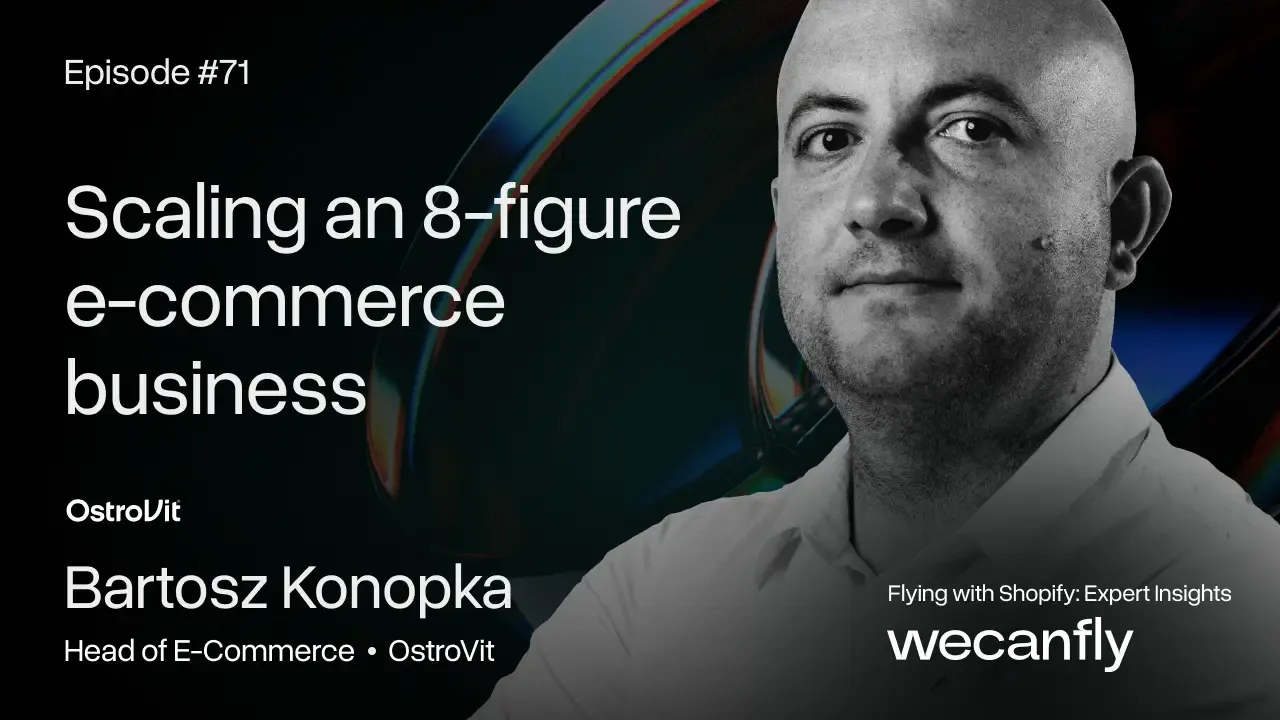
Bartosz Konopka, OstroVit: How to scale an 8-figure e-commerce business?
Discover the strategy behind scaling to thousands of global orders daily
Episode in Polish, English subtitles available. Below: an edited English translation of the full conversation.
Bartosz Konopka, head of e-commerce at OstroVit, tells Tomek Runowicz and Maciek Czerniak how a Polish dietary supplement manufacturer that started out selling protein on Allegro was, at the time of recording, fulfilling about 6,000 retail orders a day, with sales split roughly half and half between D2C and wholesale in Poland and abroad. They talk about how a manufacturer sets prices between its own store and Allegro, why OstroVit moved to Odoo as an ERP with a built-in WMS, what's missing in product information management, when a store outgrows a SaaS platform, and why France is a better first foreign market than Germany. The episode is for heads of e-commerce and e-commerce managers at large brands, especially manufacturers selling D2C, B2B and on marketplaces.
Key takeaways
- OstroVit is a Polish dietary supplement manufacturer that celebrated its 15th anniversary in 2025. Its range reached about 1,000 products; after the rebranding the company wants to focus on the top 500–600. At the time of recording it fulfilled about 6,000 retail orders a day, and in November 2025 its D2C sales broke the 10 million złoty barrier. Sales split roughly 50/50 between D2C and domestic and international wholesale; in 2019 export was much stronger than retail. (4:51, 13:20)
- As a manufacturer, OstroVit can take a product from decision to sale in a few weeks: its own plant and technology department, lab tests, notification. Because production can't keep up with sales, the company keeps buffers: below a set quantity a product disappears from wholesale so that retail doesn't run out. Previously a single shared stock level for B2B and retail made products vanish overnight, and the Allegro and Google Ads algorithms "went haywire". (8:35, 14:33, 16:13)
- Allegro, Poland's largest marketplace, was where the company started and for a long time its main retail channel: at one point it brought in half a million złoty in turnover against 100,000 from the own store. Step by step, Bartek reversed the pricing policy so the own store is cheaper than Allegro, even at the cost of losing Allegro VIP programme benefits. According to him the standard commission is 11–12%, and with a promoted offer, commission on delivery and Allegro Ads it exceeds 20%. Allegro remains an important channel: it brings new customers and a competitor benchmark in Allegro Analytics. (17:43, 21:37, 85:36)
- Since May 2025 OstroVit has run on Odoo, an open-source ERP with a built-in WMS, replacing an ERP that was too small, with a connector and a separate WMS whose stock levels could drift apart (20,000 in the ERP, 19,500 in the WMS). Choosing the system took about as long as the few-month implementation and hundreds of hours. What helped was an in-house pre-implementation analysis in which every department described what didn't work; what got in the way were reference visits to companies of a different scale and type. (30:52, 39:35, 43:52, 47:25)
- The stores and marketplaces are connected through Base, while the B2B panel runs directly on Odoo: wholesale customers see their credit limit, download documents and check product expiry dates in real time. The Achilles' heel is PIM: changes to descriptions and formulas and ordering translations take manual work that can cost a specialist an hour or two a day. (30:52, 36:08, 49:52, 51:33)
- OstroVit's seven stores run on IdoSell Shop (SaaS), and its second brand, Etil Sport, has a small Shopify store. According to Bartek the company has hit the SaaS ceiling: front-end and back-end limits that block things like loyalty programmes, "dozens or hundreds of little things" and a narrow developer market that makes the company depend on a few partners. The platform change was postponed until the ERP rollout stabilised; at the time of recording OstroVit was choosing a new platform. (30:52, 53:27)
- Abroad, the biggest barrier is regulation (e.g. ashwagandha and melatonin, permitted doses, product notification in most EU markets). The first market was Germany, which Bartek now advises against as a starting point: expensive ads, demanding customers. Melatonin on eBay at 2 euros plus 6 euros shipping barely sold, while at 8 euros with free shipping it took off. France (since August 2025) and Ukraine (store since August 2025) show results quickly. Everything ships from one warehouse in Zambrów, Poland. (58:39, 63:45, 65:45, 68:22, 69:24)
- AI at OstroVit means n8n automations with AI models: drafts of content and category descriptions that a copywriter corrects, and monitoring of sponsored articles for SEO; Bartek doesn't trust the AI recommendations in Google Ads. The company is preparing for agentic commerce. His lessons: small changes matter, defend controversial decisions, scale the team fast and give it decision-making power, choose markets on more than macro indicators, and don't scale chaos. (74:52, 85:36)
Guest
Bartosz Konopka is head of e-commerce at OstroVit, a Polish manufacturer of dietary supplements and dietetic food based in Zambrów. He joined the company in 2019, when its e-commerce structures were being built from scratch, and has built the e-commerce team from the start; at the time of recording it had a dozen or so people. Before that he worked on short- and long-term projects in e-commerce and SEO.
More about how we work on Shopify ERP integrations, PIM integrations and Shopify migrations.
Hosts
Tomek Runowicz and Maciek Czerniak run wecanfly, a Shopify Premier Partner agency that helps established brands with complex migrations to Shopify Plus.
Transcript
This transcript is based on the recording of this episode. We edited it for readability: we corrected transcription errors, punctuation, and merged sentences that were cut off mid-flow. We did not change the content, order, or meaning of anything said. Any errors or inaccuracies are our responsibility alone — not our guests'. If you spot something that needs correcting, email us.
Recorded in February 2026 (released on 24 February 2026), so OstroVit's numbers and plans reflect that time; we skip the teaser at the start of the video.
A fun fact from ChatGPT, and who Bartek is
Tomek: Hi, I'm Tomek Runowicz.
Maciek: And I'm Maciek Czerniak.
Tomek: Day to day we run wecanfly, an agency that helps established brands with complex migrations to Shopify Plus.
Maciek: And this is "Flying with Shopify", the channel where we talk to e-commerce experts and founders. Welcome to another episode.
Tomek: I have a rule, which Maciek always laughs at, that at the start of an episode I try to share some fun facts about our guests. I search the internet and different sources for information that isn't necessarily related to what you do in business. In your case I have a very interesting observation. First I did my research: Google, LinkedIn, Facebook, anything, to see what Bartek does besides being a head of e-commerce. And almost at the very end, giving up, I said: "Fine, one more thing. I'll ask ChatGPT for fun facts about Bartosz Konopka."
Maciek: Hoping it wouldn't start hallucinating.
Tomek: Incidentally, you have a namesake who I think is an Oscar winner, and I think he dominates the results.
Bartek: Yes, he's some kind of director.
Tomek: He dominates the results. But as fun facts about you, ChatGPT gives, and I stress this: an efficient e-commerce manager, grew OstroVit's business, is behind the brand's success. I said: "Well, okay, no point digging any further." Bartek, to start, could you say a few words about yourself? Tell us what you do and what you're responsible for at OstroVit. We'll probably move straight on to the brand itself, for those who may not know you. Although, as we're about to discuss, at your scale it's hard not to know you.
Bartek: Hi, guys! My name is Bartosz Konopka and I'm head of e-commerce at OstroVit. I've been with the company since 2019, when we were building the e-commerce structures practically from scratch. Before that I wasn't with any e-commerce company long term. I did short- and long-term projects of all kinds, related to e-commerce and SEO. I won't hide that I did a lot of different things, which may have given me a good background for my current role, because at the start I knew what was what, and the role was very hands-on rather than operational. That's me in a nutshell. As I mentioned, I built the team from the very beginning. Today it's a team of a dozen or so people that keeps evolving and growing, depending on market trends and what we can do together.
OstroVit in numbers: 15 years, 6,000 orders a day, wholesale and export
Maciek: Can you tell us a bit about the brand itself? We happen to know it, but maybe someone listening finds OstroVit a mystery for now.
Bartek: OstroVit is first and foremost a Polish manufacturer of dietary supplements. We've been on the market for quite a long time, in my opinion: last year we celebrated our 15th anniversary. We make supplements in capsules and tablets, but also powders such as creatine and protein supplements. We also offer dietetic food, peanut butter for example. OstroVit's range went up to about 1,000 products. Right now, as part of a rebranding, we're heavily remodelling and optimising the range, and I think we'll end up with 500–600 top products that we'll focus on in the near future. That's partly down to the optimisation, but also to purely operational things, such as having to keep stocks of raw materials, packaging, caps and labels, and making production processes smoother. We keep increasing the output of our production plants, but unfortunately it's never enough; we're always short in that area. As for key facts and figures, you may have seen a post on LinkedIn from our CEO that last November we broke through the 10 million złoty barrier in D2C sales. At the moment we fulfil about 6,000 retail orders a day. We also have, in my opinion, very strong domestic and international wholesale. We serve both the more obvious channels, like Polish pharmacies, and export, even to the other side of the world. Chile is a perfect example of how the brand is slowly becoming global. As for brand awareness, I think we still have a lot to do, in Poland too, because, as you said, there are customers who don't yet know we're on the market. We're constantly working to change that.
A manufacturer in e-commerce: more work, but all the cards in your hand
Tomek: Great. What you've said so far about OstroVit and where you are today opens up a very interesting conversation. We'd like to talk to you both about the fact that you're a manufacturer, not just a seller or distributor, and about your growth path: the challenges and problems you ran into before reaching today's scale. Let's start with the first question. You're the person who built this online channel from the start. When you look at what you've achieved in recent years, which changes and decisions were the hardest, or did the most to unlock your potential and speed up your growth?
Bartek: Looking at the reality of running e-commerce as a manufacturer, which you're also referring to, you could sum it up as: it's complicated, because there are pluses and minuses. I'll start with the minuses. The whole path is definitely harder. If we were an ordinary online store, we'd have someone responsible for buying products, and everything else would happen in the e-commerce department. We need buyers who, as I mentioned, buy jars, caps and packaging, and order labels and raw materials. The process is much more complex, which means more things can go wrong along the way. A raw material arrives, you run lab tests, and it turns out it doesn't meet your expectations. You know that if you send it back, you won't have a finished product, but you have to do it. The dark side of running e-commerce as a manufacturer is definitely a lot more operational work. A finished product takes several, or a dozen, more people than in ordinary e-commerce. As for the pluses, even though everything is much more complicated, it's quite a comfortable position. I feel we hold all the cards. There's a reason the D2C model is in fashion. A simple example: we see that a competing brand is achieving nice sales volumes on a specific product. We can price out creating a similar product, improve its formula, increase the amount of the active ingredient up to the levels permitted by Polish law. We can make the same product, say vitamin C, but with 110 tablets instead of 100, and sell it at the same price as the competition. That product can straight away get an extra feature, an extra ingredient people want. I feel we hold all the cards. We can shape our product portfolio independently of anyone and anything, within the law of course. And that gives us the most comfort, because when we have an idea for a product, for something unique that doesn't exist, or we see something on the market but think we can do it better, the road is pretty open. We have a production plant and a technology department right next to us that can prepare everything for us. We test it, and in a relatively short time we can put the product on the market. As a manufacturer we also win on responsiveness, meaning flexibility and speed. From the decision to create a product to putting it on the market, it's not long months or years. Sometimes it can be just weeks. We get the raw material, test it, do production trials. We see that it works, send it for lab tests, notify it, because by law we have to register all these products, and put it on sale. The process is much shorter. Sometimes I feel it's easier than finding a good product from an outside brand that we could trade at a sensible margin. That seems harder to me than creating something new and unique that the market can't easily copy.
Fifty-fifty: D2C and wholesale, stock buffers
Maciek: I'm wondering about e-commerce for a manufacturer like you. I assume it's only part of your turnover, because you also have export, B2B and marketplaces. Can you tell us roughly how that splits in percentages?
Bartek: I'll start by saying that when I started in 2019, export was much stronger than our retail sales. From 2019 we gradually focused on our own channels: our own online stores and our own sales on marketplace platforms. Now, at the turn of 2025 and 2026, those proportions have evened out, roughly 50/50. Fifty percent is D2C sales of the OstroVit brand, and the other half is domestic and international wholesale.
Maciek: And how do you balance product availability? I'd imagine it causes some problems when you sell in several different areas. You say you can't keep up with production and keep increasing capacity. How do you decide where to push the available stock?
Bartek: Honestly, the priority is to have at least a minimum quantity of a product for retail. That's why we have B2B buffers, below which a product isn't available for wholesale. We didn't have that in the past. When our B2B panel ran on the previous platform, we had a single stock level and we suffered a lot from it, because whether it was sales on Allegro or Google Ads campaigns or other platforms, the algorithms simply went haywire. One day a product was there and selling in hundreds or thousands of units, and the next day it was unavailable. Now we keep a minimum quantity for our own needs, so that retail customers have continuity. Of course we do everything we can to make these products available in large quantities for B2B customers too, but we keep fighting for more production capacity, because sales are growing relatively fast for now and, if I may say so, we're outpacing our capabilities.
Maciek: That's always a challenge. On one hand you have sales success, but every time you have to catch up on capacity, and on the other hand not overdo it. That balance matters.
Bartek: Yes, and on the other hand I know we'll soon open a new production plant, which is still under construction, and production may overtake sales capacity. Instead of me or my people asking when the stock will arrive, the roles will reverse and I'll get the question from the person responsible for inventory: "When will you sell this stock? There are 50,000 of them." I keep in mind that the situation may reverse. And that's actually more painful, because you take a real loss. Right now we're only talking about lost sales opportunities, which nobody counts when a product is out of stock.
Maciek: So it's either feast or famine. That's usually how it goes.
Allegro: from half a million in turnover to a reversed pricing policy
Tomek: Yes, like in most businesses. Bartek, could you expand on selling to individual customers? You have your store, but as we've already heard today, there's also Allegro, a marketplace. How big a role do marketplaces play for you? Is Allegro the only one you focus on, or do you use others too? What share of sales is it, and how important is developing these channels for you?
Bartek: Marketplaces, I won't hide it, play quite an important role in our strategy. The whole idea was partly born on Allegro, because the company owner started out selling whey protein from a local dairy on Allegro. It later grew to a size he probably didn't expect himself. It would be hard for marketplaces not to play an important role in our strategy. For a long time most of our retail sales volume went through Allegro. I won't hide that I fought hard to reverse that trend, whether by launching a new online store or by remodelling our pricing policy. But believe me, it's hard to remodel pricing policy when you don't yet have full decision-making power in the organisation and Allegro brings in half a million in turnover while the online store brings in 100,000. It's hard to go to the owners and say: "Listen, you're making a mistake. It should be cheaper in our store and more expensive on Allegro," and show them some beautiful spreadsheet, because at that point the numbers don't add up. We worked our way to that change in small steps. We managed to reverse the trend, absolutely, but Allegro is still a very important sales channel, and I'll never hide that. I'm not a big fan of selling on Allegro, but I think that in Poland you simply have to be there. Allegro helps us reach new customers. There are also customers who buy our products and who, I can feel it, will always be Allegro customers, and OstroVit customers along the way. There's no point kidding ourselves that they'll move to our online store or other platforms, because they're very attached to Allegro. Allegro also lets us benchmark ourselves against the competition that's there. Being there brings us closer to the market. There are great tools like Allegro Analytics, which lets you, for example, put all the relevant brands and the value of their sales in specific categories, such as sports and tourism, supermarket or health, into one table. Thanks to that we know how individual brands are doing in real time. We know our place in the ranking, what we still need to do and who we're chasing. Sometimes analysing sales on Allegro suggests an idea for a new product that later earns money not only on marketplaces, but also in our own online stores and on B2B platforms. We definitely watch what's happening on Allegro very closely, and we sell through it. I don't see any other way on the Polish market.
The lowest-price guarantee and commissions above 20%
Maciek: Let me just jump in with a digression. I've heard rumours lately that Allegro is planning to force sellers to have their lowest price on Allegro. It smells like that kind of practice to me. Don't you see a threat there?
Bartek: There is a threat, and it keeps materialising. I don't remember exactly when, but I think a year and a half or two years ago we got an email from Allegro saying we wouldn't get the benefits of being in the Allegro VIP programme because our prices on our own sales channels were lower than on Allegro. I smiled, marked the email as read and moved on. Yes, there's a very strong push for Allegro to be the cheapest, but as a manufacturer it doesn't necessarily suit us to put everything on the lowest price on Allegro. It's a really tough subject, because we feel that pressure all the time. We stopped getting benefits from Allegro. They weren't big benefits, but we stopped getting them because we dared to have a lower price in our own online store. I joked internally that Allegro would like to set our pricing policy, because that's a bit what it looks like. The next step was that a "Lowest price guarantee" label started appearing on Allegro listings and product pages. That also points towards Allegro actually being the cheapest. But you can't be the cheapest on price and relatively expensive on commission at the same time. If you want to sell a lot on Allegro, the commissions are simply high. With standard commissions of 11–12% you can't generate big volume. You have to promote your offer. If you promote it, on top of that 11% you add 75% of the base rate, if I remember correctly, and the numbers get quite big. On top of that you have to pay commission on delivery costs, which I find a phenomenal absurdity. At that point you're at around 20%. And when you want to boost it with Allegro Ads, because as a brand you want to sell more creatine than the competition, you go over 20% commission on Allegro. And we're talking about a lowest-price guarantee here. For us as a manufacturer, who in theory should have the highest margin, that's very painful. I can't imagine how resellers feel, who only trade goods bought from other companies. Not only do you have to buy them at a sensible price and give Allegro between 11 and 20%, but ideally you should also keep the lowest-price guarantee, because then "we guarantee you sales". In many cases, unfortunately, Allegro makes the most money, not the merchants.
Tomek: There's that joke that in e-commerce everyone makes money except the owners of e-commerce businesses, right?
Bartek: I think there's a lot of truth in it. Honestly, once, I think it was our MCT oil, I was analysing its sales on Allegro. I found an offer much cheaper than the price we as the manufacturer kept on that platform. I looked into that seller, found their wholesale orders and checked what price they buy at. I checked the commission in that category and whether the offer was promoted. It turned out someone was making literally 50 groszy on it. We know this from the inside, from the kitchen. We see what price someone can buy the goods from us at and what price they sell at. If someone has a small company with minimal costs, a very low margin may satisfy them. Although I'm not convinced, because then you have to build scale. Without scale it's just moving goods around, and if you slip even slightly, you're in big trouble.
Tomek: Yes. Our experience also shows that many such companies struggle to calculate the real profitability of their business, because they often leave out additional costs not directly related to buying the product. You said 50 groszy, but that's on the bare product. When they add everything else, it turns out they break even or even go below zero, and they're not necessarily aware of it.
Bartek: Very often fixed costs aren't taken into account: renting a warehouse or office, electricity bills, and those can be outrageous sums. And someone will run on a 5–10% margin when a product costs, say, 16.90. Those are really tiny margins, right?
Tomek: That's exactly what I mean about budgets: fixed costs aren't taken into account at all, then there's a surprise, and in the long run these companies don't survive on the market, because with that model it simply can't work.
Bartek: There's one more interesting thing: how Allegro started collecting commissions on an ongoing basis. I think that's when a lot of people realised: "You know what? I'm not actually making as much here as I need." Before, Allegro issued an invoice after 30 days and you had 14 days to pay it. Sellers kind of treated it as free working capital. If not from this source, they paid it later from another. When Allegro started collecting fees in real time, from current, daily transfers, I think a lot of sellers had their eyes opened. But let's not kid ourselves, Allegro is now heading towards professionalisation. I don't really see a place there for small businesses. Individual sellers have been completely mown down on Allegro; it's very hard to spot them. I see that Allegro is focusing on professionalisation, on merchants who don't ship parcels after hours but have a warehouse that ideally runs 24/7. You can see a trend where the smallest sellers disappear from the listings and the biggest remain. Is that good? Hard to say. We've been through different stages on Allegro. I remember a time when Chinese sellers took over the listings and sold products shipped directly from China, also without customs duty. Back then that was fine. Then, when Temu came in, the Chinese sellers disappeared from Allegro and Temu launched a strong offensive, and that was a real problem on the market. You saw it, by the way.
Tomek: Yes. Let's move on, so nobody thinks the whole episode is sponsored by Allegro.
Bartek: If it were sponsored, I doubt they'd pay for this one.
The tech stack: from two systems to Odoo
Tomek: Definitely not. Bartek, you mentioned at the start that as manufacturers your process of making products, and running the business in general, is definitely more complicated. It has many more stages where something can go wrong, or where you win. But I think our listeners, and we personally, will be interested in your tech stack, which helps you manage e-commerce day to day. We mean systems like ERP, PIM or WMS. What do you use? What's essential for you, and what can you do without? Have you found a good alternative, a solution that works for you?
Bartek: Starting from the beginning: we definitely had a kind of technology debt when it came to ERP. We stayed too long on an ERP that was too small for us, connected to e-commerce through a connector and to an external WMS. That was a very big problem at our stage of growth. The more systems and connectors, the worse, unfortunately. A big problem was that the ERP wasn't tightly integrated with the WMS. It wasn't one system, but two separate ones. Since May last year we've been on Odoo. It's a Western system, Belgian I believe, an open-source solution that's gaining popularity. I can see the Odoo community growing in Poland too. I think, immodestly, that we were the largest Odoo implementation in Poland, although I know large Polish companies are now looking at it too, or are at the final stage of implementing it. I won't hide that I was full of concerns during the rollout, because this ERP didn't have full Polish localisation and it was open source. But it worked out, and I think it runs smoothly. This ERP also has a pretty good, sufficient WMS that forms one whole with it. From the ERP you see not only stock levels and locations, but also batches and expiry dates. Everything is complete. With two systems, that information used to drift apart. I remember like it was yesterday checking the stock of a top product: the ERP says 20,000, the WMS says 19,500. And you wonder where, how, why. Now the ERP, or rather ERP and WMS, is a stable part of our organisation. Our Achilles' heel is definitely PIM, because we don't have anything in place that I'd now want to call great. I think that with the rebranding we're going through, we'll have to sort this out. As for e-commerce platforms, right now we have seven online stores on a SaaS, IdoSell Shop. I think we've hit a wall there. We've used that SaaS's capabilities to 150%. We also have one small store on Shopify for our second brand, Etil Sport. I won't hide that we're in the process of choosing a new e-commerce platform, and honestly, it feels a bit like with ERPs, because I feel the room for manoeuvre is incredibly narrow.
PIM: an Achilles' heel and too much manual work
Tomek: Okay. Bartek, I'd like to touch on the system you weren't keen to boast about, the PIM. I'm not asking which PIM it is, of course, or whether it's an off-the-shelf or a custom solution of yours. I'm asking more what you miss most in the PIM you have today. Or what would you expect from an ideal solution? Because while ERP and WMS are found in practically most e-commerce businesses, and the bigger the store the more obvious that is, our experience shows that PIM systems, perhaps because of a weak offering, aren't that widespread at all. Even very large companies either don't have one at all or manage product information from different places, which, as we know, causes problems. What makes you unhappy with your solution, and what would you expect from a system that might not be ideal, but would meet your expectations? So that you could say: I have Odoo integrated with the WMS, which gives me a lot of peace of mind about stock levels, because I manage them in one place. What else should a PIM have for you to say: I have a complete set of tools?
Bartek: Tough question, because I won't hide that the PIM role for us is currently played by a tool that shouldn't necessarily be one. I don't mean a specialised PIM system, but a solution you could call a half-measure. It's more that solution plus a set of internal processes, and we can simply see it's not quite optimal. Obviously, since it's its main job, a PIM should make managing product information easier in an optimal way, meaning it should let you avoid as much manual work as possible. I won't hide that right now we do a bit too much product information work manually, whether it's pushing changes out to all platforms or ordering translations of things that have changed. It keeps evolving in our heads. We haven't yet sat down to choose a PIM system, or even to define our needs. I suspect that choosing an e-commerce platform will very quickly bring up the PIM topic, because this will have to be sorted out. At this stage it can't be skipped any more. From my perspective, automation matters: actions that trigger by themselves when, for example, we change two sentences in a Polish product description and the system sends a translation request into the right languages to the people responsible. I think we lose a relatively large amount of time on simple tasks like that. It's not rocket science. Changing a product's visuals or its formula, done even partly by hand, can take an e-commerce specialist, say the person handling marketplaces, away from me for an hour or two a day. Of course these changes don't happen every day. But it's about optimising working time, so that specialists actually work on things they have real aptitude for, not plain fiddly busywork. I think the era of clickers clicking through things is over and won't come back.
How to choose an ERP: hundreds of hours and mismatched reference visits
Maciek: I'd like to go back to ERP, because a lot of e-commerce directors and managers ask themselves how to choose one. I'm interested in what your path looked like, because I remember that before the recording we talked about ERPs and you said something I wrote down: that in Poland there's no good ERP for e-commerce.
Bartek: I don't know whether there isn't one, or rather nobody managed to sell it to us. It's hard for me to describe right now. I won't hide that we spent a lot of time choosing an ERP. Looking back, I think far too much. It may sound strange, but you also have to remember that we were looking for an ERP that would be good for e-commerce, but would also let us plan and account for production effectively. There are some paradoxes here, for example how many decimal places your ERP supports for raw materials. If it's too few for your needs, you can end up with an inaccurate production cost. Sometimes these are really tiny figures with seven decimal places. Some ERPs dropped out in the qualifying round because, for example, they had no production module. I remember a few like that: "Do you have a production module?" "No, but we'll have one in six months." Okay, great, crossed off the list. We also had a situation where a company had two solutions: a more basic one and an enterprise one. At the selection stage we were offered one system. Of course it took time, there were reference visits and so on, I'll come to those in a moment. We rejected the offer and dropped that system from consideration; we said it wasn't it. In the end the salesperson said: "Listen, I have one more solution that the biggest companies in Poland run on." And as you can guess, we didn't want to hear about that second solution any more. When choosing an ERP, a WMS and the whole tech stack, a big problem is the reference visits I promised to talk about. Very often the account manager takes you to a company that doesn't match your scale at all. You fulfil 6,000 orders a day, and you end up at a company that does 600, and not B2C but B2B. That definitely makes it harder. I think two or three times we were taken on reference visits to places where, in my opinion, we shouldn't have gone, because they didn't match us, not so much in scale as in how they operate: product size, warehouse size, whether it's B2B or B2C sales. My reflection now is that the search for an ERP itself was incredibly hard and time-consuming. I'd venture that it was more tiresome and exhausting than the implementation. Because once you know what you're implementing, you don't analyse several or a dozen proposals and you don't spend time talking about systems you don't even know you'll implement. It's mega irritating. I think as an organisation we spent hundreds of hours finding the optimal solution. It certainly wasn't easy; it was a tough nut to crack.
Who chose the ERP, and a pre-implementation analysis of their own
Maciek: I'm interested in which roles from your company were involved in the selection and decision. I imagine ERP and WMS sit at the intersection of several, even a dozen, departments. Can you tell us what it looked like on your side?
Bartek: When choosing the new ERP we tried to involve as many people on our side as possible. There was the warehouse manager at the time, me as the e-commerce manager back then, the chief technologist, who enters recipes into the system or verifies them, and the people who account for and plan production. Of course the management board and co-owners of the company were involved too. I've probably left someone out. The chief accountant, of course, and probably a few more roles I've forgotten off the top of my head. We tried to involve as many people as possible so the system would work for everyone, because ERP is really the heart of the company and it has to fit your needs, or allow you to fit it to them. With open source, we can add anything to the system, but not everything makes sense. Our role now is to manage this change well and develop the system well, because on our previous ERPs, which were closed environments, we could do practically nothing, very little. When the full range of possibilities opens up, you can overdo it, get carried away with over-optimism and keep adding modules and features that later don't necessarily pay off in the business. So we made sure that really everyone the ERP affected, whether the wholesale department or the e-commerce department, everyone who worked with it, had some input. I won't hide that we prepared what I think was a really good pre-implementation analysis. We didn't do it from a brief with key company data; instead everyone from every department laid out what didn't suit them in the current system and how it should work. Obviously it wasn't the kind of pre-implementation analysis an ERP implementation company would do for you, but it came from the heart, from our sense of what didn't work and how it should work. And it was a good starting point. Companies got a relatively large amount of information from us straight away, without their briefs. I think it's very time-consuming when you're briefing an agency or ERP implementation partner and you have 15 forms of basic information, when you can put it into your own template and, if needed, add the extra information individual companies need.
Maciek: And then share it between them. And roughly how long did the whole process take?
Bartek: You mean selection and implementation?
Maciek: Just the implementation, because you said the selection took too long. From the moment of the decision.
Bartek: Honestly? I can't give you the exact timeframe, because I don't remember. We started in May last year, and it was a very short implementation, which I think went live in September. It's really just a few months. I suspect we spent about as long choosing the system. It was a fairly big sprint, not a marathon. I don't remember the exact number of months now, but I think, paradoxically, we spent about as much time choosing the system as implementing it. That's why I remember the selection as very time-consuming.
Tomek: As the old saying goes: if you have eight hours to cut down a tree, spend six sharpening the axe.
Bartek: Yes, that's true.
Tomek: I think the time you spent on the selection and your approach are paying off, judging by what you're saying now. Of course these are experiences you may not want to go back to or go through again, but I really like how you went about preparing your requirements. Writing down the problems, even an analysis of each department's needs, is super important material to work with. I'm thinking now from the perspective of the agency that received it: instead of generic questions, which probably make it hard to get all the necessary information across, you approached it from what needs to be in the system, with very concrete examples. An impressive approach, and I think worth the time spent. It could have been a bit faster and shorter, as you say, but from what we hear the results are fully satisfying.
Base, a B2B panel on Odoo and expiry dates in real time
Maciek: To complete the picture, I wanted to ask: you have an ERP with a WMS, which is Odoo, a store on IdoSell, on a SaaS, as you said, and some marketplaces. Is all of that connected through Base, or do you use something else to sync the data?
Bartek: Yes, the e-commerce platform is connected through Base. Only the B2B panel is built directly on Odoo, on the ERP. As for Odoo itself, now that it's launched and stabilised, we're very happy with it. I laugh because I keep saying we've only just implemented a new ERP. Then I look at the date, and it's February. In three months it'll be a year, but for us it's still a fresh implementation and some things still need sorting out. But I can see the light at the end of the tunnel; I can see it's already good. Going back to the pre-implementation analysis: I think an agency or implementation partner, whoever it is, doesn't know everything it should ask the company. Especially when production is involved. Every company has its own production, with its own specifics and its own rules. I don't think there are two identical production setups in Poland. Laying all that out ourselves was definitely a big plus.
Tomek: I absolutely agree. Bartek, answering Maciek, you also said that your B2B channel is organised and managed from Odoo. What does your B2B sales look like on the front end? Do distributors and resellers order through some tool, or through a team of sales reps? If you could tell us in a few sentences how this channel is organised.
Bartek: It's a B2B platform built on Odoo and directly connected to it. The information is pulled directly from our ERP, without any extra connectors or links. In the past it was worse. Now, thanks to the direct integration, our customers have direct access to their credit limit and download documents from the B2B panel. And a really big plus of moving to this B2B system is that the customer can check, for example, a product's current expiry date in real time. These are small things we couldn't do on the previous platform, or connecting them wasn't cost-effective. Since we've been using this solution, I've been a fan of B2B sales through platforms directly connected to the ERP, where possible. I can see how much easier it makes things. I've only listed a few aspects; the sales reps from the wholesale department would probably have a much longer list.
The SaaS ceiling: dozens of small limits and a narrow developer market
Maciek: Interesting. Listen, since you stirred the hornet's nest earlier and said you've reached the limits of your SaaS as an e-commerce platform, I'd like us to dig into that wound a little. Can you tell us where those limits are and what you're actually struggling with now? I imagine that after this recording you'll get loads of LinkedIn invitations from all kinds of reps.
Bartek: Yes.
Maciek: And agencies, and technology vendors.
Bartek: I think I already have, but I'll get even more. You know what? It comes down to a few things. You see you've hit the ceiling when you can't shape the front end the way you want. You see limitations there, and possibly limitations underneath as well. I don't want to go into details, but they don't let you develop the brand and sales the way you'd like. You want to build customer loyalty in a specific way, or roll out that kind of solution, and you see you can't do it here because the backend blocks you. I think SaaS platforms are good, they're really nice. I suspect sometimes forever, and sometimes up to a certain stage of growth. It depends on how the company scales, what revenue it makes and what its business model is. There are big companies that run on SaaS platforms and can't imagine it any other way. And there are companies that break through some ceiling and have to look for a different solution. From my point of view, we've reached that ceiling, possibly even a year ago. But managing the change and implementing the ERP was too big a process to add a change of e-commerce platform on top of it. I think that would have been too bold. The shortcomings of the e-commerce platform are small things. Not big things that stop you selling products, but dozens or hundreds of little things where you've hit the wall of "that can't be done". It's hard for me to pull examples out of my head quickly, but it's definitely also about the developer market, which in our case is quite narrow. We have limited room for manoeuvre, because with PrestaShop, Magento or Shopify we'd have a really wide choice when it comes to the developer market and hiring. Here that market is quite limited, so you have to rely on trusted partners. But God forbid those partners one day said they'd no longer provide those services, you could really be left high and dry. In my opinion that's a really big risk.
Tomek: You say that on your current solution it often comes down to details. It makes me think that at a certain scale and a certain level of growth, it mostly comes down to details, right? You're not missing fundamental features or options, but the nuances that let you stand out even more on the market or take the next step. Because you've often already taken the biggest steps as a company. And honestly, that answer doesn't surprise me. I expected that, when it comes to the platform, the devil is in the details.
Bartek: I completely agree.
Expansion: regulations, notifications and melatonin for 2 euros
Tomek: Listen, Bartek, let's take a step forward in our conversation and in your growth. I feel that so far, although it wasn't necessarily our aim, we've focused largely on your presence in the Polish market and talked about more Polish solutions, like Allegro. But you also sell internationally, as you mentioned. Let's open the topic of international sales. What challenges do you run into there? I assume one category will be your products, because their formulas are subject to different regulations in different countries. If you could say a bit about that, but I'm also curious about the more technological, e-commerce side. How are you doing in those markets, and what's new or difficult for you there that you don't face in Poland but have to deal with there?
Bartek: I think the biggest blocker and challenge is legal regulation. The hardest part is managing the product range, because one product can be legal in Poland and 10 other countries, but illegal in France. There are plenty of examples. Ashwagandha and melatonin are the best examples of products with legal restrictions in individual markets. Those restrictions can also change in individual countries, so our legal team spends a lot of time monitoring them. We lose... Maybe "lose" is the wrong word, but we spend a lot of time tracking regulations in individual markets. Another problem is managing the range because of the formula. I feel that creating high-quality products is also harder, because in Poland you have a permitted dose set by the Dietary Supplements Council, for example that a capsule or tablet can contain X milligrams of vitamin C. When you create a product, you want it to be good both in Poland and abroad. It can happen that when you come up with a new product and use the maximum dose permitted in Poland, you rule out selling it in many foreign markets. That's one example. And what then? Do we choose the lesser evil and go with a lower dose, offering Polish customers something that could potentially have been better? That's a big problem. Another thing is having to notify products. We have to register all dietary supplements in most of the European markets where we sell. There are exceptions, I won't list them now, but there are countries where supplements only need to be reported, without notification and extensive documentation. As standard, though, our legal department prepares tons of documents to notify all our products in the markets where we want to be available. That also means later reporting changes, or re-registering, when a product changes significantly. That keeps us up at night, because we lose a lot of time on it. As for e-commerce abroad, I think we're doing well, but right now we rely very heavily on performance marketing, and we need to add a range of purely marketing activities, such as influencer marketing. We're working hard on that, and on making the stores in individual markets more localised, so they better reflect the reality of specific markets. From my point of view, we have a lot of work to do here. I don't think there's ever a moment when we'll say everything is wrapped up or nearly wrapped up. It's constant change and constant improvement. Foreign stores are definitely a completely different matter, with a completely different customer. A good example is the German market. I remember, it was a few years ago: we were selling melatonin in Germany on eBay, and it was very cheap, it cost literally two euros. That was our Polish price converted into euros. We thought that with melatonin at two euros and six euros for shipping, customers would add some other products, reach the free shipping threshold or decide it was worth paying for shipping, and we'd sell on eBay. It turned out there were practically no sales. It was very hard to get German customers to buy from us. So we decided: let's change the price of this product to eight euros with free shipping. And the situation changed dramatically, because the product simply started selling in sensible quantities. That showed us that German customers attach a lot of weight to price, right?
Maciek: I think in this case the universal UX rule may have kicked in, that shipping can't cost more than the product, because that's usually a conversion killer.
Why France, not Germany, as the first market
Bartek: Yes, with foreign markets and cheap products in that price range, shipping usually did cost more, so you're definitely right. You can look at it that way. But next door there's the French market, where our good prices, very favourable relative to product quality, didn't bother customers at all. I expected Germans to be demanding customers who are suspicious of a price that's too low. In France, on the other hand, we launched with prices I thought were a bit too high to start with, and the French didn't share my concerns at all; we had no problem selling whatsoever. I can also say that the first foreign market we launched was Germany. We somehow defended that decision, but it wasn't easy. Now I try hard to talk everyone out of making Germany their first foreign market, because unfortunately the market is very expensive and the customer very demanding. The market is expensive in terms of advertising costs, and looking blindly at GMV, at how much money there is, can distort your thinking. If there's a lot of money in a market, there's also a lot of competition. You have to take that into account and know how you want to get ahead of that competition.
Maciek: Which market would you pick first now, with what you know?
Bartek: Tough question. I think we'd definitely have launched the French market sooner than the German one. We've been in France since August last year, and it seems a very rewarding market. We see the results of our work very quickly, and sales are growing. Another place where we have a lot to do is Ukraine. Our brand is recognised there, and we're seeing positive results in the Ukrainian market. That store was also launched in August 2025. Ukrainian customers really appreciate our products and value our quality. In short, the brand is simply well known and liked there. As for the order, I'd put France before Germany, but it certainly also depends on the range: on whether you're a manufacturer or a distributor, whether you want to launch another language version of your store, and which markets you want to cover. At the start, I'll admit, we somewhat ignored the smallest markets, along the lines of: "Okay, a million people live here. Maybe it's not a market for us, maybe there's no potential." I think that's a mistake. We shouldn't look at countries through how strong the economy is, how much the supplements industry is worth, how wealthy the potential customer is and how many people live there. The sum of those indicators isn't necessarily the recipe for your success. Germany is the best example: in my opinion, in Excel, before launching, everything will add up. Really, all the signs in heaven and on earth will tell you that Germany is the best thing you can do for your business. And then the trouble can start. Real problems can start when it comes to getting it off the ground and scaling it properly.
One warehouse in Zambrów and couriers in different markets
Maciek: Going back to shipping costs for a moment. I understand that's how it was at the beginning. Do you now have any local fulfilment centres, or does everything ship from Poland?
Bartek: For now we rely on one central warehouse next to the company's headquarters in Zambrów, in Podlaskie province, and we try to handle everything from there. I don't know what the future will bring. I hope it will make local logistics centres necessary, because that would mean our sales volume and number of parcels have grown a lot. But at the moment we rely on our own central warehouse.
Maciek: That was actually one of my questions: how do you handle logistics in individual countries? Since you're now in many European countries, I wonder whether in some of them delivery to the end customer, because I assume you don't ship everything yourselves, goes more smoothly, and in others you have bigger problems?
Bartek: We have our own observations about the courier market in individual countries. I'll keep coming back to Germany. In Germany we first offered DPD, while German customers prefer, for example, DHL as a kind of national carrier. I'd say it's their Polish Post, only working better. But we keep observing and learning. It's not as if we've found the golden mean. I constantly consult other e-commerce managers and heads of e-commerce: "What are you doing in this market? How do you do this, how do you do that?" Because I think that kind of knowledge exchange gives the most. We have a group where we share observations. Someone posts an insight, we start checking it, implement it, and it turns out it really works. And it seems like these are sometimes silly little things that don't affect the business. The reality is quite different.
A good product, a stable team and purchasing scale
Bartek: I kind of feel our business grew not because we have some great recipe and know how to do it, but thanks to commitment, the will to grow and making changes every day, even just to be that 1% better than yesterday. We also have quite stable management: the core management team has practically not changed since I joined OstroVit, about seven years ago, and in such a well-coordinated team we can scale everything. In a way, that's where I see the recipe for success. I also think our product speaks for itself, because it's high quality, tested and, from my point of view, quite simply easy to sell, because it's just good. I think many companies look for a great-looking store, a wonderful platform, various marketing tricks, but in the end their product doesn't hold up with the customer. We know our end product holds up, and we try to use that advantage at every step, because it can't be beaten. You can have a great, responsive store, but if you don't have a good product, the customer won't come back. That's why we focus on a very good product, really high quality, with lab test results linked in our online store. You know it's safe for you. It's at a good price, because we trade it on a mass scale. As I mentioned, retail is 50%, but the other 50% is wholesale, and that's mega important, because it lets retail customers get better prices. Buying 100 tonnes of creatine on the raw materials market, you pay a completely different price than for 1,000 tonnes, right? I feel that's where our advantage over the companies we compete with lies: high responsiveness and responding quickly to market needs.
Maciek: That's super important. I've also noticed that if a product is great, you can afford a number of shortcomings that customers will forgive. And the other way round: if a product is weak and doesn't meet expectations, whatever you do, the business just won't take off.
Bartek: Yes. We try to fix shortcomings steadily, because we keep seeing things to improve. I don't think there'll ever be a moment when we stop seeing them. But it's true that if you have a very good product, even if you allow yourself some shortcomings, intentionally or not, the product will carry you.
AI at OstroVit: n8n, content, SEO and caution about Google's recommendations
Maciek: That's definitely an old truth: a good product or a good service is the key to success. Next topic. I think we're heading towards the finish line, but this conversation can't happen without AI, the word on everyone's lips. I wonder how a company of your scale already uses artificial intelligence. Are you doing anything in this area? Planning anything? How are you preparing for the wave of agentic commerce? What's the view on this at OstroVit?
Bartek: As for AI in day-to-day work, obviously everyone uses artificial intelligence, whether for research or for solving the simplest problems with ChatGPT. But that can sometimes be a trap, because I've noticed we give the chat less and less complicated things to solve. That's a bit worrying. As for the organisation, we're definitely trying to automate basic processes using AI models and n8n. We're building processes, for example to generate content that we then use as raw material for rewriting, or to create category descriptions, which of course don't go blindly onto the internet; a copywriter reads them and makes corrections. That looks pretty good from that angle. We also use it for SEO, also combined with n8n, for example to check whether our sponsored articles are still online or have disappeared, and whether they still have links to our site. It's not used on a mass scale, because there's also the question of data security and the need to host the model internally. We're discussing that internally; those questions are being worked through. I'm aware there's a big AI hype and a lot of presentations. On LinkedIn I constantly see cases of how work was automated with AI. We try to do it too, but sensibly. It's not as if from tomorrow AI will do half of our tasks, because we also see some imperfections and shortcomings in the technology. I suspect that will change soon and it'll get even better. For now, fortunately, I don't see a way to remove people from the decision-making process, from managing sales on marketplaces and in online stores, or from building strategy. It's definitely too early for that. Definitely not for managing campaigns, Google campaigns for example, because we've seen various things. Anyone who sits in the Google Ads panel and sees the AI recommendations Google itself prepares for us won't laugh at a circus anymore, because sometimes they can really drain a client's budget substantially, and in some cases do little else. As for agentic commerce, we're preparing and doing something in that direction, if that's what you're asking, but I don't know what its future will be. I'm very curious. Preparing for it under the hood is one thing, but I'm curious what it'll look like in practice. I find it hard to imagine that hardened users of web browsers or phones will hand that process over to agents to a large extent. Although I think it's inevitable.
Agentic commerce and supplements: buying in a chat
Maciek: Not everything will go that way. I know people who still check the weather on teletext. I think it'll split. For example, Tomek's daughters search for information on TikTok; they use TikTok as a search engine. I think there will be some early adopters who'll shop through LLMs. But I think supplements are a perfect example of a product I can see in ChatGPT or Gemini. You can ask which supplements you should take for this or that problem. The chat recommends them, tells you the dosage and the suppliers. You click "buy", order a subscription. I think that's a very likely scenario, but of course adoption will probably progress over time.
Tomek: Great example with the Allegro users Bartek mentioned at one point, and we're aware of it too. You won't tear them away from that platform, let alone get them to move to your store. There will still be a group that mainly wants to shop the natural, standard e-commerce way. But as you say: your product has a lot of very measurable parameters that can be verified and validated, and around which you can build ready-made answers, for example. I feel the potential of your products in sales through LLMs is really very big. As you said, Bartek, it may be hard to imagine today how significant that scale will be for you and over what time horizon. Still, I think you have everything you need to explore it seriously.
Maciek: We can also tell you after the recording which SaaS has it built in.
Bartek: That one I know. Speaking of which: ChatGPT has released those health features, right? I'm partly glad, because it's technological progress, and partly scared that at some point you'll upload your blood test results for vitamin levels to ChatGPT, and the chat will suggest vitamins, OstroVit for example. Of course for the supplements industry that's a tempting morsel, but on the other hand I mean the health and ethical issues. Will the chat interpret it all correctly, so that it's safe for people? Because we're not driven only by selling as many products as possible. We have business ethics we stick to. We want the products to be high quality at a good price. I've probably said that three times now, but fine, let it ring out. We also want them taken according to our recommendations, which don't come from our whims, but from the law and from someone competent having studied it. I'll give you an example, because I can't hold back: melatonin. I like reading reviews of our products, whether in our online store or on that platform starting with A. I happened to be reading reviews of our product on the marketplace. You should take one melatonin tablet a day; that's okay for you. The more, the worse. It doesn't work in a way that if you take several tablets, it'll be better. And I see customer reviews: "I take five before bed", "I take eight and it doesn't work". As a supplements manufacturer I should be rubbing my hands, but I only have one thought: people, what are you doing? Your body can't absorb a dose of melatonin like that, so you're potentially harming yourselves. We try to approach this business ethically, and comments like that, and customers writing that the product only works for them after eight tablets, don't make us happy at all; they worry us more.
Bartek's lessons: small things, scale the team fast, don't scale chaos
Tomek: Definitely. Bartek, I think we've reached the end of this extremely interesting and truly wide-ranging episode. That's how I see it today, because we touched on many areas, probably without going deep enough into each, because with your scale, your challenges and the systems you mentioned, we could make a series of episodes on those topics alone. But of course, the point isn't for you to reveal all your company's secrets and know-how. At the end we usually ask our guests for two or three tips for the people who listen to and watch us, to help them make decisions in their business. In our view you represent a fairly large e-commerce business, so we're not talking about basic advice for beginners. Could you share two or three lessons from what you've recently experienced at OstroVit with the changes you've made, and assess them objectively, as encouragement that continuous growth is inevitable and lets you think of yourselves as leaders?
Bartek: I'm glad, because I'm prepared for this question. I happen to have prepared a presentation on something similar and quickly opened it just now. The first thing: small things matter. Don't believe that a small change in your checkout, on your product page, in your product's price or anywhere else doesn't matter. I think e-commerce success comes precisely from the fact that these small things matter. Every day, even by making one small improvement, you're further ahead than yesterday. That's how we built what we have now, step by small step. The second thing that comes to mind: constant dripping wears away the stone, and in a way builds scale. I'm referring here to our pricing policy, when we were cheaper on Allegro than in our own online store. I really had to bend over backwards to reverse that trend. I managed to tip the scales in my favour and defend that thesis. So I wouldn't be afraid of making even slightly controversial decisions that aren't backed by numbers at the time, if you feel it really makes sense and that you can pull it off. Among the e-commerce lessons I've learned: definitely scale your team fast. When you get decision-making power, when you already have a team or are starting to build one, I recommend simply doing it fast. Not conservatively, and above all not too slowly. From my point of view, I should have built the team faster, because the tangible benefits would have come sooner. The worst trap is thinking that you'll do everything best, you know everything best and you need full control. No, you have to hand control over to people. Of course you hold status meetings and check progress, but people also need power and decision-making authority in your organisation, because otherwise at some point they'll lose the point of coming to work, when everything they're supposed to do today is written out for them in detail. The next thing is choosing expansion directions wisely. That's very important. I talked about it earlier, so I won't repeat myself. I'd check less obvious directions and less obvious indicators, and not focus on population size and other macroeconomic indicators, because that can lead you into a trap. And the last thing: don't scale chaos. Up to a certain stage we scaled chaos, and later we had to clean it all up. That's definitely a longer and more strenuous process than getting things in order at the start in one market and then scaling to the next one, or scaling the team. Scaling chaos is definitely undesirable. At an early stage of growth it may also be necessary, a necessary evil you have to experience. But later there has to come a moment when you realise it's time to organise things wisely, because soon you'll stop coping as a manager, as a director, as a team.
Tomek: Well, Bartek, I'll be honest: I asked you for two or three tips, and you came super prepared and gave us a ready-made manual. It's great that at the end you summed it up: these are tips you'd have liked to hear at the start of your journey as an e-commerce manager at OstroVit. I think they're really valuable. Thanking you for today's meeting, we'd like to wish you and your whole company that you keep growing as ambitiously as you have so far, and make wise, perhaps faster and smoother this time, decisions about what lies ahead: a new e-commerce platform and a new PIM system. And that you'll be as happy with those choices as with the ERP choice you made last year. Bartek, thank you once again for finding the time and coming to see us for this episode. It was really very interesting and touched on many topics we don't always get to discuss with our guests. Thank you once again for a super candid conversation.
Bartek: Great. Thank you too for the invitation and the nice conversation. I hope to see you again.