
Mirosław Mikołajczak, Selsey: From Groupon to 2M parcels and 8 European markets
Groupon, not a marketplace. That’s how it all began
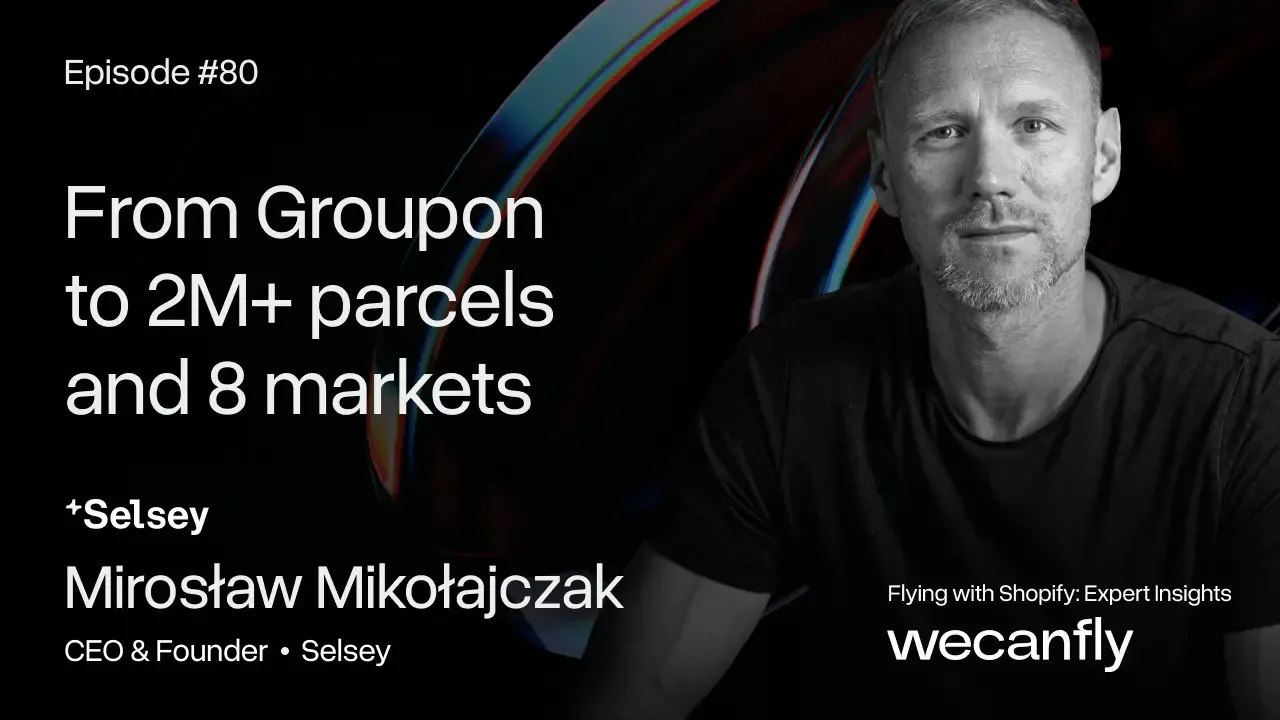
Episode in Polish, English subtitles available. Below: an edited English translation of the full conversation.
Mirosław Mikołajczak, CEO of Selsey, tells Tomek Runowicz and Maciek Czerniak how the company delivered about 2 million furniture parcels in 13 years and came to sell in around 8 European markets. They talk about a fragmented furniture market and competition from China, the logistics of heavy parcels and returns, building brand awareness, how Selsey picks its next markets, what changed after Selsey moved to Shopify, and a management style built on handing decisions to the team. The episode is for e-commerce founders and managers planning to sell abroad or to change platforms.
Key takeaways
- The furniture market is highly fragmented: people buy furniture rarely, so lifetime value and loyalty are hard to build, and smaller manufacturers that used to make furniture to order for German retailers are now opening their own stores and selling on Allegro and Amazon. According to Mirosław, large German platforms have added tens of thousands of listings, and even IKEA has, as he recalls, about 4% of the market. (5:25, 7:47, 41:22)
- A parcel with a small piece of furniture weighs about 30 kg, one with a corner sofa over 50 kg, and it goes by ordinary courier. Selsey cut damage and returns by moving from reselling furniture to its own designs: before launch, the team assembles and tests Selsey Design products, including by dropping the parcels. (15:24, 16:26, 19:16)
- Selsey's management board reads customer reviews every week, and reviews are the first slide of the weekly results presentation. In 13 years the company has delivered about 2 million parcels and collected about 40,000 reviews (on TrustMate, as far as Mirosław remembers), with about 4,000–5,000 on Google. (21:00, 22:59, 73:11)
- In a brand study of about 1,000 people, nobody named Selsey unprompted, but once told what the company does, one in four said they had its furniture at home. The response: a brand and communication strategy, better-labelled parcels and a return to a showroom in Warsaw (Domoteka, opening planned for September 2026). (10:35, 37:53, 39:25)
- Furniture designed by Selsey or sold exclusively by it makes up over 60% of sales, up from about 40% a year and a half earlier. Mirosław stresses that without your own product and a proper margin it's hard to provide good after-sales service. (42:49, 43:19)
- Selsey started on Groupon, where it was the first to sell furniture, and then moved onto Groupon in Scandinavia. Today it delivers furniture with carry-in to, among others, Czechia, Slovakia, Germany, Belgium, the Netherlands and France, and has recently started selling to Switzerland. The order of markets is set by focus: three months after launching its own store in Germany, the company isn't opening more until this one meets expectations. (46:59, 48:12, 51:28)
- After moving to Shopify, Selsey launched its German store much faster than earlier markets. Mirosław noticed more products per cart, better navigation, a faster site, a higher post-purchase NPS and quicker product uploads. German customers know the Shopify checkout, so they trust a new store, and Mirosław himself talks to his store data through a connected AI (his private Claude). (55:57, 56:52, 57:54, 58:54, 61:45)
Guest
Mirosław (Mirek) Mikołajczak is the CEO of Selsey. The business launched in 2013. Selsey designs its own furniture, has it made in Poland by trusted partners, sells through its own stores and on marketplaces, and had revenue of about PLN 240 million in 2025. Mirek is a member of Entrepreneurs' Organization (EO). The book he recommends is "Multipliers" by Liz Wiseman; he also mentions "No Rules Rules" by Reed Hastings.
Selsey is a wecanfly client. We help move its large store to Shopify as part of our Shopify migration services, and we build stores for new markets on Shopify Plus.
Hosts
Tomek Runowicz and Maciek Czerniak run wecanfly, a Shopify Premier Partner agency that helps established brands with complex migrations to Shopify Plus.
Read more on our blog: How to Build a Furniture Brand When Customers Buy Every Few Years.
Transcript
This transcript is based on the recording of this episode. We edited it for readability: we corrected transcription errors, punctuation, and merged sentences that were cut off mid-flow. We did not change the content, order, or meaning of anything said. Any errors or inaccuracies are our responsibility alone — not our guests'. If you spot something that needs correcting, email us.
Conversation recorded in July 2026 (released 11 August 2026), so Selsey's plans and results reflect that time; we've left out the teaser at the start of the video, a short digression about Polish politics, a few private threads and a few sentences about other podcast creators.
How has the founder's daily routine changed?
Tomek: Hi, this is Tomek Runowicz.
Maciek: And Maciek Czerniak.
Tomek: We run wecanfly, an agency that helps established brands with complex migrations to Shopify Plus.
Maciek: And this is Flying with Shopify, the channel where we talk to e-commerce experts and founders. Welcome to another episode.
Tomek: To start off casually: I heard in one of your recent interviews that you've seriously changed your attitude to life, to health, to work and to business. Can you tell us what your routine looks like today and how different it is from five years ago?
Mirek: The difference is huge. My first podcast is still out there somewhere, and you can see what shape I was in back then, so there's proof. I joined EO, Entrepreneurs' Organization, and got the chance to meet young entrepreneurs from Poland and see how they operate and how they work. I remember a meeting where one or two of them told me they run every day. I looked at how they looked and how much energy they had. I went running with them for a few days, and it got to me so much that I thought: time to get my act together.
I've always been active. I'm a basketball player; I've played basketball my whole life. But playing basketball once or twice a week just wasn't enough. It's always about the difference between how much you consume and how much you burn off; you have to keep a balance. Someone showed me VO2 max on my smartwatch. I don't know if you know it.
Tomek: What's yours now?
Mirek: For my age I got to about 48, I think, so I was in the high zone.
Tomek: Above average.
Mirek: I'm above average all the time, but I was in the high zone.
Why is the furniture market so fragmented?
Tomek: Let's move on to the market. How would you describe today's furniture market, both in Poland and abroad? As Selsey you're present outside Poland, and I know you have the ambition to be even more available there.
Mirek: Fragmentation, I'd say. There are a lot of companies trying to get access to a sales channel. That's not based on any research, it's my own observation. People buy furniture rarely. You don't replace your sofa once a month. That's why lifetime value isn't that important in the furniture business: it just doesn't build up that fast. Someone buys a sofa, maybe finishes furnishing and buys a table the next month, but after that they only replace the odd piece. Loyalty is hard to build here.
For a long time Poland was a place with a lot of manufacturers. We're really strong in furniture production, especially upholstered furniture, but also cabinet furniture. A lot of the work we did was for someone else: these were unbranded factories producing mainly for German retailers. Consumption in Germany hasn't been that high for a few years, and at the same time online sales are growing there and many Polish, but also Asian, companies are winning the e-commerce market, so traditional stores are losing their share of sales. Companies that were smaller and typically made furniture to order suddenly don't have as much work. So what do they do?
Maciek: They go it alone.
Mirek: They call you: "We're opening a store. Look, Selsey is doing well. Let's build a store, we've got everything we need." And that first step really isn't hard. If you make furniture, you have a margin and a market, you set up a store and get going. Many of these companies first open a store, start advertising, sell on Allegro, on Amazon, and there's more and more of it. All the platforms keep adding more and more new furniture from different companies, and it's hard for it to be very different.
What does that lead to? Take Allegro. It has a certain number of users and splits them among all the sellers. New sellers get some visibility by default, so they start selling something, but the traffic gets fragmented and it gets harder and harder to sell the furniture. I talk to large German platforms, and the number of listings they've added runs into tens of thousands. You really have to work very hard. Even if you start well and have a great product, it's hard to hold your ground on these marketplaces, because new players keep coming in.
In my view it starts with people turning away from brick-and-mortar stores. As people we're getting more and more used to convenience, and society keeps changing. Younger people, who have always had a phone with them, buy more and more online, including furniture, and it's no problem for them. And so the cycle keeps going.
Why does an online store need a showroom?
Maciek: Don't you feel you could sell more if you had lots of showrooms, stores? That someone would go, touch, sit down, and that would lift sales?
Mirek: I think it matters. We had a showroom in Warsaw and it helped us. For formal reasons related to the premises we were renting, we had to move out. We also wanted to see what would happen without a showroom. And in Warsaw we felt that we didn't have it.
So now I'm officially announcing, although I don't know exactly when this podcast will come out, our return. I hope it'll be a really great showroom. We're going back to Warsaw, to Domoteka. The opening should be in September. It definitely helps a lot: it builds credibility and shows the quality of the furniture. We're known for making beautiful furniture. We design it ourselves and have it made in Poland by our trusted partners. The showroom will let us prove that these are products of the right quality. We're very competitively priced, because we want to be accessible. Accessibility is a very important value for us. It's not only that you can buy from anywhere on the globe, but also that good design is affordable for more people. On the other hand, that can make people doubt whether the quality is okay, because the competition can charge a lot more for the same thing. The showroom will definitely help overcome that. If it works, we'll definitely want to open a few more locations like it.
Tomek: That's what I wanted to ask, and you answered straight away. So if you see the value, you'll want to repeat the concept.
Mirek: To be honest, I already have a track record. We had that showroom and I know what it gave me, so it's pretty much a sure thing that we'll open a few more locations like it. The difference is that now we're going to a place where furniture is sold, while before we were a bit cut off. But as I said, foot traffic in brick-and-mortar stores is low. I won't get extra traffic from that location. It'll be used by people who buy online and want to see for themselves. I'll still have to bring those people there, and Selsey's position in the market will definitely help draw in Warsaw and the surrounding area.
How do you deliver furniture without damage and returns?
Tomek: This topic has come up a few times in our episodes, because, I won't hide it, we work with the furniture industry quite a lot. But in your case the scale and the number of orders are very large. How do you look after the last stage of the customer experience, from the order to the physical delivery, so that nothing falls apart along the way? How do you handle logistics and after-sales service so that everything you take care of when winning the customer, designing the product and serving them in the store doesn't fall apart when the product is supposed to reach them?
Mirek: Let me start by saying that 13 years of experience at Selsey definitely helps. We've been through every stage. Just a few years ago we had real problems with it, because delivering furniture is a very difficult process. People buy a small piece of furniture and it still weighs 30 kilos. It's a big parcel and it goes by courier.
Tomek: Easy to damage.
Mirek: Imagine you're a courier pulling into some district of Warsaw and you've got 10 parcels from Selsey, each weighing 30 kilos. On top of that you're short on time, moving parcels around, shifting them, someone's at home, someone isn't. It's hard work.
At Selsey we now take a completely different approach to design. The most important change: a few years ago we moved from reselling furniture to designing it ourselves and checking it from start to finish. We still have a lot of furniture we don't make, because we're a big store. But if you browse our store, you can already see Selsey Design. These are products we design ourselves and, before launch, inspect, assemble and drop-test in their parcels. That took us time. At the beginning we grew on generally available products and quickly sold a lot, but it had very big consequences, because all those returns cost huge amounts of money. Keep in mind that we sell all over Europe. A parcel reaches Paris and the customer says: "Thank you, take it away."
Tomek: And at that point a return is already…
Mirek: What does it mean for us logistically to take it back? Once the customer opens it and it comes back, it comes back to us…
Tomek: At a loss.
Mirek: Absolutely. That's why you really have to work very hard to do it well. I won't hide that it's going quite well for us now, for which I thank my team, and you can see it: we have lots of positive reviews and nice comments. And in this business that's really not easy. Assembling furniture isn't easy either. People think: "I'll take this little piece and put it together in no time," but if you don't do it regularly, it isn't simple. A chest of drawers with six drawers takes a while, it's a challenge and it's stressful, and it's very easy to damage something or put it together wrong. It's a tough business.
Tomek: You said a 30-kilo parcel. A light one.
Mirek: Yes. But corner sofas come in parcels of over 50 kilos.
Tomek: That's worth clarifying. You use regular couriers, it's not your own transport. You've worked on how to help those couriers a bit, and above all on how to make the products resistant to anything that can happen in transit, so that in the end it all works out.
Mirek: And still, as I said, it's physics. If you drop a parcel weighing over 30 kilos on its edge from more than a metre, because you have to haul it up somewhere for someone, it's still…
Tomek: Still damaged.
Mirek: With long parcels, just bending them can cause something inside to…
Tomek: Crack.
Mirek: Yes. You need a lot of understanding from the customer, but also the right service: if something happens, the customer contacts us, Selsey gets moving and we fix the problem quickly. You can't avoid it completely. This isn't clothing, for example. Although, paradoxically, clothing has far more returns than furniture. They have their own problems.
Why does Selsey's management board read customer reviews every week?
Tomek: Sure, but I also think that with furniture good customer service is valued more highly. It translates into trust in the brand: there was some problem, some screw-up, and the company helped me.
Mirek: Yes. Problems have to be fixed very quickly and very efficiently, so that's very important for us. It's one of the things I keep a constant eye on. Every week we look at the reviews we get. Our management board simply reads them.
Tomek: You read the reviews?
Mirek: Every week we read what happened. It's Monday, things are going well, you read and: "Oh, no." Because of course we don't read that we're wonderful, we read that something's missing or something broke. We look into it and work very hard to keep our NPS moving in the right direction. The whole team does a really great job.
Tomek: Great insight. I wouldn't have expected it to happen that often. So you must attach a lot of weight to it.
Mirek: Everything stays online. Now we also have little bots that read it all and often lead you further: they've read something from years ago and say, "Careful, this one does that." But we do it above all so that the customer is happy not only with how smooth the process is and how the website looks, but with the whole thing. For us, a problem means the customer should come out of it genuinely satisfied. Quite often a customer who had a problem leaves us a positive review, because for the one who got the furniture without any problem, that's simply how it was supposed to be. They bought it, no problem, all good.
Look: in our 13-year history at Selsey we've delivered something like 2 million parcels and we have 40,000 reviews. That shows how hard it is to get a review at all. I think that's on TrustMate, and on Google it's something like 4,000 or 5,000. Really very hard. I don't know if you know this ramen place in Wrocław, Panda Ramen.
Tomek: We do.
Mirek: They have around 80,000 reviews, all positive. I'm guessing off the top of my head, but I know it's a lot. It's easy to give a good review for a good meal.
How are furniture trends changing?
Tomek: Mirek, in a moment we'll get to how you work as an organisation, but let's stay with the furniture market a bit longer. For some time now you've been designing your own products and you want them to match what customers are looking for as closely as possible. You certainly follow trends. Do you feel trends are getting shorter and changing more and more often? Or are there constants in design that you stick to because you know they'll always sell well? Is the work of your design team, which keeps delivering new concepts and products, getting more intense because people are looking for more and more new things?
Mirek: There's definitely a product life cycle. In my 13-year career I know it exists. It takes a while for a product to catch on and go through the whole cycle: it starts to grow, people start looking for it, then sales stabilise and start to fall. Very often the decline happens because similar products appear and the market fragments again. Is that changing? I think so. The need for novelty and change is very strong. People like to search for something and change something. But let's be honest, it comes back. There's style A, colour A, and it comes back, just like in clothing. Colours and shapes come back. We try to change things, add new materials, combine them, and it's definitely dynamic. My team is constantly working on making something new and unique. But is it speeding up? I don't know. Companies like Shein…
Tomek: The Chinese.
Mirek: Yes, the Chinese. They showed how it can be sped up. They hacked Zara, H&M and other companies and showed that as many new items as Zara made for the spring season, they make in a week.
Does the furniture industry have a problem with China and EU regulation?
Tomek: Good that you brought that up, because I also wanted to ask: does the furniture industry have a problem with China?
Mirek: Definitely. First, a lot of things are made in China. It's good quality, good materials and unique shapes, and things like that are very hard to make at the right price in Poland or in Europe. Practically impossible. It's the same with everything: your laptops were designed in California but made in China. They show they can make very good things in very good quality and they're very competitive, so the whole world buys there. To give you a picture of their trade fairs: our biggest furniture fair in Poland would take up roughly the area of Centennial Hall in Wrocław, maybe a bit more. They hold fairs the size of Wrocław's Market Square, only with several floors.
Tomek: Okay.
Mirek: With floors. Huge halls. Obviously not everything is a new product, but it's a very broad industry, a very broad market, and a lot of people buy there. Second: just like with cars, with furniture they can now design a product well and make it unique. From that angle it's a threat, but not only that. We all know about Temu and AliExpress and that they're opening stores and branches here for the whole of Europe. Big accounts on Amazon are now run from start to finish by Chinese companies. That doesn't help either.
I don't think we can do anything about it, and I don't think we should. We have our own production, and we should make sure it's unique, that the customer gets added value and that we can compete. It's very important that those in power let us do that, because constantly piling on new regulations makes us uncompetitive. We're killing our own industry.
Maciek: Like that meme where a guy on a bike shoves a stick in his own spokes.
Mirek: That's exactly what we're doing. I don't want to pass judgement here, but the European Union is in huge trouble and I don't see us changing anything. We're old money and we still have an influence on how the world works, but we're not helping ourselves by constantly having something new to implement. After the Omnibus and the latest rollout, we're now preparing for EUDR. It's a directive that will probably come into force next year. We'll have to show the authorities which geographical area, for example, the wood for a given table comes from.
Maciek: I see. So a kind of passport, right?
Mirek: Yes, so they know: this is from Canada or somewhere else. If they need it for something, fine. But it'll make us more expensive. Only the bureaucracy grows: someone will be reading and checking it all, and competitiveness drops. It's much harder for smaller companies. How are they supposed to handle yet another directive?
Maciek: And someone will make money on it too.
Mirek: And the Chinese?
Maciek: It doesn't apply to them.
Mirek: First, they'll sort out the paperwork, no problem at all. Second, if you want to penalise them, let someone show me which company has been penalised and what came of it.
Tomek: Yesterday I had a meeting with a client from China about e-commerce for the Polish market.
Mirek: For furniture?
Tomek: No, not this time.
Mirek: Because I was about to get up.
Tomek: With disarming honesty, the client says: "We'd need someone local to help us set up the store from a legal point of view, because we've heard that, for example, you have to show the price from 30 days earlier. Do you have any other regulations like that?" For him it's total black magic. Let someone local deal with it, because they certainly won't be dealing with it on their side. So exactly what you're describing.
Mirek: I understand all of it: the idea is for things to keep getting better for the customer. But how does the fact that the customer can return everything within 14 days square with green energy? Now I have to show where the wood comes from, because we're cutting down trees, so let's check. But how does that square with everyone being able to return everything within 14 days and parcels travelling all over Europe?
Tomek: Doesn't the return happen online? Don't you return it in the cloud?
Mirek: In the cloud of those in power, it certainly does. But does it contribute anything to green energy? I wouldn't say so.
Tomek: Unfortunately. We could talk about this for a long time, because every conversation like this goes the same way.
How big is Selsey today?
Tomek: Okay, Mirek, we now know how tough the market you operate in is and that it'll only get tougher, although you see it more as new challenges. Let's get to Selsey itself. For those who don't know Selsey's scale: where are you today, how big is the business and what numbers are we talking about? You've already mentioned two million shipments. That's really a huge number of customers served.
Mirek: The business launched in 2013, so we've been on the market for 13 years. Last year our revenue was around 240 million. We keep fighting to be more and more the designers of this furniture and for these to be our own products. That's why right now I'm not interested in just adding sales and chasing only that…
Maciek: More and more.
Mirek: Yes. I'm fighting more for better quality and for building the brand. We did a brand study, I think at the end of last year. We've been selling for 13 years, and the study showed that nobody said unprompted that they knew the Selsey brand. Out of about 1,000 people surveyed, I think, not one. But once we explained what we do, one in four said they had our furniture at home.
Maciek: Wow.
Mirek: So we've really sold a lot of it. That's a great thing that came out of the study: we're in those homes. We rely on that study and we're introducing certain actions in the company based on it. But we lack brand awareness. So Selsey is now fighting for brand awareness to follow all our hard work on the product.
How do you build brand awareness when people rarely buy furniture?
Maciek: So what's your idea for building brand awareness?
Mirek: The most important thing is that we realised it and took concrete steps to start working intensively on brand awareness. We're now working on a brand strategy and a strategy for communicating it. I should be able to approve it with the board in September, a few months from now. I've already seen the outline and it's definitely exciting. In a few places we'll pay attention to how we present ourselves. We've sent out millions of parcels, and until now I hadn't paid much attention to how they were labelled. Those were simple things I could have done earlier…
Maciek: Sure.
Mirek: …and didn't. I thought that since we sell the vast majority in Poland through our own channel, customers would remember they bought from Selsey. People often say: I bought a Philips shaver, but I bought it on Allegro, so Allegro is what sticks. I thought that since we sell only marginally on Allegro, the awareness would be there. But with furniture it isn't. That also comes from what I mentioned: these aren't frequent purchases.
Maciek: Right. But if someone bought at IKEA, they know they have IKEA furniture.
Mirek: Yes, but IKEA is the biggest player in the world and, if I remember correctly, it has just 4% of the market. That shows that even though they're the biggest and everyone knows them, they have only 4% of the market, so it's a very fragmented market. You buy rarely, so every time you approach it like this: "Okay, I'll have a look, I'll check"…
Maciek: From scratch.
Mirek: …"I'll search." We'll definitely work hard to be even more visible on social media and to present ourselves differently there, but I'd rather not give away the details.
Maciek: Sure. It's an interesting process, because first, it's work for years, and second, it's hard to measure.
Mirek: Yes, but we're giving ourselves a way to measure it. We'll run more studies and see at what point we start showing up. It's very important to me that this awareness takes hold.
How much of Selsey's sales come from its own designs?
Maciek: That was my question about your brand and branded products. What share of sales do they have today compared with all the other brands you carry?
Mirek: Right now on Selsey, every month over 60% of sales is furniture that we either own the design of or have exclusivity on, so you can't buy it anywhere else.
Maciek: Okay.
Mirek: That's a lot. A year and a half ago, I think, it was around 40%.
Maciek: A big change.
Mirek: Yes. And we're not stopping there. We have a clear course towards it being ours. It's very important to get control of this and do it well, so that the customer experience isn't: one time they buy this, another time that, and they don't really know what to expect because the quality isn't consistent. We can't check all those parcels. Very often we take the blame afterwards, and we can't give that customer the right service. That's why we're focusing hard on this: having more of it, having it be ours and, above all, making sure the service afterwards is right. Because selling a piece of furniture isn't that hard. A customer who buys cheaply thinks they got a great deal. But if there's no proper margin and proper care behind it, the after-sales service won't be good. No point kidding ourselves. As a consumer you don't think about it at first. You see a bargain, but nothing comes out of thin air.
Which markets does Selsey sell in, and how did it start on Groupon?
Maciek: To round out the scale: which markets do you sell in today? It's not just Poland. Germany has already come up, but in which markets do you feel you're really present?
Mirek: Realistically, I'd say we're also in France, that's noticeable. Definitely the Netherlands and Belgium, and the rest is marginal: a bit of Spain, a bit of Italy, a bit of the UK. We used to be much stronger there. The UK was our third market, but that was before Brexit. After Brexit, unfortunately, everything got much harder and that market collapsed a bit.
Maciek: The UK economy is also tough right now.
Mirek: A tough economy. You could say we're actively operating in about eight markets. But because we've moved to Shopify, I hope we'll go into those markets with our own stores more strongly and faster. For a few months now we've been in the German market with our own store built on that platform, and it's really picking up nicely. It's exciting and gives us new energy to start working on other markets through our own channel. We always work under our own brand everywhere; this is about our own channel. It was the same in Poland. We started on marketplaces: on Groupon, on Allegro, on Polish Westwing.
Maciek: What you said about Groupon was interesting, because it's the first time I've come across that. We often have clients who own e-commerce businesses, and their path starts with a classic marketplace…
Mirek: Yes, it's completely unusual.
Maciek: …Allegro, Amazon and so on. And with Groupon, from what you said, you were probably pioneers in selling furniture that way.
Mirek: Yes, we were definitely the first. The success we had in Poland made me start looking at the other Groupons. I won't go into how I pulled it off, but once I launched on the Scandinavian one, it went one after another and it was very easy for me to get into more markets. What was great was that it wasn't easy to get onto Groupon to sell furniture. It was really very hard. So once we got in and entered all those markets, there was little competition. There were competitors, but what we were doing was unique enough that it really put the wind in our sails.
How does Selsey choose its next markets?
Maciek: And when you think about expansion now, what are your criteria for launching a market? The platform certainly supports it, but there's a whole range of other things, like logistics or warehouses.
Mirek: We've been doing this for so many years that I can basically say I'm able to deliver furniture across the whole European Union. I'm exaggerating. I suspect I'd struggle a bit with Greece; the islands would be difficult. With flat-packed furniture, like a chest of drawers, it's definitely possible, but palletised furniture would be difficult. But the countries around Poland, so Czechia, Slovakia, Germany, Belgium, the Netherlands, France: there we can now deliver furniture with carry-in to the customer's home. That's no blocker for me. I'm just showing where else we can go and what we've got our eye on. We'll definitely try to launch our stores there. I've listed the countries I'm interested in when it comes to building more Selsey stores and trying our brand.
What matters is that we won't approach it in any special way. It's easier because we already have our portfolio, we can deliver it, we know how it works, and we'll promote it in more markets. We absolutely have the logistics. We also have years of experience in customer service. We started with Sweden, Denmark and Finland, so we were handling those languages long ago, when it was hard to do with a translator. We managed, so now it's no obstacle for us. When it comes to legal constraints, we also have excellent experience, we know how to do it, and nothing will stop us. I really don't have any blockers. We even recently started selling in the Swiss market, which is outside the Schengen area, and we're already delivering parcels to Switzerland. That potentially opens up other markets for us, like Norway, because it's no different.
Maciek: Okay. But what's the condition for deciding which country is next? Macroeconomics, economic analysis and market potential, or rather how well you feel your product fits a given market and customer? You've listed a group of countries on your radar, but there will probably be some order.
Mirek: Focus. Focus is what matters most. We're not that big an organisation, and an important goal for me is that we stay focused on what we're doing and don't start too much at once or spread ourselves too wide. We launched the German market and we've actually been there for three months. We can see which way it's going. It's definitely exceeding our expectations, which makes me very happy, but I'm far from satisfied. So I won't go into more markets, because that would mean the organisation has to spread itself thin. It's always marketing, always social media.
The constraint is time. It could certainly be done faster. Of course there's money behind it, but I've decided to do it this way. It's easy to launch on marketplaces, but with our own store we want to do it well. We want to collect good reviews from the start, build the brand and marketing automation on that store from the start. All of that takes time and the right approach for it to happen wisely. Although you can't say we're doing it slowly, because I've been in the industry for 13 years and we've already sold a lot of furniture in Germany. But you can say that when it comes to our own channel, sales on Selsey.de, we're heading for a record July.
Maciek: Great.
Mirek: And it's all thanks to Shopify. Spoiler alert!
What did the migration to Shopify change?
Maciek: Nice. Since we've brought it up, let's dig into it, because we're very interested. How do you rate the change from the perspective of these few months? Do you notice any differences? What has changed?
Mirek: Of course I notice. A lot has changed. Maybe I'll start with the problems.
Maciek: Okay.
Mirek: Maybe not problems, but with what hit us very hard. Changing platforms is a big shock for SEO. We'd been on the market for a long time, we had a strong SEO position, and at the beginning we lost a lot, despite hard work and very thorough preparation. In June alone…
Maciek: You mean the German market?
Mirek: No, the Polish one.
Maciek: The Polish one. Okay.
Mirek: It was, so to speak, factored in. It wasn't a case of "Oh my God, what just happened?". But it was really hard. Just so you know: in June alone we had 200,000 fewer people from organic traffic year on year.
Maciek: Wow.
Mirek: Fortunately it's coming back. I hope it's coming back in a big way.
Maciek: And did you set up all the 301 redirects?
Mirek: We did.
Maciek: Or maybe you cut some pages and decided some wouldn't be migrated? Or did you find the reason traffic dropped?
Mirek: You know what, two things overlapped: we switched over, and there was a Google algorithm change. Everyone dropped. It was like that German "We are sinking".
Maciek: Yes, "We are sinking". "What are you sinking about?".
Mirek: Exactly. The whole industry dropped, we took a hit too, and it was a big blow. Fortunately, for a few weeks now we've been coming back strongly, I can see it and I can already feel it. That was something really troublesome.
Maciek: Okay, that's the first thing. And the second?
Mirek: The second thing is how fast we launched the German market. Compared with how we did it before, it was turbo express. On top of that, customers in Germany, when they reach the Shopify checkout, which is the most troublesome moment of shopping online, feel like they've been here before. They know everything. That's especially important in Germany, because in Poland Shopify, although it's trying, only launched officially recently and isn't yet…
Maciek: Not at that scale.
Mirek: Definitely not at that scale. But in Germany it helps a lot that this checkout is there. Customers feel at home, so it builds credibility. Then there are the reports we have access to and how fast the site is. Those are things we noticed straight away. First, our cart grew. Not in value, but in the number of products added to the cart. Customers suddenly woke up and could add different things. Much better navigation that actually works. And for me personally, what's great is that I have AI connected and I can talk to the store: what happened, how it happened, how we're doing. It's really something.
Maciek: Do you have an external Claude connected, or do you use Sidekick inside?
Mirek: External. My private one. Not everyone needs to know what I talk about.
Maciek: That's nice, because inside you have Sidekick and of course you can talk to AI there, but when you have your own project in your Claude…
Mirek: Then you also have your own context…
Maciek: …and all the information you've added.
Mirek: Exactly. Everything is connected, you can talk to it and compare weeks. It depends what I wake up thinking about. If after my morning warm-up at the gym and other activities I feel like chatting with someone, why not about what's been happening in my store? It's great, but on the other hand it's dangerous, because the guy never goes to sleep and you can discuss all sorts of topics with him for a long time.
Maciek: He never gets tired.
Mirek: He never gets tired, so I work a bit more than my family would like. But I really like it a lot. What else is completely new for me? I don't want to labour the point, but most of all, my NPS has gone up, the post-purchase one. Customers give me noticeably better ratings for the experience, and they were already good before. Could there be anything better than my customers rating the whole process they went through when buying really highly? No more praise needed. We still have a lot of things to do. I can't wait for us to do them, because they're important things we'll be able to give our customers. I won't talk about them here, but they're exciting for me. The pace of work is also very important. I'm not trying to flatter you here, but we rarely have to fix something after it's been done. You know this industry, you're in it.
Maciek: We are. We'll take that as a compliment. You weren't flattering us, but we'll take it as a compliment anyway.
Mirek: You can. Very often people who start working with software houses and build a store, whether on Shopify or on Magento, think it's like a car mechanic: you had the starter motor replaced, you drive off, the starter breaks, so you make a warranty claim. "What? Already?". It doesn't work like that here. A business like this takes a long time to build and all sorts of things can happen. It's not after-sales service along the lines of: "We built this feature for you, so you get a six-month warranty." If it were, you'd be hit by those parcels coming back from Germany.
Maciek: There'd be returns. And the team that works on the store and handles orders, did they feel the change too?
Mirek: Yes, definitely. Our process of adding products to the site has sped up. The whole flow of communication with customers and the fact that we can see where everything is have definitely been noticed. Listen, for me Shopify is a layer on top of what we do. We run on many different systems, just so you know. It's only the tip of the iceberg that our customer sees. Underneath there's a lot of work and various systems running all the time. You've done it, so you know what it looks like. Our stack is many years old, so there's work to do. But now we have this new, powdered nose, and it's great that it works, doesn't let us down and spits out the information we want. My people are very happy, and so am I. It was a big, historic change for us that definitely helps and still opens up a lot of possibilities.
Earlier we talked about the legal requirements the European Union has in store for us. While we're talking here, they're also talking about what to add and change. On Shopify we'll very often be able to handle it with some plugin and we won't have to…
Maciek: Or natively, like the quick return button recently, which is now mandatory. I think they added it two days before the deadline.
Mirek: Yes, or natively. We worked on it too, also with you, but in the end they added it. We're a big store, so we worked on it, but a small store might not have made it in time, and suddenly it's done for them.
Maciek: I think that's the advantage of paid SaaS compared with open-source solutions: you have less to worry about when it comes to complying with all those EU regulations we talked about. That's definitely a plus. Let's move on, Tomek.
What does Selsey's founder hold himself accountable for?
Tomek: Yes. Maciek asked how the team took to the new technology. We also wanted to ask about the team, meaning which roles you involve in running e-commerce. But I'm personally curious what role you play in the company today. You don't have to justify yourself, and I'm not quizzing you on whether you still do anything in this company at all, because you've already mentioned so many areas that it's clear you're very present. But what are you responsible for at your core? What do you hold yourself accountable for, running a company like this?
Mirek: Most of all I hold myself accountable for the transformation of the company.
Tomek: Okay.
Mirek: It's always important to me that the company develops as I develop and that it uses the new technologies that are emerging now. Obviously we're talking about AI. I'll be honest with you: nothing has excited me this much in a long time as what it does and how you can put it to good use. This week we ran workshops. We have a tech team, developers, and we held two days of workshops where the business side worked together with the tech team. We picked two areas of the company we want to work on and locked ourselves in a room for two days. Everyone was very active; I have really sharp people. The goal of the workshops wasn't to walk out inspired by what AI can do, but a proof of concept: to produce something and show it can work. It's a really great thing. I'd stay locked in there with them all the time.
Maciek: And which of the things you're doing with AI can you talk about?
Mirek: You know what, we're redefining the whole of Selsey. As I said, the tip of the iceberg already looks nice, but underneath the cogs keep turning, doing things the way they evolved over the years, very often in a hurry, out of a desire for change. Now we're redefining the most important processes in the company to make use of what we've built so far. For example, we're looking at how we add products. We write it down: we take photos, we write descriptions, we enter the right categories. I won't walk you through the whole process, although I could say a lot, especially since I've just come out of the workshops. And we ask the people who build this business: what would you want? How do you think it should be done? What are you missing? The point isn't for someone to say, "I'd like clicking here to be faster," but for there to be no need to click. How do you imagine it should be done? What else should we do to win in this market?
What's great is that the workshops aren't only for people from product; there are people from the whole company with different points of view. We can use AI for that: it listens to us the whole time, hears everything, and then you can use the transcript much faster. By the next morning we already have what we talked through, and we know where the decisions need to be made. We're changing the way the company adds products so that we do it not so much faster as better. Better not only for the people who do it, but also for the customer. And that will potentially let us, I won't hide it, win. It's very exciting, and that's what I'm working on right now.
What's also great is that I'm going back to where I used to be, which is processes. I'll be honest: I'd stopped wanting to look at them, because I knew they were convoluted and that even understanding how things are done now was a hassle. I knew I wasn't really able to help. Obviously things can be improved and automated, it's ongoing work, but there's always something more important to do. And now things really have a chance to come together beautifully. All because I have a capable team that, combined with AI, can create something new.
I'm constantly working on making Selsey grow. Soon, for example, I'm flying to a trade fair in China. It's very important to me to keep a feel for what furniture is great. That has always been my passion: what furniture we sell. At some point I lost sight of it and it stopped being that important to me. I drifted a bit, and it quickly turned out that wasn't the way. The product we deal in needs constant attention. Do I have to go to China? Certainly not, I could send the team, but I care. It's as if you ran and grew your company but didn't follow what Shopify is doing that's new, because you're too big now and people can do that. That disconnects you and doesn't lead anywhere good. Then your company ends up being run by consultants. That's why it's important to me and why I do it.
Tomek: In my view you've identified perfectly what an owner should do in a company. First, work on developing the company, because it has to keep developing, it can't stand still. Second, stay up to date with what's happening and look for trends. And the customer reviews you mentioned earlier are hugely important, because they bring you down to earth and let you look at the company from a seemingly worse angle that actually gives far more value for development: what to change, what to improve.
Mirek: I get that feedback and I see negative reviews, but I look at the trend: where we were, how many positive reviews I have now and how the negative ones are decreasing. Our negative reviews are now at around 0.6 per week relative to sales. I know where I was and what our scale is, so it's a great job done. My team deserves to be carried shoulder-high, but there's always something to do and you can't forget that. You have to look at it. Then you see which manufacturer shows up there from time to time. It's the first slide of the presentation we look at every week, summarising how we did the previous week. Customer reviews and what we did about them. It's very important to us and we keep working on it.
Maciek: Great to hear that.
Tomek: Above all, it's great that you do this at your scale. Someone might think it's such a giant that the owner certainly doesn't look at this, because there's no room for it. So that's excellent.
Maciek: I like that in this conversation you often stress how much you owe to your team.
Mirek: I have incredibly smart people, really. I work with people who really want to fight for this company. Although, just so you know, it's not as if we only have the cream of the crop there and everything is easy. Far from it. As I said, the market isn't easy, it's very fragmented, and new manufacturers keep coming in who are fighting to survive. Because of that we all use the same advertising channels, which just keep getting more expensive, because that's natural: there's demand, so the price goes up, and visibility in Google goes down. Let's be honest: which of us goes to Google to search for something, and which of us goes in and chats? There's less and less traffic there, while manufacturers and small stores need sales more and more. I have nothing against it, each of them is trying and doing their best, but it makes the market tough. On top of that, as I said, awareness of the Selsey brand is low despite everything we've done, so we have work to do there. All of this makes it not an easy job, but I'm really convinced we'll pull it off and do really great work.
How does the founder use data and AI?
Tomek: I also wanted to ask, operationally, about analysing the store and how it performs. Do you do it yourself, or do you have someone who analyses the data in the store or in systems like Power BI? Do you still look at that data?
Mirek: Part of the presentation I mentioned is of course everything: what traffic we had, what conversion and other metrics. I look at it all the time and I'm aware of it, but day to day I don't look at it that much. Now, as I told you, I have it on my phone instead of Instagram. I can ask about anything and everything gets spat out, explained and compared week on week. Including: "Damn, Mirek, things aren't going too well for you here." That's easier than before. But what's important to me is that my people can work things out for themselves. I try to ask them questions. It's not easy, it's very hard.
What does "Multipliers" teach about handing decisions to the team?
Mirek: There's this book. I don't know if you know "Multipliers".
Maciek: I don't think I've read it.
Tomek: Me neither.
Mirek: It's a book about what kind of boss you are. Are you a boss who feels responsible and all-knowing and says: "Do it like this, do it like that. Have you done it? And have you done this?". Who keeps checking. That's a kind of demotivator. Or are you a multiplier, a boss who asks open questions, listens, doesn't eat up people's time and doesn't keep checking: "Have you done it yet? Have they replied yet?". It's very hard. I came across the book relatively recently, this year, and it was an eye-opener for me. I thought I was needed and that it was great that I kept checking so that people would know. But in reality we mostly hire people who very often have degrees, are educated, have their own minds and intelligence, and know what they'd like to do. We should let them work and think by asking questions, listening to them and letting them make decisions. It's a book by Liz Wiseman.
Even if you read it, learn something about yourself and think you're multipliers too, very often we slip back into not being one. We let someone make a decision, but when something goes wrong it's hard not to react, and in the end we lose our patience a bit. It's very hard. I won't hide that I want to work this way, because it gives the people I hire a chance to grow and they feel ownership. And I'm actually multiplying knowledge in the organisation. That's how I want to work, but as I say, it's not perfect. We can apply the same thing at home, in conversations with our kids. And you know how it is: very often we simply know better.
Tomek: Of course.
Mirek: It's not easy, but I try to work this way with my employees. They may be watching this, so they know how it really is. I hold my hands up, it's not easy. Every day I have a reminder set: who will I let make a decision today. Every day I have a reminder to speak last in meetings. And believe me, even though I have it, it doesn't always work. It's very hard.
Tomek: It's hard to let go of control.
Mirek: Definitely. But if you think about it, our employees don't give us their full potential. Imagine someone has to make a decision on their own that has consequences, or do what I want. First, they're bored with it, because whatever they think, I tell them what to do anyway. Second, if they do it the way I wanted, there's no problem. You see? That kills it. Then these people aren't motivated, because they do things they don't want to do. And the best ones say: "Fuck it, I'm not going to fulfil everyone's wish list. I'm going somewhere else where I can create, own something and have ownership." So it's very important. If you put it in place, your family or company has a chance to really grow. That's exactly what "Multipliers" is about: people start acting, it branches out and the organisation has a chance to grow strongly.
Tomek: I agree one hundred percent. We also told ourselves long ago in our company that we bet on employee autonomy and shared responsibility for potential mistakes, because of course you can make a wrong decision. But as you say, holding back the urge to make a decision for someone, or to change their decision because you know or feel it's wrong, is certainly not easy.
Mirek: I recommend the book, because it describes how to do it and when you can still make the decision yourself. It was written by a woman who worked at Oracle at a time when the company was shooting up. Working there in HR, she saw that they always hired the best people from every university, with the best grades. In meetings some people spoke up and dominated, and some sat quietly. When the line-up changed, suddenly other people started speaking up and contributing, and others went quiet. She concluded that depending on what type of person you are, the people working with you will close up. They sit quietly, listen and suddenly have nothing to say. But it's not true that they have nothing to say. The company hired top talent and paid huge money for it, but didn't use that talent, because those people sat quietly and said: "Okay, let's do it that way." That's what the book is based on. It's fascinating, and it amazes me how few people in Poland know it. Believe me, very few people know about it.
Maciek: In that case I'm adding it to my reading list.
Tomek: I'm surprised Maciek shook his head, because Maciek has probably read every book out there…
Mirek: Yes, exactly.
Maciek: Except this one.
Tomek: Every time someone in any meeting asks, "Do you know this book?", Maciek goes: "Yes, I read it 10 years ago."
Mirek: Then I'm glad, Maciek, that besides having nice furniture, I could bring something here.
Which books and podcasts do they recommend?
Maciek: Could you give two or three recommendations of books you value and that have helped you?
Mirek: The rest aren't particularly eye-opening, and they're not something I can sustain for long and really want to put into practice. I read a lot of books that change me in some way for a while, but then you drift away. And this is the one that has stayed with me for a long time and that I took notes from, so that I get a calendar notification every day.
Tomek: Yes, that's exactly what I wanted to ask about.
Mirek: Because it's so hard. Really hard, and also telling when it comes to applying it at home with your kids: not telling them what to do and how, but letting them make decisions and learn. It's a great book. There are a few more. At one time the book "No Rules Rules" meant a lot to me. That was Reed Hastings, right? The founder of Netflix.
Maciek: Yes, Netflix.
Mirek: It was an interesting book for me, precisely because of the feedback culture and the freedom. I remember it had a big influence on me back then. That was ages ago. I've read quite a lot of books and I still read a lot, but I can't point to anything that really determines how I operate. Besides, in the age of podcasts it's also nice to listen to podcasts.
Maciek: That's true. At one point I caught myself listening to a few too many podcasts, and then all those thoughts get lost and you feel you're working on too many fronts. That's not entirely good either.
Mirek: And I caught myself now listening to books that are total fiction. Because there was too much of it. You think and think, and in the evening you take a book to bed that makes you start doing something again.
Maciek: And you get yourself all wound up.
Mirek: So I simply cut it off and listen to books that are great too.
Maciek: Books are great in general.
Tomek: I'm similar with podcasts. There's a group of strictly business ones, but I have a set time during the day or week when I'm in the mood for them and want to listen. To get away from that, I escape to historical ones, for example, where I don't have to do anything with them afterwards. I take in the knowledge, and sure, it probably broadens it, but it's not like another motivational book I have to take notes from because something needs implementing soon.
Mirek: Sorry to jump in: do you have a must-listen you follow every week? I'd love to know.
Maciek: My favourite person on the internet is probably Morgan Housel. He's the guy who wrote…
Mirek: I know.
Maciek: …"The Psychology of Money". He's a brilliant guy, I love him. He records very short episodes, a few minutes to a dozen or so. I really enjoy listening to him.
Mirek: He teaches you how to spend.
Maciek: That's not even the point. There's more about life than about money there, and that's what I find interesting.
Tomek: And for me, Steven Bartlett.
How does Mirosław Mikołajczak see Selsey's future?
Maciek: Listen, we still have loads of questions we haven't asked and won't get to…
Mirek: That's fine, we'll do a follow-up sometime. When France launches.
Tomek: Definitely.
Maciek: Tomek, any last question?
Tomek: Yes. My last question, before I ask you for some wise tips for our listeners, specifically for entrepreneurs. Tell us, maybe not in one sentence, but briefly: how do you see Selsey's near future? What will you bet on? Where do you feel you can gain?
Mirek: Selsey's future is definitely what I talked about: continuing my workshops and hackathons and setting this business up anew, so that we operate differently and build a business that lets us really keep growing. If I as an entrepreneur am only just learning how we can implement this technology and what we can do with it, I see a lot of potential in the fact that bigger companies will have big problems adopting it well. And on the other hand, as I said, we'll fight very hard so that nobody has any doubt what Selsey is, and so that everyone thinks of us when they think about buying furniture online.
Tomek: So on one side the brand, on the other a technological edge you want to use in the market.
Mirek: Yes.
Tomek: Great.
Mirek: The third, also very important thing: for it to be a great place to work. A place where you can stretch yourself intellectually. It's certainly a place where people work hard, just so you know, in the sense that we're on the move and there's lots to do. But I want us to do something great, developmental and creative for our customers and for ourselves. To be honest, that's my goal for the next three years.
Tomek: That sounds really inspiring, and you sound very natural saying it. Those 13 years behind you certainly haven't caused any burnout.
Mirek: I think I'm far from it.
Tomek: I get the impression you're running on good fuel right now.
Mirek: I'm far from saying I've achieved some kind of success. I'm modest about it. Fine, I've managed it, I've done a lot of great things, but it's definitely not a finished piece of work after which I'll go and do something else. And anyway, it's really very exciting.
Tomek: I wonder what competitors with, say, half that revenue are thinking after listening to this.
Mirek: How much work they still have ahead of them.
What advice does Mirosław Mikołajczak have for founders?
Tomek: Mirek, then literally the last question from us. We often end episodes with a summary from the guest, for example three tips for people in your industry or for customers. What would that look like in your case? As Maciek said, we didn't get to a few other topics.
Mirek: Sorry.
Tomek: No, not at all, we didn't mean to tick off some agenda, just for the conversation to flow nicely. Your story hasn't always been about successes; there were stumbles too, smaller and bigger failures, as in any business. Based on what you've been through as an entrepreneur at Selsey, do you have three principles that still guide you and motivate you to keep going? How do you draw lessons from what happened without taking it personally? I assume lots of people face exactly the same situations and get stuck, not knowing what to do next. What would you advise others in situations like that, which aren't necessarily positive?
Mirek: There are a lot of podcasts out there, so these won't be revelations, but the most important thing for me is focus on what really works in your business. There's always something that works in a business, and as people we tend to look at other things opportunistically: something small is growing over there, so maybe we'll go there a bit. Or: we're not doing this yet, but we could. Like with your question about what decides whether I open new markets: I said it's about focus on doing things well here and now. So focus is very important. If you run a business and there's an element that's going well, or one you believe in if you're just starting, focus on it. Hard work and determination definitely help.
On the other hand, if you're focusing on something and it isn't working, don't be afraid to listen to what your customer expects. They expect something, and we have our own idea of what we'll be doing. I imagined I'd sell furniture from manufacturers online, and now I've been through a pivot: I know it has to be my furniture and that we have to know it from start to finish. You could say like IKEA. We made that pivot and we're moving on. Our customer wants furniture that looks good, but is also looked after from start to finish, conveniently presented, well delivered and does its job. Don't be afraid to change direction. We often start a business and think: "Okay, I'll do this." And later it turns out the customer actually wants something else. You have an idea and you see it: don't be afraid to change direction. Don't wait too long. Listen to the customer, listen to the person buying your service, and go in the direction that works for you. Don't be afraid of it. Those are two things that are very important to me. And then, once you've found it, full focus. Be number one there. Win that field, carry it so that it really works, and only then can you look around.
Tomek: And keep growing.
Mirek: What hurt me was exactly that I wasn't focusing on furniture. I simply wanted to be in every market and sell everything everywhere. That's a big distraction, a bit like being a fox. There's a book about the hedgehog and the fox. Do you know it?
Tomek: Yes.
Mirek: It's about the hedgehog and the fox. If you want to be the fox, you'll simply be average everywhere and it'll be hard for you to succeed and win. But on the other hand, committing to finding your place and sticking to it isn't easy, because as people we just like…
Tomek: Looking for opportunities everywhere.
Mirek: Oh yes. I'd recommend that to everyone.
Tomek: Great.
Maciek: Great conversation.
Tomek: Mirek, thank you very much for coming and for being here. We're holding you to your word that there'll be a follow-up: when France goes live, we'll compare notes.
Mirek: Okay, good luck.
Tomek: Great.