
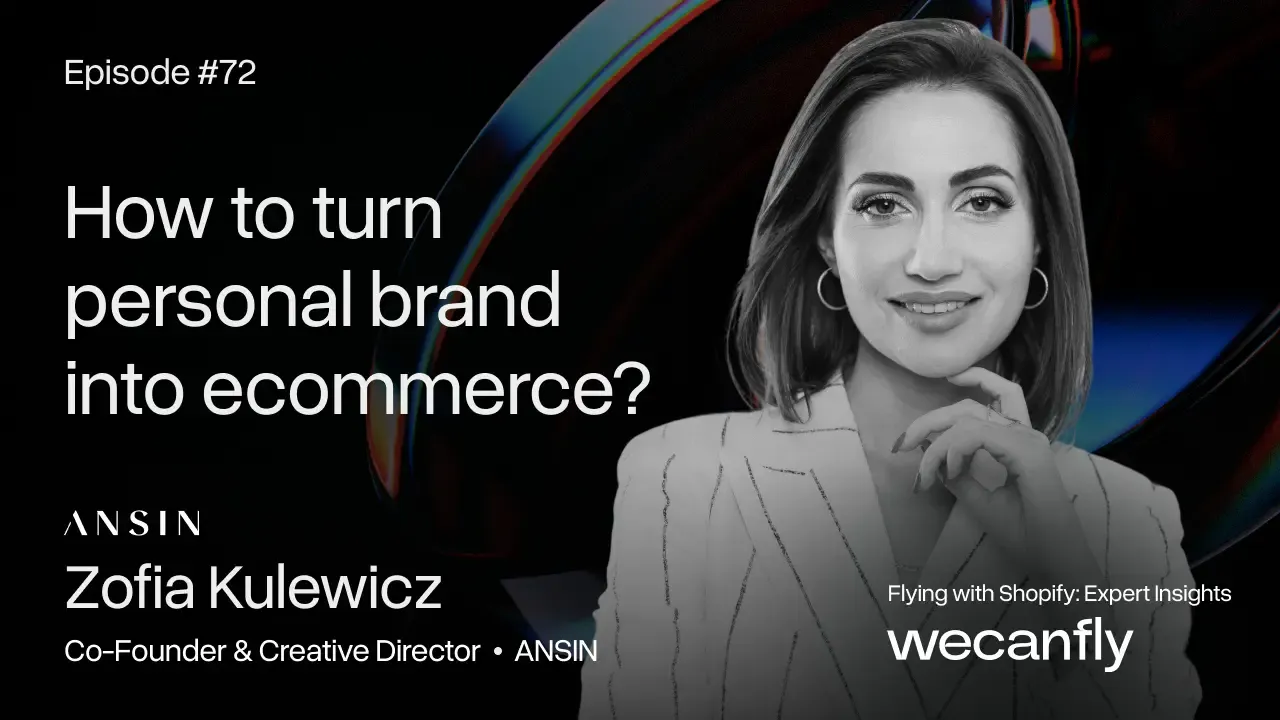
Zofia Kulewicz, ANSIN: How to successfully turn your personal brand into a profitable e-commerce business?
From creator to founder: the ANSIN story
Episode in Polish, English subtitles available. Below: an edited English translation of the full conversation.
Zofia Kulewicz, co-owner and creative director of the ANSIN clothing brand, tells Tomek Runowicz and Maciek Czerniak how her work as a personal stylist and her YouTube channel grew into a brand that started with nude undershirts for men and today has 17 people in the office and releases new products in drops about once a month. They talk about a product's journey from mood board to store, how much to listen to customers, influencer marketing and TikTok, building a brand that doesn't depend on its founder's face, and what changed when ANSIN moved to Shopify. The episode is for founders and managers of fashion brands that design and make their own products.
Key takeaways
- ANSIN started with a single product. As a personal shopper, Zosia heard every second male client ask "what should I wear under a white shirt?", but nude undershirts weren't on sale, and the ones she ordered from the US were held by customs. The first plan was nude undershirts for men in three shades; the name comes from the English word "unseen". Then came a women's version, basics, in-house designers and collections. (7:18, 7:54, 8:46, 9:20)
- Before leaving her corporate job, Zosia spent two years building her stylist work after hours. She got her first clients from Google Ads campaigns she set up herself (she had previously managed a Google Ads team), and for two years she published a YouTube video every Sunday. (4:49, 6:18, 11:33)
- Ever since the brand started growing fast, Zosia and Jarek, who is responsible for the business, e-commerce and team side of ANSIN, have been building it to work independently of Zosia's personal brand: with ads, collaborations with other influencers and a strategy not centred on one person. They measure collaborations with unique discount codes, but also count reach and new followers. (30:50, 32:28, 32:38, 37:45)
- The ANSIN team is 17 people in the office, while logistics, fulfilment, sewing workshops and pattern makers are external. A collection starts six to seven months before launch (they're considering extending it to a year): mood board, designers, garment technologist, pattern makers, sewing workshop. An in-house seamstress and sample room have sped up prototype sampling, which can take as many as eight rounds. (14:46, 15:26, 16:50, 18:34)
- New products come out in drops about once a month, with a photo shoot for each drop. Customers like the effect of freshness, and the brand doesn't produce large runs or hold large stock. Zosia reads sales reports every day, and every hour on launch day; according to the latest reports, the more distinctive the design, the better it sells. (19:49, 20:43, 25:48, 47:32)
- Customer suggestions go to an internal Slack channel called "Customer suggestions"; after one of them, the leggings are set to get a locker-key pocket in the next production run. Still, Zosia stresses that a brand needs its own vision: "You can't listen to every opinion." Her advice for people starting out or stuck: try, and face the market's feedback honestly. (28:06, 28:46, 29:14, 51:19)
- After the migration to Shopify, Zosia says the whole team felt the change and she finally likes the store: "if you create a premium product, it has to be presented as premium." She analyses sales in Shopify reports and calls the move preparation for the next steps. On expansion abroad, she says ANSIN is thinking about it, but no decisions have been made yet. (38:45, 39:02, 39:47, 48:52, 49:43)
Guest
Zofia (Zosia) Kulewicz is a stylist and the co-owner and creative director of ANSIN, a clothing brand she runs together with Jarek. At ANSIN she is responsible for creative work, communication and product. Before becoming a stylist, she worked in a corporation, including as the manager of a Google Ads team. As a personal shopper she worked with both women and men, and she shares her knowledge of style on her YouTube channel. ANSIN makes its clothes in Poland and, at the time of recording, had been running its online store for six and a half years.
ANSIN is a wecanfly client. We helped move its store to Shopify as part of our Shopify migration services. Read more about how we work with clothing brands on our Shopify for fashion brands page.
Hosts
Tomek Runowicz and Maciek Czerniak run wecanfly, a Shopify Premier Partner agency that helps established brands with complex migrations to Shopify Plus.
The ANSIN case study based on this conversation is on our blog: From Personal Brand to E-commerce on Shopify Plus.
Transcript
This transcript is based on the recording of this episode. We edited it for readability: we corrected transcription errors, punctuation, and merged sentences that were cut off mid-flow. We did not change the content, order, or meaning of anything said. Any errors or inaccuracies are our responsibility alone — not our guests'. If you spot something that needs correcting, email us.
Recorded in winter 2026 (released on 10 March 2026), so ANSIN's numbers and plans reflect that time; we skip the teaser at the start of the video.
Personal brand: a help or a burden?
Tomek: Hi, this is Tomek Runowicz.
Maciek: And Maciek Czerniak.
Tomek: Day to day, we run wecanfly, an agency that helps established brands with complex migrations to Shopify Plus.
Maciek: And this is Flying with Shopify, the channel where we talk to e-commerce experts and founders. Welcome to another episode.
Tomek: Maciek and I always joke that before each episode I do research, a bit of spying, trying to find things out. With you, it was hard to get through the sheer amount of information out there. You're on lots of podcasts, we recently even saw you on TV, so you're everywhere as someone who talks about fashion and really knows it. It was genuinely hard for me to find things that aren't strictly about your business. Family matters come up too, of course, but that's not what we're asking about. So let's settle on this: you're a very hard-working stylist and today also the owner of the ANSIN brand. And that's what we'd like to talk about today, the crux of this episode: how you built the ANSIN brand out of your personal brand, and whether that personal brand helps today or is a burden you have to deal with somehow so that ANSIN can stand on its own as a brand.
Maciek: It would be nice to start from the beginning. This morning we were still going through your YouTube. Lots of people who talk about how they started say: "Look at my first videos, I'm embarrassed by them," and so on. We started from the oldest ones.
Zosia: Really? From the very beginning?
Maciek: Exactly. We put on the first ones and I said: "Wow, that doesn't look bad." We had the impression there isn't some huge gap.
Zosia: You think so?
Tomek: You were authentic right from the start.
Zosia: I thought you'd say something else. I thought you'd say: "Respect for keeping those videos up the whole time and not deleting them."
Tomek: That you've come an incredible way.
Zosia: I was really expecting that. Because, you see, when I put on my first videos, I feel I've come a long way since then. Or maybe it's because I know how stressful it was for me at the time. Maybe I'll start from the beginning.
Tomek: Please do.
From a corporate job to personal shopping
Zosia: After university, actually already during my studies, I ended up in a corporation. One, then another. My passion in life was dancing, and the job was just a nine-to-five so I could support myself. I never thought work was supposed to be my fulfilment. I had my passions, and I had to earn a living somehow. But at a certain age, I was about 26 or 27, I started asking myself whether it wouldn't be nice to do something in life where you decide how much and in which directions you grow, where you don't go to job interviews at all, you just do your own thing and go your own way. I started testing different things to see what I'd be good at. A few ideas came up, until I finally came across a course for personal stylists. And that's how it went from there.
After that course I spent two years developing my brand before I handed in my notice at the corporation. That's a relatively long time, because business podcasts usually say half a year is the max: if it isn't profitable, move on to the next thing. Maybe that's true in most cases. It wasn't in mine. I served clients, but it was freelance work, early days, and I built it after hours. I took clients in the evenings, went out at weekends, I was out shopping almost every weekend. I specialised in personal shopping, which means going shopping with people and sorting out their wardrobes. I had both male and female clients. In the meantime I started a YouTube channel. Those first videos you mentioned were made while I was still working two jobs.
Then the moment came when I left the corporation, even though as a stylist I was still earning less than in my full-time job. But I said: "You only live once. Either I'll make it or I won't. If I fall, I'll get up. If I fall a second time, I'll somehow get up again." And as it turned out, it was literally the perfect moment. As soon as I left, more and more clients started coming in, and I had more time to grow the YouTube channel.
Tomek: Exactly.
Zosia: I started running it regularly. For two years a video went up on YouTube every Sunday. I was so determined that I missed maybe three Sundays a year. Later, when I had more and more clients and the channel was growing nicely, there came a point when I started creating my own products: online courses, webinars and so on. Today people talk about it, as you put it, as a "personal brand", as if it were some kind of entity. But quite honestly, creating content on YouTube was for me back then, and still is today, a real need to create and the joy of having learned something from working with clients and being able to share it with a wider audience.
Tomek: Sure, so a natural course of events.
Where did the idea for ANSIN come from?
Zosia: When I was starting out, the concept of a personal brand was probably just emerging, more in the States, and it wasn't popular in Poland yet. Today that's what it's called. But to the point. I developed those online courses and webinars. When I went shopping with clients, practically every second male client asked me: "Zosia, what should I wear under a white shirt?"
Tomek: Okay.
Zosia: And I'd say: "Well, a nude undershirt would be useful. But actually there isn't one anywhere." There were some foreign brands, from the States. I ordered T-shirts like that for clients, but customs held them and I couldn't get them at all. A simple product, a nude undershirt. So I said to Jarek: "Come on, maybe we'll make something like that." I'll keep going shopping as a stylist, because I loved doing it, I'll do a webinar now and then, and I'll also have a little mini-shop with nude undershirts.
Tomek: Okay, so for you that was the first time an idea took physical form: you saw a need and answered it with a specific product.
Zosia: Yes. My assumptions, or rather dreams, back then were that we'd set up a store and it would have nude undershirts for men in three shades. I'd sell them to my clients, maybe recommend them somewhere on YouTube. And that's how ANSIN was born. ANSIN comes from the word "unseen", meaning invisible.
Tomek: Invisible. Yes, we decoded it, but now the whole story really says a bit more about it, doesn't it?
Zosia: And that's how it all started. Later, sales of those T-shirts really took off. They actually sold out. Women immediately asked for a women's version, so we created one. Soon they wanted longer sleeves, a different neckline, so we expanded the range. Then we started introducing basics. I'm not a designer by training, so I approached it step by step and we developed the basics. Later, as we grew, we hired designers and gradually introduced new product categories. Today we work in collections and have, you could say, a clothing brand.
How was the first product made?
Tomek: And how did you make that first product? You say you're not a designer. I'm curious how you go from an idea to actually making something.
Zosia: At the time we had a friend, Łukasz, who worked in clothing production for various brands. He worked for many brands on commission, and he gave us our first contacts to sewing workshops, component suppliers and pattern makers. Because you need a pattern maker who creates all the right drawings so that the person in the sewing workshop knows how to cut it, how to sew it and so on. Working with them, we made the first product.
Tomek: Did you sew locally from the start, here in Kraków?
Zosia: Yes.
Tomek: Okay, so there's local patriotism on top of it.
Zosia: Yes. I nodded because by "locally" I meant in Poland. But I think our first T-shirts were sewn in Łódź, somewhere near Łódź.
Tomek: Okay, fair enough.
Where did the first clients come from?
Maciek: There are two more things I'm curious about, going back a bit to the beginning. The first: where did the first clients you went shopping with come from at all? How did they find you?
Zosia: That's a good question, because I actually didn't mention it. I worked in a corporation as the manager of a Google Ads team. I understood the program, knew how it worked, knew how to use it. So when I set up my first website, I set up Google Ads campaigns for myself. I didn't have to pay an agency.
Tomek: Great.
Zosia: Because I had absolutely no funds for it at the time and couldn't afford those costs. I set it up myself, and that's how my first clients found me.
Tomek: Great.
Maciek: And the second thing is really more of an observation. You mentioned you made those videos out of passion, for the joy of creating. I think people starting out in content creation often don't realise this: if the process doesn't give you pleasure and you do it thinking there's a pot of money somewhere at the end…
Zosia: A reward.
Maciek: …it often doesn't work out. It takes perseverance. So the question is: at what point did you feel this might become a way of making a living in the future?
Zosia: I never thought of it that way. When I was creating content on YouTube, I never thought of it as a business plan. Do you know where that urge to create comes from? At the start you have some knowledge. For example, clients on shopping trips kept asking me the same questions, I knew the answers, so I said: "I'll make a video about it and more people will hear it." That's how it was at the start. Later, the urge to create comes, for example, from your viewers' comments, because I get 150 comments per video and there are discussions there, people disagree about things. My viewers and their opinions are the source of my work. And I say: "Wow, let me tell you how I approach it." Once you've built a channel, that keeps you going.
Tomek: Yes, because your content sparked discussions and you could draw new topics out of them. What was certainly key is what you said: at the beginning, in your head, it had no hallmarks of a business, and that made it more natural and more credible. You did it out of a pure desire to share knowledge, to teach, to educate others, and the reward came over time and in a very natural way.
How big is the ANSIN team today?
Tomek: Zosia, you said you started with one undershirt, not even a T-shirt, just an undershirt to wear under a shirt.
Zosia: An undershirt, yes.
Tomek: Then you started growing to the scale you're at today. Can you tell us what scale you're at today? How big is ANSIN? How many people do you employ, or how big is the team working on the range we can find on your website today?
Zosia: Our team has 16 people employed in the office. On top of that, logistics and fulfilment are outsourced. We also work with freelancers and external agencies, but the core team is 16 people.
Tomek: And who's on that team?
Zosia: The biggest is the production team: two designers, a garment technologist, a buyer and a head of product.
Tomek: Okay.
Zosia: It's a system of interconnected parts, and without them not a single product gets made. All these people are needed to make even a simple T-shirt. I didn't mention it, but the sewing workshops and all the pattern makers are external too. Sorry, 17, because we also have Gabrysia, I forgot. We also have Gabrysia, our seamstress. Hello, Gabrysia. For a while now we've had a seamstress on site who sews prototypes for us. That has really sped up sampling, meaning sewing the first prototypes, because we have our own sample room on site and Gabrysia sews some of the prototypes there. Then we have the marketing team, that's three people. Plus a person for e-commerce, a graphic designer, a person for finance and two people supporting production.
How a collection is made: from mood board to store
Tomek: Can you tell us what the product development process looks like today with a team like that? How do you create a collection, do you plan it by season? Does it start with an idea in your head and end on the shelf of the online store? What does it look like step by step?
Zosia: Yes, exactly, it starts with my vision. We usually start six or seven months ahead. That's when I imagine what I'd like to see in our store and create a mood board of ideas. Then I go through it with the designers, and they turn it into actual designs. Then we comment on them together. Next, the design goes to the garment technologist, who passes it on to the pattern makers, and the pattern makers to the sewing workshops. The first prototypes are made in the workshops, or the patterns come to us and Gabrysia sews the prototypes in-house. Only once the first design is done do we see the first prototype. Sometimes it takes one more round of sewing and the design is ready, and sometimes eight rounds, literally. And that, unfortunately, means big production costs. But the more experience I have, the more I know that if I want to sleep well at night, it has to be spot on. So sometimes it takes that long, because something has to be moved by a centimetre, something has to be shorter, the fabric isn't right or gets discontinued because the supplier suddenly stops making it, or the colour doesn't fit the collection after all. A lot can happen along the way, so it depends on the product.
Tomek: Let me ask more about those seven months. Seven months before the product appears in the store?
Zosia: Yes. Right now it's seven months, but we're considering extending that period to have more room for exactly the situations where something sometimes has to be re-sewn eight times.
Tomek: Okay.
Zosia: Because then there's stress and nerves. None of us wants that or likes it. But we're still considering it.
Tomek: Given how the range is planned in fashion and how far ahead collections appear: it's the middle of winter today, and you're probably already starting to present summer, which will soon be selling great. The truth is that the idea has to be born a good year before the product is physically in the store and starts selling.
Zosia: Exactly. I think we'll aim for that period, a year.
Why does ANSIN work in drops?
Tomek: And how do you handle photo shoots? Do you always do a shoot for every collection? Or do you have fixed dates, say twice a year, because you have two types of collections?
Zosia: At the current stage of the brand, we work in drops. Drops come out on average once a month, and we organise a shoot for each drop. So it's usually about one shoot a month. But that changes too, because I don't think you can have rigid rules. The brand is growing, so maybe next year we'll reduce the number of drops a bit, and maybe not. It also depends on how our customers respond.
Tomek: And releasing clothes in drops: is that more of a marketing strategy, or does it come from production? Is it designed that way because it sells better?
Zosia: We see that our customers like the effect of freshness. When something new appears, they often react to it. They just buy. And we work in a system where we don't want large stock levels. We don't want to produce several hundred pairs of some trousers that then, say, don't catch on. And then what do you do with them? Working in drops, we don't have large stock levels, so products don't pile up. We're also moving more towards less waste.
Tomek: Great.
Zosia: Then it sells and we don't have a problem with it.
Tomek: The bane of e-commerce: large stock levels and old items. Once they're old, they're really hard to sell. It's incredibly difficult.
Zosia: We always aim for every product to be great. It never happens that we release something like: "Well, it's weak, it won't sell, but let's release it." We never do that. We always believe in every product. But at the end of the day, it's the market that decides whether it likes the product.
What does a "great product" mean?
Tomek: You say you care about the product being great. So what are your acceptance criteria? What does a great product mean to you?
Zosia: For me, above all, it has to make me fall in love with it. When I see it on our fit model or put it on myself and I like it, because I'd wear it myself, it has an effect on me. It depends on what the garment is for. There are clothes you put on for a weekend in the Bieszczady mountains, and they're not meant to have a wow effect like my blazer today, which is meant to have it with its colour, cut or fabric. They have a different purpose. But in some way they have to make you fall in love. Functionality in clothes is very important to me. I always ask myself where the customer will wear the garment, where she'll go in it, for what occasions. And I think about it not being just one occasion: today she'll wear it to a wedding, but if she styles it differently, she'll wear it in summer on holiday. That's also a very important criterion for me.
Plus all the finishing, so the garment sits well on the body. So that draping, cut-outs, details, whatever there is, simply look good. When the customer puts it on, it has to fall like this, sit like this. I'm not a garment technologist, but the longer I work, the more I see how incredibly important garment technologists' knowledge is today. It's also a creative world: you can finish clothes in different ways, different seams, different pleats, different folds, various details that make the product sit on the body exactly the way it does. We already work with several garment technologists, and that helps a lot, because I can have one vision and someone will test it against reality and say: "Listen, there's no way to do it like that."
Intuition or data: how do you predict a hit?
Tomek: You said that in the end it's the market that decides whether a product catches on. How many years have you been running this e-commerce business?
Zosia: Six and a half years now.
Tomek: Six and a half years. In that time, have you learned enough and got such a feel for it that you release nothing but bangers and sure things? Or does something sometimes come along that you thought would fly off the shelves, and then it doesn't?
Zosia: I'll tell you, it may sound immodest, but I have good intuition for it. Usually, and I'm learning this season by season, when I feel something 100% and I'm absolutely in love with it, it sells very well. I don't think I'm always right, so I like to listen a lot to people on the team and to different suggestions. I said "most of the time", because it happens that I don't quite feel something, I listen to someone and it sells well too. So sometimes I'm open to other people's opinions. I often listen to the team, because the women have their own views, just as our customers have different needs. I think in the end I'm learning season by season to make good decisions, because it's based on intuition.
Here's an interesting fact: a given product will only sell if it's released at a particular moment in the year. For example, for Valentine's Day, just to give an example. Then it'll sell brilliantly, but if we release it in April or May, nobody will buy it. I'm learning things like that too: that there's a moment in the year when particular products will sell well. There's some analysis involved. Every day I run sales reports and see what's selling daily, weekly and monthly, so I see what customers are interested in. Launch day is especially important to me. When new designs come out, I run a report every hour on what sold best. A combination of that analysis, intuition and knowledge of the fashion market probably helps us make the best decisions. I think we're getting better at it season by season. But we still have, and probably always will have, what the fashion industry calls "hits and flops". Although I'm working towards it and I'd like to predict everything. But I don't have that kind of omnipotence.
How much should you listen to customers?
Tomek: Listen, I'm thinking about what you said at the very start about your channel: that discussions appeared under your videos and you drew topics for new videos from them. In a moment I'd like to move on to how your personal brand still carries over to the brand and whether you feel one powering the other. But I'm wondering whether in the design phase, when ideas are forming in your head and you put them on a mood board, you take cues from comments under products, from customer reviews, or from comments under your videos where people write that something's missing or that they'd love to see a certain product?
Maciek: You said that when you did personal shopping, you got feedback first-hand.
Zosia: Yes, definitely. Especially when there are recurring requests or suggestions from our customers. We even have an internal Slack channel called "Customer suggestions", where the customer service team posts screenshots or messages from customers: what they'd like, what they'd suggest and so on. Literally yesterday we launched our first leggings at ANSIN, nice ones, made of viscose. And a customer asked whether the leggings had a place for a locker key.
Maciek: Oh, nice.
Zosia: I read it and said: "Why don't we have that?" It's a brilliant suggestion. I immediately wrote to the designers: "Ladies, when we do the next production run, we're adding a key pocket." So some suggestions are brilliant. That said, I've learned this too: you have to have your own vision for your brand.
Maciek: Of course.
Zosia: Because you can't listen to every opinion, or you'd just go round in circles.
Maciek: It's what Henry Ford said: if I had listened to people, I'd have given them faster horses instead of a car, right?
Tomek: Yes. For one.
Zosia: Exactly. And it's the same, for example, with running a YouTube channel, because people have expectations. There I get personal comments that I could be like this, do this, say that. In all of this you also have to know which feedback to pick and take into account. Some of it is very valuable, like that key pocket in the leggings, but some you simply don't take on board, and you go your own way. Because you'll never please everyone.
Maciek: It can't be done.
Zosia: That's also an important skill in life, especially when you're exposed to other people's opinions: you have your vision, and you accept that if you follow it, some people may leave you.
Tomek: Yes, that's right.
Do customers come for ANSIN or for Zosia?
Maciek: Since we're on that subject: can you tell whether customers today come more for ANSIN or more for you? Can you tell the difference?
Zosia: You know, online I have no idea, you'd have to ask the customers. But every now and then we hold an Archive Sale, a sale of samples from archive designs and previous collections, where we meet customers in person. It's always really nice when lots of people come up to me, congratulate me and say they watch my YouTube channel. There are probably quite a few among our audience and customers who followed my journey or still do. That's very nice. But I'll also admit that from the start Jarek and I had a vision for ANSIN. At the very beginning, with the nude undershirts, we had no vision at all. But once it started growing quickly, we both knew we wanted ANSIN to be a brand that could function independently of my personal brand. We knew from the start that I'd be support, I'd be the face, I'd appear, but we wanted to grow ANSIN so that even if I suddenly disappeared or wanted to disappear from the media, ANSIN would keep running on its own. In other words, so that the two could work independently of each other. We had that vision from the start, which is why we went straight for ads, influencers and a growth strategy that doesn't focus on just one brand.
Tomek: So you also work with other influencers?
Zosia: Yes, definitely. We regularly work with smaller and bigger influencers.
Tomek: Does it work for you? Can you measure it?
Zosia: Is it measurable? That's a good question. You have easy measurability in the form of, for example, giving someone a unique discount code and then seeing how many times it was used. But remember that sometimes it'll be sales through a given influencer, and sometimes it'll be just image: someone shows you very nicely, aesthetically, and their audience sees you. Even if they don't buy, it's still advertising. They'll see the logo, see the clothes, hear that person's opinion and so on. We approach it in different ways: it doesn't always have to translate into sales. Sometimes it's about being seen on someone's channel, and that's also a form of advertising. When you count up other ads, sometimes you don't get sales from them either, but they were shown to a certain number of users.
Tomek: Of course, sometimes you do it for brand awareness, visibility, cold traffic.
Zosia: Exactly. With some collaborations you don't get sales, for example, but you get lots of new followers on Instagram, which can also turn into customers in the future.
Marketing channels and TikTok
Tomek: Since you work with influencers, and I think on the whole you're happy with it, because you keep doing it and expanding it… We asked because it seems to me that how this channel performs is often a bit of a mystery. Opinions vary a lot. For some it works great, others say it's completely unmeasurable and it's hard to draw firm conclusions from it. We've covered influencers. I assume, partly because of your professional background, that paid campaigns are also something ANSIN uses to build visibility and reach customers. But are there channels you deliberately stay out of? Where you don't want to appear? Or do you try to be, in quotes, everywhere a potential customer might be?
Zosia: No, I don't think there's anywhere we don't want to go. It's more that, how shall I put it, we're still learning TikTok. That's the gentle way to put it. From my first YouTube videos my reach was good. I'll admit that when I uploaded my first videos, the reach was there straight away, and long formats come easily to me.
Tomek: Right.
Zosia: But I struggle with short formats, I admit. It's hard for me. It's supposedly the same thing, but when you have to make those 30 seconds and make them land with a bang straight away, so that someone stops scrolling… It's a bit of a challenge for me. I do it my own way. I don't get any huge reach, because it's not, say, TikTok-style. TikTok is simply a specific environment. But we're not giving up, we'll keep trying. We'll probably crack it eventually.
Tomek: To be honest, I expected TikTok. It probably comes up most often in conversations with people who run e-commerce businesses. Everyone knows how important this channel is and how much reach it gets, and that there's an older and older generation there, because the one that started on it is slowly entering the buying stage, or at least the stage where it starts making decisions. But the vast majority have the same observation as you. There's also the question of whether your customers are there, because you're a more premium brand, aren't you?
Zosia: Yes, but premium brands perform well on TikTok too. That's exactly the point: you have to know how to do it.
Tomek: I agree.
Zosia: I think it can be done, you just have to find your own way.
Who looks at the numbers at ANSIN?
Tomek: That's interesting too. I have one more question, because you touched on it and I think it's worth expanding. So far we've talked about your creative work for the brand, producing lots of content and being the face of the brand. But you mentioned you look at the numbers regularly. If we strip away the media image for a moment: how much does your day-to-day operational work involve analytics, looking at numbers and results, and making decisions based on them? Or is that more the domain of Jarek, whom you've mentioned several times, or are you close to it after all?
Zosia: Jarek and I have divided areas of responsibility at ANSIN. Jarek is responsible for the business, e-commerce and team side, and I'm responsible for the more creative, communication and product side. You can't create new collections without understanding the history of previous ones, because they give us certain signals from our customers and about their needs. So I mainly analyse sales, and that's really the main analytics I do.
Tomek: So anything deeper is Jarek's domain.
Zosia: That's Jarek's domain, so you'll have to invite him. He'll tell you more about it.
What changed after the move to Shopify?
Maciek: But do you analyse it in the Shopify reports?
Zosia: In the Shopify reports, yes.
Maciek: Since that magic word has come up: after the migration, do you feel your day-to-day operations have gone up a level?
Zosia: Definitely. I think everyone on the team has felt it. I look at our store now and I finally like it. Plus the possibilities we have because we're on Shopify, and quick changes. Correct me if I'm wrong, but you can add apps that let you make certain changes and so on. Klaudia, who handles e-commerce for us, takes care of it. Then I see the final result on the site and say: "Ladies, good job."
Tomek: Great work.
Zosia: Above all: if you create a premium product, it has to be presented as premium. There's no way a premium product can have any old packaging and any old setting, because the customer won't feel they're buying something special, that they're paying for something more. Shopify definitely helped us a lot to take that step, and our store looks much better.
Maciek: And do you have the app and listen to those notifications, that "ka-ching" when a sale comes in?
Zosia: No.
Maciek: The best sound in the world.
Zosia: Sorry?
Maciek: Just the best sound in the world. Sales notifications.
Zosia: But Jarek has them switched on!
Tomek: Jarek does!
Zosia: He has them on, and sometimes I get annoyed with him. During Black Week I thought I'd go mad. He's already asleep, and I've left my phone on the wooden bedside table.
Maciek: And it keeps vibrating.
Zosia: And I'm fuming. So no, I have them switched off. I check in at least once a day.
The decision Zosia is proudest of
Tomek: Tell us, which of your business decisions, yours or both of yours, are you proudest of? What was a game changer for you?
Zosia: I don't think I have one single decision. I try to be proud as things go, when something works out for us, and I'm proud when I have real, measurable results. Then I can say: "Okay, I'm proud." Or when we get a great review from a customer, when she's happy, when our customer service gets a message saying the product fully met her expectations and she describes it in detail. That's the moment: wow, great, this is why we do it. Literally three days ago one of the influencers, who wears a larger size, ordered quite a lot of our things as part of a collaboration, and everything fit her well. We watched that video and I said: "Wow, this is great." That's an example of a moment when I'm proud.
At the start you asked about things the internet doesn't know, and actually one story came to mind that the internet probably really doesn't know. It was three years ago. I was still working as a personal shopper then. Season by season I had fewer clients and fewer slots, the waiting list for me got longer, prices got higher and so on, so I'd have time for ANSIN. But I still had those clients. I really loved the work, and it was quite a niche premium service, so I looked after each client from A to Z. I remember sitting after hours, fixing something, ordering things for a client, sending him links and preparing outfits. Jarek saw that I was sitting after hours while everything at ANSIN was growing fast. We'd already talked about it more than once, and he'd say: "Jeez, how many of these clients? You should just let it go." But I couldn't, because emotionally it was a great job for me. It was what let me leave the corporation, which was a huge milestone for me, and I couldn't give it up. I remember one day he took me out to lunch, sat down with me and said: "Zośka, either you stop working with clients, you're not a stylist anymore. You're the creative director at ANSIN. We do this together. Or you keep those clients the way you have, and I'll hire someone. You'll be our face from time to time, but I want you to know that if we go with the second option, I'll be much less keen to do this."
Tomek: Firm.
Zosia: But honestly, when he said that, my first thought was: "Jeez, I really needed to hear that." That it's one or the other. Either you go all in, 100%. There are people who have the skills to handle both, but it always scatters your focus.
Tomek: Of course.
Zosia: Either here or there. I said: "Jarek, high five. Okay, we have to do this. When?" I still had a few clients booked, so I said: "Okay, I'll see them through to the end." And that was it. I remember I also recorded a YouTube video to cut myself off and close that chapter. It was a very hard decision for me emotionally, because that work was what allowed me to leave. I'm not saying I had it bad in the corporation, but I didn't feel as good there as when running something of my own. When I run something of my own, I feel like myself. I loved doing it. It was hard. Financially, when I worked it out, the two weren't even comparable, to be clear. But sometimes it's not only about money. Money isn't always the most important thing. That was the point. I made that decision three years ago.
What would Zosia do differently?
Tomek: Kudos to Jarek for being so brave and putting it on the line. It worked the way it should. And if you could, hypothetically of course, go back to your beginnings at ANSIN: would you tell the Zosia and the ANSIN brand of those days to do something differently? To make the journey faster, or for you to grow even more? Looking back, do you feel you held off on something, didn't commit to something, or that some decision along the way was a miss? Or do you feel you did correctly what you could do at the time?
Zosia: That's the thing: you never know how things would have turned out if you'd done something differently. But I think I'd have gone bolder with the collection earlier.
Tomek: Okay. Meaning new colours, new looks…
Zosia: New cuts and so on.
Tomek: …not necessarily everything understated.
Zosia: At the beginning we were a basics brand. We had the slogan "We are premium basics", and it was meant to be a brand of basics. At some point, as I said, we started expanding into more categories, but I think I'd have gone bolder earlier.
Tomek: Okay. Interesting.
Zosia: But on the other hand, I don't know. Maybe that was meant to be the path, maybe that was only the right moment.
Tomek: Maybe you had to grow into it.
Zosia: I say this because I was afraid of that move, and in the end our latest reports show that the more distinctive the product, the better it sells.
Tomek: Okay. Distinctive meaning…
Zosia: Meaning design.
Maciek: A unique design.
Zosia: For example, this blazer is bold, given ANSIN's history, because it has a strong colour, wide shoulders, shoulder pads, so it's oversized. That was a bolder step.
Maciek: If we wore one like that, we'd look a bit like George Michael. That kind of vibe. Think about a men's version, then we'll buy it.
Tomek: Absolutely.
Plans and foreign markets
Tomek: Zosia, if we can try to look ahead: which direction are you looking in today as the owners of the ANSIN brand? Maybe you can reveal some of your plans, whether for the collections or further expansion? I think it would be really interesting to know where you are in your plans today.
Zosia: Pass.
Tomek: Okay, fine.
Maciek: Have you ever thought about going abroad?
Zosia: Seriously? I don't want to talk about it, because these are very bold decisions for us.
Tomek: Okay.
Maciek: They haven't been made yet.
Zosia: They haven't been made yet. But if you're asking whether we want to grow, whether we're thinking about new channels and whether we're thinking about going abroad, then yes.
Maciek: Yes to everything.
Zosia: Yes, yes to everything. We're thinking about it, we want it, but I'd love to tell you 100% that yes, we're doing it, once it actually happens.
Maciek: We'll definitely be the first to know.
Tomek: There's a good chance we'll be the first to know.
Zosia: Listen, quite possibly. Especially with the expansion.
Tomek: Yes, that may be.
Zosia: Yes. Shopify definitely makes it easier for us, and moving to Shopify was definitely preparation for the next steps. Last year we streamlined a few business things in the hope that this year, 2026…
Tomek: You strengthened the foundations so that now…
Zosia: Exactly. "We strengthened the foundations" is a good way to put it. So that we can go further this year.
Tomek: Great, that's definitely what we'll wish you and keep our fingers crossed for. We're cutting out that praise of Shopify and turning it into a testimonial.
Maciek: Of course.
Tomek: Thanks for agreeing.
Zosia: Sure.
Advice for people starting out or stuck
Tomek: Maciek, any more questions?
Maciek: No.
Tomek: At the end we always like to leave our listeners with insights or tips from our guests that they can take away and think about for themselves. If someone were sitting across the table from you who is thinking about following your path or opening an e-commerce business, or someone who's already doing it but is a bit stuck and doesn't know what next: what tips would you give them from your perspective? What advice, so that they take a bold look at their business?
Zosia: The first word that comes to mind is "try". However banal it sounds, without trying we have no real data and no feedback from the market. You can think something might work and create visions without actually starting. Lots of things may seem a certain way to us, but only once we launch do we get feedback. We see how we find ourselves in it, how our business is doing, how customers and the market react. So first: you simply have to try. Second: face the market's feedback for real, both the positive and the negative. So if something isn't working, it isn't working, and you have to take different steps: change how you operate, or change the product or service. Don't deny that it isn't working and count on it somehow working out. Not necessarily.
Tomek: Face the truth at that point, right?
Zosia: Exactly, face the truth. Exactly.
Tomek: Don't be afraid of it.
Zosia: This works, this doesn't. So what do we do next? So I think it's about really looking at the results.
Tomek: Okay.
Zosia: There was supposed to be a third one, right? I had an idea for a third. I think those two are the most important: you try, and then you face the feedback and analyse it honestly.
Tomek: They seem all the more valid to me because they come from you, the person whose main role at your brand is exactly this: listening to what people expect and what they might not like, and building ANSIN's product range on that basis. I think from your perspective these really can be the key points.
Maciek: Yes. I'd add the third one. What comes through clearly in the story you're telling us is that you were brave. And that courage is something these efforts can't do without.
Tomek: And I'll add one more thing at the end: credibility, which is where we started when we talked about your channel and what you did from the very beginning. Maciek, you mentioned it too: if someone is fake in what they do, meaning they set themselves a business goal rather than a real need they're addressing, the reception will never be the same as for someone who truly believes in what they do. I think that's important too.
Production, an influencer brand and looking into wardrobes
Tomek: Zosia, thank you so much for a really enjoyable meeting and a genuinely great conversation. We often talk to experts and specialists who serve e-commerce businesses from the outside, and meetings like this with owners and representatives of the businesses themselves are super interesting, because we can see things a bit from behind the scenes. And when production comes into it, which isn't standard either… It's easier to run an e-commerce business that's essentially a distributor of products. It's easier operationally. I'm not talking about the business's profit, because, of course, the margins are different.
Zosia: Different, yes.
Tomek: With manufacturing businesses it's always really interesting. That's why Maciek and I ask about exactly these details.
Zosia: About production.
Tomek: About production, about how it's all made.
Maciek: The influencer-brand angle is also really interesting, because it's a completely different story. Often someone says: "Okay, let's make something." In fashion, it usually goes like this: the product someone was looking for didn't exist on the market, or they didn't like anything.
Zosia: Exactly. But you see, with me it was different. What you just said is a good point, because lots of clothing brands start that way. You know what else I think helped ANSIN grow? That right from the start, because I went shopping with clients, I didn't look at the brand from the perspective of my own need, but from the needs of other people I worked with. I looked into their wardrobes, went shopping with them and saw what they were missing. I talked to them. I literally looked into their wardrobes. I saw what they didn't wear, what they did wear, what they looked good in, what had been bought for no reason and so on. I had market insights that are hard to come by, so I think that helped us too.
Maciek: What's the strangest thing you've ever found in someone's wardrobe?
Zosia: Some weird, crazy things?
Tomek: Gosh, your imagination has run away with you. People dress normally.
Zosia: I think people knew I was coming.
Tomek: Exactly. They'd tidied up those wardrobes.
Zosia: Once I was at a client's place and pulled out a jumper with a teddy bear on it. I said: "Oh no, you're not wearing this anymore." And he said: "Oh, but my wife bought me that." And she happened to be walking past, and I knew I was in trouble.
Tomek: But he had an excuse. Thanks again, Zosia. Really great conversation. Thank you so much for dropping by, for finding the time and for sharing all this so openly. I think it was super interesting to get the other side of how ANSIN works today, but also where it comes from and what's behind the brand's success. Congratulations to you, to Jarek and to the whole team. Now we know: 17 people.
Maciek: And Gabrysia.
Zosia: With Gabrysia. 17, you got it right.
Tomek: You studied economics, I studied economics. We've got numbers in our blood. Great. Thank you so much.
Zosia: Okay, thanks.
Maciek: Thanks.