


In this blog post
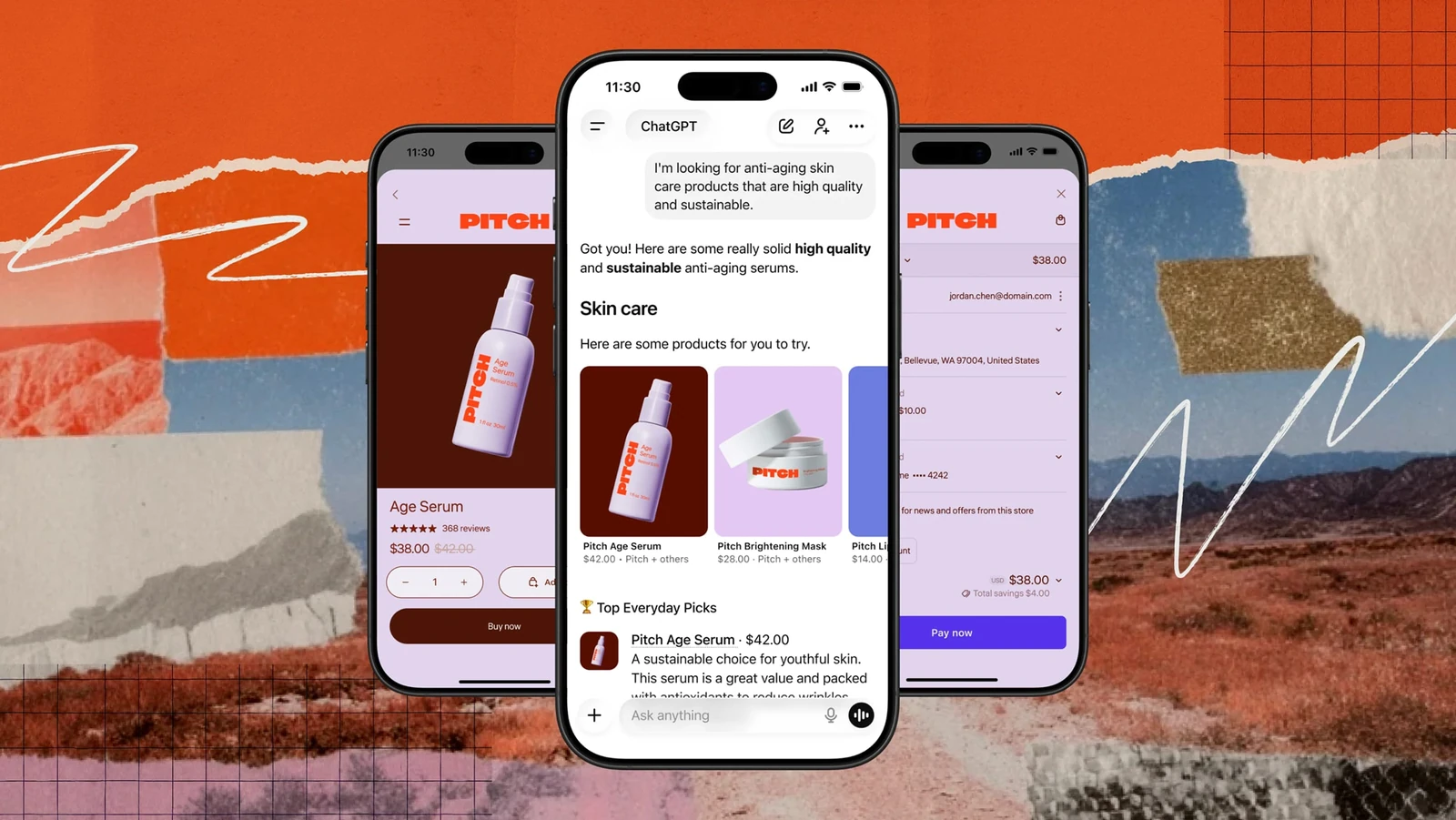
There is a lot of buzz around AI and commerce, with many new terms being misunderstood or conflated: agentic commerce, agentic storefronts, AI toolkits, commerce protocols, and MCPs. Agencies are repositioning themselves as AI-native, AI-first, or AI-engineering shops. Many developments are happening simultaneously under the "agentic commerce" label, and I felt the urge to organize this knowledge to gain a better understanding of the field. As the saying goes, if you want to learn something, try to teach it first.
The first facet is AI as the shopper: AI agents acting autonomously on behalf of humans – browsing, comparing, waiting for the right price, negotiating among themselves, and completing purchases across the web. Your Shopify store is already prepared for this, whether you have considered it or not. That is the Shopify philosophy – every store is AI-ready by default.
The second facet is AI as the builder and operator: using AI coding tools to build and run your Shopify storefront. As Daft Punk would say, it is "harder, better, faster, stronger." This model is more efficient and offers more control than the traditional development model, but it requires deliberate implementation.
This guide provides an overview of what is currently happening in the world of AI in e-commerce and explores where the industry might be headed in the near future.
The other question I ask myself is this: is Shopify the best positioned platform for this AI shift, what are its strengths and weaknesses. How it’s navigating the change. Where it’s placing its bets. Are ecommerce platforms that essential or maybe something else is the truth – the value moving from the platform layer to the AI layer.
Part 1: AI as the Shopper
What is agentic commerce?
Imagine this: You’re brushing your teeth in the morning and mention to your partner, “We’re running out of toothpaste.” By noon the next day, the toothpaste is delivered to your door. Your partner wasn’t even involved. Amazon Alexa or Google Assistant heard you, and your personal AI agent – authorized by you to make small purchase decisions – executed the order. It might buy it immediately, add it to a monthly list, redeem loyalty points, apply discounts, or even negotiate a price. It sounds like science fiction, but it is already happening. While some might argue it's easier to train a human partner, AI agents don't forget and can be communicated with as naturally as a person.

For the past two decades, e-commerce worked the same way: a human searched for something, clicked through a results page, landed on a product page, and decided whether to buy. Every part of that loop depended on a human being present and making decisions in real time.
Agentic commerce breaks that assumption. For the first time, the buyer is not necessarily a human. This shift was unthinkable just a few years ago, and we are only beginning to see the repercussions of this new actor on the e-commerce scene.
Consider a few more examples of goals customers might set for their agents: "Reorder my usual coffee before I run out" or "Find me a hotel in Rome for the first weekend in October, under €200 a night, with late checkout." The agent browses, compares, checks policies, and completes the transaction within pre-set parameters – even selecting preferred delivery methods and adding order notes.
This isn't theoretical. Shopify data shows that orders originating from AI channels grew 15x from January 2025 to January 2026. Furthermore, the average order value (AOV) from AI-referred transactions consistently outperforms direct traffic, with early merchant data pointing to a 30% higher AOV. This can likely be attributed to higher intent, better-informed decisions, and AI-driven insights.
How Shopify enables it technically
I like this quote from Shopify’s CEO - Tobi Lutke:
“What looks like a smart strategy today is actually just a good technology choice we made years ago”.

Shopify has spent years collecting billions of data points and building the infrastructure that enables agentic commerce at scale. Having been a Shopify agency for over a decade, we have had a front-row seat to this evolution. Shopify is not just reacting to a trend; they are defining it. Their strategy has always been to be present wherever customers are – from Instagram and TikTok to Roblox and LLMs.
They are moving from being an e-commerce platform to becoming the data layer and infrastructure that AI commerce runs on. This is a strategic pivot toward infrastructure rather than just features – a move that, in hindsight, seems like a calculated bet on the future of commerce.
So here's what that stack actually looks like:
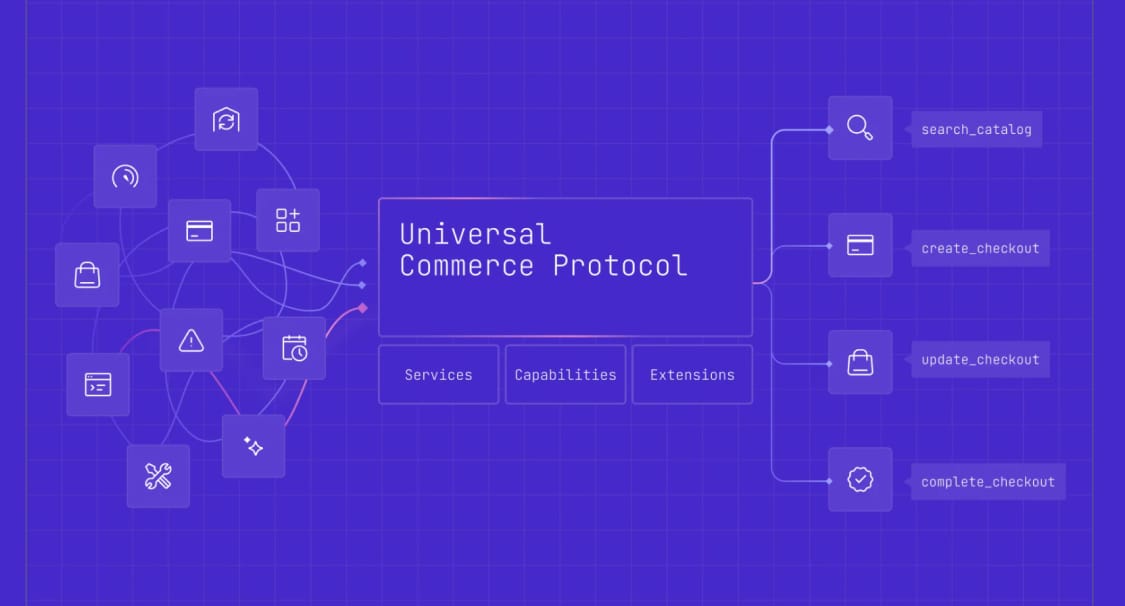
Universal Commerce Protocol (UCP)
This is the open standard Shopify co-developed with Google to connect merchants to AI shopping channels at scale. It serves as a shared language, allowing any AI agent to query product information, check availability, and initiate a purchase. Before UCP, each AI channel would require a bespoke integration; UCP standardizes the connection.
Moreover, it is as flexible as Jean Claude Van Damm doing an epic split on Volvo truck wing mirrors. It can serve any edge case and address the entire customer journey from product discovery (querying product catalog), through ordering and checkout to post purchase experience. We break it down in detail in Shopify UCP Explained.
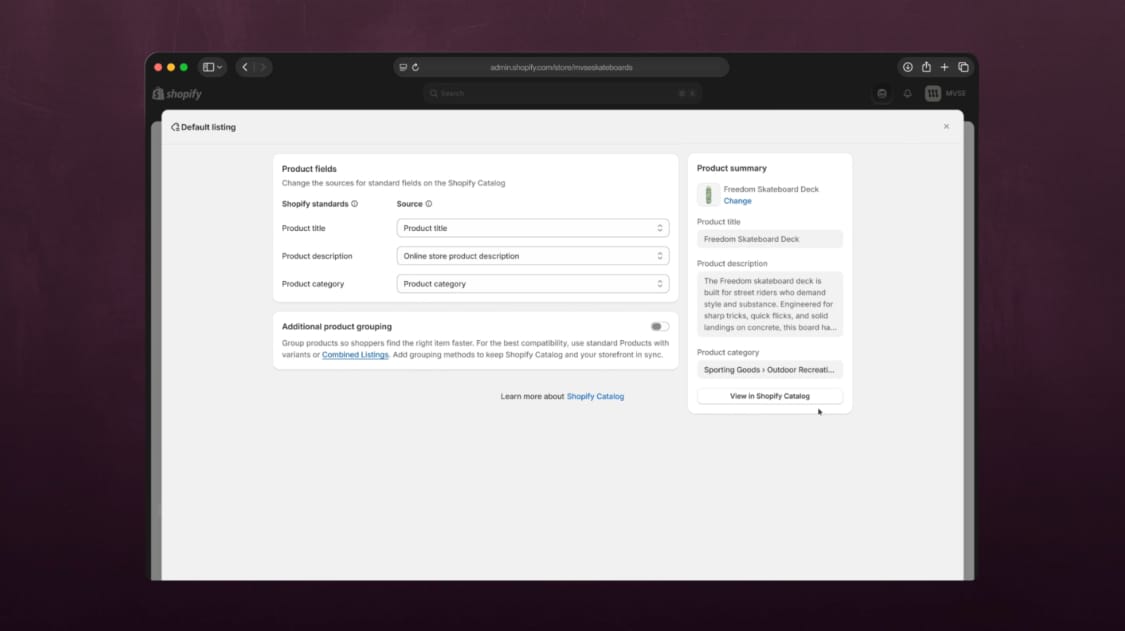
Shopify Catalog
The structured data layer that agents access when they're researching products. This is more important than it sounds. AI agents have a strong incentive to call a product catalog via API rather than scrape a website. API calls require far fewer tokens, which translates to lower cost and faster responses. I think you might be sure that LLM’s will prioritize structured data over scrapped from websites.
A well-structured Shopify Catalog means agents can confidently read product attributes, variants, pricing, availability, and policies without inferring them from HTML. Stores with poor data—such as missing specs or vague descriptions—are harder for agents to recommend accurately.
Good news for Shopify merchants. If you’re on Shopify it is enabled by default. No surprises here. But what about those running on Magento, Presta or other Shopware? We’ve got you covered. You can use Shopify’s Agentic Plan and connect your store or your PIM to the Shopify catalogue. All you have to do is map your data to catalogue standards. This is the easiest way to enable your store to appear in LLMs and give your customers the possibility to buy from you via an agentic storefront.
There is another way obviously. You can add your product using the Google Merchant Center Route, setting up your business with Google Pay, publishing UCP profile and completing native checkout integration (Google has a well documented guide for this naturally).
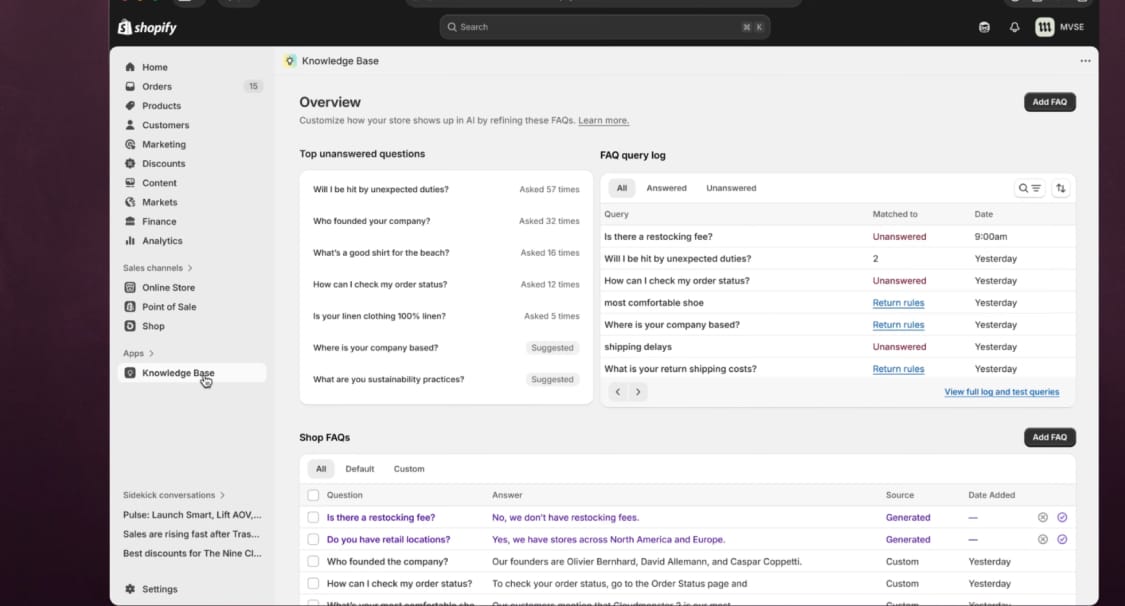
Shopify Knowledge Base
I think this one is a little bit underestimated. This little app from Shopify gives merchants direct control over how AI responds about their brand. Using the Knowledge Base app, you can see what questions customers are actually asking AI agents about your products and provide authoritative answers about your returns policy, sizing, delivery, materials, or anything else that commonly comes up. Think of it as SEO for AI responses rather than search rankings. Another cool feature is the ability to preview your product in LLM searches that will present some evaluation criteria - why your product shows or not in the answer. And the last one - you can see the list of unanswered questions. So to sum it up - it allows you to control the narrative. Whether you like it or not, AI is collecting information about you and it is definitely better to have a say in what is said about your brand, right?
Shopify MCP (Model Context Protocol)
My favourite analogy of MCP is an USB-C port. One universal standard and port that connects all your devices to your computer with one standard. So MCP is exactly that: a universal USB-C port for AI. It gives AI models an easy way to plug into data, tools, apps, your store’s info: catalogue, cart state, orders, policies, and checkout. MCP is what allows a ChatGPT shopping agent to not just show your products but actually complete a transaction — checking stock in real time, adding to cart, and processing payment through Shopify's checkout.
Shopify has created specialized MCPs for different tasks: the Storefront MCP for discovery and purchasing, the Customer Accounts MCP for post-purchase actions (like tracking), and the Dev MCP for developers to connect directly with IDEs like Claude Code or Cursor, exposing backend configurations and APIs. We unpack what each of them exposes in Shopify MCP Explained.
Shopify AI Toolkit
This layer consists of plugins and extensions designed for coding agents like Claude Code and IDEs like Cursor to write code for Shopify. So one might say that it give architectural definitions and code blueprints need to build for example a custom backend Shopify app or some front-end functionality.
Agentic Storefronts
Where it all comes together. An Agentic Storefront is a backend distribution channel that syndicates your product data and checkout capabilities directly into AI platforms. It connects your store to ChatGPT, Google AI Mode and Gemini, Microsoft Copilot, Perplexity, and the Shop app and more channels are being added. From a merchant's perspective, this is a new sales channel: one where the customer may never visit your website, but the transaction still runs through your Shopify infrastructure. For some of these channels like ChatGPT you’ll see Shopify Checkout and will be able to complete the purchase through it without leaving the chat window.
Key point: Architecture is secondary
Whether your store uses Liquid or Hydrogen, you have access to Agentic Storefronts. This is a platform-level feature, not a complex engineering project.
The philosophy behind all of this is worth naming: Shopify isn't adding an AI feature. They're becoming the infrastructure layer that AI commerce runs on — the same way Visa became the infrastructure layer that card payments run on. Brilliant move if you ask me. Good luck to competition trying to replicate this. Why?
Shopify's moat matters more than it looks
The strength of Shopify’s checkout moat was evidenced when a well-funded competitor struggled with the same challenge.
In late 2025, OpenAI launched ChatGPT Instant Checkout — the ability to complete a purchase directly inside a chat conversation. OpenAI is one of the best-resourced and best-staffed technology companies in the world. They had obvious motivation to crack in-chat commerce. On March 4, 2026, they quietly pulled the feature. Approximately 30 merchants had been live at the time. The core problems: inaccurate pricing and inventory data, both stemming from the fact that OpenAI was relying on web scraping rather than a live product data layer.
Shopify, however, possessed that data layer and twenty years of infrastructure: fraud detection, payment relationships, and PCI compliance. When Shopify embedded its checkout into AI channels via UCP and Agentic Storefronts, it succeeded because the entire infrastructure was already in place. ChatGPT’s shift toward product discovery is an acknowledgment of this gap.
The AI shopping channel landscape
Google AI Mode is arguably the most significant. Google's Shopping Graph contains over 50 billion product listings, refreshed at 2 billion per hour. With 75+ million daily active users and checkout already live with select merchants (Etsy, Wayfair), Google is building the most complete agentic shopping infrastructure. Their co-development of UCP with Shopify gives them the deepest integration into the merchant stack. Buyers using Gemini or AI Overviews won’t probably see Shopify checkout interface and use Google's AI interface but they promise that retailers remain the seller of record and maintain control over their customer relationships and data (quite different from marketplaces’ modus operandi, right?).
Microsoft Copilot gets less attention but is shipping fastest. Copilot Checkout launched in January 2026 with Shopify, PayPal, and Etsy integration. Microsoft reports 53% more purchases within 30 minutes of shopping intent and 33% shorter shopping journeys. Worth watching.
Perplexity was the first mover — "Buy with Pro" launched November 2024, now supporting purchases from over 5,000 merchants through a PayPal partnership. Positions itself as unbiased and ad-free. Currently in a legal dispute with Amazon over whether AI agents can shop on closed marketplaces — a case that could define the boundaries of the entire category.
ChatGPT remains an important discovery channel despite the Instant Checkout pullback (see above). OpenAI is repositioning around product recommendations and dedicated merchant apps rather than in-chat purchasing. Amazon's $50B investment in OpenAI (February 2026) is already redirecting where their commerce partnerships go next — likely more Amazon-favoring than independent-brand-favoring.
What this means for your store today
As we have established before, the good news is that if you're on Shopify, you're AI-ready by default. The infrastructure is there. You are ready to sell through these new channels.
The question you should be asking yourself is: what determines whether AI agents recommend you over a competitor. Quick answer: the quality of your underlying data (thanks to Shopify Catalog and Shopify Knowledge Base), quality of your code structure and schema (the usual on-site SEO stuff) and user sentiment expressed in opinions, reviews, testimonials published mostly in different sources than your own website.
This is where Generative Engine Optimisation (GEO) fits in. Structuring your content not for Google's ranking algorithm but for AI agents making recommendations. We’ll tell you more about this in a different article.
Part 2: AI as the Builder and Operator
The old Shopify engineering workflow — and why it doesn't work for some brands
Another aspect of agentic commerce involves agents building and operating your store – analyzing, improving, and automating tasks to provide a competitive edge.
For many Shopify brands (mostly the small ones), the technical stack evolved the same way: start with a theme, add apps when you hit limitations, hire a developer when something breaks or needs changing, and gradually accumulate a dependency structure nobody fully understands.
For mid and upmarket the pattern is similar: design mockups in Figma, rebuild them manually in Liquid, add another app whenever native Shopify functionality doesn't quite fit, use developers for some more complex functionalities or anything that is risky. You know, the usual. Nothing wrong with this approach, it makes sense for most brands.
However, with the rise of AI’s capability, merchants begin to entertain these four aspects.
Speed: a layout change that could now take 10 minutes but historically took two weeks once you account for the development queue. Money: app subscriptions for functionality you could own outright. Flexibility: You have some specific logic for your loyalty program in mind but need to compromise on what is actually available in the app store? Or maybe you had some functionality in mind that was just too expensive to develop? With AI – not a problem anymore. Performance: compounding third-party apps come with a hidden tax of slowing down your page and affecting conversions.
Shopify is changing parts of this itself. Shopify Magic handles AI-assisted copy and image and even front-end functionalities generation. Sidekick – Shopify's AI assistant – allows you to build custom backend apps (plugins) that handle some simple functionalities that allow you to save a godless amount of manual work. And now connects to your installed app stack through Sidekick app extensions, letting you ask questions like "how did my Klaviyo campaign perform last week?" or "what are my open returns in Loop?" directly in the Sidekick interface, without switching between dashboards. If someone prefers to build their storefront with their favourite vibe-coding tools like Replit and Lovable it is now doable and easy to connect to Shopify. These are some real improvements for standard store management.
But they don't address the deeper problem for brands that have outgrown the default workflow. Shopify Magic doesn't give you version control. Sidekick doesn't let you run your own custom operations model. Lovable and Replit are for vibe coding your way to a landing page – they're not built for enterprise engineering with the safety requirements that come with it.
That's where AI-assisted engineering is a genuinely different tool.
AI-assisted engineering: what it actually looks like
The tools at the center of this workflow include Claude Code, Cursor, Codex CLI, and the Shopify AI Toolkit.
Here's what you can actually build with them:
- Custom Hydrogen storefronts featuring clean, isolated component libraries versioned securely in GitHub
- Custom apps replacing SaaS subscriptions: cart logic, store locators, loyalty mechanics, and subscription management, effectively eliminating performance bottlenecks.
- Complex integration layers connecting Shopify to ERP, PIM, or WMS systems with specific business logic that standard solutions cannot accommodate.
The workflow itself: a developer writes a spec, the AI generates the implementation, the developer reviews, iterates, and merges. Everything lives in GitHub. Deployment is controlled. Nothing ships without a human review gate — we've documented the full AI-assisted Hydrogen workflow, end to end. As a Shopify Premier agency - wecanfly is constantly working on improving our own AI assisted workflow for shopify store development.
The benefits beyond speed are probably more important than the speed itself. Speed is the headline: what used to take months takes weeks, a claim backed by real examples. But the structural changes are more significant:
Cost:Historically, headless builds were more expensive. That is changing. Replacing SaaS subscriptions with owned components involves a one-time build cost versus ongoing fees, and custom components reduce the long-term maintenance cost of managing multiple vendor roadmaps.
Fit: apps are built for the median merchant. If your business logic is non-standard — unusual pricing structures, complex B2B rules, custom checkout flows — you're always fighting against someone else's assumptions. A custom component does exactly what you specify.
Control: Your team owns the codebase. You can modify it and understand exactly how it functions without vendor lock-in or breaking changes.
The pitfalls are real. AI-generated code can be incorrect; it can hallucinate function signatures or fail in edge cases. Context drift is also a challenge in long sessions. Without structured review processes, AI-assisted development can lead to unstable production environments.
A good development team behind your project is more important than ever. Seasoned shopify developers will deliver high quality products faster, same goes for inexperienced devs - poor quality code only faster. If speed is your only northstar, you need to brace yourself for a rough ride and eventually pay a steep fare hike.
The workflow discipline matters more than the tools. Teams that ship successfully with AI coding tools have: a clear spec before any generation starts, consistent review gates, a testing framework that catches regressions, and explicit limits on what the AI can modify without human approval.
Running your store with AI
Beyond coding, brands should focus on managing Shopify stores using natural language. Shopify's MCP connects to the data layer, allowing you to query data, manage products, and generate reports within interfaces like Claude.
So why would one rather use this approach and not just Sidekick (which by the way runs on Claude)? The biggest advantage, in my opinion, comes from the simple fact that you can cross-reference data from multiple tools in one query. To give you an example: most brands review their Shopify analytics in isolation. A configured AI workspace can pull Shopify analytics alongside Google Analytics, surface discrepancies worth investigating, and implement technical SEO recommendations from Google Search Console and Ahrefs. All in a single working session. The integration work to set that up is real, but the ongoing operational leverage is significant. Oh, and you can have it run as a scheduled task in Claude Cowork or set up as a self menaged autonomous agent. Possibilities are limited only by your imagination. Or your LLM’s model ;)
OK, let’s say that you don’t want your marketing team to have access to all this critical areas of your store or they just want to have a regular CMS experience for their daily work and don’t want to or shouldn't be touching the codebase, a headless CMS (we like Strapi or Sanity) sits between Claude and the frontend. Editors can update content independently through a structured interface while developers maintain the component layer. Well, you can connect any tool actually - if you prefer to upload your blog posts from Notion it is totally doable.
For design iteration, tools like Paper.design change the Figma-to-Liquid cycle. Prompt a component variation, review it visually, push it to staging without a full design-to-dev handoff cycle each time you want to test something. We found it actually quite efficient in the “from code to design and back” cycle. Paper allows you to keep your design synchronized with your code base and edit as you like - either in natural language in claude code or let your designers have regular “figma-like” experience.
The guardrails problem
Would you give an AI agent unsupervised access to your product catalog, pricing, or ERP without guardrails?
Nobody should. Some people obviously do. No enterprise operation does.
Proper guardrails in an agentic Shopify setup look like this:
Controlled access: AI agents must operate within defined boundaries. Separate access contexts should be used for product updates, order management, and infrastructure.
Spec-driven operations: Changes must follow structured prompts and validation logic rather than freeform generation.
Review gates: Material changes—like pricing or collection logic—must include a "human-in-the-loop" approval step before going live.
Rollback strategy: Version control at every layer ensures that if an error occurs, the system can quickly return to a known good state.
This layer of governance is what makes AI operations reliable. For brands exploring agentic access to backend systems, guardrail design is the most critical architectural work.
When Shopify's architecture becomes the constraint
There's an honest limitation to Shopify's AI-assisted engineering story that's worth naming clearly.
Shopify's backend is proprietary. AI agents can work well on your frontend (Hydrogen is a clean TypeScript codebase), and they can read and write your store data via MCP. But they cannot read or modify Shopify's core backend logic — because you don't have access to it, and neither does an AI agent. Business logic lives in Shopify's servers.
When you need custom backend behaviour on Shopify, your options are: Shopify Functions (sandboxed WebAssembly, limited context, no external calls), webhooks (event-driven, stateless), and third-party apps (opaque to your codebase and to AI). These tools are workable for a wide range of use cases. But they create a ceiling.
That ceiling becomes visible when a brand needs: complex B2B pricing logic that can't be expressed in Shopify's discount/scripting model, custom data models (multi-vendor structures, bespoke order types), or workflows where the business logic itself needs to evolve – not just be configured.
For these cases, an open-source TypeScript commerce framework like for example Medusa.js offers a fundamentally different surface for AI-assisted engineering. Because the entire backend codebase is yours and readable by AI agents, Claude Code can understand data models, write and refactor business logic, and use Medusa's built-in Workflow Engine — which executes business processes step-by-step and rolls back automatically if something fails. The AI isn't working around a black box; it's working inside a codebase it can fully reason about.
This isn't a criticism of Shopify for what it is. Shopify is an excellent platform for the vast majority of direct-to-consumer e-commerce, and its AI channel distribution story (see the first part of this article) is genuinely platform-level infrastructure that open-source alternatives don't match. But for brands with complex backend requirements where AI engineering needs to reach into business logic, the architectural trade-off is real.
If your requirements point in that direction, we work on Medusa.js projects through our sister company mohi.to — that's the right conversation to have before committing to a Shopify rebuild that may hit the same walls.
Part 3: The Shopify Agentic Commerce Stack
Tool map
| Tool | What it does | Who it's for | Architecture requirement |
|---|---|---|---|
| Shopify UCP | Open standard for AI channel distribution | All Shopify merchants | None — platform-level |
| Shopify Catalog | Structured product data layer for AI access | All Shopify merchants | None — optimisation matters |
| Shopify Knowledge Base | Controls AI responses about your brand | All Shopify merchants | None |
| Shopify MCP | Exposes catalogue, cart, orders, policies, checkout to agents | All Shopify merchants | None — any architecture |
| Agentic Storefronts | Backend channel syndicating to ChatGPT, Gemini, Copilot, Perplexity | All Shopify merchants | None |
| Shopify Storefront API | GraphQL API for building headless (Hydrogen) storefronts | Headless / Hydrogen stores | Headless required |
| Shopify AI Toolkit | Claude Code plugin, Cursor plugin, Codex CLI for dev workflows | Developers building on Shopify | Hydrogen strongly recommended |
| Sidekick + App Extensions | AI store management assistant, connected to your app stack | All Shopify merchants | None |
Does headless (Hydrogen) matter for agentic commerce?
This is the question brands ask most often, and the answer depends on your specific goals.
For AI shoppers (UCP, Shopify MCP, Agentic Storefronts): No. Any Shopify store can access AI channel distribution regardless of whether it is Liquid or headless. Architecture is irrelevant for basic visibility in ChatGPT or Gemini.
For AI-assisted engineering and operations: yes — Hydrogen enables the full workflow.
One of the first questions I had when we explored this new workflow was why AI assisted engineering works better with Hydrogen compared to Liquid. It fundamentally comes down to how the AI tests its own work. Think of Hydrogen like a modern software project: because it is built on standardized, predictable code, AI tools like Claude Code can build a layout feature and instantly verify that every piece fits perfectly on the fly, catching and fixing its own mistakes locally in milliseconds. Liquid, by contrast, is an older system tightly glued directly to Shopify's cloud backend. The AI cannot test its code locally; instead, it has to upload the files to Shopify’s live servers and wait for an internet browser to physically render the web page just to see if something broke. This slow, blind "guess-and-check" loop creates massive friction for an AI agent, whereas Hydrogen turns your storefront into a clean, modern workspace that AI tools already understand perfectly. We've documented our AI-assisted Hydrogen workflow end to end, and our headless Shopify development team can help you scope the move.
It is worth noting that Shopify is actively developing AI-assisted tooling for Liquid stores (Shopify Magic, Sidekick), so this gap may narrow in the coming months. Consider this when evaluating your long-term architectural decisions.

Part 4: What Brands Should Do Now
For AI shopper readiness
The following checklist covers the foundations of AI readiness. These are primarily content and data operations, not technical projects.
Product data:
- Every product requires a comprehensive, specification-driven description—moving beyond marketing copy to include precise specs, materials, dimensions, and use cases. In our work with furniture brands, we’ve found that AI agents prioritize quantifiable signals of quality. While reviews are critical trust signals, structured data – like durability certifications – is increasingly influential. For example, explicitly documenting stress-test results (e.g., "guaranteed for 50,000 sitting cycles") provides a verifiable metric that agents can index to validate product longevity.
- All variants are fully specified with accurate attributes
- Product titles are descriptive, not clever
- Inventory accuracy is maintained – agents that recommend an out-of-stock item lose trust (btw. Did I mention that Shopify Catalog allows agents to fetch real-time inventory?)
Brand and policy content:
- Returns policy is clearly stated and findable
- Shipping information is current and specific
- FAQ coverage addresses the most common pre-purchase questions
- The Shopify Knowledge Base app is configured with your answers to frequent brand questions
Structured data and metadata:
- Schema markup is implemented for products
- Product categories map to standard taxonomies
- Images have accurate alt text (I know you have hundreds if not thousands of these, but hey - you can now write a Sidekick app that will help you patch this really quickly. Been there, done that.)
Distribution:
- Agentic Storefronts is enabled and connected (check your Shopify admin under Sales Channels, just turn all of them for now - won’t hurt)
- You've verified how your store appears in ChatGPT shopping and Google AI Mode
Robots.txt — AI crawlers: Check yourstore.com/robots.txt. Shopify recently added default scraping restrictions that can accidentally block the retrieval crawlers that power AI search results.
- Allow (retrieval crawlers): OAI-SearchBot, ChatGPT-User, PerplexityBot, Google-Extended.
- Block optionally (training crawlers): GPTBot, anthropic-ai. The distinction is critical: OAI-SearchBot puts products in search results, while GPTBot merely trains models. Blocking the wrong one can remove you from AI search results.
When agentic commerce isn't the right priority
Not every store benefits equally from investing in AI channel readiness now.
Highly configurable or bespoke products – custom furniture, made-to-measure clothing, anything requiring a consultation – lose too much of the purchase experience when an AI agent tries to compress it into a recommendation. The same applies to categories where tactile or sensory experience drives the purchase: luxury fragrance, artisan textiles, fine jewellery. An agent can describe these products accurately; it can't replicate the discovery experience that closes those sales.
What if you have a small catalogue? I think AI can actually help you get discovered. We see that many brands that were hidden in the 3rd and 4th search results page get even 4x more traffic from AI channel.
What about brands selling commodities on Amazon? I think this is a perfect product for agentic ecommerce. Anything that does not involve judgment or emotions can be easily delegated to be bought by agents. Moreover – I think it will be faster for anyone to just say or type in ChatGPT: order some coffee filters, find and buy the cheapest plastic hangers, get me a 3-pack of black t-shirts I always buy. It’s even faster than Amazon 1-click checkout, right? My prediction is that AI sale channels will go after marketplaces.
And I think merchants will benefit from this shift. When transactions happen inside marketplaces, brands lose direct traffic, first-party data, and can't control purchase experience. They are not merchants of record. There was the same concern with OpenAI’s attempt to create a checkout experience but with Shopify filling in this gap this is not an issue anymore. By the way, that’s one of the reasons I was always a Shopify fan. It's a completely different philosophy than Amazon. They’re all about supporting merchants and helping them thrive. Have you noticed they’ve named their AI assistant Sidekick? Love that.
For AI-assisted engineering
Before committing to a build or rebuild, the useful starting point is an audit of your current stack:
What is already custom-built, and how maintainable is it? Custom code you do not understand is a liability; custom code you do understand is an asset.
Which apps are you dependent on, and what would it cost to own that functionality? Not every app should be replaced, but those solving problems unique to your business logic are prime candidates.
What do you want to manage from Claude? Starting with a well-defined use case, like product descriptions or collection management, is more effective than attempting to connect everything at once.
Retrofit vs. rebuild decision framework:
If you are on a Liquid store that is functioning well, native tools like Sidekick and Shopify Flow may be sufficient. The case for Hydrogen is strongest when you require deep engineering control, custom frontend requirements, or complex server-side logic.
The early mover window
There's a real window here for brands willing to move before the playbook is written.
The structural shift is underway. Some brands will stay on the default stack, let the platform handle AI incrementally, wait for the methodology to be documented. Others will build the AI-native operations model now, accumulate the learning curve advantage, own the internal capability before it becomes a commodity hire. The first path is lower risk in the short term. The second path is where the structural advantage compounds.
The brands building AI-native Shopify operations today are doing it without a well-documented methodology, without a deep pool of agencies that know how to do it, and without the case studies that will eventually make it feel safe. That's uncomfortable. It's also why the window exists.
This isn't an argument to rush into something that isn't ready. The guardrails work is real, the Hydrogen rebuild commitment is significant, and the ROI case needs to be made seriously. But for brands where the underlying conditions are right – a team that wants more control, an existing stack that's becoming expensive, a technical appetite for early adoption – the timing is as good as it's going to be. If those conditions sound like yours, talk to our Agentic Commerce team.
FAQ
What is agentic commerce on Shopify?
Agentic commerce refers to AI agents – ChatGPT, Google's AI Mode, Copilot, Perplexity – acting as buyers on behalf of humans. Shopify enables this through its Agentic Storefronts infrastructure, which syndicates product data and checkout capabilities directly into AI platforms. Separately, "agentic commerce" is also used to describe AI-assisted store engineering and operations – using tools like Claude Code to build and run Shopify storefronts. These are two distinct things that often get conflated.
Does my Shopify store need to be headless for agentic commerce?
No. AI channel distribution (appearing in ChatGPT shopping, Google AI Mode, Copilot) works for any Shopify store regardless of architecture. Headless (Hydrogen) becomes relevant when you want to implement AI-assisted engineering – the developer workflow with Claude Code, Cursor, and the Shopify AI Toolkit works significantly better in a Hydrogen environment than Liquid.
What is Shopify MCP and what does it expose?
Shopify's Model Context Protocol implementation exposes your store's live data to AI agents: product catalogue, cart state, order information, store policies, and checkout. It's what allows a shopping agent to not just display your products but complete a transaction in real time. Full deep dive: Shopify MCP Explained.
What is Shopify UCP?
The Universal Commerce Protocol is an open standard co-developed by Shopify and Google to connect merchants to AI shopping channels at scale. Think of it as a common language that any AI agent can use to access product information and initiate purchases, without requiring bespoke integrations with each platform. More detail: Shopify UCP Explained.
What's the difference between agentic commerce and AI-assisted engineering?
Agentic commerce (as most people use the term) refers to AI agents shopping on behalf of humans – the consumer-facing side. AI-assisted engineering refers to using AI coding tools to build and operate Shopify storefronts – the merchant and developer side. Shopify's infrastructure supports both, but they require entirely different things from you as a merchant or agency.
Can I manage my Shopify store from Claude?
Yes, with setup work. On a properly configured Hydrogen storefront with Shopify MCP wired up, you can manage products, collections, content, and pull reports through Claude without opening Shopify admin. The setup involves MCP configuration, access controls, and guardrails design – it doesn't happen out of the box.
How do I make my Shopify store visible in ChatGPT shopping results?
Enable Agentic Storefronts in your Shopify admin (under Sales Channels). Then focus on product data quality: complete descriptions, accurate variants, clear policies. The Shopify Knowledge Base app lets you control how AI responds to brand-specific questions. GEO (Generative Engine Optimisation) – structuring your content for AI recommendation rather than search ranking – is the ongoing discipline for improving visibility.
What guardrails do I need before giving AI agents access to my store?
At minimum: controlled access scopes (agents can only act within defined boundaries), spec-driven operations (structured prompts with validation, not freeform generation), human review gates before changes go live, and a rollback strategy. For any connection to backend systems (ERP, PIM, WMS), the guardrails design is significant engineering work and where most of the risk lives.
Is Shopify agentic commerce available for B2B?
Yes, though with additional complexity. B2B agentic commerce involves connecting MCP to backend systems — ERP for pricing and availability, PIM for product specs, WMS for inventory. The Shopify B2B + headless + MCP stack is technically feasible but requires careful integration design, particularly for access control and data consistency.
Do I need a Shopify Plus plan for agentic commerce?
No. Agentic Storefronts and the consumer-facing AI channel infrastructure are available across Shopify plans. Shopify also offers a standalone Agentic Plan for brands not currently on Shopify who want AI channel distribution without a full migration. AI-assisted engineering (Hydrogen, Claude Code workflow) doesn't require Plus either, though the ROI case typically makes more sense for brands with the project scale that usually correlates with Plus.
We also dig into this in our podcast episode Agentic Commerce – 15x more orders from AI channels!.