

In this blog post
What UCP is, how it differs from MCP, and how AI shopping agents use it to discover and buy from your Shopify store.
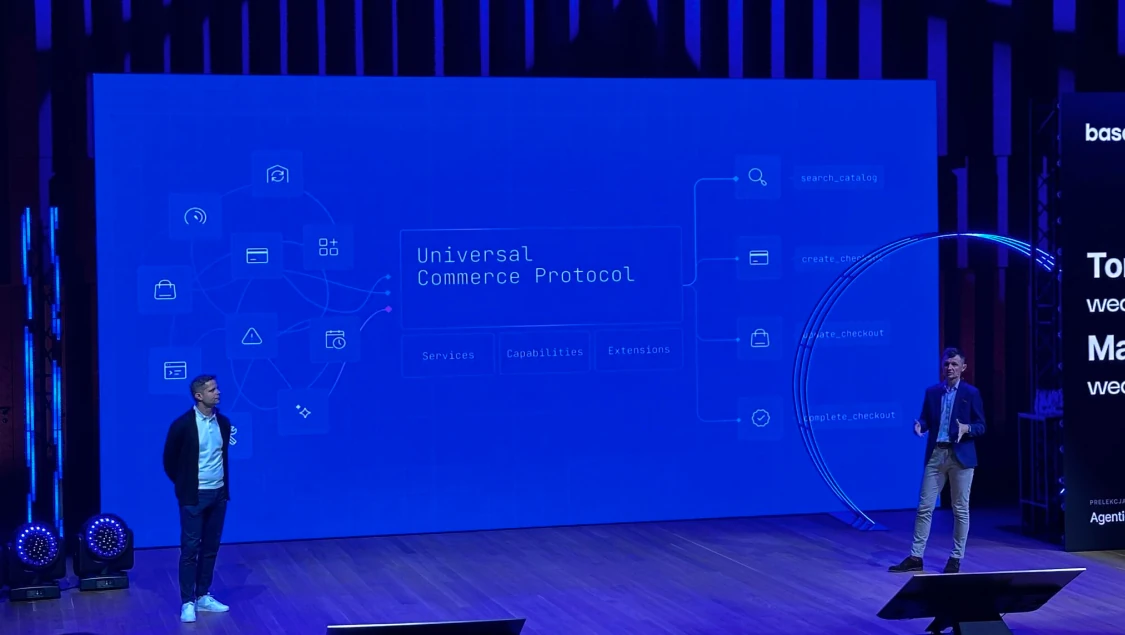
After my recent keynote presentation on Agentic Commerce at the Base Expo, my conversations with founders and e-commerce directors were dominated by a single, urgent topic: AI shopping architecture.
Everyone intuitively understands the shift: AI agents (like Gemini or ChatGPT) are transitioning from answering questions to actively buying products on behalf of users. Early movers will win the digital shelf. But the technical anxiety is real: How do we actually implement this? Do we have to build custom integrations for every single LLM? Can AI handle our complex loyalty programs and unique shipping matrices?
The answer lies in the Universal Commerce Protocol (UCP), an open standard spearheaded by Shopify and Google. Here is the definitive guide to what UCP is, how it compares to early attempts like OpenAI's ACP, and what you need to do this quarter to make your store machine-transactable.
What is UCP? (Beyond the Technical Jargon)
To understand UCP, we have to look at the broken state of AI shopping. Historically, if an AI agent wanted to buy from your store, it had to navigate your specific, custom API. It was like trying to negotiate a complex contract in a language the AI barely understood.
UCP (Universal Commerce Protocol) is the new open standard for how AI agents discover products and execute transactions. It provides a shared, universal business language.
To visualize how the pieces fit together, think of the technology stack like this:
- Your Store's Backend: The database holding your products, inventory, and logic.
- The Cable (Transport Layer): How the AI connects to your store. This can be the new MCP (Model Context Protocol), but it doesn't have to be. UCP is transport-agnostic. It can run over MCP, traditional REST APIs, or specialized A2A (Agent-to-Agent) connections.
- The Language (UCP): The standardized "business dialect" spoken through that cable.
Because UCP standardizes the data shape (Catalog, Cart, Orders, Identity), an AI agent doesn't need to learn how your specific API handles a cart structure. It reads your store in the universal UCP format, and the protocol seamlessly translates that intent into the necessary API executions under the hood.
Crucially, UCP is not just a static product XML feed. It is a dynamic transactional layer capable of handling the edge cases that enterprise merchants care about: sophisticated loyalty programs, recurring subscriptions, dynamic discounts, and complex, multi-tiered shipping rules.
UCP vs. ACP: The Protocol Wars
If you've been following the space, you might be asking: "Wait, didn't OpenAI and Stripe just release the Agentic Commerce Protocol (ACP)?"
Yes. ACP was a pioneering move by OpenAI and Stripe to bring transactional checkouts (and shared payment tokens) directly into ChatGPT. However, it was inherently tied to specific ecosystems (OpenAI as the LLM, Stripe as the primary PSP).
UCP is the broader, platform-agnostic evolution of this concept. Backed by Shopify and Google, UCP is designed to be the universal standard for all commerce platforms, all payment gateways, and all LLMs. While ACP proved the model worked, UCP is the infrastructure built for the entire internet to use, preventing the e-commerce landscape from fragmenting into siloed "ChatGPT stores" vs. "Gemini stores."
Shopify vs. The Rest of the World: The Architectural Divide
The most significant takeaway for enterprise merchants is the emerging divide in implementation effort.
The Shopify Advantage: "Agentic Ready by Default"
If your brand runs on Shopify or Shopify Plus, you can relax. From an architectural standpoint, preparing for UCP requires almost zero engineering effort.
Shopify stores have this infrastructure enabled natively. You do not need to publish a custom UCP manifest or manually translate your backend data into a format that agents understand. The Shopify Catalog is automatically exposed to UCP standards. Your architecture—whether you use a traditional Liquid storefront or a headless build—is entirely irrelevant here. The data layer is decoupled and agent-ready by default.
The Challenge for Legacy Platforms
If your brand relies on Magento (Adobe Commerce), Salesforce Commerce Cloud, or a custom legacy build, the reality is starker. You are not natively connected to the agentic ecosystem. To participate, your development teams must manually implement the standard based on the open-source UCP specifications, mapping your complex data to the new global standard. In a landscape where early movers capture the first wave of AI-driven revenue, this delay is a significant strategic risk.
The WeCanFly Playbook: 3 Steps to Optimize for AI Shoppers
Technical readiness is only step one. Being technically accessible to an AI does not guarantee the AI will choose to recommend or buy your product. You must optimize for the machine.
If we were sitting down with your executive team today, here is the exact 90-day playbook we would deploy to capture agentic market share:
1. Control the AI Narrative
Turn on the Shopify Knowledge Base feature. AI agents don't just look at product titles; they synthesize your store's policies, brand history, and support documentation to answer user queries (e.g., "Which sofa brand has the best return policy for heavy items?"). By explicitly feeding your structured knowledge base into the ecosystem, you dictate the brand narrative the AI uses.
2. Replace Marketing Fluff with Hard Data
AI agents do not care about your marketing adjectives. They cannot parse "highest quality fabric" or "luxurious feel." They buy based on parameters, structured data, and measurable facts.
We see this constantly in the furniture industry. To win an AI recommendation, you must strip out the fluff and inject hard metrics into your product mapping. Don't write "durable." Write: "Endurance: 100,000 Martindale rub test cycles." Provide exact dimensions, specific material compositions, and sustainability certifications. Data density is the new SEO.
3. The "Agentic Plan" for Non-Shopify Brands
If your brand is stuck on a legacy platform but you need immediate access to agentic distribution channels, do not attempt a full-scale replatforming project right away. Instead, utilize the Shopify Agentic Plan.
You can integrate your existing PIM (Product Information Management) or ERP system directly into the Shopify ecosystem, matching your data to the Shopify Catalog format. This creates a headless "agentic storefront" that speaks fluent UCP, instantly bypassing the limitations of your legacy backend.
UCP vs. Traditional E-commerce (Executive Summary)
For a quick reference on how UCP shifts the paradigm, see the table below:
| Feature / Dynamic | Traditional E-commerce | Agentic Commerce (via UCP) |
|---|---|---|
| Discovery | User searches Google, clicks links, navigates menus. | AI agent queries the UCP Catalog Capability instantly. |
| Data Format | Visual frontend (HTML/CSS), optimized for human eyes. | Structured JSON via UCP, optimized for machine parsing. |
| Integration Effort | Custom API connections required for every external marketplace. | One open standard (UCP) unlocks all compliant LLMs globally. |
| Optimization Focus | Keyword density, page load speed, visual UX. | Data density, explicit parameters, standardized operational policies. |
FAQ: Navigating the UCP Transition
Is UCP only for Shopify stores?
No. UCP is an open standard co-created by Shopify and Google. However, Shopify has natively built it into their ecosystem, making Shopify merchants "agent-ready" automatically, while other platforms require manual integration.
Does UCP require MCP to work?
No. While they work exceptionally well together, UCP is transport-agnostic. It serves as the business language and can run over MCP, traditional REST APIs, Embedded protocols, or Agent-to-Agent (A2A) connections.
How does UCP affect my current SEO?
Traditional SEO focuses on ranking in Google Search. UCP is about GEO (Generative Engine Optimization)—ensuring your products are formatted so AI models actively recommend them in direct answers. The two strategies run parallel, but GEO requires much stricter, parameter-based data structuring.
Want to ensure your enterprise brand is the first recommendation an AI agent makes? Speak to the Agentic Commerce engineering team at WeCanFly.
Prefer listening? We cover this in our podcast episode Agentic Commerce – 15x more orders from AI channels!.