
Grzegorz Tukaj: process automation in e-commerce – processes, marketing automation and measuring results
How to optimize processes in an online store?
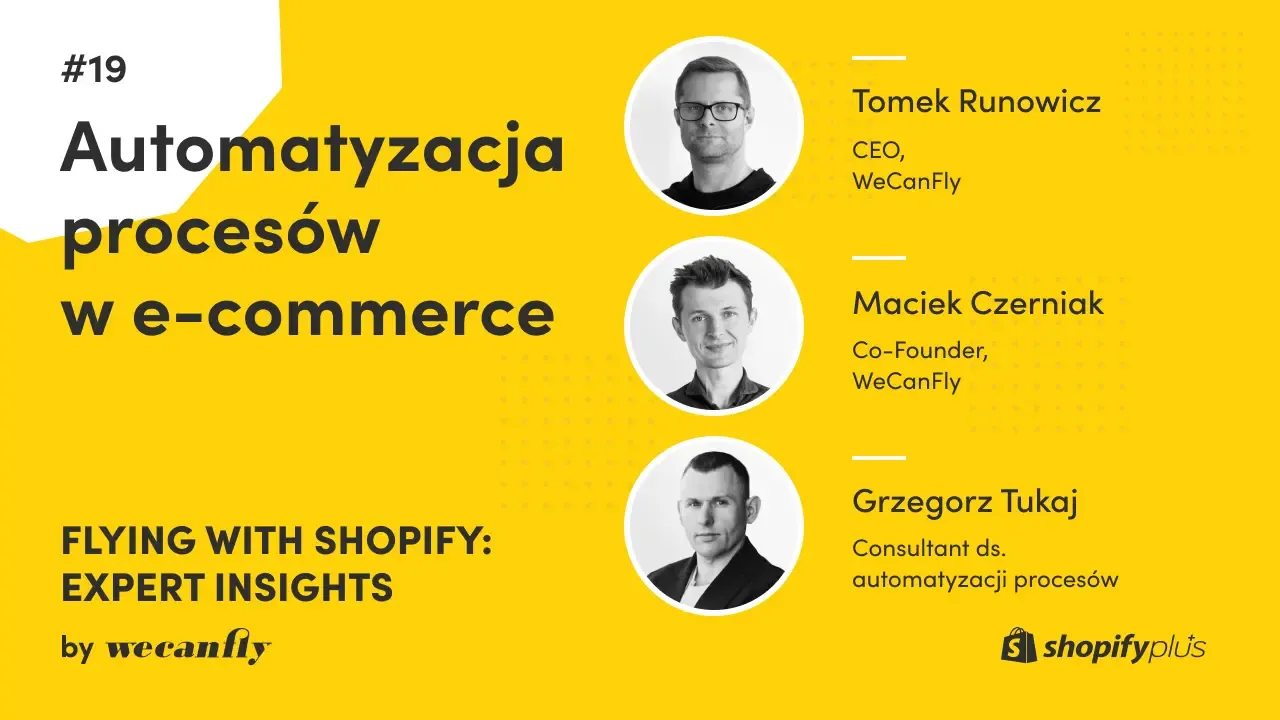
Episode in Polish, English subtitles available. Below: an edited English translation of the full conversation.
Grzegorz Tukaj, a consultant who has spent more than 10 years automating marketing and sales, mostly in e-commerce, talks with Tomek Runowicz and Maciek Czerniak about where to start automating a store: with documented processes, not with buying a tool. He explains why companies use only about 50% of their marketing automation tools, when recovering abandoned carts doesn't pay off, how to measure revenue and time saved, and why stores forget to communicate about refunds. It's for e-commerce owners and managers who want automation to actually save time and money.
Key takeaways
- You can't automate what doesn't exist: first a stable process, mapped out step by step and kept in one place (the tool, such as Miro or Lucid, matters less). Overlapping processes cause errors, such as a package leaving the warehouse even though the payment never went through. According to Grzegorz, many managers keep their processes in a notebook or in their heads, while reality looks different. Automation doesn't depend on scale: Grzegorz cites Amica, whose high-bay warehouse is run by two people, but a store with its warehouse in a garage can have a process too. (2:03, 3:45, 10:13)
- A tool alone won't solve the problem. Recommendations only work with a well-filled product feed (gender, color, size, price, brand), off-the-shelf platform plugins don't cover a store's specifics, and someone has to prepare 15 personalized emails for 15 segments of a 100,000–150,000-contact list, banners included. One person is rarely a designer, copywriter and developer at once, so marketing automation tools end up used at about 50%. (14:16, 17:42)
- Abandoned-cart flows need an email list. In a niche with a small list (with 10,000 contacts you're talking about single carts), investing in cart recovery doesn't pay off; it's better to predict the next purchase from order history and build a community. Grzegorz's example: a store with products for children sent new mothers a weekly Monday guide instead of a product list and got open rates of 60–70%. (18:27, 20:23, 34:38)
- Agree on the source of truth before you implement anything: Analytics, the CRM or the sales department, not the tools' own reports. Grzegorz has seen a performance agency and a marketing automation agency each claim 300,000 zlotys while the CRM showed 500,000. Measure the time between the first and second (and later) purchases against a control group, average order value, on-site conversion and working time saved. Discounts can depend on purchase history, for example a bigger discount for a customer who has spent 1,000 zlotys when the average order is 300–400. (26:48, 28:21, 32:11, 32:25)
- AI needs input data and won't replace thinking about your own business. In 2023 Grzegorz used ChatGPT for descriptions and dimensions in the product feed and for first conclusions from data, but a person verified every result. For graphics, one template in Figma or Canva produces 15–20 creative sizes in no time. (21:02, 28:53)
- Smaller teams with well-designed processes will be worth more: five people in marketing can do the work of 15. Marketing automation should go two ways, saving work and building relationships, because "buy, buy, buy" newsletters lose their audience's attention. (34:38, 38:13, 40:40)
- Stores have nailed return logistics (InPost, the Zalando experience), but forget to communicate about refunds: when, how and under what procedure. Few ask customers who don't come back why (with an NPS survey, for example); according to Grzegorz, the most common reason is a description that doesn't match the product. (40:53)
- The biggest obstacle in implementations is a lack of resources and delivering the automation backlog. Teams are more afraid of control (logging working time, for example) than of being replaced. Processes should be written by the specialists who do the work, or at most one level up, not by the CEO. (45:35, 50:00)
- Grzegorz's order: first the goal and the segment (how often customers buy), then the processes, and only then a tool that fits the needs, such as Klaviyo or HubSpot for marketing automation. Everything is tied together by an ERP (mostly in larger companies) or by no-code integrators like Zapier or Make, with a single data source in Airtable or Google Sheets. After launch, keep measuring and optimizing, because processes change with the seasons. (55:17, 57:42, 58:21, 62:36) 2026 update (Maciek): things have changed over the years. Today our team, working with AI inside our processes and with a person reviewing every change, quickly builds even complex custom solutions for a store, such as server-side tracking or loyalty programs, so you don't need to buy a separate app for every need.
The set of more than 100 automations Grzegorz mentions at the end of the conversation (Marketing Automation Builder in Notion, in Polish) is available here.
Guest
Grzegorz Tukaj is a consultant who helps companies design and automate their processes, especially in marketing and sales. At the time of recording he had more than 10 years of experience in marketing automation, mostly in e-commerce, and had worked with companies in many industries, from B2C to B2B, including manufacturers, which, he says, is where he picked up process thinking. He was also implementing AI in his clients' processes.
Hosts
Tomek Runowicz and Maciek Czerniak run wecanfly, a Shopify Premier Partner agency that helps established brands with complex migrations to Shopify Plus. Today we work with AI agents built into processes and guardrails that come from what we've learned across many projects, and an experienced member of our team signs off every change. See how on our Agentic Commerce for Shopify page. We build the marketing and retention automations Grzegorz talks about as part of our Klaviyo for Shopify services, and connect stores with the rest of the business through Shopify ERP integrations.
We also talk about retention in Jędrzej Przeździęk, OpenGift: How to build retention in e-commerce?. You can hear how we talked about AI in online stores in 2023 in AI in e-commerce, and how AI is changing shopping today in Agentic commerce: 15x more orders from AI channels and Marcin Kamiński: e-commerce in the age of AI.
Transcript
This transcript is based on the recording of this episode. We edited it for readability: we corrected transcription errors, punctuation, and merged sentences that were cut off mid-flow. We did not change the content, order, or meaning of anything said. Any errors or inaccuracies are our responsibility alone — not our guests'. If you spot something that needs correcting, email us.
Episode published on November 28, 2023; the AI and automation tools discussed reflect what was available at the time.
Who is Grzegorz Tukaj?
Tomek: Hi! Welcome to another episode of Flying with Shopify. We think today's topic will interest every online store owner and e-commerce manager, because we're going to talk about how to automate the processes in your stores and, as a result, how to save time and money. Our guest is Grzegorz Tukaj, who has been doing this professionally for more than 10 years. Enjoy the episode. Hi, Grzegorz.
Grzegorz: Hi.
Tomek: It's great to meet you in person, here in the studio, and I'm glad you found the time to come in. Before we get into the topic, could you introduce yourself, tell us what you do day to day and what your background is?
Grzegorz: My name is Grzegorz Tukaj. I help companies design and automate their processes, especially in marketing and sales. I have more than 10 years of experience in marketing automation, its best-known area, especially in e-commerce. These days I also help a lot of companies with other sales and marketing processes, meaning setting up their processes as a whole.
What is process automation?
Tomek: Great. Today we want to talk about how we should think about automation in the e-commerce businesses we run. Because let's be honest, process automation often means big savings in time and money.
Grzegorz: That's true.
Tomek: And that's what this business is about. Let's start, as we usually do on this show, with a definition.
Maciek: Tomek likes to start with definitions.
Tomek: I always like to start with definitions, but Maciek, we have an expert today, so I'll leave you alone. Grzegorz, how would you define process automation? And, as you mentioned, is it mainly about marketing, or could we also automate the other processes in the e-commerce ecosystem?
Grzegorz: The first part of the definition has to be that to automate anything, you need a process. That's often the problem: a lot of people want to automate, but they don't have a process. If you have any process you stick to and that's stable, then you can talk about automating it. E-commerce is a special field, because most of what has to do with selling is already automated. You have the process of adding a product to the cart and going through checkout. It's a linear process that the user, the customer, can of course abandon, but it's a process. So the first definition is process automation, and the processes have to exist. The second thing, the part you don't see, is automating human work. That's happening right now: using AI in everyday work. It's obviously a hot topic, we're all talking about the new versions of ChatGPT, but there are more and more tools to use. The strict definition here is increasing efficiency and cutting the time spent on specific tasks.
How to prepare and document processes before you automate
Maciek: About those processes, since, as you said, they should be the starting point for building automation: how do you go about it? What do we need to have in place before we can automate processes at all? How should they be documented, written down? How do you approach it?
Grzegorz: At the first stage, we have to think in terms of processes. Process thinking means taking a task you have, as a team or individually, and breaking it down into the components that will get you step by step to solving the problem. Then, of course, it's good to write those processes down so we know what's going on in the company, in the e-commerce business. In e-commerce specifically, there are a few categories: processes related to the warehouse, logistics, customer service, and purely marketing. In logistics automation, meaning the warehouse, there are different setups for different businesses. There are big e-commerce businesses. One pioneer in automation is Amica Polska, which has a warehouse run by just two people; everything else is automated. It's a high-bay warehouse, a really big hall. But there are also stores whose warehouse is in a garage, or that use dropshipping. You can implement automation and processes in both cases, because it doesn't depend on size. Of course, the processes differ in complexity. If your warehouse is in a garage, it's enough to have your shelves organized properly, and depending on the system you choose, that's how your garage logistics will be organized. With dropshipping or other fulfillment, you depend somewhat on external partners, but it's still a process the company has. It works the same way for everything else. You need a task, some state you want to get to, and then you design the process and map it out. It doesn't have to be pretty. There are techniques for designing processes, of course, but it's enough to have it in one place. That's important, having it in one place, because processes often overlap and then there are conflicts. That's usually when errors show up. Take the payment process: someone didn't pay because something went wrong, but the information already went to the warehouse and the package was shipped, even though nothing was paid. Those are cases where processes collide, and you need to have them under control.
Maciek: And I take it automation lets us catch those edge cases?
Grzegorz: Yes. Logistics and what I'd call the back end of e-commerce are heavily automated. A lot of the tools e-commerce businesses use, whether it's a PIM or tools that pull data from different platforms or marketplaces into one place, already have automation built in, so part of the work has been done. What's often left are the company's internal processes. And those definitely need to be worked through.
Maciek: And I assume those processes don't have to be linear; they can include branches.
Grzegorz: Yes, of course: different scenarios and different dependencies. What's interesting and nice about processes and designing them is that they bring stability and a sense of security. We all like to have things organized and don't like working in chaos. That often applies to employees too. If we asked e-commerce employees, say in the warehouse, what they dislike, it would be exactly that chaos. Shipping out packages is a process, and it has to be well organized. I'm not passing judgment on working at Amazon, but Amazon can be an example of process thinking. I don't want to judge whether the instructions for moving from one workstation to another should allow 30 seconds or whatever, because that may be too much. But in terms of process thinking, the way Amazon designs its processes is, I'd say, a very high level.
Maciek: I think at Amazon, with every step calculated like that, the idea is probably that these processes help the company scale a lot. When a new employee comes in, they can learn the process and find out how to do their specific tasks without bringing chaos into the organization.
Grzegorz: Yes. That's very interesting, and it also ties into what I said about the back end of e-commerce: Amazon operates all over the world and has the same work instructions everywhere. I'd say the same about McDonald's and the story of its success. It's just repeated processes: how do you get the same burger and the same taste in Poland, in the Czech Republic or in the States? And as you said, scalability is very, very important, especially with employee turnover in the market. It depends on the industry, of course, but there is turnover, and to keep the same quality, we should be working on our processes.
Where to document processes
Maciek: I wanted to ask about practical tools for documenting processes. I assume companies don't document this in a notebook, but in something like Miro or whatever you call it. Are these usually some kind of visual diagrams?
Grzegorz: Yes. You may be surprised, but a lot of managers keep it on sheets of paper in a notebook, and that's a problem. Sometimes I meet with management boards or e-commerce CEOs and they show me: "Okay, this is how it should work." Of course, that drifts away from reality, because processes are often created in the owners' heads, how things should look, and in reality it's something else entirely. There are many tools, like Miro or Lucid, that help with automation or with designing processes in general. Some already use AI, some don't, but the tool usually doesn't matter at all. What matters is that the company knows about the processes, meaning every employee knows where to find a process and check whether things really work that way. I've worked with manufacturing companies, and that's where process thinking was instilled in me, because in manufacturing there has to be a technological process, and quality control is based on checking that process: was it actually done according to it or not. That should be in place in every company.
Marketing automation: a tool alone won't solve the problem
Maciek: Okay, so we know processes are the foundation. You mentioned the different areas we can automate. When people hear about automation, the first obvious association is marketing automation. You tell me, this area was probably the first to start automating processes, right?
Grzegorz: Marketing automation is the best-known form of automation, and abandoned carts in e-commerce are the key that opens everything. As I mentioned at the start, I have more than 10 years of experience in marketing automation, and I think I've worked with every kind of tool, including Polish ones, which really aren't any worse than the foreign ones. I'd also like to stress that there are a lot of tools, they're different, and they suit different e-commerce businesses.
Maciek: Mm-hmm.
Grzegorz: First, a few words about tools in general, because it's important for listeners and viewers to know that every e-commerce business is different and has different customers. If you run an FMCG store where people buy often within a month, marketing automation will rely mainly on good knowledge of the customer: what they like to buy and when. That matters. On the other hand, there's electronics or, say, triathlon bikes, which you don't buy every month or even every year; it's a longer horizon. There, the breadth of your assortment or knowing when a customer might be looking matters. Marketing automation will focus more on recommendations, because in electronics the margin isn't on the main product, it's on everything around it, on cross-selling all the other cables.
Tomek: Or even on logistics.
Grzegorz: Or on logistics. That's the main thing. Most of the tools available offer most of the features an e-commerce business should have: recommendation widgets, personalized messages and, for abandoned carts, building the whole workflow. As I said, most tools provide that. The problem comes later, in running them.
Tomek: Right, sorry to interrupt, but when I hear about tools, I immediately think of every store owner's dream: "I'll install and configure a tool, and from then on I'm automated. Everything works, and I can just sit back and watch the results." And practice shows something completely different.
Grzegorz: Yes. The tool alone won't solve the problem, because, as I said, most tools have the features. The problem starts with adapting to them. Take recommendation widgets. For recommendations to work, even when AI optimizes them, you need input data, meaning information in the product feed that a product is for women or for men, has a particular main color, a particular size, is on special or is directly tied to a brand. That means the product feed has to be well filled in, and someone has to spend time filling it in. That's also a cost of marketing automation, because someone has to put in the time. The second interesting case is segmentation and sending personalized messages. Personalization like: someone bought something and we can match products (here we're back to the feed), add their first and last name or an attribute used in the purchase. On the one hand, that data has to be sent to the tool, so the integration with the tool has to be practically complete. Tools often have plugins for individual platforms, for PrestaShop, WooCommerce or Magento. But those aren't complete integrations, because every e-commerce business has its own specifics, and the integrations are built around what's generic and don't cover those specifics. So again we're back to investing in IT to integrate and connect it properly. The next element is personalized attributes. Let's say we want to send messages to 15 segments. We have a store with a database of about 100,000–150,000 users with consent, which also matters, and we want to send 15 personalized emails to 15 segments. Someone has to prepare those emails. Even if we optimize sending with dynamic blocks or product recommendations, the graphic banners, say for a segment for eco products or for dairy in FMCG, also have to be tailored. Someone has to make them. That's more work inside the organization devoted to automation. And you could go on listing things like this pretty much forever. When choosing a tool, few people consider the extra work required during implementation and later when running it. It's also worth stressing the role of running it. Most e-commerce businesses don't have a dedicated marketing automation specialist, because that would only pay off as a full-time job. And it's not a self-sufficient person, because it's very rare, almost impossible, for someone to be able to do design and be a good copywriter…
Tomek: And code a bit on the side.
Grzegorz: And code and send it all out. That's unlikely to happen, so they need all those people around them. Companies often outsource it to agencies. Agency costs are rising too, that's the market. So that's another problem of additional costs. In the end, these tools are used at 50%. They could be used better, but the organization's people resources aren't enough for that.
Tomek: So really, like with everything, there's no shortcut. You have to approach it seriously, concretely.
Grzegorz: Comprehensively.
Tomek: Comprehensively, across many areas, exactly.
Abandoned carts and predicting purchases
Grzegorz: Yes. As I said at the beginning, processes have to come first. For me, automating marketing is something a bit different from marketing automation. Automating marketing is designing the process around content creation. Marketing automation works when you have a database, and the abandoned cart we're all after is the crux. There are really two paths. The first, the classic one: we email a user who abandoned their cart. But first we need that user's email. Most e-commerce businesses take a bit of a shortcut and give a discount on the first purchase or on later ones. That cuts into the margin. Sometimes it pays off, but it's discounting and building the database. If, however, you're in a niche, even if you earn well and have a high margin on the product, say you sell triathlon bikes or things from a very narrow field, sports or lifestyle, you won't build a large database quickly. Then investing in marketing automation tools to recover abandoned carts isn't a good idea, because the database will simply be small. Of course, you can also communicate on-site. But if someone abandons a cart, they usually do it quickly, and there are very few tools that can predict that someone is moving their mouse away and clearly not heading for the cart but thinking of leaving. There aren't many tools like that.
Maciek: But we can make predictions, maybe not based on real-time behavior on the site, but based on historical behavior. If we know someone has bought at a certain frequency, we can predict when they'll buy next.
Grzegorz: Yes, that's a very good example. Again, I'll come back to the additional costs. All these tools can do that, and we can do it, but someone has to analyze it and spend time on data analysis.
Will AI replace data analysis?
Maciek: And artificial intelligence won't help us with that?
Grzegorz: But to have artificial intelligence, you need input data. Everything comes down to good integration. Either you want to use AI and full-featured tools for prediction, or someone just has to sit down and analyze it. In the same way, Google Analytics on its own doesn't give you value in the form of "something is wrong in your store"; you need a specialist who sits down, analyzes the data and finds the patterns. Every e-commerce business is also different. E-commerce segments vary a lot. I've worked with practically every industry, from B2C to B2B, and I've learned that behavior varies a lot. In electronics, practically every purchase ends with checking the product on Ceneo [a Polish price comparison site]. You can have the cheapest product, and the customer will still want to check on Ceneo and will just leave the store. Maybe they'll come back in a moment, or come back through Ceneo; it doesn't matter. In FMCG, customers have habits, for example when buying organic products, and repeat purchases happen on, say, Mondays or Tuesdays. Their habit is to add products over the weekend, because someone remembers something has run out, and to check out on Monday or Tuesday. That's a completely different behavior. It's similar in B2B: if you want to buy milk and other things for the office, you open a cart and collect the items so the purchase is as sensible as possible. And then there's an abandoned cart when we leave, or when the customer orders. Artificial intelligence doesn't necessarily know our segment. I implement AI in my clients' processes, but right now AI tools have too little data about the businesses themselves, about business information. AI or ChatGPT can help us generate content faster or support us in data analysis, but it won't replace our core and our thinking about our business. Not all markets are equal. The American market is completely different from the European one, let alone the Polish one. So those are the differences.
Maciek: A small digression, going back to what AI can do. Yesterday I watched a TEDx talk by the CEO of Duolingo. He said they spent millions of dollars figuring out when to send people notifications reminding them about lessons. And it turns out that if you had time for a lesson at 7 p.m. yesterday, you'll probably have time at the same hour the next day.
Grzegorz: Yes, because entertainment is another segment of e-commerce. The competition there is TV channels and other kinds of entertainment. Someone has an hour or two a day to spend on it, and the fight is over who gets their attention first. You don't win there with the lowest price, but by convincing someone that your content is more valuable. That's a completely different game. The same goes for services in e-commerce, because that's also a part of e-commerce that's growing very fast: Duolingo, or platforms for booking specific repairs. These are e-commerce businesses that don't compete directly on price but on the service. Sometimes the service is paid, of course, like labs or anything else, but the behavior is different. Marketing automation looks a bit different, and automation relies on different things, more behavioral, more on emotions. In classic e-commerce, we know price plays quite a big role, especially now with inflation. Showing that the price is attractive matters, whereas in service e-commerce it's more about emotions.
How to measure whether automation pays off
Tomek: We've said that automation and processes show up in different areas of running a business. Not just marketing, but also day-to-day management: as you said, logistics, distribution, adding products. In each of these areas, processes should first be written down, and then we should automate them, or at least analyze where automation would be needed. But what also comes through in what you say is that automation means real costs. Costs directly related to the tools, but also the cost of the people working on it. The question I naturally ask myself is: how do I assess whether the automations I bring into my store actually pay off for me? I'll put a whole team of people and several tools to work so that my work is more convenient and the store earns more. How do I measure whether I did it right and whether it really brought the benefit I expected?
Grzegorz: You put it well. The key word is "measure." If we haven't measured how much time we spend on specific things, if we don't have processes and an analysis of how much time a given specialist or employee spends creating content, preparing an email or handling customer service, we won't be able to properly answer the question of what marketing automation will give us. The key word is measuring and turning it into a process. In marketing automation, the basic dimensions are the natural ones. Most messages are emails, so the main metrics are email metrics: open rate, CTR and last-click revenue. A small digression, and maybe also a message for marketing automation tools, because this is hilarious: most marketing automation tools have their own analytics and present it as something great. I agree that this data may be more precise from the tool's point of view. But at the end of the day, the e-commerce manager or director is held accountable for the numbers in Analytics, in their sales department or in the CRM. At the end of the day, that's the source of truth. I often see an agency that ran performance marketing come in and say they made 300,000 from the campaign.
Tomek: And show a report from…
Grzegorz: From Analytics. And then the agency running marketing automation says: "I made 300,000 too," while the CRM and the bank account show we made 500. And then: okay, so who really made that money? Because the channels overlap. Someone who saw the email didn't necessarily click, because sometimes the message is that something's on sale and I'll just buy later. And someone saw the email and clicked on an ad.
Tomek: That's a question of the attribution model.
Grzegorz: Yes. That's the purely financial dimension, because tools show their case studies and their revenue. That brings us back to your question of how to measure revenue. That single source of truth should be defined earlier, before implementing marketing automation. The second issue is optimizing working time. As I said, marketing automation takes up a lot of time. That comes precisely from the lack of processes, because we can set it up so it doesn't. Here we're already talking about automating marketing, meaning how teams are structured: entire newsletters can be built, for example, from dynamic blocks based on product feeds or on Excel. You just enter the content in Excel, and it automatically moves into the tool, into the right fields. When it comes to creating graphics, you also know well that in Figma or Canva, for example, you can set up automation: one template with different graphic sizes. For one campaign, you can generate 15–20 sizes from one graphic in no time. That's classic marketing automation, where we optimize the cost of an employee's work. With the product feed, as I said, you first have to define what's key, what customers want, what they pay attention to. Often it's dimensions, and that's also a kind of automation, because dimensions are given in different ways, and they're a differentiator. You need to spend time thinking about how to describe dimensions well in the product feed. Once you've done that as a process, then for product descriptions or dimensions, if the products aren't new to the market, ChatGPT, which I've tested with several clients, does a very good job. It takes an average and can prepare a description or tell you whether given sizes fit. That already helps us get things done. With data analysis, we can directly calculate the cost of working time. You said it would be great to set up automation for customers who viewed a product and a related product, because it's about prediction and the time spent on analysis. If we know which data we want to analyze, ChatGPT or other tools can help us aggregate it and draft the first conclusions based on prompts, but then we have to verify them. Because we're not yet at a stage with AI where we can trust it 100%.
Tomek: So there are two components. The first: how much store revenue increased after introducing the automation. The second: how much time we saved in running the store day to day.
Grzegorz: Yes. Let me be more specific about revenue, because that's a very general term. As I mentioned, there's revenue purely from the database. We calculate the time between a customer's first and second purchase, because that matters for our database, then between the second and the third. The shorter that time, the better. You need to compare against a control group: what the time between the first and second purchase was before implementing marketing automation tools, without messaging, and what it was afterward, with messaging. Cart value, because often the number of orders doesn't grow, but the value of the whole order can. And conversion, when you improve on-site messaging. There are lots of examples of discount policies based on purchase history. There are tools like Voucherify that connect to your CDP or CRM and check whether a customer has, say, spent 1,000 zlotys, while the average purchase is 300–400 zlotys. Then you can give them a slightly bigger discount, because they're already a premium customer, and you don't necessarily lose margin on the purchases themselves. Those are the components of revenue, and that's key.
Is automation only for big companies?
Tomek: Listen, now a question, because at the start we gave some examples. You mentioned Amica and Amazon, and it's probably no coincidence that we're talking about big companies, because their automation really has gone very far and underpins their whole business. If we asked whether every e-commerce business is suited to automating processes: is there a group of e-commerce owners and managers who should say, "We're too small" or "This isn't for us"? Who is automation for?
Grzegorz: I think the trend now will be that smaller teams that can do more will be more valuable. So you have a five-person e-commerce marketing team, a kind of special unit that's well organized around processes, well automated, and can do as much as 15 people. That comes from demographics, because various sectors are short of workers, and from the costs of doing business. The truth is that there are a lot of e-commerce stores and marketplaces that drain margins, and prices are being squeezed, so someone has to cut costs. Optimizing work in smaller companies is an advantage. If you have a medium-sized or small store, even a one-person business, and you organize it well around processes and build good automation, you'll be able to generate really big revenue. Of course, if you want to grow, that's also a process. Amica needed huge investment to build a large automated warehouse. A medium-sized store can't really afford that. Although I think that in the near future fulfillment companies will move into this, a lot of them will appear, and optimizing warehouse work will be their advantage. That's a trend. Regardless of the size of the business, it's worth implementing automation. Marketing automation is a bit of a separate matter, because there you have to focus mainly on the database. I mentioned automating a niche, and I think the market trend is also that there will be niches where we focus on the customer and on value, because we know a lot about something. If I'm a triathlete, I know the sport, maybe not brilliantly, but to some extent. The same goes for boxing or B2B, some specific field. In those niches there won't be a huge number of customers and the database won't grow much, but it will be a specific one, and keeping that community will matter. So even for smaller clients marketing automation will matter, just in a different way. Not in the sense of building abandoned-cart flows, for example, because with a database of 10,000 those are practically single carts. Unless we're talking about FMCG, but generally you can say those are isolated cases. It's about building a community and giving customers value. I remember once running a store with products for children. In the newsletters sent out every Monday, what mattered wasn't adding products, but information for mothers who had just given birth: how to cope in a given week, how the baby should be developing, growing and what it should be doing. That information was eaten up, and open rates were 60–70%.
Maciek: Great.
Grzegorz: You can also see it in community newsletters: paid newsletters like Bartek Pucek's have open rates of 80–90%, because readers get value. To give that value, you have to put in time and, above all, have the knowledge. But it's a way to build relationships with customers, and I think marketing automation and automation in general have to go, as I said, in two directions. On the one hand, optimizing the cost of work, meaning productivity; on the other, building a community instead of sending purely informational templates.
Newsletters, returns and customer service
Maciek: I completely agree with you. I think building a brand on the one hand and giving customers value on the other is the only sensible long-term strategy. Up to a point, performance marketing works like this: the more money you put in, the more it brings in, but at some point it flattens out and you're just burning budget. That's not a way to grow steadily. But adding value, tying customers to you through content, or building a community, maybe around shared values, what matters to me, to our brand and to our customers, I think that has a future.
Grzegorz: Usually B2B learns from B2C, for example in digitalization, because retail has gone very digital and B2B is catching up a bit. But in communication, I think it should be the other way around. In B2B we know how to do prospecting, how to give value, how to write to customers, and that should carry over to B2C to some extent. So writing more about solving problems and adding value. Of course B2C is also driven by emotions, and you have to strike a balance, because buying a new pair of trousers isn't always about a problem. Sometimes it is, but in most cases it's emotions, and showing the product the Instagram way matters. You just have to strike a balance.
Maciek: I think in the long run, newsletters that come once a week and keep telling the customer "buy, buy, buy, this is us, this is our product, buy" have no future.
Grzegorz: Yes. People have announced that email is dead a few times already. It's true that it's the basic channel, but there's a lot of it now, because the market is very big and e-commerce has grown, so we have banner blindness and it fades. It's still a source of revenue, of course, that's true too. But customers also look at the experience. I'd like to go back to something that maybe didn't come through, and it's very interesting in the context of e-commerce: everyone focuses on abandoned carts and forgets about customer service. That's one thing; the other is returns. That's something small e-commerce businesses in particular do very badly. The logistics side has been handled very well: we have InPost, fast returns, the Zalando experience has carried over to the market. But nobody remembers about refunds and the refund process, and that matters a lot to the customer and really shapes how they feel about the store. Especially for small brands or brands selling their own products, particularly shoes or clothing: the return has arrived, the terms say 14 days, but there's no communication at all about the return. We send beautiful newsletters, but we forget to tell people how and when we'll refund their money and what the procedure is. That's something e-commerce businesses completely forget. And in the end, if someone made a purchase once and then doesn't come back, that's partly our problem. It would be worth e-commerce businesses looking at it that way: if I've already convinced a customer to make one purchase, why aren't they coming back? Sometimes it's the offer, sometimes something else. Few businesses look into it and send so-called NPS surveys to get feedback from customers on what could be improved or what went wrong that they don't come back. Sometimes it's logistics outside the store's control: the courier lost the package or something happened. But in most cases it's a description that doesn't match the product, or something like that. There's no relationship between the customer and the store. The newsletters sent to customers are one-way: "here's an offer for you," but the other way, "what would you like to tell us?", isn't there. I think ChatGPT, after the latest changes and with the ability to build your own mini chats, will be a stand-in for that kind of correspondence. As a test, I set up customer service for one client where someone with questions by email gets answers as if in a chat. We're in the testing phase, so I can't talk about results yet, but it's something the customer interacts with. The customer service communication is designed so that if the customer decides to buy by email, they get a payment link. They don't need to go to the online store at all, just to the payment link, and they can fill in their details there. I think that's the direction automation should go.
The biggest challenges in implementation
Tomek: Grzegorz, share some more of your experience with us. You've implemented automation many times, in many different companies. What challenges and problems did you most often run into with your clients? On the one hand, they understood the need, and the whole team saw it. But, as we've said, implementing automation often means a lot of work up front and changing habits that have worked more or less well so far, but that we've got used to. What would you name as the biggest difficulty in these implementations? What did you, or e-commerce owners in their teams, struggle with most often?
Grzegorz: A lack of resources, broadly speaking. When we implement processes, they change over time. Something that works in a given sector for one client, based on my experience, won't necessarily work for another, because the product range is different, the customer is different, the specifics are different, and you have to analyze it: did the implementation make sense or not? The same goes for segmentation tests, sending newsletters, messaging, pop-ups, push notifications or text messages. That's the first thing. Second, once there's a backlog for developing these automations, the problem is delivering it, because it takes more time to prepare a send or to automate processes inside the company. Because, as I keep saying throughout this conversation, above all you also have to automate and structure the work around it. If I'm somewhat external, I can say things, and people may listen a bit, but it won't happen on its own. That work is on the managers or bosses, who have to roll it out in the organization. And that's a problem of understanding the process. Interestingly, it's a problem in marketing and sales, broadly speaking, because in manufacturing, for example, there's no discussion. Everyone knows it just has to be fine-tuned. Companies tend to pay specialists to improve a process. Should the cabinet stand five meters one way or the other? Because we'll save two minutes of walking, and two minutes times an eight-hour process adds up to one more product made. That's process thinking, which is missing in e-commerce, and in services people don't understand it. If you have friends or employees who work in manufacturing or in the military, I recommend talking to them, because the military is also one of the bigger organizations, structured around processes to the extreme, I'd say. Sometimes maybe too much, maybe not. But those are good habits. I started getting a bit interested in the military from the angle of procedures and information flow, I talked to people from that world, and it showed me how deeply process thinking is ingrained there. Because people with all kinds of backgrounds come in there too. There's no room for anyone to debate things.
Tomek: Or negotiate.
Grzegorz: Or negotiate that they have a certain personality or different procedures. Sometimes procedures are bad or out of step with the times, granted, but generally it's about optimizing the process.
Tomek: I think it would be good to hire people like that at Amazon.
Grzegorz: Yes, they are there, and I'll add…
Tomek: They fit in great.
Grzegorz: Today I listened to a podcast about how Amazon is built, and military people play a really big role there. The same at McDonald's. If you've noticed, the biggest companies are American and they're scalable. And military people play a really big role in them. […]
Are teams afraid of automation?
Tomek: Okay, listen…
Maciek: I have one more question about the last thread, Tomek, the one you raised. I'm wondering whether, in any of the teams where you did an implementation, you've seen a team afraid that automation would replace them and they'd lose their jobs. And they went and set fire to the server room where the automation tool was running.
Grzegorz: I don't think so. I have a lot of interesting takeaways more from CRM implementations, because I have experience there too, and sales departments tend to push back. Once someone threw a pen at me, saying he wasn't going to do it, period. Because he was used to driving out to meet a client and wasn't going to write up notes, because what he talks about…
Tomek: Is the relationship.
Grzegorz: …is the relationship, end of story. It's more that kind of fear. I haven't come across the fear that someone will replace me. It's more a change of process, and, as I said at the beginning, you have to measure it. So the fears are more about, for example, having to log working time. In services that's fairly well accepted, but in regular marketing teams at companies the fear is: "Aha, someone wants to control me." People don't consider that it's meant to help optimize the process. Someone spending an hour on Facebook can sometimes be good, because they're doing research, and it doesn't matter. It's only about optimizing the process. The fears are more about control, about creating unnecessary procedures and about not being involved in creating those procedures. Because, as I stress when working with clients, the CEO can't be the one who prepares the process. The specialist should do it. It doesn't work otherwise. At most, one level up. So if there's a CEO and middle managers, the processes describe what the CEO expects from the managers, not from the specialists, because at the bottom it may look completely different. The idea that a social media specialist just sits there writing posts, rather than watching what gets people excited, that they're out of touch, comes from the fact that their work isn't visible from the CEO's level. Those are the kinds of fears.
Tomek: So it's what you'd call fear of change.
Grzegorz: Yes, well put.
Trends: hyperautomation and personal AI assistants
Tomek: It's just change, and you have to prepare for it. Speaking of preparing: how do you see the upcoming trends in e-commerce marketing automation? Which direction do you think it should go, or will go? What are you seeing?
Grzegorz: All the market trends point to hyperautomation, meaning narrowing things down to matching products one to one. We'd like to predict things, make predictions. The challenge is getting the information. The automations being developed now will focus on getting as much information from us as possible. How many children we have, how old they are, how we get around, whether we work remotely, from home, because that partly defines our needs. If we work from home, we probably don't need more clothes, but coffee, water and other things take up a bigger share of the household budget. So it's collecting information, automating information collection, and, looking at AI, at Bing, at ChatGPT, more like creating personal assistants. I imagine that soon we'll have a personal assistant on our computer that learns along with us.
Tomek: Especially after that latest release.
Grzegorz: Yes. We'll buy a new computer, and it'll collect data on everything we do, recommend products based on that, give suggestions, and act more like an advisor.
Tomek: We could create an advisor that helps us run our e-commerce business.
Grzegorz: Yes.
Tomek: And learns from our data.
Grzegorz: I think absolutely. Regulatory problems are slowly appearing here, because with AI, even with writing texts, there's already the question of copyright and so on. There are discussions, the Polish government and the EU are looking into it, and individual countries are slowly introducing regulations. That's a problem. And there's the question of how far we can share our data. If you run a medium-sized store, you can rationalize it: the benefit of having ChatGPT analyze the data outweighs the risk of putting the data in. But in larger organizations, in corporations, that's a matter for the legal department, and it can be a blocker. The alternative is running an instance on your own servers.
How to start automating your store: a quick-start guide
Tomek: I'm also wondering whether…
Maciek: Maybe let's give a practical quick-start guide. I own an e-commerce business and want to start automating. I know the first thing I need to do is processes. What's the next step? Should I choose a tool? If so, which one would be good to start with?
Grzegorz: First you need to answer what the goal of the implementation is and what segment you're in. If you're in a segment where users buy often, once a week, every two weeks, twice a month, that's an e-commerce business with fairly high retention. There you have processes with lots of personalized messages and so on. So you need to set up the processes and think about how you'd handle it if you wanted to send, say, 100 newsletters or 100 messages a week. What would have to happen? It's asking questions beyond your actual scale, of course, because obviously nobody's going to send that many, but it's a thought exercise that lets you picture what could happen, what errors there could be and what you might need. If you want to implement good product personalization, how do you get as much information about the product into the feed as possible? What would have to happen? How many people would have to work on it? Is feeding in the data enough, or can you use ChatGPT or another AI plugin? Once you know that and you know what you want to achieve, only then do you look for a tool. Because there are a lot of tools.
Maciek: You just match them to specific needs.
Grzegorz: To specific needs and specific goals. Some tools specialize in retention and good segmentation and can handle a large number of attributes very quickly. For example, FMCG products: weight, size, expiry date. That's interesting, because there are, say, organic cosmetics, which have a shorter shelf life than regular ones. And what matters there is sales, and sorting the earliest batches in the warehouse, the ones that expire sooner. Because if we don't sell them, we'll throw them away. So those are automations too. The information in the product feed matters to us as a business. And then you choose the tool to fit your specifics.
One central tool: ERP or no-code integrators?
Maciek: Okay, but let's put it this way: we have one marketing automation tool, we choose Klaviyo, or HubSpot, say, or whatever someone needs. We have another tool that helps us manage the warehouse or automates the work of the team running the store: customer service, order fulfillment or returns. Is there one central tool that ties it all together? Or do we have to work in several different places and be a bit scattered? There are also tools that help integrate tools with each other, like Zapier.
Grzegorz: Yes, that's what I wanted to say: you can do it in two ways. The first is a classic ERP, a tool for managing the whole company. There are cheaper and more expensive ones, but I think that's for bigger companies, at least fairly well-organized ones, or for manufacturers that have a production department. There are also a lot of tools like Zapier or Make that help integrate tools. That's also part of process automation. So you choose one tool that integrates the others for you, and we now actually have no-code tools. You don't need developers, just a person who thinks in processes. In Zapier, a prompt is all it takes, and the automation you need pops up. Say you want the campaigns you're currently running to be in Airtable or Google Sheets. No problem.
Maciek: You don't even have to click it together, you just tell it, and it writes a chunk of code.
Grzegorz: Exactly. You type in a prompt and the automation pops up. There are even AI solutions for coding. Say you need to change seconds to milliseconds: no problem, JavaScript gets written and it's changed. So you don't need programming skills. You need the ability to think in processes, to organize it well, and one place where you have all the data, whether it's Airtable or Google Sheets, depending on your preference. Then you send that information on to the individual tools. We have the knowledge about the whole company, the whole operation, and the tools know as much as they need to communicate effectively with the customer.
Where to learn about automation
Maciek: If someone wanted to learn more about automation, how to start working with it, how to educate themselves, what would you recommend? What sources?
Grzegorz: First of all, YouTube, because there's a lot of material there. There are also a lot of companies that specialize in it. I don't have one single source on marketing automation tools. Some people have published books on marketing automation, and they're worth reading. But you have to approach it comprehensively and, I think, above all understand your own business: what you make money on, what you want. And then learn about specific solutions, preferably in specific segments, because marketing automation looks different in different segments, and a tool that works in one may not work in another. That's worth knowing. Many companies run workshops and offer advice on preparing and implementing it. It's worth meeting and talking to people in the industry.
Wrap-up: think in processes, measure and optimize
Tomek: To wrap up, after today's conversation, a way of thinking has clicked for me: let's start thinking in processes as store owners. Let's stop clicking everything by hand and thinking only we can do it best. It's better to build a process around it and think in terms of where we'd like to be and how much we want to scale, because that's how we can put process automation to work for us. Maciek, you asked how to approach it and what steps to take in order. The last thing I was missing is what we talked about earlier: let's measure our results and keep assessing how the automation is working and how to optimize it further. Because, as with many processes, introducing automation is probably just the first step, and optimization and continuous improvement are natural, and you need to prepare for that based on the results you get.
Grzegorz: Exactly. The first thing is implementation, without even worrying about whether the process makes deeper sense. It's better to implement it and check whether it works, or to structure the way it's worked so far, and then optimize it, because processes change over time: seasonality changes, products change. You often see with clients that their processes look completely different in summer and in winter, in fashion, for example. Measuring and optimizing the process is what matters.
Tomek: If someone wanted to get in touch with you, what's the best way to reach you?
Grzegorz: Find me on LinkedIn. I'll try to post regularly, but either way, you're welcome to connect with me on LinkedIn.
Tomek: Are you still taking on clients?
Grzegorz: Yes, I try to help clients as much as I can. I try to do consultations regularly. Sometimes it ends with just consultations, because I simply don't have the time to do the hands-on work. But mostly, yes, I try to help.
Tomek: Before the recording, we talked about how you've prepared a starter kit for our listeners, a guide with ready-made automations. Can you tell us what's in it?
Grzegorz: The tool has a list of more than 100 automations, mostly related to marketing automation. There's a description and the basic processes are laid out: how they should look, how they should be measured, what statistics and how to prepare them. It's all in Notion, which is a discovery of mine, because it's a tool that can bring together practically all your tools, from Miro to Google Sheets, and present them in a uniform way, in one place. I think if someone already has a marketing automation tool in place, they'll find automations there they can implement right away.
Tomek: We'll put a link to it in a comment, and also in the comments wherever we announce the video. All that's left is to thank you for a really interesting conversation and for finding the time, considering how involved you are in so many processes at so many organizations. Huge thanks for being here today.
Grzegorz: Great, thank you very much.
Tomek: Thanks, Grzegorz.
Grzegorz: Thanks.
Tomek: Thanks a lot. And thank you for watching and listening to another episode. As always, leave a comment and send us suggestions for topics we should cover in future episodes. Thanks so much for today. Take care!