

Joanna Kwiatkowska, Kubota: B2B sales, brand building and slides by the kilogram
B2B sales, brand building, and flip-flops by the kilogram
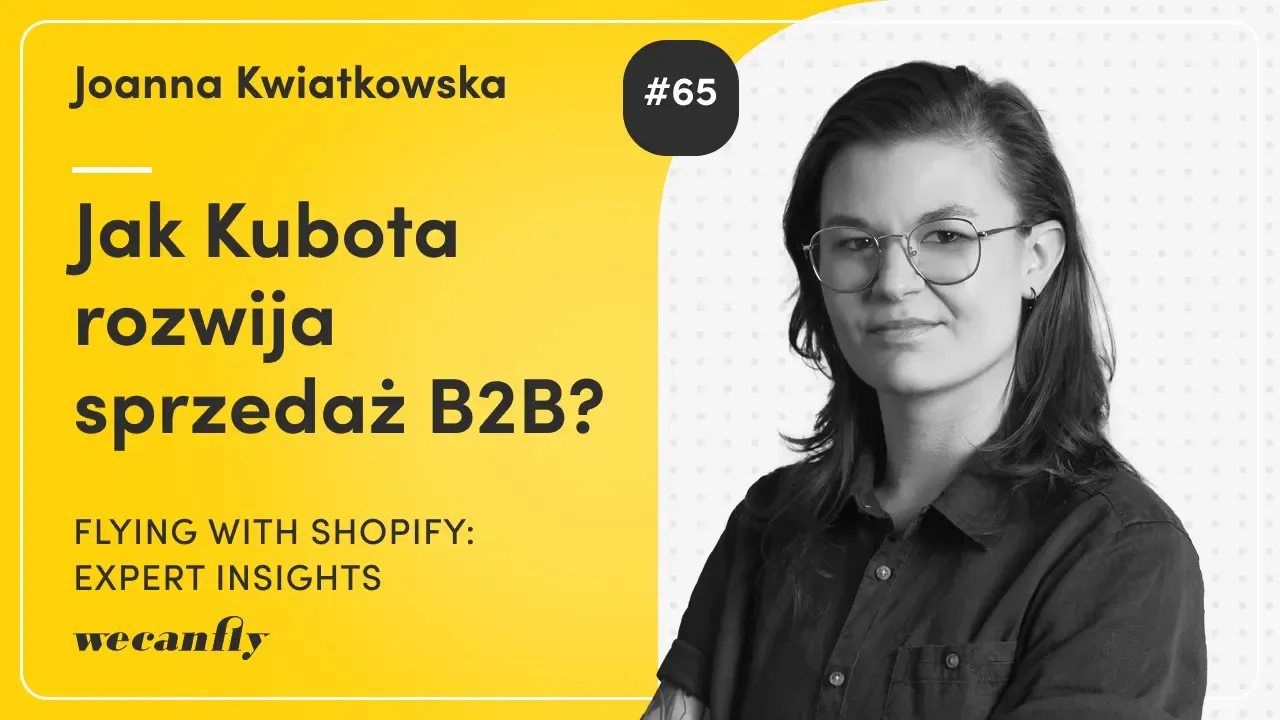
Episode in Polish, English subtitles available. Below: an edited English translation of the full conversation.
Joanna Kwiatkowska, vice president, co-founder and sales director of Kubota S.A., tells Tomek Runowicz and Maciek Czerniak how the Polish slide brand, revived in 2018, built a B2B channel that, according to Joanna, accounted for most of Kubota's sales at the time of recording. They talk about the first order from the Biedronka discount chain, three B2B segments (retail chains, wholesale and personalised products for companies), a B2B portal launched in two weeks, the decision to drop distributors in order to control prices on marketplaces, and how to prepare a company for orders measured in tons. The episode is for owners and sales directors of D2C brands thinking about entering B2B or putting their wholesale in order.
Key takeaways
- Kubota came back in 2018 with premium slides, 100% leather and made in Poland, for 200 zloty, and a year later launched its cult velcro model. Its first B2B customer, in 2019, was Biedronka (Jeronimo Martins Polska), with a test in-out order; at the time of recording the brand worked with the chain on several promotions a year. The same year it started selling personalised slides to companies, beginning with an order embroidered with "Just Join IT". (11:03, 12:53, 13:51, 17:44)
- B2B at Kubota is three channels with separate processes: key accounts (retail chains), classic wholesale for small and medium wholesalers, and personalised products for agencies and brands, where orders are bigger but decisions sometimes take months. In sales conversations the brand relies on its recognition: according to Joanna over 70% in Poland, and second in spontaneous awareness for slides, after Adidas. (17:05, 23:02, 24:15, 25:14)
- Until 2022 wholesale ran on email, phone and Excel. With around 60–70 seasonal outlets, Kubota launched a simple B2B portal on Shoper, integrated with BaseLinker and set up in two weeks. At the time of recording about 80–85% of small and medium wholesale customers used it, and an order could be fulfilled in 24 hours instead of two or three days. Joanna's advice: keep the portal simple and don't weigh it down with plugins. (26:42, 27:40, 31:16, 31:54, 38:01)
- The stack at the time of recording: the Kubota Store (B2C) shop, Kubota B2B, Kubota Custom (a request-for-quote platform without visible prices, because personalisation prices depend on quantity and on whether an agency or a brand is buying), BaseLinker as the OMS and a stand-in PIM, an external WMS, and a dozen or so marketplaces covering most European markets. Personalised products don't get separate SKUs, so the catalogue of 5–6 thousand SKUs doesn't swell every month. (39:20, 40:52, 41:02, 41:38)
- Since 2022 Kubota has had no B2B distributors: contracts prohibit wholesale customers from reselling to other businesses and from listing products on marketplaces, so the brand doesn't compete with 30–40 sellers for the buy box on Allegro, Poland's largest marketplace. In doing so it consciously gives up about 50–60% of the market, and explains different prices across chains by different assortments and volumes, not lower quality. (43:33, 45:06, 46:53, 50:19)
- Kubota sets discounts individually, looking at the channel margin, order size and potential of the relationship. The sales team uses a playbook with several dozen arguments that explains to customers why one pays less and another more. B2B marketing relies on LinkedIn and the same values as B2C, and according to Joanna the cost of acquiring a B2B customer can't be calculated directly because the channels feed each other; what is measurable is the cost of a request for a quote for personalised products. (33:36, 51:27, 56:10, 58:35, 1:00:05)
- A big order from a retail chain, measured in tons, starts with a meeting of several departments and a template in Asana for that customer, and before accepting it Kubota calculates the margin from every price-forming attribute. The biggest unknown is freight: according to Joanna a container could cost 2,000 dollars and six months later 10,000, and it can't be insured, so the brand assumes worst-case scenarios. Her advice for brands entering B2B: prepare production, logistics and the team for both a bumper crop of orders and a lean year. (1:04:39, 1:08:04, 1:09:24, 1:12:25, 1:15:28)
Guest
Joanna Kwiatkowska is vice president of the management board, co-founder and sales director of Kubota S.A., a listed company that revived the Kubota brand in 2018. She comes from technology and e-commerce: she set up Kubota's online store and was responsible for it for a long time, and today she develops the brand's B2B sales. Kubota's office and warehouse are in Łódź.
Kubota is not a wecanfly client and does not sell on Shopify. If you're thinking about wholesale on Shopify, see how we implement Shopify B2B and wholesale: since April 2026 Shopify's native B2B features are also available on the Basic, Grow and Advanced plans, not only on Plus.
Hosts
Tomek Runowicz and Maciek Czerniak run wecanfly, a Shopify Premier Partner agency that helps established brands with complex migrations to Shopify Plus.
We cover B2B further in the guide How to implement B2B on Shopify and in the episode Shopify Plus B2B: frequently asked questions.
Transcript
This transcript is based on the recording of this episode. We edited it for readability: we corrected transcription errors, punctuation, and merged sentences that were cut off mid-flow. We did not change the content, order, or meaning of anything said. Any errors or inaccuracies are our responsibility alone — not our guests'. If you spot something that needs correcting, email us.
Episode recorded in Polish at the start of the fourth quarter of 2025 (released 21 October 2025), so Kubota's figures and processes are described as they stood then. Kubota does not sell on Shopify, and the conversation is about B2B regardless of platform; the teaser at the start of the video is not repeated here.
Weddings in Kubotas and golden slides in the office
Maciek: What's the most interesting, or the craziest, story connected with your slides?
Joanna: People get married in Kubotas. Recently a girl wrote to us saying she's a fan, a fanatic even, and she and her husband were wondering how to make the wedding more special so that everyone, and above all they themselves, would be comfortable. She wrote a really long email. We have a section for selling personalised products, but we also use it for marketing, to grow our community and look after it. So we branded one pair of slides for her and another for the groom, and they practically got married in Kubotas. Stories like that are almost commonplace. Before we revived Kubota, one IT company, I think it was still Divante back then, had golden Kubotas in its office. They bought a pair of the velcro slides, spray-painted them gold, and they stood there like a statue.
Maciek: Humble gold.
Joanna: Yes. When we revived Kubota, they sent us a photo to show they keep the story alive.
Maciek: Beautiful story. Great.
Is Kubota a fashion brand?
Tomek: I think there's no point pretending: the Kubota brand, both before the revival and especially now, is built on storytelling and on real stories that are unimaginable in their origins. It would be hard to write a script like that or predict such situations. I think it's written into your brand's DNA, and I assume you keep building on it.
Joanna: Yes. Authenticity and building stories, as you said, storytelling around the brand. It's completely unpredictable, so you have to be dynamic and flexible enough and think about which way it's all going, and it goes in different directions. When we introduced more expensive clothing lines and a more expensive range, it turned out they were worn by people who really feel the trends. We try to respond to lifestyle and fashion trends, so the products are comfortable and fit what customers need. We're growing our customer base in different directions.
Maciek: Before the recording, Tomek and I were wondering: is Kubota a fashion brand?
Joanna: Yes. We make clothing and footwear. It's interesting, because we discussed this a lot among the directors. Twice a year we have strategy workshops, and at the last one we asked ourselves whether we're a fashion brand. We make clothing and footwear and try to do it as much as possible in line with current lifestyle trends, so yes, we are. But do the connotations of a "fashion brand" fit us? Not quite, because we don't organise runway shows or big SS or AW collection launches, we do it a bit quietly. Above all, we don't need to. There's a launch announcement on social media, and we do it the way most mid-market brands do now.
Maciek: I think as a brand you probably made fashionable, I don't know how to put it, the trend for slides from Lidl and socks from Biedronka. I don't know if it's a category, but it reminds me of guys with broccoli haircuts lifting weights at the gym in socks and slides. I think Kubota is the source of that concept…
Joanna: I think that's quite a bold statement, because we don't want to take credit for it. It's a trend that came to Europe from the United States around 2010–2012. We're responding to it. When we do market analyses, on the broad trends of course, competitor analysis and what people want and search for now, slides have had almost the same search trend for 10 years, and if anything it grows year on year. If you check Google Trends, even over the last four or five years it's at the same level every year. Of course there are peaks around the holidays and in summer. But the trend is there, because it's a very comfortable combination. People wear slides at home, outside, they go out in them, and depending on whether they're popping to the corner shop or taking out the rubbish, they have different slides for different occasions.
Joanna Kwiatkowska: vice president, co-founder and sales director
Tomek: That's true. Listen, we have a very nice, natural run-up to today's conversation. Joasia, a very warm welcome to our channel, and we're glad you'll share with us not only how you as a brand reach the proverbial average Joe we just mentioned, but how you build a great brand that has made its mark and is doing very well in B2B in the broad sense. That's definitely what we want to talk about today. As is our custom, we'll ask you for a quick introduction. What's your role? I can see so many functions under your name that I'll let you say which one you identify with most.
Joanna: Thank you very much for the invitation. Maciek, Tomek, it's a pleasure. As you said during our warm-up, about a week ago I think, we don't use the technology you represent, but I think it's great to talk about what's happening on the market and to be open within the industry. The e-commerce and marketing industry in particular is naturally open to what's happening at competitors and on the market. By way of introduction: my name is Joanna Kwiatkowska, I'm vice president, co-founder and sales director at Kubota. I don't know which role I identify with most. I think it depends on the day and on what's going on in the company. Right now, as we enter the fourth quarter, I probably feel most like the sales director. We're a listed company, so in our stock exchange reports we have to, to put it bluntly, confess to certain metrics. For some people that's demotivating, but for me it's very motivating: working with targets is very close to my heart and my head.
The revival: premium slides for 200 zloty, then the velcro model
Tomek: Great. Thanks again for joining us. Let's move to today's topic. You've certainly talked about how the Kubota brand transformed and was revived, there's a lot of information online. You've often mentioned it yourselves and were surely asked about it, because it's a super interesting case, and everyone probably wonders whether they could repeat it with another brand from that era. Today, though, I'd like us to focus on the direction you went next and how you're developing the Kubota brand. Let's start from the beginning, since we'll be talking about the B2B channel. What was the first trigger, when after the brand's revival you saw that interest in the product was what you'd assumed from a business point of view, and decided you should open up to B2B? I'm curious whether it was your initiative or came from the bottom up, from customers and a need they reported.
Joanna: The B2B market's response to our products really didn't come straight away. We revived Kubota in 2018, and at first we sold only premium slides made in Poland, with a suitably high price point, because footwear production costs in Poland are relatively high compared with, say, Asian countries. For the first year, to be honest, we weren't very attractive to trade partners, because the market wasn't yet used to the idea of premium slides, 100% leather, that you could wear out in town. If they had Versace or Gucci written on them, people would buy them for 800 or 1,000 zloty, and we were selling Kubota slides for 200 zloty. That was probably one of the biggest twists: the Kubota brand, associated, to put it bluntly, with the bazaar and poor quality, nostalgically linked to the Jarmark Europa market, launched slides. It came back not with its cult product but with premium slides for 200 zloty. The first wave of hate came straight away. We had to grow a pretty thick skin so as not to worry about it, and reach people who understood what we were about and didn't see us through the lens of nostalgia. A year later, in 2019, we launched our cult model, the velcro slides, and it was a bullseye. We joined forces in the company with Kubota's original founders, so everything came full circle.
Maciek: Fastened with velcro.
Joanna: Sorry?
Maciek: Fastened with velcro.
Joanna: Fastened, yes. With velcro on both sides. To this day they're shareholders in the company. At the beginning we got a lot of know-how about production and working with Asian countries from our partners. From our side came the whole base of modern e-commerce technology, an understanding of marketing, of modern society and modern buyer personas, and building sales processes in a thought-through way.
The first B2B deal: Biedronka
Joanna: The moment we decided this could really work on a bigger scale than just e-commerce, a niche and just slides came in 2019, when Biedronka, that is Jeronimo Martins Polska, approached us and proposed a test listing of our products in Biedronka as an in-out promotion. Financially it was a big injection, but for a moment we wondered whether it was the ideal association. We decided you have to start somewhere. I should also add that a few years ago the Biedronka leaflet was the biggest bulletin in Poland, because it's de facto the biggest retail chain in Poland. Both in business terms and for our image, to spread the news of our revival to people who didn't know about it, it was a very good opportunity. We fulfilled that order, and to this day we successfully work together on several promotions a year. It's an area of dedicated B2B offer for a large retail chain, through which we reach really many millions of people in Poland. Back then we couldn't afford high-budget paid campaigns reaching millions of Poles. We did of course have very high organic reach and a lot of press coverage in titles like Wprost or Forbes. Later, with our first clothing line, we had an article in Vogue, so, thinking about fashion, we started flirting a bit with people who get fashion more and who until recently thought we were cheap market-stall slides from the bazaar. I think 2019 was the moment we decided we had to go wider. People like our product and we have a good price point. We improved the 90s product in terms of build quality so it wouldn't fall apart after a week or two, and above all we built trust in the quality.
B2B segments: retail chains, wholesale and personalised products
Maciek: I have to admit you surprised me that this was the first B2B segment you started with. I thought it happened more organically, that software companies were demanding a B2B offer from you, merch for their employees. But maybe let's talk about that, because retailers are only one of the B2B segments you work with.
Joanna: Apart from being an omnichannel company, in both B2C and B2B, even our B2B is quite clearly split into sales channels. As I mentioned, we have so-called key accounts, the retail chains we work with. In selling our regular products we also have, let's say, classic B2B for medium-sized and small wholesalers. And, with its own sales processes and its own products, we have what you mentioned: selling personalised products, which also started in 2019. It was a direct response to the first enquiries from tech companies, which wrote: "Hey Kubota, we really like you, we wear your slides. We'd like to brand them somehow, to build our employer brand and strengthen the sense of community in the company." The first such order we fulfilled wasn't yet on plain velcro slides, but on our classic slides with our logo, and on the side there was a "Just Join IT" embroidery. It looked average, frankly terrible, but the client was super happy, because it had both Kubota and Just Join IT. That pushed us to order a test batch of blank velcro slides in a few colours. That's how our adventure with personalised products began. Then came prospecting in the IT industry, naturally, and later other tech companies, medical companies, corporations in fact. We noticed it's a very good alternative to yet another water bottle, pen, lanyard or notebook, because we usually have more than enough of those as employee or corporate gifts.
Tomek: The first thing is funny, at least from my perspective. I always heard that the IT industry supports the economy and is the backbone of the modern economy, but I didn't think it could so strongly support the growth of a company like yours. That the IT industry fell in love with your slides so much and is such a strong core. Or at least it was when you started.
Joanna: I can just add that maybe two or three years ago, and this is ironic, we decided this industry might be saturated. Of course it's not our only buyer persona among end customers. We did an order for Brand24, and Mr Sadowski posted the Brand24 slides, not on LinkedIn as it happens, but on Facebook. I think about a hundred people reacted, there were loads of comments. I don't remember exactly who wrote it, and I didn't take a screenshot, so I'd have to dig for that comment. But there was a slightly ironic comment that stung us a bit: that a proper IT company now has to have Kubotas, and that it's already, maybe not passé, but let's say a bit hackneyed. We decided: OK, first, let's step up prospecting in other industries and diversify even more, and second, we started thinking about expanding the range, so as not to rely only on our core, the slides, but to offer other products from the regular collection for personalisation, also for the IT industry.
How Kubota looks for B2B customers
Tomek: I'm interested in two aspects. We're talking about the segments you serve, and on the other hand you said in the introduction that you like to look at metrics and numbers and make decisions based on them. I'd like to combine the two and ask how you go about finding further customer groups, those buyer personas. Is it closely tied to metrics, numbers, the KPIs you set? How do you define a group that could be your next good audience in B2B?
Joanna: I think it happens in a similar way in all our B2B channels. When selling regular products, we look at chains, shops and companies that have their own online store or brick-and-mortar shops. Above all, we ask whether we're a good fit and whether we solve a given company's problems. We try to identify them and address them already in the email or the first conversation. So classic, modern customer acquisition and sales building. We don't focus only on ourselves and we don't say we have great products at a great price, because every company says that now. We also talk about the brand and its recognition, which is now over 70% in Poland, so it's a really strong value proposition. We can compete with the biggest global brands and we're not ashamed of it at all, because in Poland we're one of the most recognised brands. In slides, in spontaneous awareness, we're second, right after Adidas, so we have no complexes. We're proud of it, we're a love brand, and that's how we want to encourage customers to work with us: why, given a choice on the shelf, the end customers of those chains and shops should choose us. With personalised products, the sales processes are different, because the promotional gifts industry has different products, so we have somewhat different sales processes and a different sales team there, and in regular brainstorms we think about further buyer personas. The two best identified ones are agencies and end clients, meaning brands we write to with an offer and meet with. We always build it in response to a problem, usually rising staff turnover, losing people or a weakening employer brand. That's usually why our merchandise is bought. Agencies need these products mainly to serve their own clients, so we're not cutting off any sales model. Maybe in the future we'll decide to focus only on agencies, because there are many promotional gift producers who work only with agencies, and loads that sell only by cutting agencies out. With agencies, average orders are much bigger, but the decision processes are very long: before we send an offer, and the agency runs a whole tender for its client and offers 10, 15 or 20 different gifts, it sometimes takes months. In each sales channel the decision-makers' processes look different, and our quoting for different products looks a bit different too, and we've organised it all so that in the end we solve customers' problems and simply make money on it.
From Excel to a B2B portal in two weeks
Maciek: I wanted to ask about the technology you chose for sales, because B2B sales are very often associated with sales reps who drive around and send orders by fax. I'm wondering how you approached choosing the technology. What was a must-have for you, the non-negotiable features?
Joanna: We started with very simple quoting, in Excel. I have to say honestly that I was, I won't say surprised, but disappointed with the level of digitalisation in the clothing and footwear industry when we entered it and noticed that business-to-business processes work differently: the basis is often email, phone and Excel, not a B2B platform. It started to professionalise a lot, but I think only in the last few years. Until 2022 we operated on: email, phone, meeting, Excel. Then our work with seasonal outlets, which usually runs from May to September, intensified. When we had around 60–70 of them, we decided a must-have was a simple, intuitive platform, a B2B ordering portal. We tried to move those customers to the B2B portal as quickly as possible, and we chose Shoper, which back then had a direct and very well-working integration with BaseLinker. Even though it's not the technology our main online store runs on, we chose it because, hand on heart, designing a very simple layout, adding the products and rethinking pricing took us literally two weeks. I don't like making hasty decisions without lots of data, but it was a bullseye, because customers moved over very quickly. Of course there were still people with a very traditional approach who even sent orders by text message, because on the go they had no time to sit down at a computer. Why would they, if they can send a text? It's very convenient. But the product presentation, description, recommended shelf price and so on are invaluable elements that shape the decision. That's how it looked. We've had the B2B portal for three years, and the most important thing, I think, is that it mustn't be overcomplicated, with loads of subpages and blogs, because we're not going there for now. We try to keep it as simple as possible, and that's it.
How many orders go through the B2B portal?
Tomek: You raised a nice thread, which Maciek started humorously: how B2B channels used to work, or how people imagined them. You confirmed that you were surprised how analogue those solutions were. You went for a digital solution to, I assume, automate it on your side, professionalise it and have better control over it. But how is it today? Has the platform fully taken over receiving and handling your customers' orders, adding them to the database? Or does a physical sales rep still have a role? If so, what role?
Joanna: Our B2B portal doesn't serve all customers. Retail chains and larger partners in particular have their own ordering processes. We can't bend their processes; as a brand we have to adapt, and as multibrand retailers or big chains they can't adopt ours. The B2B portal serves what we call medium and small wholesale. Today the share is very satisfying, I think around 80–85%. We managed to move customers from emails, spreadsheets, copying Excel into tables and text messages onto the B2B portal. They're happy, because everything is integrated with our OMS, BaseLinker. We took the B2B processes partly from B2C, and that combination, also in logistics and the warehouse, is now super efficient: we can fulfil an order within 24 hours. Before we had this system, goods-issue notes had to be entered into the system and data retyped from Excel. If an import worked, great; if not, you had to change formats to get it to load. The shortest fulfilment time back then was about two or three days. That wasn't satisfying for us, so we tried to automate and integrate it all within similar handling processes. To answer your question directly: the vast majority of small and medium wholesalers use this portal today. They also use the product information, the content, because in every industry, B2B and B2C, customers are increasingly demanding. Sending a PDF catalogue is absolutely not enough. The customer also wants to read a simple description, the product's specifications, its composition. Now everyone looks at the details before spending a zloty.
Discounts and margins in B2B
Tomek: Since we're talking about rising customer expectations and prices: do you have a recipe for managing discount policy in B2B? Have you set price tiers? Do you have a formula?
Joanna: I think the recipe should be individual for each company and brand, because it all depends on what margin a given brand is happy with. For some, 15–20% is enough; for others, 70% is too little. Above all, you have to check the company-wide business goals and the goals, KPIs and margins of a given channel. Of course it also depends on order size and the potential for long-term cooperation. I think we're a fairly human business partner, because we try to approach it in a human way. We often look at the first, second and third orders long term, as an investment. In the end it's an investment not only for our customer but also for us. We advise on what to order and whether it should be bestsellers. If someone is very focused on a high margin, we advise where the highest margin will be. Even when we exceptionally send spreadsheets outside the B2B portal, we show what the customer's final margin will be and what discounts they can afford to offer. Of course it depends on the customer's size, the potential of the relationship and its history. We try not to apply one discount to everyone but to take an individual approach, and above all we group customers within medium and small wholesale.
The B2B portal as a product: UX, speed and the tech stack
Tomek: I have a question, quite honestly, I'm thinking out loud a bit. You said you made the B2B platform as simple as possible, so that a wholesaler quickly gets to the products that interest them and can order in the simplest, most convenient way. Do you also look at how the platform itself performs as a product? We said business users have the same buying expectations as direct D2C customers, so they expect the same flow, a good product description and presentation. Do you pay attention to classic e-commerce metrics on the B2B platform? Do you measure them and optimise the platform, or is it more of an order aggregator for you, with UX and functionality not a priority? I'm curious how it looks for you.
Joanna: Good that you're curious, because we definitely check those metrics. Of course not as intensively as in our main B2C store, Kubota Store. But when it comes to UX, simple navigation and going through checkout, we try to make it intuitive and as close as possible to B2C consumer habits. Not only in operations and ordering: in decision-making too, personal beliefs, values and preferences have an increasing influence on the final decision among B2B decision-makers. Back to the platform: it's fast and we're happy with it. So far there are no complaints from customers, so I think it's well optimised. We try not to install loads of plugins so as not to weigh it down, so above all we approach it rationally. I come from technology, from e-commerce. I set up e-commerce and the store at Kubota and was responsible for it for a long time, so I have a certain bias. With every new platform, whether Kubota B2B, where we have regular products, or Kubota Custom, the platform for personalised products that launched last year, I often dig into details. It takes up my time, so afterwards I slap my own wrist so that specialists do it, not me. But that's a habit, unfortunately.
Maciek: Since you come from technology, I have some follow-up questions. As I understand it, your tech setup looks like this: you have the D2C store, the B2B store and the custom store, all connected to BaseLinker, which serves as the OMS. Do you have any other technologies on top, an ERP, a WMS, a PIM?
Joanna: Kubota Custom doesn't yet allow direct ordering. It's more of a request-for-quote platform, because we don't show prices of personalised products openly. They depend mainly on quantity and, frankly, also on the customer. Of course we have our regular price list, but we don't want to show prices because, as I said, we have both end clients and agencies. If we didn't explain to each group why they get a certain price, the price shown on the platform would be a bit unfair to one of them. So for now we collect requests for quotes and then send offers. Kubota Custom isn't connected to order handling, but it runs on the same technology as Kubota Store. Template handling, page building and so on are as aligned as possible, so that our technical e-commerce team can manage it easily and knows that if something changes in one store, a similar feature can be added to the other. That's Kubota Custom. Otherwise you're right: Kubota Store, Kubota B2B, we have an OMS and an external WMS with integrated stock levels. The role of a PIM is currently best filled by, in quotation marks, "the BaseLinker PIM", because it doesn't yet have all the integrations and features we'd expect. But it meets our requirements for listing offers on marketplaces, of which we already have a dozen or so, and we serve most markets in Europe. That's the technology. I don't know if I answered well enough.
Maciek: Yes. I was very interested in what that setup looks like, and it's more or less what I expected.
Joanna: Yes. Personalised products from Kubota Custom, to put it in a slightly convoluted way, are no longer the same products as in our regular range once they're branded. They'd need their own EANs and identifiers, and handling all that would make our database of five or six thousand SKUs swell every month, not even proportionally but exponentially. Creating an artificial product database is a bit unhealthy.
No distributors: controlling prices on marketplaces
Tomek: Maciek asked you about the technical side and went deeper. I'd like to go back to your role as sales director and look at the finances, because a moment ago you said something very important: avoiding unfairness among customers if some saw prices in the custom channel and others had regular ones. You have B2B. I'd like to ask whether in the strictly B2B channel you feel any conflict or threat from having different pricing for different customer segments. Don't you get signals from distributors coming back and asking: "Why do they get those prices and we don't?" They probably know each other. Do you also deal with problems like that day to day?
Joanna: I'll answer directly and cut off part of the potential answer: we don't have B2B distributors. That's a decision we made about three years ago, in 2022, when we noticed a very large part of the market we didn't control, which could cause us bigger problems year after year. It has pros and cons. The pro is that as the only official store on Allegro and other marketplaces, we don't let someone sell our products 50% cheaper or with a margin of literally a few percent, because they're an incomparably smaller business or a sole trader and a 10% margin is enough for them. We try to control, maybe that's the wrong word, rather oversee this market with such entirely legal arrangements and know exactly what's going on. We're no longer a small brand, but we're not a huge brand either that can sell everything to everyone and be happy with a margin of a few percent. Our contracts prohibit B2B customers from reselling and from listing products on marketplaces, so that one Allegro listing doesn't suddenly have 30–40 sellers with us as the most expensive. Everywhere now there's the buy box trend taken from Amazon, and on Allegro price wins. If we fully freed up distribution, it would turn out our products were sold 50% cheaper and we'd have no way to develop our brand on marketplaces. And we want to keep our DNA even there, build our own catalogues, listings and product pages, so that someone who lands on them knows they're buying from Kubota, not from Allegro or another marketplace. That matters for B2C consumers, who don't know exactly how marketplaces work and think they're buying from the platform, when in fact they're buying from a merchant. We want them to feel they're buying from Kubota. That's the main answer: we try to control what's happening on the market. Thanks to working with retail chains, I think we know exactly which products will end up on the shelf at what price. And that's fine too; it's about what we do with it. Let's not fight the fact that a given chain is happy with a certain margin. Another very important point: for about three years we've been diversifying the product offer as much as possible for each sales channel, that is for each retail chain customer, because that's what the biggest brands actually do. Adidas sells the same slide to different customers even in different qualities, and that's completely acceptable. We don't sell in different qualities, we try to keep quality at the highest level. When asked why a seemingly identical product is sold cheaper somewhere, we explain it's not a matter of lower quality but of order volume and, ultimately, our target profit.
Tomek: Your approach is remarkably conscious and very smart. But I think it's not often seen, because you have to be aware that you're limiting your expansion up front, right? If you went with your product to a wide network of distributors, I assume you could at a given moment have a proportionally bigger sales volume, because they'd reach more customers. But from what you say, I read that the control over price and over the market that you gain this way makes a lot of sense in the long run. A very interesting strategy. It does postpone some of the benefits of the sales, but it lets you build the long-term image of a brand that doesn't rely on turbo discounts and where you don't need to search many suppliers because you'll find it cheaper somewhere. The brand doesn't have to fight itself or merchants on Allegro, doesn't fall into a typical price war, and keeps control in its own hands.
Joanna: Yes. For a long time I couldn't find a name for this phenomenon, which brands, whether in Poland or in Europe, take on at their own risk. Building wide, unrestrained distribution is in fact a vicious spiral. At some point you sell to one, two, five, ten distributors. The next consequence is that they resell or list those products. In the Polish B2B clothing and footwear market it's absolutely natural that those merchants' shops then go on Allegro. And then, as I said, we have a product in our online store and at our regular price on marketplaces for 100 zloty, and then we see it for 50 or 60 zloty, because sellers are fighting for the buy box. What I haven't said yet is that the downside is a very big cut in the market. We estimate that today we consciously turn away around 50, even 60% of the market, because it's mainly distributors and sellers who have very developed shops, incomparably bigger even than ours, on Allegro or other marketplaces where we also are, such as Zalando, Amazon or Decathlon.
A sales playbook instead of competing on price
Maciek: Is managing these, how to put it, price levels the biggest challenge in your B2B, or more broadly multichannel, sales? Or are there others?
Joanna: I think so. It's price levels, but also price levels depending on the products, which are already quite differentiated per channel. Recently we've been working very hard on an advanced wholesale playbook, which in fact is no longer a wholesale playbook but simply a playbook: a line of argument and a value proposition that everyone in the company should know, even when they meet someone for business or privately, with family or friends, and need to explain something. In this playbook, which already has several dozen arguments, a dozen or so per sales stage, we explain and show our B2B customers directly why one customer pays less and another more. We try to do it transparently. If we can't convince someone with these, I think very logical and human arguments, then we won't reach an agreement. We don't want to force anything. We don't want to compete on price either, because we know our product deserves a reasonable price, but we offer our B2B customers suitably high margins. They're not the lowest margins when it comes to reselling to B2C customers.
B2B marketing: LinkedIn, "Kubota-fied" messages and non-slides
Tomek: If we can touch on something around e-commerce and the platform itself, B2B marketing: I'm very curious how much it differs from the marketing you do for end customers. We said that, to put it bluntly and colloquially, you practise storytelling, which built your brand very strongly and, I think, is still a strong purchase driver. In B2B, do you use completely different channels or different campaigns to bring in potential customers?
Joanna: That's a very interesting question, because, honestly, our B2B marketing is somewhat less developed than our B2C marketing. But at a recent brainstorm we realised that, given our brand's specifics, B2C and B2B marketing often blur, and we no longer know which campaign promotes which sales channel. Some campaigns promote all channels, because someone who types "Kubota" into a browser will find both personalised and regular products. There are differences, of course, but they come from the buyer persona. In B2C marketing we use somewhat different messages, even the tone is a bit more relaxed. But in B2B marketing we also smuggle in the "Kubota-ness". We try to avoid the stuffy tone that B2B marketing usually has, with multiply complex sentences and nothing but praise of your own brand, where in the end you don't know what the brand issuing the message actually wants. We try to keep it professional enough but, as we call it, a bit "Kubota-fied", so there's an element of our brand in it. All our marketing, B2C or B2B, is based on the same values: joy, comfort, inclusiveness and broad accessibility, and we want that to come through. I mentioned the playbook earlier, which always has an intro: who we are, why we do it, who our customer is. Who we are and what we want to achieve is practically the same in B2C and B2B marketing. So we try to make the messages original and specific, in B2B marketing as specific as possible. The channels are indeed a bit different from B2C. We rely heavily on LinkedIn. For a while we ran ad campaigns there, but at some point we switched them off. Now we'll come back to them, to look after not only the bottom of the funnel but also build brand awareness. Including awareness that we don't only have slides in our range. That's hugely important for us. One of our strategic goals is that alongside diversifying sales there's gradually also a diversification of products. We call it the "non-slides" group. Our strategy really has groups and shares written into it: slides and non-slides. We're working hard to grow the non-slides group, because we want to build further revenue legs. We have production capacity in the product team, we follow trends, we make things our customers like, and we keep the momentum going. Even when testing the potential of such non-slide product groups, the sales results at our biggest partners, such as Decathlon or Biedronka, show that non-slide products can also achieve really great results.
B2B customer acquisition cost: can it be calculated?
Maciek: Listening to you and your answer to Tomek's question, my takeaway is that it simply pays to invest in the brand. What works for you in both D2C and B2B is the brand, which then pulls the marketing along. You mentioned earlier your 70% brand recognition, and I assume that makes negotiations with potential B2B partners easier. Tomek, you also touched on metrics, so I wonder: can you measure, for example, the cost of acquiring a B2B customer, or estimate lifetime value?
Joanna: I'll tell you, that's something I keep puzzling over, because I used to think we could. But B2C marketing often works hard for B2B. And B2B marketing, and our presence on the shelves of the biggest retail chains and industry leaders in general, also translates into B2C success, because people come to our store or look for us on marketplaces after buying in a shop somewhere in a chain. The channels work for each other so much that those metrics would be very approximate. The most measurable channel is selling personalised products. We've been running ad campaigns there for several years, search campaigns. Gradually we'll of course develop it towards building brand awareness: through YouTube, business channels on YouTube, ads in those placements, or remarketing. We're still developing this kind of B2B marketing. But we do measure metrics such as conversion rate, cost per conversion and, ultimately, the cost of getting a request for a quote, because that's probably the best metric. Can we say it's our final cost? I don't think so. I think it's inflated in a way, because people who come to us didn't necessarily hear about us at a trade fair. I'm talking about personalised products now: maybe they were on our Kubota Store site and went from there to the personalisation site, because there are such acquisition paths too. We have a lot of ways of acquiring customers, and I think capturing all of that would be very artificial and arbitrary, based only on technology metrics and performance marketing metrics. The bigger your recognition, the bigger the word of mouth, which is completely unmeasurable, and the translation of recognition into customer acquisition cost calculations is completely unmeasurable too. To answer directly: we try to capture it in certain elements, which you also have to measure, and to check whether campaigns pay off, but it can't be answered directly.
What to prepare before a brand goes into B2B
Tomek: That's a very sensible answer, because correct attribution in marketing is the holy grail. And with everything you do and the way the channels overlap, it would indeed be, as you said, quite artificial and arbitrary to say which channel performed and what effect it had. That shows managing it is certainly not the easiest thing, because making decisions in an information fog has to rely heavily on intuition and experience. And that's what I'd like to move to. As we've said, you've been running this channel for quite a few years. You're developing B2B and, as I see it, you're at a very advanced level, with a fairly large group of segmented customers. If you could step aside for a moment as an advisor with your experience and give tips to brands considering going into B2B: what do you think they should pay attention to at the start when assessing whether the brand is ready, given the nature of this channel? Bulk orders, and I assume the production and logistics side. With hindsight: which decisions should have been made earlier, what should you have prepared for, and what should people listening who are thinking about it be aware of, so they're surprised as little as possible?
Joanna: I think a talk on what needs to be prepared and how to prepare the team organisationally, operationally and mentally could last at least an hour. I won't hide that, like every brand, we made loads of mistakes in various areas. More than once we had a very unplanned bumper crop. A bumper crop is great, of course, but when some departments and processes don't have the highest capacity, certain things become blockers. The simplest advice: prepare for that bumper crop. When suddenly there are lots of B2B orders and you're both a B2C and a B2B company, you need to handle it logistically, operationally and in the warehouse, so that, for example, B2C orders don't get stuck because you have to fulfil a big B2B order. It's also about adapting processes and the team, for example to an OMS, which makes things much easier. For clothing and footwear brands, you have to start at the beginning, with the product. Are we prepared on the design side, meaning the design team, the team handling orders and production, and transport, import and delivery to our warehouses or a partner's warehouse? Because when a big client comes along, yes, they base it on our product proposals, but often one modification comes in here, another there, and it really changes everything. At the sampling and prototyping stage the design team has to redo the product, create new documentation or modify the old one, and every further changed product causes bigger and bigger problems. So I think it's about being prepared at those early production stages. If it's not a big client but a smaller one, it's a simple order, which of course you have to handle operationally, in production and in import. The main advice: prepare for a bumper crop, but also for a lean year. I don't have universal advice here; I think it's mainly a marketing matter. What I call the back office is very important, everything that happens behind the scenes: logistics, production, import, then packing and palletising. That's loads of things you don't see, because the customer only looks at the order and the products that reach them and doesn't know that along the way there were dozens of processes and points in that product's history. I'm talking about selling goods, not services, which sometimes seems easier to me when you look at warehouse handling or simply the physical nature of goods.
Slides by the ton: how a big order from a chain works
Maciek: It made me think straight away, when you talked about the bumper crop. I went back to the start of the conversation, when you mentioned that Biedronka came to you and placed an order. What do you do when they say: "We'd like 10 tons of slides, please"? How did you handle it?
Joanna: That's very interesting. It's the first time I've heard that slides can be sold by the kilogram. But yes, these orders are in tons, and orders for our own channels are in tons too. Everything starts with a cross-department meeting. Tomek, I can go back to your question about advice here: good communication between teams, or at least mutual respect, is absolutely essential. If that doesn't work, nothing in the company will work and it'll go under very quickly. On the one hand that's universal advice, but on the other we forget it very often, and unnecessary bad blood in a team is a huge blocker. When a retail chain comes to us, it all starts with a cross-department meeting: product, logistics, sales, so at least four or five departments meet. We swear by Asana, and every process that happens at least twice we try to turn into a template by the second or third time. Right from the start, from quoting, we have templates written out for each customer, because we know each one requires something different. It all starts with an offer. When the offer is accepted and the order comes in, we break it down in Asana. Then the product and design departments get to work, checking whether the customer had any reservations about the products presented at the meeting or sent for approval. If not, the purchasing team steps in, gathers all the information and talks to our supplier. Then import, meaning organising all the transport and calculating the final costs. All that adds up to the order. It's very important for us to fill in absolutely every price-forming attribute, which at the end shows us what margin we'll have. We also don't accept every order straight away. First we calculate whether the price that satisfies the customer satisfies us, and if it's not at the level we require, we go back with a negotiating proposal. As everywhere in B2B, negotiations are sometimes easier, sometimes harder. Once the price is accepted, the next links in the chain follow: placing the production order, production, quality control, bringing the goods in via our import specialist, transport from the port to our warehouse or directly to the customer's warehouse, and finally putting the products on the shelf.
Maciek: Easy peasy.
Tomek: Exactly.
Joanna: Simple. I can only say that getting to all these processes, and to capturing in total all the costs, of which there are dozens for a product like this, isn't simple. It's not just the product cost, but also customs duties, inspection costs, exchange rates, which were different a week ago and will be different in three months. And freight costs, which are so unpredictable that, and this is a curiosity, you can't insure against them. Right now, for example, a container costs 2,000 dollars, and in six months it could cost five times as much, 10,000 dollars. That's currently the biggest unknown in international imports. There are only ever rumours in the corridors, and our import specialist knows roughly what the big shipping companies, which ultimately shape those prices, are saying. There are many unknowns, but we try to calculate every partial price that adds up to the total price we pay for a delivery.
Worst and best decisions: freight, pessimism and the Polish B2B market
Tomek: Maciek of course said jokingly that it sounds very simple, and it's quite the opposite. To finish: if you think back to how you developed this channel to where you are today, do you remember two extremes? On the one hand, something that in hindsight went worst, was the worst business assumption or where you fell flat the most. On the other hand, an event that exceeded all expectations. To show the extremes of this fairly complicated process.
Joanna: I think there were a few such falls, and that's why it's easy for me to talk now about what works, because we've fallen flat on various things more than once. For example, assuming predictability, I mean transport costs. I don't know if you know what was happening in the pandemic, in 2021, when containers cost 10–15 thousand dollars and those were absolutely the highest rates in history. Those things don't depend on us. Did we fall flat? Not quite, but it was close. I think financial and credit safeguards are hugely important in this industry, because you always have to reckon with the worst. Thanks to that we learned to be completely pessimistic, or semi-pessimistic, in absolutely every calculation. We assume the highest exchange rates and often the worst freight scenarios, because we don't want to kid ourselves that it'll be great. And when it does turn out great, and over the last two or three years we've most often been pleasantly surprised, after totting up the deliveries we come out further ahead than we thought. We prefer to build euphoria that way rather than celebrate at the start of an order that we'll have a 90% margin, only to find it's 10%. I'm giving an example, but I really think you have to assume the worst scenarios. I sound like some Nietzsche, but unfortunately that's how you have to operate.
Tomek: I'd rather call it the attitude of an experienced entrepreneur.
Joanna: Of an experienced entrepreneur, yes. The second mistake, in a way, was thinking that brand recognition would immediately, with a big bang and great success, translate into success in B2C and B2B. At first the bigger successes were in B2C, because in the first years of the pandemic we had a very big boom in orders and had to adapt warehouse processes very quickly for faster handling and even greater capacity. That was a huge plus. But when it comes to B2B and recognition translating directly into orders: once you've been on the market for a few years, it turns out the Polish market isn't that big at all and doesn't have that many players. Going back to one of the questions, who we work with and who we don't, and what kind of challenge that is in B2B: we often try to work with the leaders of their industries. As for Biedronka, which we mentioned, we try to work with the leader among discount stores and the leader among multibrand stores in Poland, because we want to be fair. If working with another player is a big problem for them, I'll say it directly, we consider whether to work with that competing player at all, because in the end they might drop their orders next year and the years after. We try to apply ABM, account-based marketing, in our case account-based sales, because it's fair and above all healthy for our business not to create competition between our customers.
How much of Kubota's sales is B2B?
Maciek: To finish, I have one more question, which maybe we should have started with. What's the ratio of B2B to D2C sales volume right now?
Joanna: I can't say it directly, because we're still ahead of publishing various data. But currently B2B is the majority of our sales. When we started out with Kubota, B2C was the pioneer and the majority of our sales, but as we won more large customers, B2B volumes became bigger than B2C. Although in B2C, like every brand, we of course have a higher margin.
Maciek: Sure.
Where to meet Joanna Kwiatkowska
Tomek: Joasia, I think we're reaching the shore at the end of today's journey, which was extremely interesting and, I think, very interesting for many people, because from your perspective it's really quite a story: you revived the brand, built an amazing brand and are doing great in the B2B channel. Your last piece of news, that it's the majority of your sales, shows it, so you've proved it can be done and that you can do it. Just one more question, since you've fully shown how much knowledge you have. If any of our listeners and viewers wanted to ask you something, apart from, I assume, the obvious LinkedIn, where you're probably active from time to time, can people meet you at industry events? Are you active in such places, or is it just: try your luck?
Joanna: LinkedIn, as mentioned, of course, I try to reply. If someone can't get through by message, comment on my posts. I also get invitations to conferences and various debates, and as far as my time allows I try to take part; if I can't, thank you very much for the invitation anyway. The day before yesterday I was at the Cross Border conference organised by the Polish Chamber of Commerce and Amazon, so it's a fresh topic: I talked about the current challenges in cross-border sales. I also often share information on LinkedIn, that's where you can find me. And if someone would like to meet face to face, we have an office together with a warehouse in Łódź. We welcome you by prior appointment.
Maciek: Speaking of LinkedIn, yesterday I saw a cartoon by "Andrzej rysuje" that I hadn't seen before: a father kneels and says to his little son: "Listen, child, find a job where you won't need a LinkedIn account."
Joanna: I know giants, CEOs in Poland, who don't have one. They probably have some incognito accounts, precisely so they don't get distracting messages. Maybe that's the final stage of your business career, when you already have gigantic successes.
Tomek: Joasia, let's be glad, then, that you're still available, active and sharing your knowledge. Thank you very much for taking part in today's episode. I think it's a lot of really interesting information, both for people who aren't yet operating in the B2B channel and for those who probably sometimes ask themselves whether they're doing it right or what they're doing wrong. It's not simple at all: even with a brand as recognisable as yours, the B2B channel doesn't sell itself; you have to put a lot of work into it and, as you said, create a huge number of processes for it. Thank you very much once again. It was a pleasure to have you. I hope to see you, whether at events you take part in or maybe we'll manage to invite you again and talk about further elements, for example processes, because what you said is also extremely important: the dozens of processes created for practically every order must be extremely interesting. Thank you very much.
Joanna: Thank you very much too, and see you.
Tomek: See you. Thanks to all of you for watching this episode, and of course we invite you to the next ones we've prepared for you. Take care.
More episodes
All episodes Episode #64
Robert Stolarczyk: Data as an advantage in e-commerce
Learn more Episode #63
Karol Dziedzic: Google Ads for e-commerce – Performance Max without assets, ROAS and choosing a specialist
Learn more Episode #62
Marcin Kamiński: e-commerce in the age of AI, agent traffic and store visibility in LLMs
Learn more