
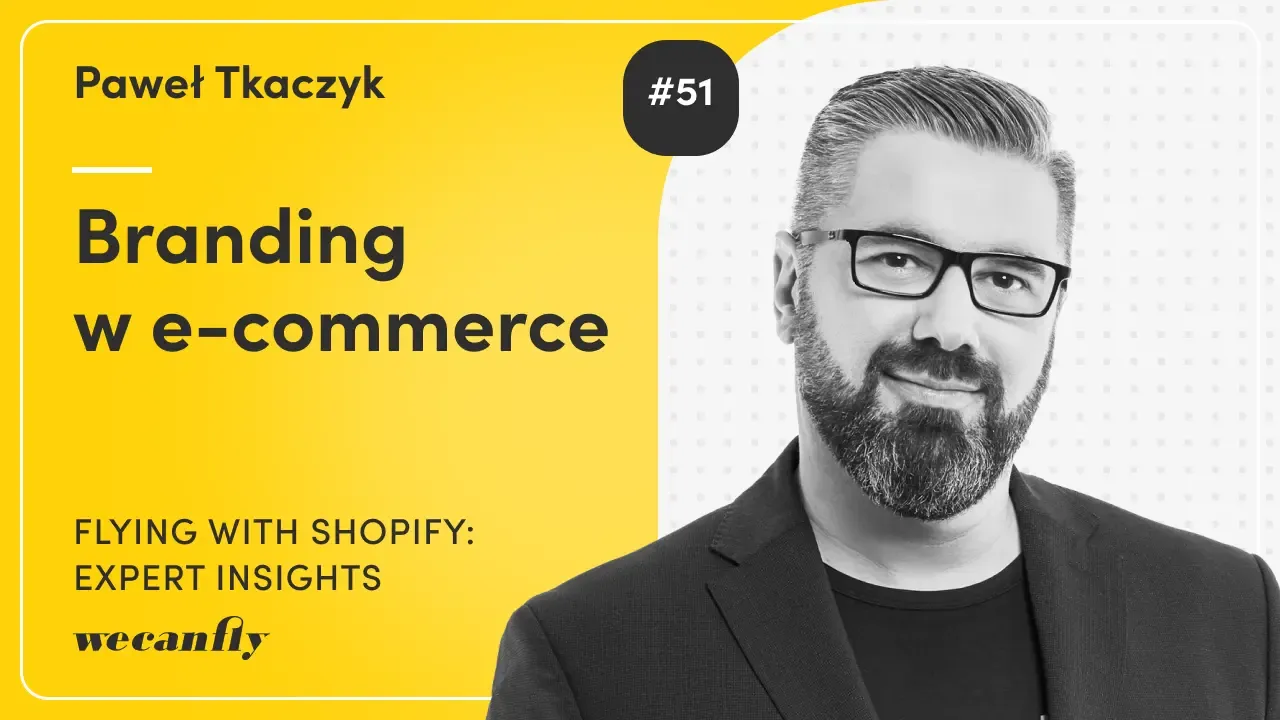
Paweł Tkaczyk: branding in e-commerce – personal brands, marketplaces, AI and where to start
Your brand doesn't need branding? You're about to change your mind!
Episode in Polish, English subtitles available. Below: an edited English translation of the full conversation.
Paweł Tkaczyk, a Polish brand strategist who makes his living telling stories, talks to Maciek Czerniak and Tomek Runowicz about what a brand is and what it isn't: why it's an opinion about a product rather than a logo, when a founder's personal brand starts holding a store back, why a seller on a marketplace such as Allegro is a "commodity", and what AI changes in brand building. He ends with an order of work for an e-commerce business on a small budget: start at the bottom of the funnel and buy traffic last. The episode is for owners and marketers of brands that want to stop competing on price alone.
Key takeaways
- A personal brand only helps up to a certain scale. The most valuable brands in Poland, such as the grocery chains Biedronka and Lidl, have no face, and a store built on an influencer sells to "friends" and hits a glass ceiling: in fashion e-commerce brands Paweł worked with, products sold when the founder showed them, but not with a different model on a different account. His advice: hand the stage to specialists in your team as soon as possible, the way Tim Cook does at Apple product launches. (10:10, 12:00, 13:25)
- A brand is an opinion about a product ("what people say about you when you're not in the room", after Jeff Bezos), so a good product won't sell itself, and "having no brand" means customers don't know your product exists. You can only influence a brand indirectly, through stimuli (logo, colours, catchphrases, scents), so only put into customers' heads what affects the purchase, not "our company was founded in…". (16:18, 17:41)
- A good brand has four elements that, in Paweł's view, won't change: identification (name, awareness), category assignment ("something for everything is good for nothing", translated from Polish), emotional affect (it doesn't have to be liking: the Polish electronics chain Media Expert annoys people with its ads, yet it's the first store that comes to mind when your mouse dies at 7 pm) and a point of difference, being "first, only or best", which doesn't have to be about the product and can be, for example, the standard of service. (17:41, 21:20, 24:12)
- Customers don't buy the best, they buy what's good enough that it stops being worth looking further (Richard Thaler). That's why "we couldn't find clothes for ourselves, so we started a brand" isn't enough, while "we're the only ones importing this fabric from an Italian mill" is. To a customer, "first" means the first brand they heard of, so better marketing alone can be the advantage. (27:20, 28:21, 31:20)
- A brand's authenticity can't be verified, so a brand should be credible and manage expectations. People form opinions about brands from 15 seconds of Stories, and "if you have something smart to say, find a good-looking person to say it": a model in the photos will sell clothes better than the founders. (32:40, 36:42, 37:32)
- AI: a language model gives a business starting from scratch a brand strategy that is roughly 60% good, which is 60% more than nothing, and the human value lies in spotting nonsense, which will shrink. Paweł starts his work with a language model as a sparring partner and would happily put his name to an article on measuring a personal brand produced with Deep Research. A "written by a human" label has value, but until it's regulated (like "organic" on yoghurt), anyone can stick it on. (41:33, 43:30, 45:59, 47:29)
- A seller with no brand on Allegro, Poland's largest marketplace, is a "commodity" at the mercy of the search algorithm and the platform's fees: customers remember Dyson and Allegro, not the seller. Price only matters when you're interchangeable (Red Bull at a convenience store). The next levels are product, service and experience, so a store selling the same thing as five others can stand out through advice, for example a method that gets a child seat fitted 10–15 seconds faster. (49:26, 52:40, 54:23, 56:38)
- The order on a small budget, from the bottom of the funnel: a referral process, a premium variant and average order value (upsell, cross-sell), repeat purchases and subscriptions, a newsletter with a pop-up instead of a footer field, conversion, and only then buying traffic, so you're not pouring water into a leaky bucket. Brand awareness research (aided and unaided, every six or twelve months) comes once you're big enough. Reel views are a poor metric, and communities are better built in closed channels and with superfans who get to co-create the product. (64:48, 65:18, 66:57, 71:34, 74:16, 76:40, 81:21, 83:32)
Guest
Paweł Tkaczyk is a brand strategist who, as he puts it in the episode, makes his living telling stories. He runs strategy workshops for companies, audits e-commerce businesses from a brand perspective and works with his team on brand strategies, including for fashion e-commerce brands. He has been in marketing since the days when the industry was still wondering whether the internet would catch on.
Hosts
Maciek Czerniak and Tomek Runowicz run wecanfly, a Shopify Premier Partner agency that helps established brands with complex migrations to Shopify Plus.
How a founder's personal brand grew into a clothing label is the subject of our episode with Zofia Kulewicz of ANSIN and the article From Personal Brand to E-commerce on Shopify Plus. For the bottom of the funnel Paweł describes, see ecommerce subscription models, the episode How to build retention in e-commerce and our Klaviyo for Shopify services.
Transcript
This transcript is based on the recording of this episode. We edited it for readability: we corrected transcription errors, punctuation, and merged sentences that were cut off mid-flow. We did not change the content, order, or meaning of anything said. Any errors or inaccuracies are our responsibility alone — not our guests'. If you spot something that needs correcting, email us.
Episode recorded in Polish, published 1 April 2025; the teaser at the start of the video is not repeated.
Who is Paweł Tkaczyk?
Maciek: Paweł, I'm convinced that most of our YouTubians, when they see you, will think…
Paweł: YouTubians?
Maciek: That's right, YouTubians.
Paweł: That's a good word.
Maciek: …when they see you, they'll think: “Dario from 'Blinded by the Lights' (a Polish crime series)”, and I've seen you somewhere before. But even so, we'd ask you to introduce yourself to the millions of radio listeners.
Paweł: We're old enough to remember that. Hi, my name is Paweł Tkaczyk and I make a living telling stories. That's my gig.
Maciek: I wanted to say at this point that as a rule we always ask the guest to introduce themselves. In your case it's unnecessary, so I wanted to ask about things nobody knows about you. Can you tell us, in two or three sentences, something about yourself that few people might know?
Paweł: You know what, there are circles of people who know me better and less well. My close circle of friends knows that I'm a pretty strong introvert and that I don't talk much.
Maciek: Uh-huh.
Paweł: And that's exactly the reaction of the outer circle when I say it. But the truth is, there's a sort of counter of words I'm able to say in a day, and then it runs out and I'm cut off.
Maciek: Okay. And does it reset every 24 hours, or does it stretch out later?
Paweł: It varies. Generally I assume that when I'm talking and being expressive, I'm at work. And when I can quieten down, I'm not. So most often, after eight hours of strategy workshops, I go to the cinema alone to sit in silence and darkness. To the dumbest film I can find, just to sit in silence and darkness.
Maciek: I have the same thing. Tomek forced me into recording a podcast together, and now it's going to cost me a week to recover.
Paweł: And you'll switch off the lights and just sit there.
Tomek: What week? You're supposed to be ready again tomorrow.
Maciek: I also learnt something about Paweł I didn't know before the recording: Paweł races a Batmobile on race tracks.
Paweł: I do now and then, yes. Better on tracks than on the streets.
Maciek: Yes, that's a practice known especially in Warsaw.
Tomek: Where can you do that kind of thing in Poland?
Paweł: There are various tracks. In Poznań, for example, there's a brilliant track. Near Łódź there's a nice track, a more technical one. The lap time there is fifty-something seconds, 17 corners.
Tomek: We'll check it out.
Paweł: 17 corners in 50 seconds. So basically there's no straight. Various outfits like drift schools and so on are attached to these tracks. Highly recommended.
Mazda, Mustang or Tesla: what does your choice of car say about you?
Maciek: Speaking of cars. I really wanted to ask about this, because we recently saw on LinkedIn that you're getting rid of your Mazda.
Paweł: It's already gone.
Maciek: Gone.
Paweł: Yes. There was a queue from the morning. People asking when they could start viewing.
Maciek: Did one of your newsletter subscribers buy it, or some other fanboy?
Paweł: You know what, a young lad from Nowy Targ bought it. He came, had a look. Actually the first guy who came, saw it and bought it for cash. The ad I recorded, the one that, as you say, flashed past you, where I was messing about, got wonderful reach. But reach is reach; people still have to see what's for sale. He came, looked it over. The car was good, so there was no problem at all. It went in about two days, I think.
Maciek: You didn't have to do much persuading?
Paweł: No.
Maciek: Right, all it took was a spray of Plak on the cockpit to make it shine nicely. Mate, everyone knows that.
Paweł: There are tricks.
Maciek: And of course you ring him every week to listen to the engine. Okay. We also know, because it was in the ad, that instead of the Mazda there'll be a Mustang. Why not a Tesla?
Paweł: You know what, there was a time when I was crazy about Teslas. That was quite a long time ago. I'm a geek, I really like gadgets. And the Mustang and the Tesla actually represent two different categories. The Mustang is a flesh-and-blood car, but it isn't a gadget as such. The Tesla is a gadget, so I'd drive a Tesla to test the automatic navigation systems, the bells and whistles, if I could get them switched on. The Mustang I have… because you say “there'll be a Mustang”. I sold the Mazda because it was one of several cars I had and I didn't really need it any more. I've actually been driving the Mustang I have now for going on three years. And it's a model, speaking of tracks, in a version more optimised for the track. It doesn't have a single gram of sensors. Apart from a reversing camera, it has no driver-assistance systems. Just pure driving. I really like that.
Maciek: Old-school motoring too.
Paweł: Unlike modern cars, packed with electronics, which interfere with your driving and say: “Car too close, you've crossed the lane” and so on. They beep on all sorts of occasions.
Maciek: One last quick digression about cars. On the one hand I have a very analogue car, for the kind of driving you're talking about. On the other I have one that's too new, and recently, when I was driving down a really bumpy, potholed road and changing lanes to avoid the holes, the too-new one literally shouted a message at me: “Return to your lane” and turned the steering wheel itself so that the car…
Paweł: Well, there you go, see how it interferes with your driving.
Maciek: There was no arguing with it.
Paweł: Exactly. That's what the automatic navigation system did. I looked at the new Mustang, the one that came out after mine. We get on well at the Ford dealership, so they gave me one to drive for a few days. For my taste it has too many sensors. Everything beeps there too, so it's not fun.
Why is branding easiest to talk about using cars as an example?
Maciek: I'm asking about this partly as an introduction to the topic of our conversation, because each of these brands represents certain categories, certain perceptions. And it seems to me that branding is easy to talk about using cars as an example, because people easily identify different characteristics of cars, safety for instance.
Paweł: That's one thing, but branding in cars is also easy to talk about because it's the same category with different positioning. Notice that all cars meet the basic needs required of the category in exactly the same way. Whether you have a Bugatti Veyron, a Daewoo Lanos, a Mustang or a Tesla, stuck in traffic on Zwycięska street, you'll get to work in exactly the same time. And yet people buy a Volkswagen, a Ford or a Seat for different reasons, because those brands are positioned differently and we notice that positioning. That's why it's so easy to talk about.
Does Elon Musk's personal brand affect Tesla's results?
Maciek: That's one thing. But the second thing that comes to mind in the context of Tesla is, of course, the personal brand.
Paweł: Elon Musk's, that is. That's what we're talking about.
Maciek: Exactly. Before we go further: how do you assess what's happening around the link between the personal brand and the Tesla brand? Do you read the situation as what Elon does having a direct impact on the brand's results?
Paweł: Yes. And it always has. Notice that linking a personal brand with a product brand in the car market is an exceptional situation. Only it's a double-edged sword. When Elon was regarded as an innovator, everything was going his way and so on, Tesla sales went up, and Tesla shares were worth more than Volkswagen shares, even though they produced far fewer cars. The double-edged sword is that Elon, in my opinion, has messed up. Maybe there are people who like it, but he's messed up from the point of view of public image. And that's connected to how people buy cars, especially in markets where they have a choice. We agreed that all cars satisfy the basic needs to more or less the same degree. It turns out that a Tesla can be swapped for another car. It isn't unique in any respect. So if I don't like Elon Musk, I can say quite calmly: I'll drive a different car. Full stop.
Is a human face becoming more important in branding?
Maciek: 100% agree. That's exactly what I'm thinking about, because in the context of today's conversation it seems to me that the human face element in branding is becoming more and more important.
Paweł: I don't know if I agree with you.
Maciek: Okay.
Paweł: If you look at the most valuable brands in Poland, in the world and so on, they aren't personal brands. Biedra (Biedronka). Do you associate it with any face?
Maciek: No.
Paweł: Lidl?
Maciek: No.
Paweł: They rake in unimaginable cash, and they aren't personal brands. We live in a bubble. Up to a certain size, a personal brand helps growth, because it's easier to build relationships with a person than with a product. But, as I said, it's a double-edged sword, because it turns out you're selling to friends. You can only have a limited number of friends, and that deals you a massive blow when scaling. It turns out people were buying the product because they like you, not because the product is good. You take that product to strangers and they say: “Why would I buy this? It's junk.” So honestly, if I were building a brand with the intention of scaling big, from the start I'd put effort into cutting myself off from the personal brand.
When should an influencer-led e-commerce business cut itself off from the personal brand?
Maciek: Okay, so for example someone has an e-commerce business built on their influencer activities, let's call it that. Incidentally, we have quite a few clients like that, and I see that the conversion rates in their shops are sky-high. If other e-commerce owners saw them, they'd cry like Matthew McConaughey in “Interstellar”, because they're simply absurd. So your recommendation is that it'd be good to cut yourself off from it, make yourself independent, from the start?
Paweł: I said that at the beginning you get a bonus precisely because you can be an influencer. But no influencer will ever reach the level of Biedra, Lidl, McDonald's. There's absolutely no way. There's a certain glass ceiling there, and if you don't make the effort to cut yourself off from the personal brand at the right moment, it shows. We're talking about e-commerce, but also about services. If you're a trainer, a strategist, a dietitian, an adviser of anything, you also feel that glass ceiling very strongly. People want to work with you, and when you try to replace yourself with an employee, it turns out not necessarily. We've worked with fashion e-commerce businesses where the problem was, for example, that when the founder was the model and showed the products on her account, people bought. And the same product, a different model, a different account, and nobody buys. And you'd like to go on holiday someday, right?
Maciek: Yes, true. That's limiting. Let's try to dig into this a bit. What recommendation would you see, and at what point should you start thinking about moving from a personal brand to making the brand independent? Where would you start if you had to advise someone?
Paweł: You know what, I don't know how closely you follow this, probably you do, since we talked about Tesla and tech. For a long time Apple was Steve Jobs's company, and you can see that really nicely at Apple's conferences and product launches. Steve Jobs used to come out on stage and basically talk the whole time. If they had 40 minutes, it was Jobs for 40 minutes. Then, as Jobs grew weaker, he started handing the stage over to his people. Today, if you watch a product launch hosted by Tim Cook, it turns out he comes on at the beginning and says: “Hi, a very warm welcome to you all. And this is the first person who'll tell you about our product.” And he doesn't come back until the very end. Metaphorically you can translate that into rebuilding a business. Of course at the beginning it was me. But the owner, the influencer or whoever should be bringing others in. Saying: “Look, this is my good friend Krysia. Krysia is a specialist.” And importantly, Tim Cook says: “This guy will tell you about the processors, because I don't know about that. I run the company, and he's the specialist.” Back to Krysia: “This is Krysia, the skirt specialist, and Krysia will tell you about skirts. This is Krzyś, the waistcoat specialist, and Krzyś will tell you about waistcoats.” At that point, as an audience member, I'd actually rather listen to Krzyś and Krysia than to the brand's founder, because the founder used her authority to say: skirt specialist, waistcoat specialist. Building the brand on individual or random people who actually rotate, so that very few fixed elements remain, is something we should do as soon as we possibly can. You asked when. Honestly: as soon as possible. Because the sooner people believe in Krzyś and Krysia, the sooner I'll really be able to go on holiday, and they'll be selling waistcoats and dresses.
Maciek: As soon as possible, but no later.
Paweł: Yes.
What is a brand? Jeff Bezos's definition
Maciek: Okay, good. Since we're on the subject, let's try to define it. I'd like us to talk a bit about what branding is and how it's changing, and then head towards what it's going to be in a moment. If you had to explain to someone in the simplest words, what is a brand? The topic has probably been flogged to death, but many people still imagine that a brand is a logo, maybe with a claim, some colours, and that's it. We'll commission it, pay a graphic designer, put it on the website and we're done.
Paweł: No. Let's start with the basics. Jeff Bezos, the owner of Amazon, once said a very wise thing: “Your brand is what people say about you when you're not in the room.” Honestly, I don't know a better definition of a brand. Of course we can tidy it up from a drawing-room bon mot and so on. The first consequence of Jeff Bezos's sentence: a brand is not a product. A brand is an opinion about a product. A hugely important thing. You said there are people who live in the belief that a brand is a logo and so on. I agree. There are also loads of people who live in the belief that a good product will speak for itself. That's nonsense, because a brand isn't a good product. A brand is an opinion about a product, which means I can imagine a product that's objectively rubbish and sells brilliantly because it has a good reputation. For example, the opinion of some influencer. Have you ever bought junk just because someone you trust said it was good, because they'd been paid? That's an opinion about a product.
Maciek: Alfa owners, for example.
Paweł: Do you drive an Alfa?
Maciek: “Drive” is a bit of an overstatement.
Paweł: Fair enough. We shouldn't say that.
Maciek: Yes, we shouldn't.
Paweł: Okay.
Maciek: Why reopen old wounds?
Paweł: You know. So a product that's objectively rubbish, but with a good reputation, sells great. The reverse is also true. I can imagine a product that's objectively wonderful, because the owner put their heart, mind and loads of skill into it, and it doesn't sell. It doesn't sell because it has a bad reputation. But that's honestly quite an advanced situation, if it already has a bad reputation. Most often it doesn't sell because people don't know about it. People have no opinion about the product. When people ask what it means not to have a brand: not having a brand means having a consumer who doesn't know your product exists. And that's a really, really important thing.
Why don't we have direct influence over a brand?
Paweł: Because a brand is what the consumer has in their head about your product, another consequence of Jeff Bezos's words is that we don't have direct influence over a brand. That's quite important. I can't make you think something about me, about a product or about anything else. I can't go out to people and say: “Listen, you're to think that Paweł is clever, handsome and brave.” It doesn't work like that. We don't have direct influence, but we do have indirect influence. And that indirect influence, technically speaking, is called stimuli. Stimuli are all the things connected with sensory experiences that affect the associations we have with a brand. So what you mentioned: the logo, brand colours, catchphrases, scents and so on are stimuli. And they have to lead to a very narrow set of associations. Because another consequence of Jeff Bezos's bon mot is that since the brand happens in the customer's head, space in the customer's head is very valuable. It's very hard to squeeze something in there. We don't have room to know a lot about many brands. If I ask you what year IKEA was founded, it turns out, well, exactly. And it's very important to squeeze into consumers' heads the things about the brand that influence the purchase, and not to bother them with things that have no influence on the purchase. Knowing what year IKEA was founded has no bearing whatsoever on whether you go to IKEA and buy furniture. Meanwhile, you go to an e-commerce site, to the “About us” page, and how does it start? “Our company was founded in such-and-such a year.” Very often that's unnecessary information. Thinking about the brand in terms of what the consumer needs in order to make a purchase decision is a universal thing.
The four elements of a good brand: identification, category, affect and point of difference
Paweł: You said we'd talk about what a brand is, will be and was. There are certain universals in brands. Very often they're arranged along the decision-making process, because generally we don't change and evolve that fast. So certain things to do with how we make decisions won't change. I'm prepared to bet money on that for 50, 100 years. A brand should have a name that identifies it. Absolutely. Because I should know whose website I'm on. That's called awareness. People should know you exist, and they should know what you're called. The second thing is called category assignment, meaning people should know what you sell. Because even the strongest brand loses its power outside its category. If, for example, I'm thinking about sending my child to French lessons, then however highly I think of IKEA, I don't consider it, because it's completely outside the category.
Maciek: It's also a bit like this: if, in terms of category, you aim your product at everyone, then you don't have a brand.
Paweł: No, it's different. There's a saying in marketing: “Something that's for everything is good for nothing.” We can explain it with the example of a child who wants to learn French. If you have a choice between one institution called a language school and another called a French school, consumers will prefer the French school, because they believe specialisation equals higher quality.
Maciek: I can confirm that.
Paweł: And business owners' greed very often comes down to them saying: “Right, we'll sell kettles, hoodies, spotlights and other things too.” And it turns out that for a kettle I'd rather go to a specialist kettle shop, for spotlights to a photography shop, and so on. So that kind of jack-of-all-trades mishmash very rarely works. Unless the driver is something else. If the driver is, for example, the influencer as a person, and he sells soap, a kettle and jam, and you're interested in owning anything with his logo… Paw Patrol is the best example. Write Paw Patrol on anything and it turns out the child wants it, longs for it. Has just started having a need. So think about it in those terms. But category assignment is a very important thing. Emotional affect is the third layer. I have to like you for something. That's what we talked about with cars, especially when there's a lot of competition within the category. You've assigned me to a category, like language school, cars, soap shops, and I'll choose the shop I like more. I like it because it made a nice ad. I like it because I like the person who represents it, and so on. Those are three things. And the fourth obligatory thing in a brand, which I know will never change, is called the point of difference. We look for something where we can say with full deliberation that we're first, only or best. Again: if I'm choosing a language school for my child and I look around the whole landscape of language schools, I'll choose one that's first, only, best, one that says something to me. It's the same in a shop. If you sell clothes, cosmetics and so on, what are you first, only, best at? If that isn't there, you have to sit down and work it out. That “first, only, best” doesn't have to be about the product. You might sell products imported from China or anywhere else, others have the same ones, but I can say, for example, that I'm the only one with this particular standard of customer service. That I was the first to bring these products to the market, and so on. And then people start to make a distinction. Distinction is a preference in some direction. If you have identification, category assignment, liking and distinction, you have a good brand.
Does emotional affect have to mean liking?
Maciek: Okay. I'm still wondering about emotional affect. Does it have to be liking?
Paweł: No. There are several things connected with this. First: yes, we have preferences towards things we like, so liking is one of the better affects. But emotions in our heads have one very important function. All of them. Different emotions have different functions, but there's one function they all have: emotions mark a moment to be stored in long-term memory. If I ask you what you were doing on 15 March 2010, it'll turn out you don't know. But if I ask what day of the week 10 April 2010 was, it turns out everyone knows. Because they went through something that day. A brand should have emotional affect, first of all because it makes it easier to remember. It's much easier for me to think of a brand that has the product I need and had controversial ads. I don't have to like the controversial ads. Take Media Expert, which bombards you with ads and annoys you by switching on low prices, all nice and lovely. On a conscious level you can say it annoys you. But when your mouse dies at 7 p.m. and you have to finish a project, the first thing that comes to mind is Media Expert. You get in the car and buy one. That's how it works. So no, not necessarily liking. Lots of brands choose liking, because it's easier and safer to build than controversy or annoyance. But it's absolutely not necessary.
Do a unique value proposition and positioning still make sense?
Maciek: Okay. My next question in this context: I'm wondering whether marketing and branding concepts, such as the unique value proposition, tools like archetypes, or the concept of positioning, are in some sense becoming outdated. Take the unique value proposition. As a brand, are we still able to stand out? Isn't it an increasingly complex task, and isn't real differentiation harder now? Are these concepts still important?
Paweł: I don't know what you mean by real differentiation. I can make an assumption, or you can explain.
Maciek: Let's take e-commerce again, say fashion brands. We go to the “About us” page and we get more or less the same old song every time. Here are Jessica and Vanessa: “We couldn't find clothes for ourselves, so we started our own brand.” That's what it looks like 95% of the time. At the same time, all these people are convinced it's their differentiator, because they decided it would be a new quality.
The consumer doesn't buy the best: Richard Thaler's principle
Paweł: Right, we need to sort out a few things here. Richard Thaler. A guy who's a behavioural psychologist, or rather a behavioural economist. He got the Nobel in 2017, if I remember correctly. Don't hold me to the years, but he definitely got the Nobel. He deals with the psychology of decision-making. One of the wise things Thaler said is: the consumer doesn't buy the best. First we need to get our heads around that concept. If I ask you what the best pizzeria in Wrocław is, I assume each of you has an opinion on that. Which one?
Maciek: Absolutely. As it happens I don't have one in Wrocław. I have one just outside Wrocław.
Paweł: Okay.
Maciek: In Kobierzyce.
Paweł: Okay. And which one is the best?
Maciek: The one that's there. On the best Italian dough. For me the dough is…
Paweł: Wait, I need a name.
Maciek: Fitosa 17.
Paweł: Okay, Fitosa 17. That's what it's called. And what about you?
Tomek: In Wrocław? Mania, I think, right?
Paweł: Okay, let's assume so. And now the question I'll ask you: is that objectively true?
Maciek: Objectively, no.
Paweł: Objectively, no. Listen, to answer objectively, not even in general, but personally, which pizzeria in Wrocław is the best for me, we'd have to go to every pizzeria, try the pizza and only then compare. And we're convinced this one is the best, even though we haven't been to all of them. Where does that conviction come from? Thaler says: the consumer doesn't choose the best. The consumer chooses something good enough that it stops being worth looking any further. That may not be iconoclastic, but it's a concept that changes how you think about branding and about brand building and marketing in general. Because you don't have to have the best product. You have to have a product good enough that the consumer decides it's no longer worth looking further. And the words that very strongly suggest it's no longer worth looking further are “first”, “only” or “best”. So if I'm eating pizza at some place in Wrocław, I really like it, and the owner comes up to me and says: “We're the only pizzeria that serves this signature sauce”, that's a very strong signal that it's no longer worth my while looking further. Because if only they serve this sauce, then why bother. When you talk about real differentiation, you're thinking of an objective factor: we have the best product, nobody else has it and so on. But the consumer doesn't need that. They need to live in the belief that it's good enough that it's not worth looking further. The positioning of Vanessa and Jessica you mentioned, “we made a product” and so on, isn't enough. I agree with you there. But if Vanessa and Jessica say they went to Italian sewing workshops, were the only ones to import some fabric and made a dress, a waistcoat or whatever out of it, then I have enough signals to say: “Okay, Vanessa and Jessica. I'd probably find something comparable, but since I like this and I know they're the only ones doing it, I'm staying here.” So paradoxically, these key words don't mean real differentiation. It's differentiation the consumer believes in. But “first, only, best” are very important things a brand should have.
Maciek: It seems to me, looking at our sales experience when we sell our services, that we really do often see that if the client gets what they want during the conversations, they just don't go any further.
Paweł: Yes.
Tomek: Absolutely. The concept is that we forget about objectivity and comparing ourselves with the whole environment, with the competition, because that's practically impossible. That's how you have to think about the client too. For them, too, it's impossible to compare everything. Like that pizzeria example.
Paweł: And one more quite important thing: remember that knowledge of the market is a function of the time we spend in it. And we, brand owners, always spend much more time there than our customers. Even if I'm aware that competition exists, the customer may not be aware of it, because they haven't been to Italy, didn't know who else imported those fabrics and so on. And another thing that really shatters this perception: for the customer, first isn't the one who was first on the market, but the first one the customer heard about. So again, we can build a competitive advantage by having better marketing, by reaching the customer better. We got there first with information about the product, and the customer says: “Okay, they're first, they're the only ones in my head.”
Authenticity or brand credibility?
Maciek: Okay. I think along the way we've touched on two more concepts we talked about before the recording. Authenticity versus credibility. People are often convinced that a brand has to be authentic.
Paweł: Nonsense.
Maciek: Okay.
Tomek: Here we go.
Paweł: The end.
Tomek: Here comes the war.
Maciek: What does that even mean?
Paweł: Why does a war start? When you say “authenticity”, it makes my blood boil. Because there's no such thing as authenticity. Let's quickly define authenticity so we can deal with it. Authenticity is when a person, let's narrow it down to a person for a second, thinks the same as what they say and do. So to judge whether someone or something is authentic, we have to see what they do, hear what they say, and compare that with what they think. None of us has the ability to compare that with what the person thinks. We don't have insight. We can guess what the person thinks, but that's our intuition, which leads us badly astray. So it's nonsense. On top of that, we're convinced we have good intuition, which is also mistaken, just so there's no doubt. So we consider authentic something that matches what we ourselves inwardly believe. And whether it really matches what the person thinks? We don't check, we don't try. A brand should give people what they expect. A brand should be credible and should manage expectations. So a brand should influence what people consider authentic. But there's no room for real authenticity in the case of a brand. Especially since I build my impression of authenticity on the basis of a few interactions. Look at your reaction when I said I'm an introvert. First, you have absolutely no way of checking whether it's true. I could have lied to your face, because I think one thing and say another. You have no idea whether they're connected. Second, people form opinions about other people, and about brands in the same way, on the basis of 15 seconds they watched on Instagram Stories. I'll happily pretend for 15 seconds that I'm chatty, and on that basis you'll extrapolate what my whole day looks like. So on social media, in this fast-paced world, paradoxically there's much less room for authenticity than in the past, when we spent a long time with people and it was harder to pretend. If we worked together, you'd know whether I'm telling the truth or not, because it'd be much harder for me to pretend for eight hours. And if we then went out somewhere together, God forbid. Then it'd be even harder for me to pretend. But on social media I'll happily pretend. This chase for authenticity is our illusion. We kid ourselves that we crave authenticity. But all it takes is for a brand to do something we don't want, and we say: you're inauthentic, goodbye. Even though it may be perfectly in line with the ideals of the brand's owners. Authenticity is an argument we bandy about all the time. Worth nothing, but we really like it, because then it turns out the world matches our predictions.
Maciek: Okay, so for example: if Tomek and I were now opening an e-commerce shop with supplements for bodybuilders.
Tomek: That would mean we'd be at the start of our journey.
Paweł: No, because look, it'd be stupid of you to put your own photos in that e-commerce shop. But I'll tell you one very important thing. Nobody checks.
Maciek: On the internet, nobody knows you're a dog.
Paweł: Exactly. So if you're opening a dietary supplements shop, you put up a photo of pumped-up hulks and write: “Want to look like us? Buy our supplements.” End of story.
Maciek: Or studs like these.
Paweł: Selling those supplements, you're much more authentic in public opinion than if you'd put up your own photos, which makes absolutely no sense.
Maciek: That really is a great refutation of that definition of authenticity, shown with an example. If we put up our photos, we wouldn't be credible?
Paweł: No, you'd be authentic, truly authentic by the definition of authenticity: what I think matches what I do. But the world would say: “Nah.”
Maciek: That's how I read it. A very interesting approach. Right, so still in the context of that…
Paweł: Wait, speaking of marketing, because it's marketing we're talking about here. The Americans have a wonderful saying: “If you have something smart to say, find a good-looking person to say it.” And that applies to e-commerce too. You're that Jessica and Vanessa opening a shop. If you find a model who looks better than you, people will decide your clothes simply look better, because they look better on the model, and that's that.
Maciek: I don't know what it's called professionally, a transfer of authority or shining with reflected…
Paweł: Reflected light. The moon strategy. Yes. But look, two things. On the one hand it could be someone genuinely famous, and then it would absolutely work. And on the other hand it's someone who simply has objectively better attributes. That's why people selling all kinds of scams take photos of themselves in front of rented cars, and influencers rent cars just to show how much cash they make.
Maciek: The same…
Paweł: The same car rented by 15 influencers.
Will AI change the definition of branding?
Maciek: We've touched on what branding is. You defined it very extensively. I'm still wondering about one issue: do you think this whole field, or the very definition of branding, will change over the next few years, in the era of AI, robots and all the social transformations that the change happening now will set off?
Paweł: I don't think so. Or rather: the tools will of course change. But I've been in marketing long enough to know that very few things change in marketing. When I was entering the industry, we wondered whether the internet would even catch on or whether it was some passing fad. Then came social media, then came AI. And we make decisions in the same way. That's the first thing that won't change. Second: we're lazy when making decisions. In a great many cases we can't be bothered to dig around and examine the authenticity of different things. We have a certain view of the world. We readily accept concepts that fit into it. If, in our opinion, it doesn't particularly harm anyone, we don't check and we don't dig. So there'll probably be more AI-generated content, and if, and it's a big “if”, it agrees with my worldview, I'll accept it and treat it as true, credible. “True” may be the wrong word, but as credible enough not to get worked up, to buy and so on. When we were preparing for this conversation, we talked about the Porsche ad made with AI. If I like Porsche, if I liked Porsche before that ad, it doesn't bother me that the Porsche in it looks like a Porsche, and it doesn't bother me that it was generated by AI. And people who wouldn't have wanted, bought or liked that car anyway can complain.
Will a “written by a human” label become a brand differentiator?
Maciek: Okay. I'll go back a bit to what I said at the beginning: it seems to me the human element will matter precisely in this context. You can already see people adding a “written by a human” note to their email signatures or to articles.
Paweł: You know what the problem is? Nobody checks it.
Maciek: Okay, 100% agree. But I assume that if someone adds something like that, then for now…
Paweł: Then it's the label that has value, not the written content.
Maciek: Yes.
Paweł: That's something you have to understand. Until it's regulated by law, and that's being worked on right now and it's the biggest change… If there's no legal regulation, then when marketers, salespeople and business owners realise that a “not generated by AI” label has value, they'll stick it on everything they sell, which doesn't necessarily have to be not generated by AI at all. That's why in food we regulate eco and organic. You can't just stick “organic” on any old yoghurt, because there are regulations covering it, because it turns out that the “organic” sticker itself has value. Or free-range hens. That has value, so you can't stick it on just any product. In AI, nobody checks it at the moment.
Maciek: Okay, but if legislation goes in the direction I think we should go, so that this distinction does exist, then in your opinion will the human element be able to be a brand differentiator?
Paweł: Yes, absolutely. Only it's a differentiator regardless of whether there's legislation or not. Legislation only ensures that people actually stick to it. Because let's be honest, people without ethics will decide: why hire a carbon-based unit to write a note when it's enough to add a “not generated by AI” footer at the end and it works exactly the same. Because we humans, sorry, but we can't tell the difference. I don't know about you, but if you give me two yoghurts and ask which one is organic and which isn't, I can't tell the difference.
Maciek: Okay. Maybe only by the price, right?
Paweł: Except the price, again, is a function of the sticker, not of whether the yoghurt really is organic.
Will AI replace the strategist in brand creation?
Maciek: True. Okay, one more question in the context of AI. Will the brand creation process itself change? Can AI replace people in creating brands?
Paweł: Yes. To a large extent, yes. Let's start with the language model, because I'd like us to talk about AI precisely. Everything is called AI now. Going one level down in precision: a language model. A language model has knowledge and is great at structures. And those two things are exactly what you hire a strategist for. A strategist comes along and brings you knowledge of what a brand should have, plus a certain framework, a structure and so on. And honestly, this is how I see it: if you know nothing about brand design, you sit down with ChatGPT or Google's Gemini and ask step by step what you should do to build a brand, a strategy and so on, you'll get it. You'll get a pretty good, decent outline that's better than nothing. A human still adds value to this process, because they can tell when the AI is talking nonsense and when it isn't. As long as we're dealing with a tool that talks nonsense more often than not, a human still provides value. But these tools are getting better and better. They'll talk nonsense much less often than they have so far. And it'll turn out that the value of the human doing the checking will keep falling. So I'm a big fan of people who have nothing at the very start, because for example they don't want to work with strategists or can't afford them, consulting AI. They should consult a language model, because they get something that's, let's say, 60% good. That's 60% more than they had before. And then possibly patch the gaps with someone who has experience and knowledge. I also believe the progress of these tools is such that loads of knowledge-based industries will simply be driven out of business, just because it's enough to talk to a language model, which also has knowledge. So if you sell knowledge alone, without guidance on how to do it, without tailoring it to a specific industry and so on, language models, and AI more broadly, will absolutely cut you out of the business.
How does Paweł Tkaczyk use language models in his work?
Maciek: I'm curious whether you've ever done an experiment where you wrote in the LLM of your choice: “Act as Paweł Tkaczyk. Advise me on how to create a brand.”
Paweł: I do it all the time. In fact I do it every day. When I talk about those 60%, it's very often the case that I start my work with a language model. I treat it a bit like a sparring partner. I still feel I have enough experience to catch it when it's talking nonsense. But note: in areas where I have years of experience. I'll catch the nonsense when I'm talking to a language model about strategy. But I can ask the same model about planning a garden and, honestly, I'm completely lost. I feel smarter for the knowledge, but I absolutely can't tell which part of it is nonsense and which isn't.
Maciek: That's true. If someone has domain knowledge, they'll quickly catch even non-obvious hallucinations.
Paweł: Yes. You asked whether I use it. Of course I use it, because on the structure side it gives me loads of ideas. It's a kind of engine for creativity. I say, for example: “I'm writing an article about measuring a personal brand. Prepare a list of parameters we should use to measure a personal brand.” I know roughly what I want. But it helps me to have it in order. Plus it helps me to see: a) here's some nonsense, b) here's a point I didn't think of in the original version, so I can refine it.
Maciek: I was even thinking one step further. Have you ever asked it: “Write me an article in the style of Paweł Tkaczyk”?
Paweł: No, because that's the wrong use of language models. Teaching it Paweł Tkaczyk's style would require training an entire model. No ChatGPT can do that. You'd have to train a model, modify the weights and so on. There are no easy tools for doing that. So people who try prompts like that in a general language model won't get good results. On the other hand, I was recently blown away, because sometimes I have these AI moments of awe, by Deep Research. It's a feature both Gemini and ChatGPT have. It gets a topic, goes outside, does research on the internet. Practically the whole answer is fed by external knowledge, and then it returns a result that no longer looks like what's commonly described as AI-generated. From time to time I test new models on exactly this topic, that is, ways of measuring a personal brand. I showed the article I got from Deep Research to my people. I said: this is something I'd put my name to. I'd put my name to it without any hesitation.
Does an Allegro seller need a brand?
Maciek: Okay, let's leave AI and move more towards e-commerce. In many e-commerce businesses there are misconceptions or myths about brands: what do I need a brand for? I don't need it. Change my mind. Or: I've been selling on Allegro, Poland's largest marketplace, for over ten years, I have tens of millions in turnover, who needs that?
Paweł: Sure.
Maciek: How would you address these perceptions? Is it really the case that we don't need it? Can you live without it?
Paweł: You can. It's just a somewhat harder life. Of course everything has its pros and cons, but again I'll use an analogy. Let's start with the Allegro example. If you don't have a brand and you sell on Allegro, people buy from you not because they distinguish you from the rest, but because Allegro has a strong brand, they came to Allegro in droves, and you popped up in the search results. So your business model is at the mercy of Allegro's search algorithm. In real life I compare it to people who open a shop in a shopping centre. That has huge advantages, because I don't have to build a brand. I don't need consumers convinced enough of my product's quality to step off the beaten path and come into my shop standing somewhere out of the way. I have consumers who came to the shopping centre. They're there in droves, and I have to persuade that crowd to step slightly off the path. Plus I get for free the fact that very often they get my logo shoved in their faces, because even if they don't buy from me, they walk around the centre. That step off the path I'm persuading a large number of people to take is relatively small, and that's how I make money. The downside of this model is that when the shopping centre terminates my lease, there's nothing in my business model that depends on me. In the long run it's unsustainable. In the long run we should strive for as many things in the business model as possible to depend on us. Companies obviously do this. If I'm Zara, I rent space in a shopping centre, but I encourage people to buy in my online shop. And it turns out my customers are in the online shop, and they only come to the centre to exchange goods or to touch them. Allegro doesn't give me that option, in the sense that Allegro fights against me, the seller, trying to sell my customers on the idea of my own online shop. I can get banned from Allegro for that. And rightly so. But it's something we should be building, because Allegro might come to an end. Allegro might raise its fees. Allegro might require something I can't deliver, and I'll disappear from the search results. In the long run we have to build something that depends on us. That's one thing. The second is that on Allegro, and I'm putting Allegro in quotation marks, because it's an example of a certain business model, people have no preference towards me as a supplier. People came to buy a Dyson vacuum cleaner, went on Allegro, and they're only thinking about Dyson and Allegro. Those are the two brands they have in their heads. And if I, the seller between them, changed my name or disappeared, they wouldn't notice. That's a problem. In the long run it's a problem, because we don't have loyal customers, we don't have customers delivered to us by anything other than the Allegro channel. When Dyson or Allegro turns its back on me, I'm left with nothing.
Does only price matter in e-commerce?
Maciek: What you're talking about is also the source of another myth: that only price matters.
Paweł: No, price matters when you're completely interchangeable with the rest. If I go to Żabka (convenience store chain) for a Red Bull, I'll buy the Red Bull for whatever Żabka wants for it. They may have cheaper energy drinks, they probably do. But in my head Red Bull can't be swapped for anything else. And that's that. This myth really only persists among people who haven't built their brand enough to be treated as irreplaceable.
Maciek: Okay, so irreplaceability is…
Paweł: Take that Dyson we were talking about. Absolutely. How can someone who sells Dyson vacuum cleaners say that only price matters, when there are a gazillion cheaper vacuum cleaners on the market and people come for the most expensive one?
How much money does a brand bring in? From commodity to experience
Maciek: 100% agree. What other practical aspects are there? Show me the money. What else does an e-commerce business need a brand for?
Paweł: Money is a very good indicator, because a brand is the difference between the price people will pay for a generic and the price they'll pay for a branded product. It's much more complicated than sticking on a logo. But to simplify massively: if I take any product and stick the logo of a well-known brand on it, it turns out people are willing to pay more for it. I'll show you an extreme example.
Maciek: Okay.
Paweł: When we talk about product development, there's a certain framework described in the book “The Experience Economy”. A brilliant book written a long time ago by guys from Harvard Business Review, still relevant. At the lowest level, where you compete on price, there's something called a commodity. A commodity is a good, an indistinguishable generic. Take coffee. Commodities are sold on the exchange. Coffee or a grain of wheat have certain parameters. You buy arabica coffee and you don't really care where it's from. If it has the right parameters, that's enough for you. You buy wheat to make bread. It has certain parameters and you buy it as cheaply as possible. Above the commodity is the product. A product differs from a commodity in that the customer can tell one sack from another. If I have sacks that just say “coffee” on them, I can stick a logo on a sack, and if it's a logo the customer knew before, they'll pay more for that sack. Now I'll show you the paradox. I can stick any logo the consumer knew before on that sack. Netflix coffee will be worth more than just coffee. Even though I don't associate Netflix with coffee, I've heard of it before. So Netflix coffee, Amazon coffee, Sony coffee will be worth more than just coffee. Those are products, and we can charge more for the same sack when we have a product. Further on, “The Experience Economy” talks about wrapping the product in a service. Coffee with delivery, coffee turned into Starbucks coffee. You squeeze much more cash out of every bean. And above that level there's something else called experience: coffee at Disneyland, wrapped in a whole experience, is worth much more. When we talk about building a brand, we build it on several levels. You can have nothing built, and then you're a commodity. That's the Allegro seller. He's a commodity. You can start being distinguishable, and then you're a product. And you can charge more because you wrap the product in a service. That's what would be worth investing in.
How can an e-commerce business wrap a service around its product?
Maciek: So how exactly can e-commerce businesses wrap a service around their product?
Paweł: E-commerce businesses sometimes have to wrap a service around the product. Notice one thing. You're selling those Dyson vacuum cleaners, let's leave Allegro aside now. You've moved up from commodity to product level, meaning you sell Dyson vacuums, just in your own shop. The problem is that when I type “Dyson vacuum cleaners” into Google, five shops pop up selling exactly the same vacuums. So if you want to stand out, you can't stand out with the product. You have to stand out one level higher. You can say, for example: “Fine, but we pack much better. Our advice is on a much higher level.” And you can charge money for that advice and stand out precisely because you charge for it. You sell child car seats. A child car seat has no value until you know how to fit it. If I sell you exactly the same car seat as everyone else, but I offer advice that helps you understand better how to fit it, or you fit it faster. I have my own method and I'm the only one on the entire internet…
Maciek: You fit it on the roof rails.
Paweł: Wherever you like. If the kid likes a thrill, sure. Just not in rain or snow. But what I mean is that I have my own method that lets you fit the seat and put your child in it 10–15 seconds faster than elsewhere. And as a parent you count how many times you put that little porridge-eater in and take them out. You multiply that by 10–15 seconds and say: “Blimey, that actually gains me a week of my life.” So it pays off.
Maciek: A longer holiday.
Paweł: Yes.
Maciek: Some stand-up comedian said that when he puts his kid in the car and walks round to the driver's seat, that's his holiday. In that context those 15 seconds are a second week away.
Tomek: The example that comes to my mind seems very obvious. If we have the same products, then as you said: some model, a unique way of fitting it, or even adding a whole section, even with videos showing the value of that particular product.
Paweł: After-sales service and all sorts of things like that are all things people pay for. They can pay you by actually buying your fitting training, or they simply pay you with their choice. Meaning the customer buys from you because you add that little course to the car seat, and doesn't buy from someone else. And that's what makes you money. So yes, there's money in a brand.
Does a service around the product make sense in fashion and FMCG? The 4Ps of marketing
Maciek: And do you think wrapping a service around the product is for every e-commerce business? I can imagine it when you sell swimming pools. Choosing the equipment is complicated, so you'll definitely buy an advisory service. But if someone sells clothes or FMCG, everyday consumer goods, is there a chance here too?
Paweł: Of course. If I were selling clothes… On the one hand, you don't have to do it if you can build your uniqueness lower down. Below service we have product, place, price, promotion, the 4Ps of marketing. If you're the only one who has a given product and people need it, you don't need to add anything. If you're the only one who has a Tesla, a Mustang, a Porsche 911, people will buy and you don't need to add anything. If you're the only one selling in a given place, you don't need to add anything. Żabka. Place really means either closer or open. Żabka has both. If I want to buy a Red Bull and it's Sunday, 9:30 pm, I'm not really going to argue and I don't demand any extras from Żabka.
Maciek: Exactly.
Paweł: Because why would you, right?
Maciek: Like a toilet on a hiking trail for 10 złoty.
Paweł: Exactly. Price: yes, but we should talk about that one at more length. A price leadership strategy happens 100% on the cost side, not on the price side. We don't have a low price because we fancy it, but because we've designed our cost structure so that we can produce cheaper and sell cheaper. A topic for a longer conversation. Or promotion: you're the first brand that comes to the customer's mind when they think of a given category. You're not the only one on the internet, but you're in first place on Google. The customer basically has no choice, because they just can't be bothered to search. But if you don't have an advantage in the 4Ps, then you build a service. And I can easily imagine, for example, an FMCG company that sells yoghurts exactly the same as others, and I buy from them because they throw in recipes for dishes made with those yoghurts. You sell building blocks for kids, let it be Lego or anything else, but you have a sensory education course with those blocks, so I'll absolutely buy from you, because that's added value. The point is to think about what the consumer does with your product. If we're talking about fashion, no problem: I show you ready-made outfits straight away. There are people who like playing with fashion and coming up with things, but there are also those who'll say: “I don't know anything about it. That's exactly why I'm buying, so you show me something ready-made.”
Brand driver: how TOMS and a great adviser let you expand your range
Maciek: A silly thing just came to mind, but I'll say it. Once in Wrocław, on Kromera street I think, there was a shop called “Maternity wear, liturgical wear. Mum and Me”. Is it the case that a brand lets you expand your range and still be credible?
Paweł: Yes, but to understand that, we need to introduce a concept called a driver. A driver is the reason the customer buys. Not the goods you sell, but the reason the customer buys. I'll start with an example. There's an online shop, since we're talking about online shops, called TOMS. For a long time TOMS sold shoes online. Except it sold exactly the same shoes as others. Why did people buy at TOMS? It sold them at a higher price. So why did people buy at TOMS? Because TOMS had, and still has, because they still exist, a programme called One for One. One for One means you buy shoes, you pay for two pairs, one goes to you and the other goes to some barefoot child in Africa. And people bought at TOMS because of the charity. That was the driver. I don't need shoes. I need that charity just as much as the shoes. I need to make the world a better place. And now TOMS introduces glasses frames. Shoes and frames as products don't have much in common, but you also buy the frames driven by One for One, because there's a One for One programme for frames: you buy one pair of frames, and the price includes an eye test for some child in Brazil. So you can do this when what drives your brand isn't the range, but for example brilliant advice. If I sold running shoes and in my shop there's Mr Zbyszek, who is a bloody brilliant adviser for runners, I can introduce a range other than shoes for those runners. I can introduce tracking bands, water bottles, whatever runners need. And it's all driven by the fact that Mr Zbyszek gives brilliant advice. So here you can absolutely do it.
Where to start with e-commerce branding on a small budget?
Maciek: Okay. Right then. So, listen, maybe we'll move on now to the practical…
Paweł: So that's the intro done?
Maciek: Yes, exactly. We've laid the groundwork. We're having this conversation partly to satisfy our own curiosity too, so now I'd like there to be something for others. How do you implement branding in e-commerce in practice? We know we need a logo, a name, some visual identity. But what's the order of steps, especially at the beginning, when we have a small budget?
Paweł: There's no such thing. Or let me answer differently: implement things in the order that makes you money fastest. Because otherwise there's no point. Remember that whatever I say about marketing and branding, and I'm a specialist in brand building, brand strategy and so on, at the end of the day what counts is cash on the table. So I'm not a fan of marketing for marketing's sake. Refreshing your logo just because you got bored of it…
Maciek: There are better ideas for spending money.
Paweł: It's a poor idea for spending money. Exactly. So if I had to say, I'd say this: there's a sales funnel. From the top of the funnel, where you bring customers in, to the very bottom, where we have recommendations from those who bought. Implement from the bottom. What does that mean? It's actually not even branding as such. You already have a working shop. The question is: do you have a procedure that encourages customers who bought from you to recommend you further? Whether it's one-to-many on social media, “say this shop is good”, or one-to-one, “talk Krysia into it, because you know she needs a similar frock”. If you don't have that procedure, money is slipping through your fingers. Your marketing is reasonably good, people buy from you, but you leave the customers who bought alone, when you could encourage them. And customers are much better brand promoters than ads. People trust a Krysia who bought from you much more than an ad on Instagram. So the question is whether you have a procedure for it. That's the first thing.
Premium variant, average order value and subscriptions
Paweł: The second thing I'd take care of is a bit higher up the funnel: revenue. A very important question: are your prices optimised? Are you selling for the maximum amount people are willing to pay? The first thing to check that… I said “first” and held up two fingers. I'm saying that for those who are only listening. The first thing to do it is to introduce a premium variant of your product.
Maciek: Okay.
Paweł: The most basic thing. You have anything: a product, a frock, a jug. Bring out a premium jug. In services it works even better. You buy training, advice, premium advice. There are companies that are perfectly aware of this. Look at Apple. Again a huge company, but it's worth learning very simple things from them. You can buy an iPhone, you can buy an iPhone Pro. If you use your phone for calls, it turns out the iPhone does it exactly the same as the iPhone Pro. But some of your customers are driven by so-called snob motivations. They won't settle for a regular iPhone, they'll pay more. So, iPhone Pro.
Maciek: Have some self-respect.
Paweł: Have some self-respect. MacBook, MacBook Pro, Apple Watch, Apple Watch Ultra. And the Apple Watch Ultra is advertised as a watch for sports fanatics who climb Mount Everest.
Maciek: For when an avalanche buries you.
Paweł: Yes, absolutely. It'll save you when an avalanche buries you. I see loads of people around me walking around as if under avalanche threat, because they've got those Watch Ultras. They paid more because they could. If you run a shop that a customer walks into who could pay more but has nothing to buy, you're being a right mug. So there's a dress and there's a premium dress. A variation on this theme is upselling and cross-selling, meaning all kinds of bundles. The assumption is that if you've already sorted recommendations, sort out the parameter called average order value. Because that also gives you money immediately, and there are standard methods for it: raise prices, upsell, cross-sell, a premium product. Then you can deal with so-called retention. By retention I don't mean returning customers here, because we can talk about that too. If someone has already bought from you, do you have a procedure for encouraging them to buy again? That still falls under increasing basket value, because it's also about customer lifetime value. So the question is whether you send customers who've already bought from you emails saying: “Hey, buy from me again.” Maybe the dress has worn out, maybe the yoghurt has run out, maybe something else. There are loads of companies selling products that are absolutely suited to continuous consumption, and they don't reach out to customers who've already bought. The extreme form of reaching out like that is a subscription. If I sell pet food, pet food runs out at regular intervals. I should absolutely be encouraging customers to subscribe, because I lose a customer at the moment their food runs out and they look around the market to see where else they can buy. And when there's no looking-around moment because they've taken out a subscription, I can even give them a discount for it. Because then I won't lose them, no problem.
Newsletter, social media and conversion: what to check before buying traffic
Paweł: But retention also applies to people you're already winning over who aren't your customers yet: that's lead nurturing. The question is what you do so that, for example, they read your newsletters. You have a website and people signed up for your newsletter on it. The question is whether they open it and read it. Because if they don't open it and don't read it, they might as well not have signed up. So you check, for example, whether people read your newsletters, whether they click on your social media. Are you doing a good job on social media? Because if people followed your social media and then nobody clicks there and nobody engages, they might as well not have followed. You have to look after that parameter, because at some point it also translates into sales. Then we can work on conversions. We go to the website and check what percentage of people who landed on it click on what I'd like them to click on. Because I don't want them clicking on everything. Of course I'd like them to click on buy, on the basket. I'd like them to click on the newsletter, because if they don't need to buy anything right now, let them at least stay on the newsletter. That means very simple things. You have an online shop with a newsletter sign-up. Because there are loads of cases where the newsletter sign-up is in the footer.
Maciek: When someone usually hasn't got a clue, then…
Paweł: And who signs up for a newsletter in the footer? Think back.
Maciek: Who even gets down that far, first of all.
Paweł: Think back to the last time you were frantically searching for the newsletter sign-up field in a footer. Nobody. Simply never. And then people are surprised nobody signs up. You have a newsletter, so there should be a metric for how many people sign up per month, and you should push for it to keep growing. It'll keep growing when you have a decent pop-up, which works best. And again people may say: “Okay, Paweł, but that annoys people.”
Maciek: Then let him not do pop-ups.
Paweł: What do I care? Look at your account. I'll tell you one thing about mindset, something that's been on my mind lately and that I'm working on. People who don't succeed in business aren't people who don't know how, but people who have a problem arguing with themselves. A thing that straightens my head out really nicely: look at your bank account. Are there separate sub-accounts for money from customers you annoyed and from customers you didn't annoy? There aren't. If there are no separate sub-accounts, it isn't separate money, so how is it supposed to be a business metric anywhere else? How does “but customers will get annoyed” become a business metric? Either they pay me or they don't pay me. That's the only metric I have. Of course, if annoyed customers stop paying me and you can find that correlation, I have no problem with that. I'll deal with it and fix it. But unfortunately that correlation doesn't exist. If you find it, come to me and we'll talk. As of today, as far as research goes, it isn't there. Annoyed customers pay too. I can be annoyed with Żabka, but I need a Red Bull and I go if I have no choice. That's how it is. And only at the very end would I deal with bringing people to the site, to the e-commerce store. Why? Because once you've patched up all the other things, it turns out that bringing people in is basically never-ending work. And if you're doing the never-ending work of herding people in to pour water into a leaky bucket, that's a bit pointless. But once you've patched up recommendations, upselling and all the other things, it turns out it pays to herd those people in. If you were asking me about the order in branding, that's roughly how I see it.
How do you measure a brand? Aided and unaided awareness research
Maciek: Tell us one more thing, because I know you audit various e-commerce businesses. I can imagine an audit from the UX side or conversion optimisation. What does an audit from the branding side involve? Is it also that kind of analysis…
Paweł: No. If we're talking about pure image… You asked me what a small e-commerce business should spend money on. On what I talked about, not on image as such. But if we're talking about the top of the funnel, pure image, then it's, for example, brand awareness research. You're doing good marketing work when your brand awareness grows and more and more people have heard of you. This kind of research is done once every six months or once a year. The nicest method is telephone interviews, online interviews or a mix. But one very important thing: you have to ask people in your market. We actually ask two questions, because there are two kinds of brand awareness. The first is aided awareness: I go to my market and ask people whether they know brand X. Yes or no. Do you know brand X? It's much easier to explain with a local business than online. If I run a restaurant in Białystok for parents with small children, my market is parents with small children in Białystok. So asking random people on Instagram whether they know brand X is a botched study, because that's not my market. In e-commerce it's a bit harder, but I should also have chosen some niche, a target group and so on. In a telephone survey like that, usually handled by an external research agency, you ask that question. It should be done regularly, once every six months or once a year, because then you see whether the money you're pumping into image campaigns is having an effect. Has anyone ever told you image can't be measured? Well, it can. And if it's not having an effect, stop and start pumping money into something else. The second study is so-called unaided (spontaneous) awareness. That's a question about the category: if you wanted to buy furniture, a summer dress or something else, which shops come to mind? And again: if you're pumping money into image, you should be popping up there. It's very depressing for a lot of small companies, because it turns out they have zero awareness. That's why I don't recommend it to start with. Focus on sales much more than on building your image, because sales is where the money is, and it's a really long way from image building to sales. When you're big enough, you can do it.
Why does social media reach mislead brand owners?
Maciek: At the same time, many business owners, not just e-commerce ones, are convinced that everyone knows them.
Paweł: Yes. And I'll tell you about two things to watch out for. The first happens in your head. Daniel Kahneman, another Nobel laureate, also from behavioural economics, once said a wonderful thing: “What you see is all there is.” What you see is everything there is. Because we're often in contact with our own brand, we're convinced that people know us, everyone knows us and so on. That's not true. And an objective study where you phone the average Joe Bloggs brings all kinds of owners right back down to earth. But the second thing, much more dangerous, is social media. Because on social media, again going back to “What you see is all there is”, what you see is everything there is. Social media gives you certain metrics, and running a business you think they're good metrics, even though they're very bad. Instagram shows you how many people viewed your Reel. I'm taking the first example that comes to hand. And you think it's a great metric. The problem is that you have to set the group of people who viewed your Reel against a second group: the group of your potential customers. And those two groups overlap only to a very small extent. We get all excited that our Reel was viewed tens or hundreds of thousands of times. Meanwhile it turns out there are no sales from it, because the people who viewed it aren't our customers. What good is it to you that you sell, say, educational games for small children in Poland, and some guy in Bangladesh viewed it? Instagram shows a view from a Polish mum exactly the same as one from a guy in Bangladesh. There's absolutely no distinction. So we get excited about social media, and then people are totally disappointed: “I put out a Reel, totally viral, I boosted it.” That's another nice bit: you even boost it. “I boosted it and there are no sales from it.” And I say: “Because the wrong people were viewing it. What good is it to you that it gets views? The wrong people were viewing it.”
What should an e-commerce brand show on social media?
Maciek: That's true. Since we're on social media: what should an e-commerce brand really show there apart from pushy “buy” messages?
Paweł: Entertainment. I don't know whether pushy “buy” messages are okay. Some industries are more social than others. If you're fashion or make-up, it's natural to be on Instagram, and those industries actually do pretty well. But if you sell educational toys for children, social media gives you very little. You should use it to herd people towards other channels you have more control over. On the one hand reach, because social media is like that shopping centre: there are loads of people there. They aren't necessarily interested in you, but they're there. So show them you exist, and then persuade them to come to your shop and have a look around. And if they don't want to buy now, because let's be honest, people don't go on Instagram to shop, then persuade them to at least sign up for the newsletter. To make it more fun, I wanted to point out a certain paradox. Social media used to be a distribution platform for us. Before social media we had blogs. A reminder for the younger ones.
Maciek: What's that?
Paweł: What are blogs? There was a world before Facebook, before 2007. And we looked at social media as a distribution platform. I had an article on my blog, nobody read it. But I had Facebook, I posted the blog article there and people who followed me on Facebook went to my blog.
Maciek: That's right.
Paweł: And now pay attention. Today I post a Reel on Instagram. The best way to get that Reel to spread wider is to send my list a newsletter saying I have a new Reel.
Maciek: Okay.
Paweł: Social media has become the opposite of a distribution platform. Because why? Well, reach and so on. So if as an e-commerce business you don't have a newsletter list, it turns out you have to pay social media to distribute your content. That's daft. I'd rather people from social media signed up for my newsletter, and then when I post something on social media, I warm up the Reel with the newsletter.
Community around a brand: why move off open platforms?
Maciek: And that brings us to building a community around the brand.
Paweł: Social media is only so-so for building a community around a brand today. The trend I see is moving off open platforms towards closed communities. Tools like Circle, or channels on Instagram or Telegram, are much better than building a community around an Instagram, TikTok or Facebook account. Because all the sorting algorithms, as we know both from research and from what the people running these platforms say, are generally cutting the “do you follow me” parameter out of the decision about whether you should see my content. Right now people spend more time on TikTok's For You page than watching the people they follow. From an engagement point of view, that's wonderful for TikTok. From the point of view of a creator who's built a community, it's tough, because people follow you on TikTok and then don't check in on you, they go to For You instead.
Maciek: Definitely. Speaking of TikTok, it reminded me that recently I read or saw some study where someone was talking about long-form online content, lasting over a minute. Fairly long.
Paweł: You mean we'll just chop today's episode up?
Maciek: Yes. The Reels will be going out all year. That's how it's done now.
Paweł: Sure.
Superfans and co-creating a brand: what does Everett Rogers teach us?
Maciek: Since we're on communities, there's one more thing I wanted to ask about, but it slipped my mind. Brand co-creation. Is that some kind of trend?
Paweł: What does brand co-creation mean?
Maciek: Co-creation in the sense that people who buy from you have some influence on what the brand offers, how it communicates, what it does.
Paweł: That's not new in any way. In the 1950s a book comes out called “The Diffusion of Innovations”. It was written by a guy called Everett Rogers.
Maciek: Did he get a Nobel?
Paweł: No, he didn't get a Nobel. Rogers is just an ordinary economist, but for a dozen or so years, starting in the 1940s, he studies American farmers in terms of how they adopt new generations of maize seed being introduced to the market. In other words, how they take up innovations. And he finds that people don't really rush at innovations at all. After a dozen or so years of research he writes a book that is still very valuable today. I won't talk about the whole book, just one concept. Rogers showed the so-called product life cycle. Everyone's heard of it. He says that when a product, some innovation, enters the market, the first to come are the so-called innovators. After them the early adopters, then the early majority, the late majority, and finally the laggards. Never mind. What matters is what makes innovators tick. Because in that sales hump, the early and late majority, where you rake in the most cash, people are driven by herd mentality. They buy because everyone around them has it. They buy, for example, because the early adopters bought. And early adopters are called that because they imitate someone. They imitate the innovators. So to sell a product on the mass market, we first have to convince the early adopters, and the only way to get early adopters to buy is to convince the innovators, because those are who they imitate. So the million-point question is: why do innovators buy? Innovators want one thing. Innovators are your superfans, that's probably what this trend is called today: superfans. They want influence over the product. What they really want is to co-create the product. Let's say I'm a car fanatic. If Audi rang me and said: “Listen, Paweł, we know you don't even drive an Audi, but we have the new RS8 in production and we're not convinced about how we've laid out all those gauges on the dashboard. Could you take the trouble to come to our factory? We have a race track around the factory. Take the RS8 for a spin and let us know how the dials should look. PS entirely at your own expense, we won't pay you anything for it.” I'd pack my bags and go. For each of us there are product categories we know about. We feel we're experts in them, and we'd do exactly the same. We very rarely get the chance to co-create a product. But a brand that's going to launch a new product should absolutely identify its superfans, meaning the innovators. There won't be many of them. Rogers says it's 1–2% of your whole population, the whole market. And give them the chance to co-create, because afterwards they'll be your most hardcore advocates.
Maciek: We'll tag Audi under the post. Audi Polska.
Paweł: Exactly. In my mind I'm already on their track in Ingolstadt. I'd give it a go, no question.
Summary: the fundamentals of branding don't change
Maciek: Tomek, since I've rather dominated the conversation.
Tomek: Yes, you're in your element with this topic, so I had a feeling it would go exactly like that. I think we're coming in to shore now. Paweł, as always you firmly defended, and still defend, the definition of branding, its value, and the idea that a changing world won't really shake its foundations. And I suppose those foundations still need looking after and nurturing. I really liked the summary at the end, about how to introduce the elements of branding step by step and what to take care of. And it's interesting that you left branding itself, which is your hobby horse, until the end, only for the most aware.
Paweł: Because if you're not making money, it's art for art's sake. If my clients don't make money, I don't make money.
Tomek: Then you don't make money either. Of course. I think these were super valuable tips for everyone watching and listening to us today.
Maciek: For the YouTubians.
Tomek: For our YouTubians. Yes, exactly, Maciek. Huge thanks, Paweł, for finding the time and sharing your oh-so-valuable advice. We're extremely grateful to you for it. And thank you too for watching and listening to another episode. I think you've got the same impressions as we do. Of course we encourage you to comment and to watch the next episodes, coming soon on our channel. Thanks a lot.
Maciek: Thanks.
Paweł: Thanks.