
Mateusz Grzywnowicz: Expansion into foreign markets
How to conquer new markets? These mistakes are best avoided!
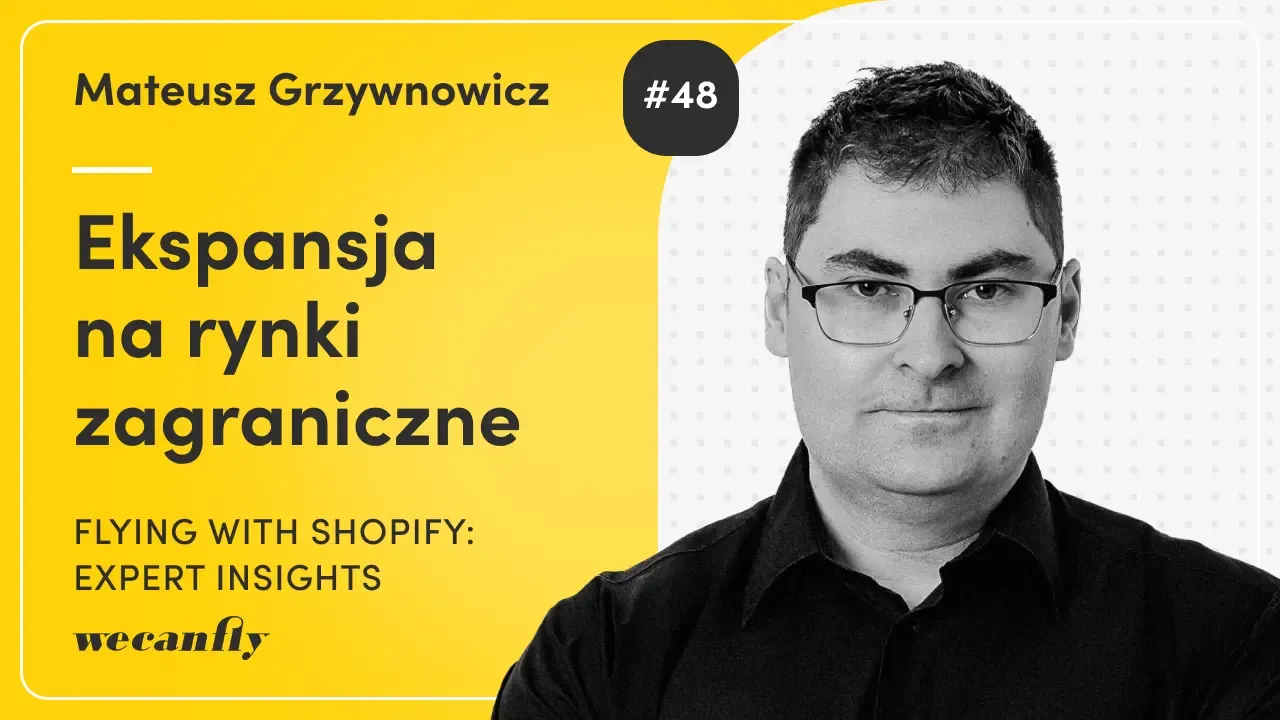
Episode in Polish, English subtitles available. Below: an edited English translation of the full conversation.
Mateusz Grzywnowicz, who has spent 15 years getting Polish sellers onto foreign marketplaces, talks to Tomek Runowicz and Maciek Czerniak about how a Polish company can start selling abroad. He covers how to tell it's the right time, the three mistakes companies make most often at the start, and how to pick products and a market with tools like Helium 10. He lists the paperwork you can't launch without (EU VAT OSS, terms and conditions, currency, packaging and waste registrations, language) and gives his own profitability yardstick: when you're losing money, when you should break even and when you should start earning. The episode was released in February 2025 and is for e-commerce owners and managers planning their first foreign market or another sales channel, including on Shopify.
Key takeaways
- Mateusz splits the story of Polish companies expanding abroad into before and after Allegro opened up Czechia and Slovakia. Before that, companies decided on their own to go abroad, usually once they had Allegro, Empik and their own store covered. Allegro, Kaufland Marketplace in Czechia and Slovakia, and integration tools like Apilo and BaseLinker showed sellers it could be done. In countries with a few million customers, like Lithuania or Czechia, expansion is practically mandatory, while many Polish companies still haven't fully used their home market. (11:22)
- The three most common mistakes: treating foreign sales as a rescue for a company in crisis, going in too fast by copying the catalog through an integration tool, and picking the wrong direction. On Amazon, Mateusz is blunt: "If you've experienced Amazon, Allegro feels like a walk in the park." (14:39)
- A mattress manufacturer with a German subsidiary was still unprofitable in Germany after working with two agencies. In the third month of working with Mateusz, after adding markets like Pigu (Lithuania, Latvia, Estonia), eMag and Allegro in Czechia and Slovakia, it sold 10 units on Amazon and 60 units across the other marketplaces combined. (14:39)
- Mateusz says choosing the product and category is 50% of success. On Amazon the basics start with fulfillment by Amazon (FBA), because it earns the Prime badge. With someone else's popular brand only price matters, while your own brand gives you control over image, reach and sales; often one product in two colors is enough. (21:44, 23:26)
- Mateusz uses Helium 10 to analyze products and markets. Comparing real account sales with the tool's estimates, he saw about 95% agreement (1,000 units a month versus 995 in Helium 10). For eBay he recommends ZIK Analytics, and Kaufland has built-in best-seller statistics. (28:09, 30:00)
- Germany isn't El Dorado: shoppers know Temu and AliExpress, shipping will always cost more than domestic delivery, and the margin has to cover commissions or store advertising, currency conversion and local rules (for example different permitted supplement ingredients, and packaging registrations in Poland, Germany and France). Using fulfillment from Amazon, Kaufland or eMag instead of shipping from Poland can cut some of those costs. (36:22)
- Before launch, Mateusz prepares five things with every client: a decision on EU VAT OSS once sales in the EU pass €10,000, terms and conditions for each country, accepting payments in euros without conversion, waste and packaging registrations, and listings in the local language. (46:10, 47:15)
- Foreign customers rarely call. There are few questions when the product description is complete (for window blinds Mateusz gave the RGB number of the color) and the customer gets automatic order notifications with a tracking number. AI translation handles the rest. (52:36)
- On Kaufland three months show whether sales make sense; on Amazon, eBay and Alibaba the minimum is a year. Mateusz's yardstick: for the first three months you lose money, after six to eight months you break even, after 12 months you start earning, and if you don't, it isn't the channel for your product. Include a fourth quarter in the assessment. (58:31, 61:39)
- Get the first market really right, ideally with products prepared in a PIM, your store or an integration tool, because you copy the catalog from there to the next countries. Then test widely: one of Mateusz's clients sells more on the Black Red White marketplace than on Allegro. (73:12)
Guest
Mateusz Grzywnowicz had, at the time of recording, worked in marketplace sales for 15 years. He started by selling dietary supplements and sports nutrition, including abroad through eBay, then, as the first employee of a Warsaw window and door company, launched its sales on eBay and Amazon. He ran training courses and founded an agency specializing in marketplaces, which the Kraków-based company Shoper invested in and bought. As he says in the episode, he had recently started working as a consultant and adviser to companies that already sell abroad, and was building tools that support marketplace sales. Our 2025 episode description introduced him as the founder of Octosello and a trainer at Akademia Marketplace.
Hosts
Tomek Runowicz and Maciek Czerniak run wecanfly, a Shopify Premier Partner agency that helps established brands with complex migrations to Shopify Plus and with selling in many markets. Today we work with AI agents built into processes and guardrails based on experience from many projects, and every change is approved by an experienced person on our team.
Mateusz's advice to get one market right first and then copy it works for your own store too. Eveline Cosmetics had separate stores for Poland, Germany, Ukraine, Czechia and a pan-European market; we merged them into one Shopify Plus instance built on Shopify Markets, with content in five languages and prices in several currencies (Eveline Cosmetics case study). For GANT's Polish store, instead of designing everything from scratch, we adapted the brand's global template from the Canadian market (GANT case study). How Selsey picks the next of its roughly 8 markets, and how it launched its German store faster after moving to Shopify, Mirosław Mikołajczak explains in Selsey: From Groupon to 2M parcels and 8 European markets.
We build stores for new markets as part of Shopify Plus development, connect stores with Amazon through Shopify Amazon integration, and organize product data for many countries with Shopify PIM integrations. How we decide between one store with Markets and separate stores is covered in Shopify Markets or separate stores?.
Tools Mateusz mentions
- Helium 10: sales, keyword and ad analysis for Amazon
- Jungle Scout: product and competitor research for Amazon
- ZIK Analytics: sales potential research for eBay
Transcript
This transcript is based on the recording of this episode. We edited it for readability: we corrected transcription errors, punctuation, and merged sentences that were cut off mid-flow. We did not change the content, order, or meaning of anything said. Any errors or inaccuracies are our responsibility alone — not our guests'. If you spot something that needs correcting, email us.
Conversation released on 18 February 2025. Below is an edited translation: we removed repetitions and asides but kept what the hosts and the guest said. Regulations, platform features and fees are described as they were at the time of recording; where something has changed or needs context, we add a dated 2026 update. We've left out the teaser at the start of the video.
How did Mateusz get into marketplace selling?
Tomek: Mateusz, I won't hide that it's a huge honor for us that you've joined this episode and that we can welcome you on our channel. The topic we want to discuss with you today, Polish brands expanding into foreign markets, is incredibly interesting and hot right now, which shows in the number of conferences and events about how to do it well. But in my opinion there's far too little substantive knowledge on it. I won't say it's scarce, but it's a topic that's badly underserved. As a practitioner with huge experience, I think you'll have plenty of interesting information and case studies for us, so we're counting on that. Before we get into the substance, could you introduce yourself to our listeners and viewers?
Mateusz: Of course. Thank you very much for the invitation, it's a real pleasure. Especially since I'm a bit rusty when it comes to interviews; I had a longer break, so it's ideal to start again with a podcast that fits the trends so well. The world of cross-border, international sales keeps growing. And when I started 15 years ago, there was no knowledge on the subject at all.
Before I say a few words about myself: I liked how one of your guests, Krzysztof Mużyn, started his story with his university years. That really inspired me. I won't go back that far, but one thing at university showed me a direction that has stayed with me to this day, and I have a feeling it was similar for Krzysztof. At university I was in the Student Forum of Business Centre Club, and from that moment I knew I'd run a company. It didn't matter whether I took a job somewhere; in the end I was going to be an entrepreneur. That's how it worked out, because you can't sell online, teach others to do it or run a company like that if you don't sell yourself.
Like everyone, that's how I started. At university and right after, I started selling dietary supplements and sports nutrition, partly continuing a passion, since I trained in track and field. I always went all in: while running two stores with sports nutrition and supplements, I took a nutrition coach course and studied dietetics at the University of Physical Education to run those stores better. Something completely different from what I do now. Even then I had the "brilliant" idea to take Polish brands and sell them abroad. At the time it happened to be to England, and the main direction was Germany. It turned out to be a spectacular success: the products started selling very well, even shipped from Poland. The first marketplace was eBay. Fifteen years ago eBay probably had better reach than Amazon.
In the meantime a small crisis hit sports nutrition, supplements and the whole fitness industry. As a small business owner I didn't make it through and took a job at a company in Warsaw where I was the first employee. The company sold windows and doors, another unusual product. The owner trusted me right away, and his idea was to sell abroad. I said: "Let's get on eBay and Amazon and start selling there." We listed a one-meter-by-one-meter PVC window. A rather unusual product and, you could say, an unusual channel.
Two weeks later an email suddenly arrives: "Congratulations on your sale on eBay to Italy." And we're like: "How? What sale? This was only supposed to generate inquiries, bring in customers so we could prepare quotes." That was the idea. And the very first product sold straight to Italy. We packed that window in a tomato box so it would somehow make it there. Luckily it did. Two or three days later another email: "Congratulations on your sale on the eBay platform." We said: "Wow, something's happening." It turned out the idea had become, again in quotes, innovative. We took Polish products from an industry Poland is famous for, because we have great window and door brands, and it became very popular abroad.
I worked there for many years. We built a team, there were quite a lot of people, and we were sending lots of trucks every week. There wasn't much knowledge about the different marketplaces, so my second idea was born: I started running training courses. I did it on the side, but it turned out training isn't everything; people need help with marketplaces. That's how my first agency came about, specializing in various marketplaces. Not the classic Amazon-only approach: we tried to reach different channels, like eBay, Kaufland, back then still Real, and AliExpress. During COVID we brought quite a few companies onto marketplaces. I quit my job, started hiring people and built the agency.
To cut a long story short: the agency became attractive enough to catch the eye of an investor, Shoper from Kraków. It fit their philosophy of running a business, so they invested and bought the agency. I grew the business with them, then they went their way and I went mine. For 15 years I'd been setting up eBay and Amazon accounts for companies, and I got a bit bored of it. I decided it's better to work with companies that already have experience selling abroad and need a bit more of my help. I recently started a new adventure as a consultant and adviser. Meanwhile we're building extra tools and solutions that help with marketplaces, because that's my passion. Some people collect stamps; I collect marketplaces I've managed to bring a seller onto.
Tomek: Mateusz, just a quick comment. First, your introduction fully justifies why we invited you today, so thank you for confirming it. And second, the inspiration from Krzysztof, whom we warmly greet, is very clearly visible.
Maciek: Let me add a quick aside. Listening to that, I thought it's a really nice, inspiring story that shows how the compound interest of experience eventually turns into success. It was a pleasure to hear.
Mateusz: I hope I didn't bore you, but let's get to the point.
When should a company start thinking about foreign expansion?
Tomek: Not at all. It really was a very interesting and, as Maciek said, inspiring story. I'm all the more glad we can talk about foreign expansion today. Let's try to structure it and start at the beginning. You mentioned you worked with companies you were bringing onto foreign markets for the first time, and today you often work with those that are already there and need support. Let's focus on the first group: companies that for now sell in Poland as manufacturers, distributors or intermediaries. From your experience, are there symptoms or signs that make something click: "Okay, this is the moment to think bigger, maybe Poland doesn't have to be my only target country"? Is there an "aha" moment you've most often heard about from clients? And can it be spotted in a more measurable way, with an indicator or a concrete sign?
Mateusz: I'd split it into two periods: before Allegro opened up Czechia and Slovakia, and after. Why? Because before Allegro's clear and widely available message, "Come and sell to Czechia and Slovakia," companies had to make that decision themselves. A fairly natural part of a company's growth was: we've conquered Allegro, we've conquered Empik, we have our own online store, we're growing and need more fuel to keep growing. So we go further and expand.
Although Poland as a country, in terms of e-commerce and customer wealth, is very good and very big. Some companies don't even think about expansion yet, because they haven't fully explored the Polish market. It's different in Lithuania or Czechia, where there are a few million customers rather than tens of millions as in Poland. That's a completely different level, and there international scaling is practically mandatory. In Poland it wasn't like that; many companies did perfectly well. On Monday, shortly after our recording, I'm talking to a company that only now, after 25 years in business, has come up with the idea that it needs to go on Amazon. So there's still room, and there are still quite a few companies like that. That's the period before Allegro.
Allegro inspired many sellers with the message: "We'll help you with Czechia and Slovakia, you can start selling there." That opened people's eyes, and more sellers started looking around. Suddenly it turned out there's Amazon, there's Kaufland Marketplace, also available for Czechia and Slovakia, in Poland and in Germany, and expansion became more and more visible. Of course integration tools like Apilo, BaseLinker and others also push this strongly by showing the possibilities. Those are the general signs. There are also internal signs, which we'll probably talk about: companies reach a certain level and need fuel to grow. They see it internally, and by listening, watching and getting inspired by what's online, they see that it's worth going there, because it's not that hard at all, which I hope we'll get into.
What mistakes do companies make when they start expanding?
Maciek: Okay, let's say someone has decided. I always like asking about traps and mistakes that are easy to make at the start without a broad understanding of the subject. Could you list typical mistakes and misconceptions about foreign expansion?
Mateusz: Absolutely. At the start, many companies operating in the Polish market go onto Amazon or other marketplaces thinking it'll rescue their business. There's a crisis in their industry, like the crisis I had in sports nutrition and supplements, and these companies look for rescue in marketplaces, especially foreign ones. That's a fairly big mistake, because first, it doesn't happen quickly, and second, it often isn't a rescue at all. These marketplaces are no friendlier than Allegro. Everyone online says Allegro is so bad and so on, but Amazon is worse, to put it bluntly. If you've experienced Amazon, Allegro feels like a walk in the park. It's a completely different experience. So let's not treat cross-border or foreign sales as a rescue for the company. If the company has problems, we need to sort out the strategy, step back and take care of the home market, which can easily give us stability. Only then will cross-border give us the drive to grow, and that's how we should treat it.
The second thing is going in too fast. I have an integration tool, I have some software, I'll duplicate my offer, upload it and it'll somehow work. It won't. The days when adding a product to a marketplace or an online store was enough for it to start selling are gone for good. If we don't think it through, don't make a plan and strategy and don't add the product in good quality, nothing will come of it. It'll just sit there. Of course there are gems: we add a product, it turns out there's nice demand for it, and it starts selling organically. But those are exceptions that prove the rule. So: going in too fast and poor preparation.
Another common mistake is the wrong direction. I have a nice case study here that I mentioned to you. A client decided on his own to start selling his products, mattresses as it happens, in the German market. He approached it very professionally and even set up a German company to open eBay and Amazon accounts. One agency tried to help, another agency tried to help, and the result was that the business didn't add up. There were sales, but profitability was still far off. They reached out to me for a last-ditch attempt. We increased sales on Amazon, but it was still far from satisfying. In the second month I said: "Listen, let's try other directions. Amazon looks great, we've done eBay, we're on a very good path, but let's take Lithuania, Latvia and Estonia with the Pigu marketplace, go onto eMag, or move products from Allegro to Czechia and Slovakia and see what happens." The second month passed, and what was the result in the third? They sold 10 units on Amazon and 60 units on the other marketplaces combined. It turned out you can sell there. You don't have to go only in the one direction of the German market, which of course is a good direction in many cases. But today we have so many possibilities that it's worth testing them, because other, emerging markets may turn out to be much more receptive and much better for us than a long marathon fighting for sales in Germany.
How do you choose products for a foreign marketplace?
Tomek: Mateusz, let me briefly sum up the three areas I understand you identify. The first piece of advice: let's not go abroad with, let's call it, an unhealthy business. If we see internal problems, let's address them internally first and not look for a remedy abroad. Second, as I read it: take entering a given market seriously. We don't launch something done in a hurry and expect it to sell itself.
Mateusz: Definitely.
Tomek: So if we decide to do it, we do it seriously. And the third, a really nice insight, because the standard thinking is "let's go west." There's even the phrase "go west," and Germany shows up for all of us as the first potential market. But the possibilities we have, the many neighbors around us and tools like dedicated marketplaces let us do it better. If those are the three things, let me follow up. A product won't sell by itself unless it hits a nice niche or demand is high. But if, instead of hunting for gems, we focused on our own product: are there good tools and practices that help store owners identify which products are most attractive and best to launch with? We don't have to list our entire range abroad right away. We probably look at where the margin is higher, but also at fit. Tell us how you work on this or what you advise clients: what to analyze and what to look at to choose the right products.
Mateusz: Preparing for foreign sales is best started with choosing the product. Choosing a product to sell has become almost an art. Analyzing potential, prospects and costs is now really advanced. We live in the age of AI, so it's easier and simpler to analyze and calculate, but we still have a lot of work to connect many aspects. I believe that launching the product and identifying the right category is 50% of success. We need to know whether there's still room for us in the category, whether we're competitive on price if we go in, and what decides success.
Take Amazon, which is very important in an international sales strategy, in many categories essential. The first thing considered there is whether the product ships from your own warehouse or from FBA, Fulfillment by Amazon. It's almost a basic criterion for choosing and promoting our product, for a simple reason: if the goods are in FBA, our product automatically gets the Prime badge. Like Allegro Smart here. Do you have Allegro Smart, guys?
Tomek: We do.
Mateusz: Exactly. In the West people have Prime the same way, and in Poland more and more people use Amazon Prime too, if only for the films. And along the way you suddenly find out you can order goods with free next-day delivery or even on a Saturday. We as sellers get access to Prime if our goods are in an FBA warehouse. It's one of the basic elements of the whole strategy.
The second element: do we have our own brand, or are we selling someone else's popular brand? Amazon is ruthless then. If we sell someone else's popular brand, price is what counts. Then maybe fulfillment, but price, price, price, and we have little influence over it. With our own brand we have much bigger opportunities to shape image, reach and sales, and control over the whole sales process. So when choosing a product, definitely go for your own brands, because they're easier to sell. Unless we're a big distributor or wholesaler and can compete, then it's a different strategy. But for most sellers private label, their own brand, will be the better and more interesting choice.
In Poland there's also a belief that to make sure you earn money you need to put hundreds, if not thousands, of products on a marketplace. On Amazon it works the other way around. Often one product, or one product in two colors, is enough to sell hundreds, if not thousands, of units. It's a completely different sales model and a different approach to the business. We have to focus on the product. When we prepare content, titles and descriptions for Amazon, it works well to show that our product solves the customer's problem. We don't push the product on them; we want to solve their problem. The problems can be all sorts of things, but let's try to show it.
You asked about tools. Amazon sets the benchmark here, with hundreds, if not thousands, of tools for analyzing potential, keywords and sales. Starting with the most popular, like Helium 10 or Jungle Scout, which let you track the results of top sellers: what model they sell in, what ads they run, whether they advertise at all, what keywords they use to rank better and reach customers. I definitely use Helium 10; it works best for me on Amazon. Other marketplaces vary: some have no such tools at all or haven't got them yet, or the tools are simpler. For eBay, which is also very popular, there's ZIK Analytics, which lets you check sales potential. It's definitely worth looking at, because Amazon, coming back to it, is ruthless. If it has a leader in a category, a company or a product that sells very well, then, colloquially speaking, it sees no need to let others in. We always have to fight for and claw our way into a position in a category, because Amazon won't help us. We have to make our mark there with an idea or, often, an investment in advertising.
Do tools like Helium 10 show real sales?
Maciek: I'm wondering whether these tools have access to real, detailed data, or whether the traffic and sales are estimates.
Mateusz: I can't answer 100%, because it's their know-how. But take Helium, which at one point had access to this data and developed algorithms and models that predict sales very well. I often compared an account's real sales with what Helium showed, and it matched in 95% of cases. The differences in monthly sales were like: we had 1,000 units and Helium showed 995 sold. So it's fairly predictable. It certainly won't be completely wrong and suddenly tell you it's a bad product or won't work for you. In fact it won't tell you that at all, because the interpretation is up to us. But the data is reliable enough to make a good decision.
How do you analyze the market you want to sell in?
Maciek: That does sound like a reliable tool. While we're on tools and product analysis, a nice addition would be to talk about how to analyze the market itself and its potential. We mentioned the first instinct: Germany, of course, German, the "devil's language," everyone knows a bit.
Mateusz: Grzegorz Brzęczyszczykiewicz. You know?
Maciek: How do you approach market analysis? How do you estimate potential? Are there tools for this too? How do you start thinking about this choice?
Mateusz: We can look at it through the most popular platforms, like Amazon, eBay or Kaufland, where you can see sales. For Amazon there are external plug-ins, for eBay there's ZIK Analytics, and on Kaufland, which I didn't mention earlier, there's a built-in tool showing sales potential and best-seller statistics. We can start with that. If marketplaces account for over half of sales in many countries, or Amazon alone for half, that will certainly be a very reliable source of information.
The traditional view through Google's tools, including Google Analytics, which let you track customer searches, will also give a broader picture of the market. But remember it's a bit like in Poland: what's on Allegro isn't always reflected in Google results. There are tools where we can compare them. In Helium, for example, we can put Amazon results right next to Google Trends and see whether sales and searches match. In most cases they do, but there are some deviations that show Amazon or another marketplace may turn out to be the main place to sell.
Where do you start with a foreign sales strategy?
Tomek: From what you're saying, Mateusz, about the role of marketplaces in this analysis: there are many tutorials and guides saying that even if we don't consider a marketplace as a sales channel, it's a treasure trove for analytics. What you said about the tools just proves it: there's a huge number of transactions and massive traffic, so there's so much data that you can produce very meaningful analyses that help make a decision and better understand the target market.
A small disclaimer: Mateusz, if you could share links to these tools with us, we'll gladly add them to the description of this episode, because for people listening and watching it's really important to know which tools to use. I see you're nodding, so I hope you don't mind.
A quick synthesis of what you said about the product. In a moment I'd like us to step away from marketplaces and look more broadly at expansion through different channels. But whichever path we choose, it'll always be easier with our own product. First, less competition, because there's no direct one-to-one rivalry on the same product; we work on our own unique one. Second, platforms like Amazon or eBay will certainly reward us, because we bring something new to their marketplace, something they don't have. We don't have to compete on price alone. Of course the price can't be detached from reality, but it doesn't have to be the only argument. And importantly, we can build storytelling around the brand, whether on a marketplace or in our own store. We know from experience that this adds a lot of value: it generates organic traffic better, helps us communicate with users and take care of the customer far beyond the product itself. You're nodding, so I guess I didn't make up much along the way.
Now I'd like us to step back from marketplaces for a moment and look more broadly at how to think strategically about foreign markets. A marketplace is one channel. There are others: your own store, a network of distributors, partnerships with local companies. I assume your experience goes beyond marketplaces, and even if you didn't handle other areas yourself, the companies you worked with may have operated through different channels. How would you approach this in the context of a long-term brand strategy? Should you always start with a marketplace, or another channel, and stay there? Or develop it further? What's your experience?
Mateusz: We need a plan. We build a house with a plan too; without one it may not work out. We definitely have to start with a plan and think it through. The days when just adding a product somewhere worked are over. That's the first thing: let's plan and think through our strategy, whether for an online store, distributors, partners, intermediaries or a marketplace. We should consider everything, because today customers are in many different places and we have different channels to reach them. There are Amazon fans, eBay fans, and companies and people who buy only in online stores. Plan, first of all.
The second thing: we have to calculate margin, markup and those other difficult words properly. Will it really pay off? And compare it with competitors' prices, because foreign expansion may turn out to be unprofitable for us. It's a myth that Germany is El Dorado, that they pay in euros, so we'll take the product, multiply the price by four and it'll work. Unfortunately it's not like that anymore. They also know marketplaces like Temu and AliExpress exist, they know perfectly well how to order from there and that it can be cheaper. We Poles aren't the only ones who came up with the brilliant idea of shopping on AliExpress. Although now we can sell on AliExpress too, which is quite interesting. In this context it may turn out we don't need the German market, because we can't afford it.
Then of course there's shipping and logistics. You can ship fairly cheaply to markets like England, France or Germany, but it will never be as cheap as domestic shipping. That's another barrier. If we add it all up and there's still room for what we have to pay, whether a marketplace commission or advertising for our store, then it makes sense. That's key, and companies sometimes forget it. Or put differently: if we conclude that foreign sales aren't a gold mine, it's still worth considering them for building brand reach, image and promotion. A store or a marketplace presence may attract business and wholesale customers, and the brand may start growing locally. Using foreign sales that way can make sense too.
Coming back to logistics for a moment: we have to do the math, because it may turn out we don't need to ship from Poland at all and can use fulfillment from Amazon or from Kaufland, which offers it too. And if we sell, for example, on eMag in Romania, they also have their own logistics centers and are happy to take goods for distribution. That can mean a completely different policy and different sales options. A simple example: we'll never ship from Poland to Spain as cheaply as if we sent the goods in bulk, stored them in Spain and shipped locally from there. That's another element to consider: add up all the elements carefully and check whether it will pay off.
An element that's probably obvious: check the law, whether we can sell in a given country at all. Take dietary supplements, which I dealt with years ago. It's still the case that different ingredients are permitted in Poland, Germany and England. Same with cosmetics or electronics, which have various requirements. Then there's eco-waste and eco-taxes related to selling in the European Union. In Poland we have BDO, the waste registration system; in Germany LUCID; in France Léko. Those are three countries where it already applies, and on marketplaces you practically have to provide the registration number or you won't be able to list the product. But every country already has the obligation to do this and keep it up to date.
Then currency: in Poland we have the złoty, there the euro, so conversion comes in. There are solutions to manage it, like Ebury or Revolut, but it's still another element to watch. Once we start adding it all up, it becomes quite a sizable amount. It's also a myth that on a marketplace I have to pay a commission, while an online store is cheaper because there's no commission. There won't be a commission, but for the store to exist we have to advertise it: work with influencers or simply pay for Google Ads or other promotion. We have to remember that too.
There are quite a few elements of strategy and preparation, but it's definitely worth doing, because it has never been easier to start selling internationally. I could scare you that it's expensive, that you need terms and conditions, need to check everything and so on, but these things can be done in a week or even a day. We don't need God knows how much time or resources to check whether we can distribute what we sell abroad and whether it will pay off. We can verify it very quickly, on our own or using services like mine. It's calculable and doable, and there's no better time than now to get into international sales. Because, you know, there was the year of mobile: it was, it is and it will be. Now it's the year of AI: it was, it is and it will be. Same with cross-border. It's something you have to consider when planning business growth.
2026 update (as of 8 November 2026): when you sell from your own store to countries outside the EU, such as the UK or Switzerland, Shopify can add duties and import taxes at checkout so the customer doesn't pay extra on delivery. According to Shopify's Help Center the fee is 0.85% of the order with Shopify Payments and 1.5% with other providers (temporarily 0.5% for everyone since 2 February 2025), products need HS codes, and shipping labels have to come from a carrier that supports DDP shipping, because Shopify's own labels don't. Duties don't apply to shipments between EU countries (help.shopify.com, help.shopify.com). We cover handling foreign returns in Foreign Returns on Shopify: 10 Tips for Selling Internationally in 2026.
What does registering with BDO, LUCID and other waste systems involve?
Maciek: You said a lot of interesting things. I'd like to dig into one thread that caught my attention: BDO, LUCID and the other registrations. How complicated is that process?
Mateusz: As every lawyer says, though I'm not a lawyer: it depends. In some countries the process is fairly well organized. In Poland or Germany registration is fairly consistent, simple and doesn't take much effort. But in countries like Austria, Slovakia or Spain you need a power of attorney and a notarized signature before you can register with the waste system and file a declaration. It depends on the country, but it's something we generally have to do. Do we need to learn it? It's essentially a one-off: we register, and then there's only an annual report of the quantities we put on the market. The EU is what it is, but we have to comply. What's motivating are the penalties for not being registered. At least I haven't come across a case where someone got a penalty for doing something wrong, rather for not doing it. So it's "let's do it, and then worry about the rest." It's also an area that keeps developing. Poland, Germany and France are already very advanced, and other countries will probably catch up soon, so we'll have to watch it everywhere.
Tomek: Mateusz, just so we fully understand BDO: does everyone who sells any kind of product online, clothes, furniture, car accessories, parts, anything, regardless of how they sell, through a marketplace or their own online store, have to register with BDO in Poland?
What to sort out before launch: VAT OSS, terms, currency, waste and language
Mateusz: In short, yes. I'd even broaden your question, because whenever I start working with a company, whether it's training or anything else, there are fixed elements we have to prepare regardless of whether we sell through an online store, a marketplace or anything else. The first thing is registering for VAT OSS. That's the basic element. If, again, we're in the EU and exceed €10,000 in sales, we have to decide whether to register for VAT in every country we sell to, or for VAT OSS, the simplified procedure where our Polish tax office settles with the foreign one for those international sales. A must-have: we need VAT OSS or a decision on what we do about it.
Maciek: Sure.
2026 update: the €10,000 annual threshold for distance sales of goods to consumers in other EU countries and the OSS procedure have applied since 1 July 2021 and are still current (vat-one-stop-shop.ec.europa.eu). Once you pass the threshold, Shopify charges VAT at the customer's country rate, but it doesn't file returns or remit tax for you (help.shopify.com, help.shopify.com).
Mateusz: The second element is terms and conditions. No need to be scared, but in Germany we have to have them, in France too. Every country requires sales terms from us. On Kaufland, my favorite marketplace, you can't even activate sales without providing your terms. But it's not scary at all. Look at Allegro or an online store: you need terms and conditions, a privacy policy and a returns policy. Abroad it's no different from what we have in Poland.
The third element: we need to be prepared to accept euros. At the start we may not need to do anything: we make a sale, some currency conversion hits us and we pay for it. But be aware that with higher sales the cost of conversion gets quite large, so we need to solve it with technology, at the bank or with the right account, so we can accept payments in euros without conversion.
2026 update: in your own Shopify store, Shopify Markets shows prices in local currencies, but that requires Shopify Payments, which has been available in Poland since 2025. Payouts in several currencies are available on the Advanced and Plus plans (shopify.com/pricing, help.shopify.com). Managed Markets, the service in which Global-e acts as the seller and handles taxes and duties for the store, is only available to merchants based in the continental United States and certain stores in Canada and the UK, so a Polish store handles VAT and registrations itself (help.shopify.com).
Mateusz: The fourth element is BDO, waste. We have to check whether we need to register, because sometimes there are sales thresholds below which you don't. Or the extended version: if we sell electronics and put a product on, say, the German market, we have to check whether it contains batteries or another power source and whether it's electronics being placed on the market for the first time. We have to take care of that too. Those are four must-haves.
The fifth, maybe less legal but also important: localizing the offer in the given language. We live in the age of AI, so it's easier, but we have to offer products in the local language so customers understand them. A simple example: if I go to Allegro and see listings in English or German, I'll at least wonder why. Same if someone sold in Germany and offered their product in English. It raises doubts about credibility. These are the core elements without which we won't get started at all: VAT, packaging, terms and conditions, and whether we can sell our product.
2026 update: your own Shopify store can sell in up to 20 languages on Basic, Grow and Advanced and in 30 languages on Plus. Shopify's free Translate & Adapt app lets you add unlimited manual translations, and Shopify's automatic translations cover up to 2 languages (up to 8 in select countries) (apps.shopify.com, help.shopify.com). In our projects a person always reviews AI-prepared translations before they go live. For Eveline Cosmetics we moved content in five languages and built an app that syncs and translates customer reviews across language versions (Eveline Cosmetics case study).
How do you serve foreign customers in another language?
Tomek: Great that this came up, even though it wasn't the main point of the episode, because we didn't expect strictly legal or tax expertise from you. It's great you covered the almost formal principles that need to be met, because in the heat of quick, impulsive decisions like "I'll quickly add a product to Amazon and start selling," we'll simply bounce off and needlessly burn a lot of energy, time and sometimes money.
I wanted to follow up on language. In practice: when we decide on a market, do we stick with German? Actually, no, let's change it, because everyone will think we first dissed Germany as not quite El Dorado and now it's all about Germany anyway. So we go into the French market, where the language is even harder. We've translated the site, the store, our listings, our Amazon account, everything is in French, great. But in practice, should we expect that sales support, customer experience and service will follow, that someone will ask me something in a chat? Should I have a solution for that? If so, what would you recommend, so that the customer is, first, taken care of, and second, doesn't get suspicious that we're from another country and our credibility drops? Did companies immediately hire a translator at least part time, or something else?
Mateusz: When you asked that, you nicely said the customer will write in a chat. If you'd asked two or three years ago, you'd have said they'll call. And that's mostly a myth too. Customers very rarely call, even though on most marketplaces, and even in an online store, we give a phone number, so a determined customer will find a way to contact us. But there really aren't many calls; it's a tiny part.
Second, if we prepare our listing and all its elements well, we can expect as few questions as possible. I've always believed in describing products and giving every detail: a photo with dimensions, the weight, the color shade. We used to sell window blinds and gave literally the RGB number of the color, so there was as much product information as possible and fewer questions. Especially on marketplaces, because in an online store you have full freedom to present and describe the product however you like. I'm a big believer in this, and it really works. Unless we sell a product where we want the contact. Like with the PVC windows: there we wanted the customer to call, write, ask for a quote. But that's the exception that proves the rule.
Third, we absolutely have to integrate everything well, the store or the marketplace, through some integration tool, it doesn't matter which. Every tool gives you notifications: "We've received your order," "Your order is being processed," "Your order has been shipped, here's your tracking number." Notice that this way we knock out all the customer's questions and doubts. Whether it's a Pole, a German or a French customer: if we keep them updated on what's happening with their order, that it's been received, processed, shipped and has a tracking number, there aren't many questions. And if there are, they're like: "Where's my parcel, and why is it taking so long?" Then there are a fraction of the questions we might expect. So really, don't be afraid of it; it isn't a big problem.
And again, the age of AI: we have tools integrated even with BaseLinker, like Responso, which does this. And if a question comes in through some messenger, we can translate it even with ChatGPT and reply. "This is your tracking number" sounds very similar in every language and isn't complicated, and in my view most questions were about exactly that. That's how I'd look at it.
How long before you can tell whether expansion pays off?
Tomek: Great, because on one hand you've reassured us, and it's good you said it. We're all watching this changing trend. Maciek even swears by the saying that today's young people don't answer calls from their parents because they simply don't like talking on the phone. For better or worse, that's how the world is changing. From the point of view of what we're discussing today, it works in sellers' favor, because it simplifies communication a lot, reducing it to simple messages at most, which we can easily handle in a given language.
Mateusz, I have one more area. We're going step by step through the process: first the company realizes it wants to go abroad. Then we choose products and the range for a given market. Along the way you nicely paused on the legal and terms-and-conditions issues we need to handle. We've got it all set up, I won't say by the book, but well enough that we feel comfortable. And we start: sales begin, the marketplaces or our store start working. When and how would you recommend analyzing what's happening in terms of evaluating the investment itself? Did we make a good move? Should I see revenue after three months? Should I expect a return on investment in the first month? Business doubts about whether the decision was right start to appear. How do you approach this analysis, and what would you advise people who have already launched but don't know when to say "That was a good move" or "Let's pull out, there's no business there for us"?
Mateusz: Three months is a good period, but not in every channel. If I had to split it: on a marketplace like Kaufland, three months will tell us whether it was worth it, whether there are sales, and if so, whether they're satisfactory. In channels like Amazon or eBay, or even Alibaba if someone sells B2B, a year is the minimum we should plan for in the strategy.
Tomek: And where does the difference come from?
Mateusz: First, from the number of customers on the platform, from how hard it is to rank on it, and from the fact that we often have to build our position the classic way, with reviews, with customers accepting our product. First we pay for advertising, and then we sell organically. That definitely makes it take longer. On Amazon thousands of products and thousands of sellers appear every minute, so we need a chance to fight for our position with ads, organically or through other channels, and to get found. It's a marathon, not a sprint, and that's how we have to see it.
It'll be very similar with an online store, because once we set up a store in a market, we also have to start doing SEO, optimizing keywords and products, maybe finding influencers to promote our product. We have to spread it over time. It's worth getting ready for the market before the holidays, the fourth quarter, because it's always the best test: does our product sell even in that boom? Unless we sell garden benches, which aren't a Christmas present. Although one client sold the most of them in December. We have to get to that point, sum up the period and then judge whether it was a good one.
Maciek: Okay, I see.
Tomek: Sorry, Maciek, before you go on: one more thing about those time frames, the three months and 12 months depending on the platform, which Maciek asked about. After those three or 12 months, should I see a return on investment in the results, or that I'm starting to make money? What's the specific indicator? What tells me it's the right direction?
Mateusz: Okay, let's take the year, 12 months. For the first three months I'm definitely losing money. Without question, I'm losing money. After six to eight months I should be breaking even; that would be very good. After 12 months I should start earning. If not, it means this isn't our channel, because investing further makes no sense. There are two options: either our product didn't catch on there and it's not the right channel for it, or the competition is so established and strong, organically or through reviews and comments, that we can't break through. Remember that on marketplaces reviews are fundamental and play a huge role. If a seller has 100,000 positive reviews and we come in with zero, we have to fight for it. Marketplaces give us some opportunities; it's partly ending now, but Amazon had a so-called honeymoon period, a window when we had a chance to prove ourselves. But it may be that the other seller has a good price and so many reviews that our product simply can't beat them.
There's also the question of what we wanted to achieve. Some, as we said at the start, think cross-border will save their business, while for others it'll be an extra 20%. Their core is in Poland, with an online store and Allegro, foreign channels generate 20%, and that's enough for them; that was their goal. Others want to move fully to foreign markets, so they have to sell there. And a third type of client wanted to build a brand, reach, recognition and presence there. I once had a great client selling cosmetics who used Amazon: we launched with him in five markets. He invested a lot and sales were slow, because the product was expensive compared with the category leader. But he used it as leverage: he ran a campaign on Kickstarter or a similar crowdfunding site, promoted the store, attracted investors and built a brilliant business in Poland and Europe. And thanks to Amazon he showed he was already a global brand. That was the third type.
In the end we have to watch the return on investment; nothing protects us from that. We have to calculate carefully whether the ROI is right and whether it adds up, because shipping, storage, fees, advertising and work with foreign partners simply cost more. I think it's worth planning for a year and including the fourth quarter in it, because that gives a very good assessment. Of course there are categories and industries where it doesn't matter, for example automotive or furniture: the fourth quarter isn't for them, because in the West the season for those products runs all year. That's quite important too.
How can you reduce the risk of foreign expansion?
Maciek: Twelve months sounds like an expensive investment if it goes wrong. Can anything be done to minimize that risk?
Mateusz: I like that you put it in the context of marketplaces, maybe not even Amazon. Notice that the commission you pay on sales is a success fee. You paid a commission, which means you sold something, you succeeded. As my accountant likes to say: if I pay high taxes, it means I earned a lot. It's the same here. From that angle it isn't a big investment. Getting into foreign sales in itself isn't expensive.
Let me explain what I mean. When I work with companies as an agency, we discuss the ideal setup: product pages, rich content, everything at the highest level, using FBA and advertising. But if you're a seller with decent sales in Poland, you already have many of these things ready: materials, content, graphics, partnerships. Using them to appear in a foreign market isn't an extra cost; you use what you have. Same with logistics companies: if you're an attractive customer for them in Poland, you'll also get an attractive offer for international shipping. Again, your cost doesn't go up, and preparation isn't much more expensive.
The one thing that definitely gets added is advertising. Whether you have an online store or another channel, we have to pay for PPC, ads and positioning of the offer to make our mark. Marketplaces are ideal for this, because everything is very precisely measurable. We can find out how many impressions we need to get clicks and conversions. It can be calculated and forecast very well, so it won't surprise us. We can say that if we spend €1,000 a week, we can expect a return on investment at such-and-such a level. For me that's not a sky-high cost, especially if we're already well set up in the domestic market.
Maciek: It probably also depends on the approach. If someone sends a few trucks of goods to fulfillment centers abroad and overinvests heavily in advertising, it'll look very different. But it's reassuring that it can be done the optimal way you describe.
Mateusz: Yes. As we said, these channels often let you test sales with one, two or three products. We don't have to ship hundreds or thousands of units right away, or list hundreds or thousands of products. We can check it on a fairly small group of products and know whether it's the right direction, whether there's potential and interest in our products. You can check that very quickly.
One market at a time, or many at once?
Tomek: Great. You know what? It reminds me of a sentence constantly repeated in macroeconomics classes when talking about how certain factors drive change: always ceteris paribus, assuming all other variables stay the same. In the case of what you're saying, the profitability analysis and time frames like three, six or 12 months, I think it should come with the caveat that you're doing it properly and are well prepared. I assume that if you approach it with the mistakes we talked about, poor product fit and very weak commitment, the 12-month payback period will get distorted, and so will the assessment of whether this market has potential for us or whether we simply shouldn't be there. It's important to say this clearly: strategy, an idea of how to do it, and a systematic approach are essential, and without them the data will always be distorted, because we won't take enough care to expect a return on investment later. That's how I understand it: the time frames you give can be treated as average market standards.
Guys, we've followed the process and reached the point where our virtual company has assessed after 12 months whether it was a good investment. We've reached the end of the beginning of our presence abroad, because 12 months is only validation of whether the idea and direction were right. I have literally one more question, and then we can wrap up. From your experience, would you advise companies to conquer foreign markets one after another? If so, are there moments when you think: "Right, I've got the French market covered, some indicator has turned green, I'm moving on"? Or, since marketplaces are global solutions that let you sell, for example, across Europe with the same level of complexity, would you recommend going after more markets at once?
Mateusz: That's a really hard question.
Tomek: I saved one like that for the end.
Mateusz: It's hard because, on one hand, we have the opportunity and convenience: thanks to tools and the marketplaces or other channels themselves, we can fairly quickly move our offer to many markets. But on the other hand, if we do it badly at the start, if our base, let's take our beloved German market, is poorly prepared, we'll be copying from bad material and will have to fix and optimize it anyway. Whatever the first direction, Czechia, Germany or any other country, let's prepare it really well. Let's focus on graphics, descriptions, content, packaging and all the processes. If that's done, it'll be much easier to move it to other marketplaces and other countries. The first point has to be done really, really well.
Best of all, prepare the products in a PIM, an online store or an integration tool. They'll be well prepared there, and we'll draw from there when listing in other countries and channels, because otherwise we'll copy lots of mistakes. But once we've done that, there's nothing stopping us from testing new directions and markets and listing as widely as possible. Because sometimes, even when we prepare and plan well, something can surprise us positively, and a given channel may turn out to be where we sell the most. A fun fact: during COVID we were adding companies to AliExpress when it wasn't yet possible from Poland, and it turned out to be a spectacular marketplace. Or now: one of my clients is on the BRW, Black Red White, marketplace and doing fantastically. He sells more there than on Allegro, when you'd think it would be the other way around. There are things we can't predict that may surprise us very positively. But the key is good preparation at the start.
Tomek: So the foundation matters. If it's well built, deciding on the next markets is simpler and easier.
Mateusz: And the cost is much lower.
Tomek: Yes, the cost of entry is much lower.
Wrap-up, and the UK after Brexit
Tomek: Maciek, do you have any more questions before I move on to a short summary?
Maciek: No, but I wanted to share one remark. This is probably the second episode in the history of our podcast where I focused so much on listening, and there were so many interesting threads that immediately set off different thought processes, that I drifted off a little.
Tomek: Wow. Mateusz, that's high praise. Really high praise for you. I can only humbly add to it and thank you for this episode. As Maciek said, we covered a lot of important points. I won't say we demystified foreign expansion, because that's too trivial a statement. I'd frame it like this: you said earlier that we live in times when expansion is the easiest it has ever been. It's never been easier to try and enter foreign markets, so I think we all agree and warmly encourage you to try. Properly prepared attempts, of course. If we lack knowledge, there are people like Mateusz, so we invite everyone to get in touch with him. You've seen for yourselves how willingly Mateusz talks about his experience and shares his knowledge, so I'm sure he can help you too.
Thank you very much, Mateusz, and you, Maciek, for this episode. We're leaving everyone a little hungry for more, but that opens space to discuss a specific topic from today in detail, maybe in another episode. Dear listeners and viewers, we're counting on your comments. If you'd like us to expand on any of these areas, we'll try to persuade Mateusz to join us again and focus on one specific element. And as promised, the episode description has links to the analytics tools Mateusz talked about. We warmly encourage you to use them. Huge thanks for listening to and watching this episode. Mateusz, many thanks for being here; it was a pleasure to host you.
Mateusz: Thank you very much, a real pleasure. I'm actually feeling hot.
Tomek: Turn on the air conditioning, you'll be fine.
Maciek: But it's a success, because the guys didn't drill into the wall, so we made it to the end.
Tomek: To the end.
Mateusz: Peace and quiet.
Tomek: Thanks again.
Maciek: Thanks.
Mateusz: If I could add something at the end: I hope I've encouraged rather than discouraged you from selling abroad, because it's really the perfect moment and the perfect time. Same with all those myths. We didn't even mention a key one like the UK, which people say is so hard after Brexit, when in fact it's no problem. According to statistics it's still one of the most popular destinations for Polish expansion, so it's worth doing. It's worth thinking broadly and definitely not being afraid, because it's one of the better growth directions we can choose.
2026 update: since 1 January 2021, a seller based outside the UK that sends consignments worth £135 or less to UK consumers has to charge and account for UK VAT at the point of sale (gov.uk). If you sell from your own store, plan for UK VAT registration; sales through marketplaces follow separate rules.
Tomek: Great. We've got an idea and a topic for another episode with you, Mateusz. Many thanks again. All the best, take care. Bye!
Mateusz: Thanks, bye.
Maciek: Thanks.