
In this blog post

How much Shopify really costs in 2026: plan prices, transaction fees, break-even points between plans, and the total cost of ownership compared with Magento.
Shopify costs $39 to $399 a month on its standard plans, and Shopify Plus starts at about $2,300 a month. But the monthly subscription fee is rarely the biggest number on your bill.
Payment processing fees, apps and development usually cost more, and the right Shopify plan depends on how much you sell and how you accept payments. We are a Shopify Plus agency, so we see the full invoices of Shopify merchants at every stage.
This guide shows each pricing plan, all the other Shopify fees that sit on top of it, and the sales levels at which upgrading actually saves you money. Most importantly though, I tried to give you a framework on how to compare costs of Shopify and other platform - since there are some hidden costs of free (open source or just non-SAAS) platforms that costs your business a lot.
Who this guide is for: founders choosing their first Shopify plan, growing brands deciding whether an upgrade pays off, and e-commerce managers comparing Shopify Plus with Magento or another platform. If you only need the numbers, start with the table below but I encourage you to read entire article - comparing just fees won't let you calculate real costs.
Last updated: 7 October 2026. Plan prices in USD, EUR and GBP; card rates and examples for the US unless stated otherwise.
Key takeaways
- Shopify plans cost $39 (Basic), $105 (Grow) and $399 (Advanced) a month in the US, about 25% less on yearly billing. Shopify Plus starts at about $2,300 a month.
- Payment processing usually costs more than the subscription. Use Shopify Payments to avoid Shopify's extra 0.2–2% transaction fee.
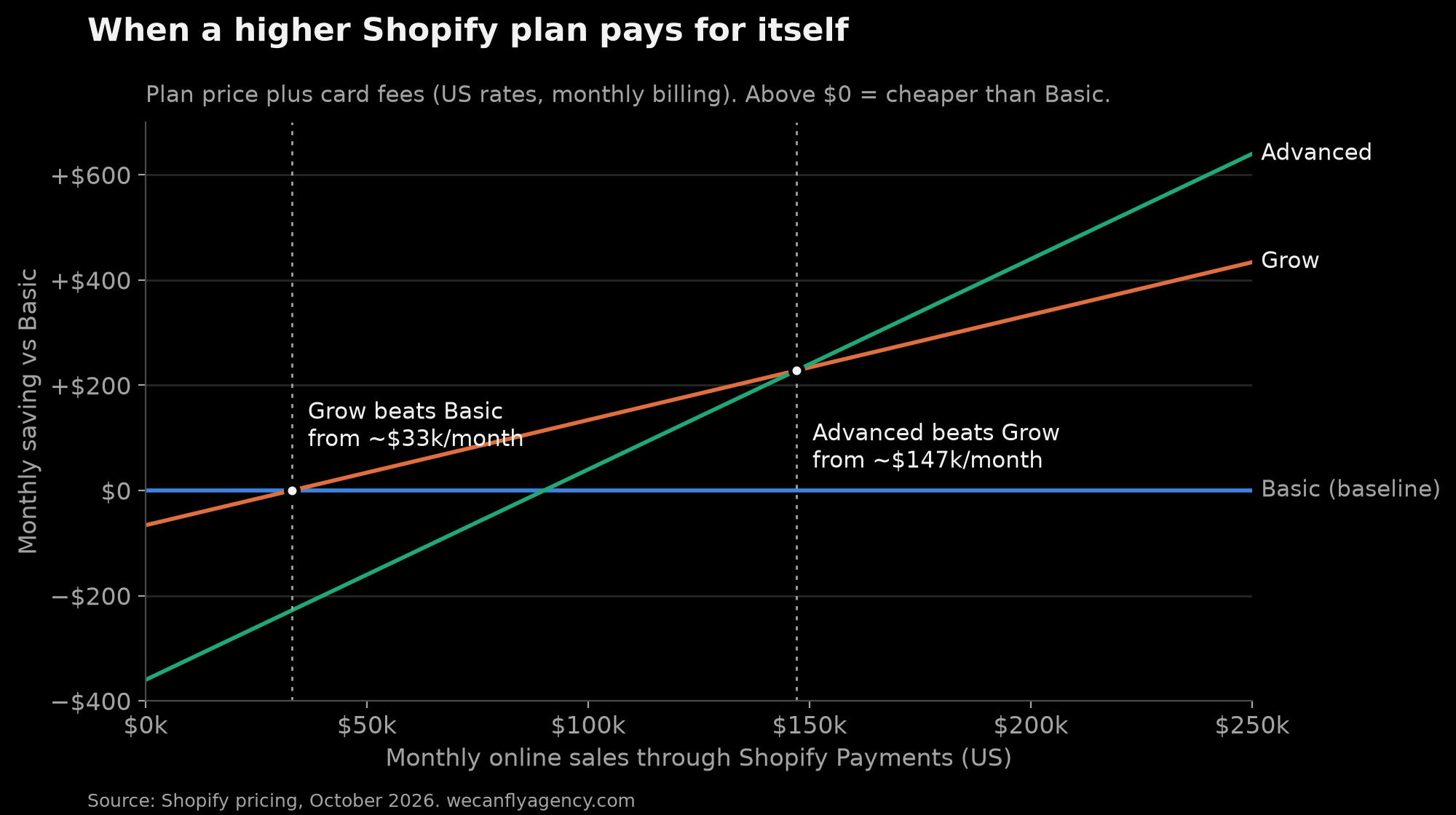
- Grow pays for itself from about $33,000 a month in sales, Advanced from about $147,000.
- Total cost of ownership matters more than the plan price: for a €1M-a-month brand, Shopify Plus can cost about half of a “free” Magento setup over three years.
- AI selling channels (ChatGPT, Gemini, Copilot, Meta's Muse) are included on Shopify; on self-hosted platforms you build them yourself.
Shopify pricing at a glance
| Basic | Grow | Advanced | Plus | |
|---|---|---|---|---|
| US, billed monthly | $39 | $105 | $399 | from $2,300 (3-year term) |
| US, billed yearly (per month) | $29 | $79 | $299 | from $2,500 on a 1-year term |
| Euro area, billed monthly / yearly | €32 / €24 | €92 / €69 | €384 / €289 | from €2,100 (3-year) or €2,250 (1-year) |
| UK, billed monthly / yearly | £25 / £19 | £65 / £49 | £344 / £259 | from £1,800 |
| Online card rate with Shopify Payments (US) | 2.9% + 30¢ | 2.7% + 30¢ | 2.5% + 30¢ | from 2.25% + 30¢, negotiable |
| Extra fee if you use another payment provider | 2% | 1% | 0.6% | 0.2% |
| Staff accounts | owner only | 5 | 15 | unlimited |
| Inventory locations | 10 | 10 | 10 | 200 |
| B2B features | yes (since April 2026) | yes | yes | yes, plus per-company price lists and expansion stores |
| Best for | new and small stores | growing stores | established brands, larger teams | high-volume and multi-market brands |
Quick answer: most new stores start on Basic or Grow. Grow pays off once you sell more than about $33,000 a month through Shopify Payments, and Advanced above about $147,000 a month.
Plus usually makes sense from several hundred thousand dollars a month or when you need its features. The maths is below.
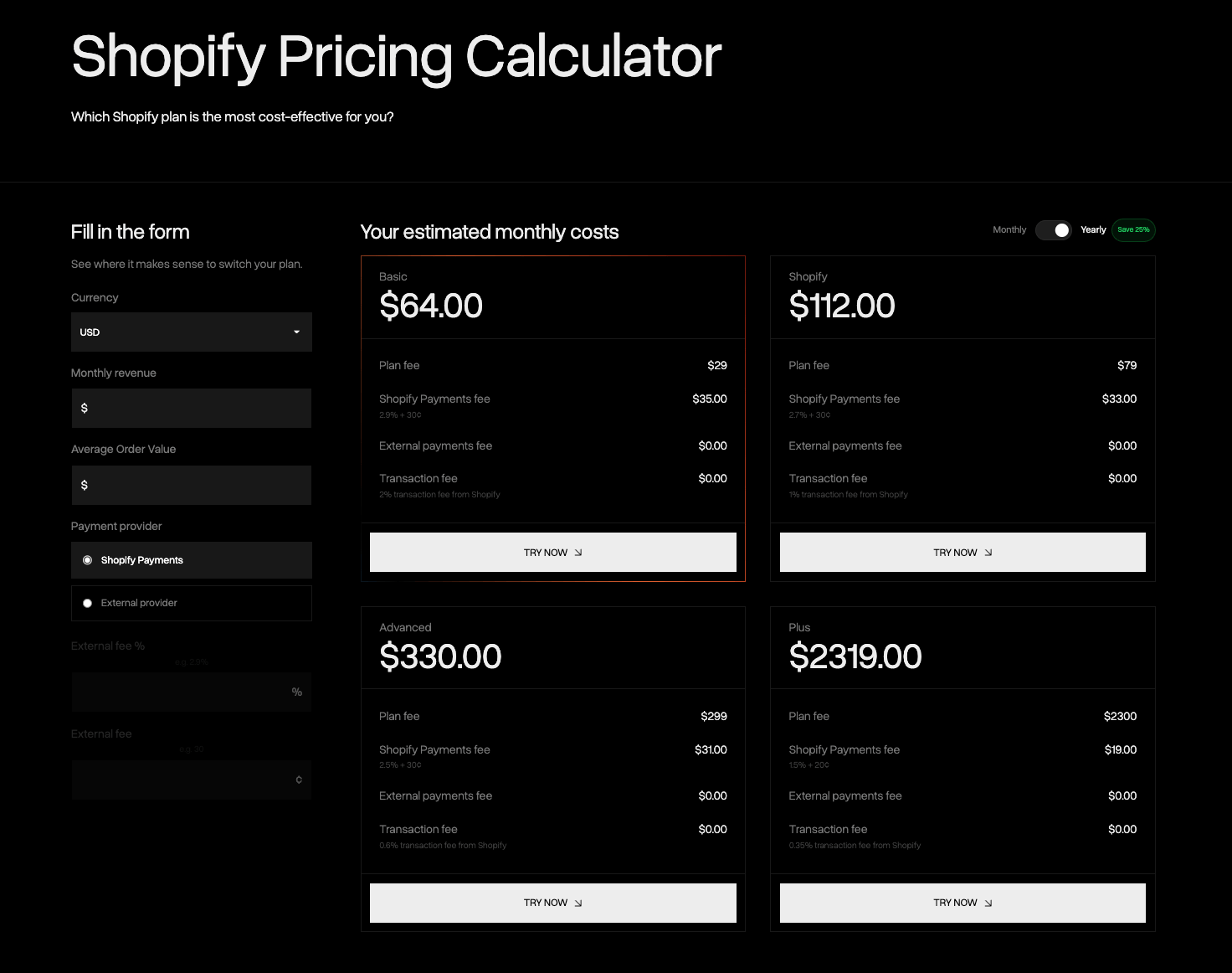
Want your own numbers? Use our Shopify plan calculator.
Shopify plans explained
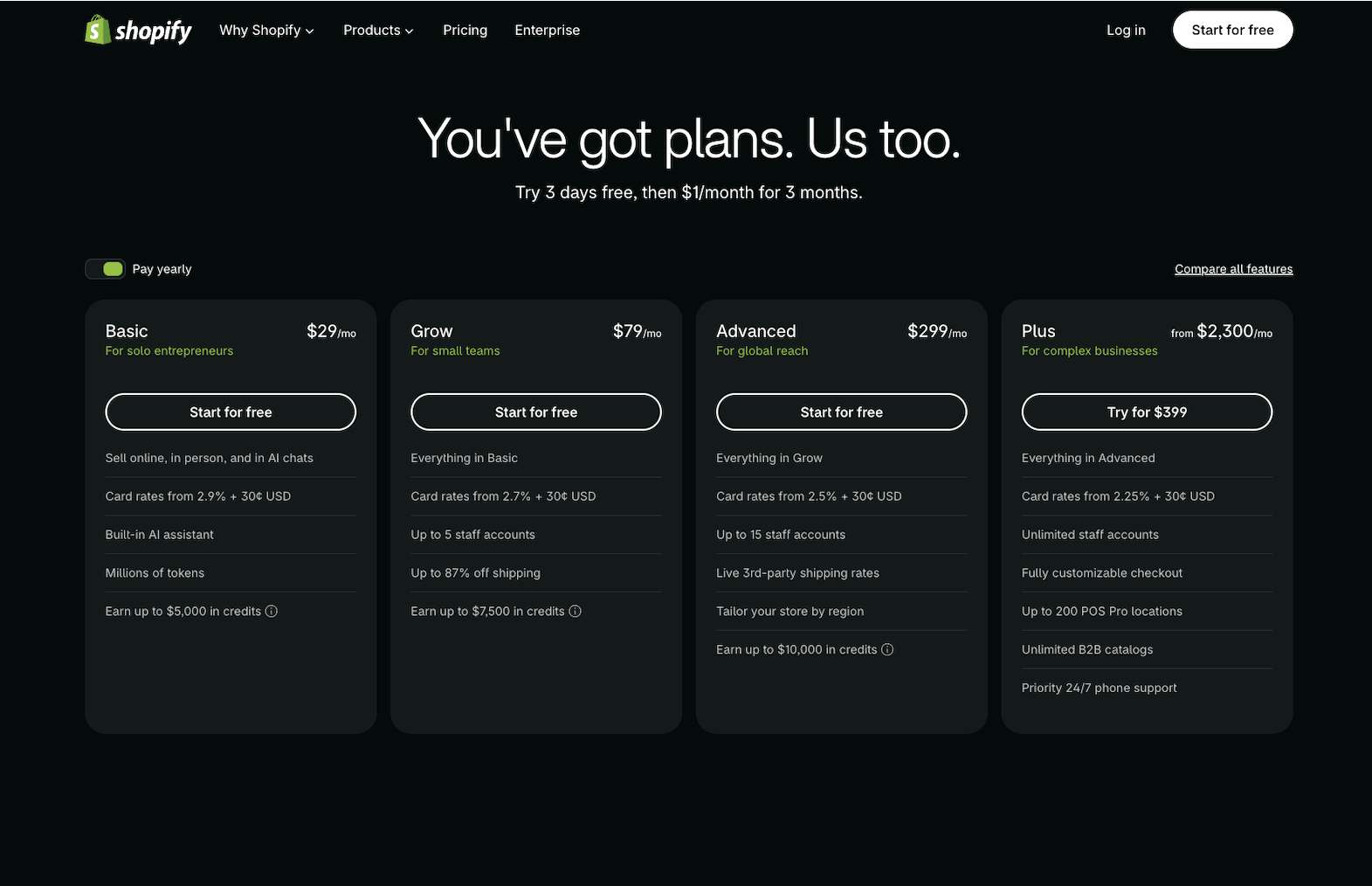
Every Shopify store runs on one of these pricing plans. You can pay monthly, or choose an annual plan paid annually, which is about 25% cheaper on Basic, Grow and Advanced.
Each step up to a higher paid plan unlocks advanced features and lower credit card fees, so the right plan changes as your business grows.
Shopify Starter plan ($5 a month)
Not a full store: checkout links and simple product pages for selling through social media or an existing website.
It charges a 5% fee on every sale, even with Shopify Payments, so it only makes sense for testing an idea with a few hundred dollars of monthly sales.
Shopify Basic plan ($39 a month, $29 billed yearly)
Everything you need to launch an online business: your own store with Shopify checkout, unlimited products, inventory management, Shopify Markets for selling abroad, and native B2B features since April 2026.
You run it from the Shopify admin, can sell across multiple sales channels (social media, marketplaces, messaging apps, in person with Shopify POS), start with a free theme from the Shopify Theme Store and add apps from the Shopify App Store when you need them.
The limits are the higher online credit card rates and no extra staff accounts. Basic (still often called the Basic Shopify plan) fits small businesses and founders running the store themselves.
Shopify Grow plan ($105 a month, $79 billed yearly)
The plan formerly called “Shopify”, renamed in 2026 with the same features. You get 5 staff accounts and lower payment rates.
Most stores that have a small team and steady sales end up here.
Shopify Advanced plan ($399 a month, $299 billed yearly)
15 staff accounts, the lowest card rates on the standard plans, more advanced reporting and third-party calculated shipping rates at checkout. For B2B it adds a dedicated B2B checkout and storefront experience.
It fits established businesses with a team and enough revenue for the lower rates to cover the price difference.
Shopify Plus (from about $2,300 a month)
The enterprise plan. Pricing depends on the contract term, and larger or more complex businesses move to a variable platform fee based on revenue.
It adds unlimited staff, up to 200 locations, 9 expansion stores (for other brands, markets or B2B), checkout customisation, Shopify Functions, per-company B2B price lists and dedicated support. More on Plus below.
Shopify Agentic plan (free)
A newer option for brands that sell only through AI channels such as AI shopping assistants: no monthly fee, you pay only when you sell.
It isn't a full online store, so it complements rather than replaces a regular plan.
Shopify free trial
Shopify currently offers 3 days free, then $1 a month for your first 3 months in the US (€1 in the euro area, £1 in the UK). The offer changes from time to time, so check the pricing page before you start.
Shopify transaction fees and payment processing
This is where most of your Shopify fees are, and where the plans really differ.

With Shopify Payments you pay only the credit card rate: in the US 2.9% + $0.30 per online transaction on Basic, 2.7% + 30¢ on Grow and 2.5% + 30¢ on Advanced. On Plus it starts at 2.25% + 30¢ in the US and can be negotiated.
To accept in-person payments, the Shopify POS system has its own, lower rates.
With a third-party payment provider (for example PayPal as your main gateway, or a local payment processor), Shopify charges its own transaction fee on top of the provider's fee: 2% on Basic, 1% on Grow, 0.6% on Advanced and 0.2% on Plus.
These higher transaction fees add up quickly. On a store selling $50,000 a month on Basic, that is an extra $1,000 every month.
Other fees to know about:
- Currency conversion when customers pay in a currency other than your payout currency.
- International and premium cards, which usually carry a higher rate than domestic standard cards.
- Shopify POS Pro, about $89 a month per location in the US, if you sell in physical stores (included for 20 locations on Plus).
- Local rates differ. For example, in Poland Shopify Payments costs 1.95% + PLN 1.20 per online card payment on Basic and 1.45% + PLN 1.20 on Plus. Always check the rates for the country where your business is registered.
Rule of thumb: if you can use Shopify Payments, do. Paying Shopify's extra transaction fee on top of another provider only makes sense when a local payment method is critical for your customers and isn't available through Shopify Payments.
Shopify pricing in the UK and Europe
Plan prices in euros and pounds are in the table at the top. Card rates are set per country, and in Europe they are much lower than in the US. The upgrade logic stays the same.
| Online card rate | Basic | Grow | Advanced | Plus |
|---|---|---|---|---|
| US | 2.9% + 30¢ | 2.7% + 30¢ | 2.5% + 30¢ | from 2.25% + 30¢ |
| UK | 2% + 25p | 1.7% + 25p | 1.5% + 25p | 1.3% + 25p |
| Ireland | 2% + €0.25 | 1.7% + €0.25 | 1.5% + €0.25 | 1.4% + €0.25 |
| Poland | 1.95% + PLN 1.20 | 1.8% + PLN 1.20 | 1.65% + PLN 1.20 | 1.45% + PLN 1.20 |
With UK rates and monthly billing, Grow pays for itself from about £13,300 a month in sales through Shopify Payments (£40 more, 0.3% lower card rate), and Advanced from about £140,000 a month (£279 more, 0.2% lower rate). Shopify's current UK offer is a 3-day free trial, then £1 a month for 3 months.
In the euro area (Irish rates, monthly billing), Grow pays for itself from about €20,000 a month (€60 more, 0.3% lower card rate) and Advanced from about €146,000 a month (€292 more, 0.2% lower rate). EUR prices are from Shopify's Irish pricing page; other euro countries can differ slightly, and card rates there are shown excluding VAT.
Shopify POS pricing
Every plan includes Shopify POS Lite for simple in-person sales on a phone or tablet. POS Pro adds staff roles, advanced inventory and omnichannel features for real shops: about $89 a month per location in the US and £69 in the UK. Shopify Plus includes POS Pro for 20 locations.
Budget separately for hardware such as card readers and barcode scanners. Stock, orders and customers stay in sync between the online store and your shops.

When does a higher Shopify plan pay for itself?
A higher plan costs more per month but takes a smaller cut of every sale. It pays for itself once the savings on fees are bigger than the price difference: break-even sales = extra monthly cost ÷ difference in rate. For Basic → Grow that is $66 ÷ 0.002 = $33,000 a month.
Here are the break-even points for monthly online sales (US rates, monthly billing; the fixed 30¢ per transaction is the same on every plan, so it doesn't change the result).
| Upgrade | Extra monthly cost | What you save | Break-even: sales through Shopify Payments | Break-even: sales through a third-party provider |
|---|---|---|---|---|
| Basic → Grow | $66 | 0.2% card rate, or 1% transaction fee | about $33,000 a month | about $6,600 a month |
| Grow → Advanced | $294 | 0.2% card rate, or 0.4% transaction fee | about $147,000 a month | about $73,500 a month |
| Advanced → Plus | about $1,900 | negotiated card rate, or 0.4% transaction fee | depends on the rate you negotiate | about $475,000 a month |
With yearly billing the thresholds are lower: about $25,000 a month for Grow and $110,000 for Advanced (with Shopify Payments).
Three examples
Example 1: a new store selling $20,000 a month
With Shopify Payments, Basic costs $39 + about $580 in card fees = about $619 a month. Grow would be $105 + $540 = $645.
Stay on Basic until sales grow (or until you need staff accounts).
Example 2: a growing brand selling $150,000 a month
With Shopify Payments, Grow costs $105 + $4,050 = about $4,155; Advanced costs $399 + $3,750 = about $4,149.
On fees alone it's a draw, so the decision comes down to features: 15 staff accounts, better reporting and B2B checkout tip it towards Advanced.
Example 3: an established brand selling $600,000 a month
This brand takes payments through a third-party provider, for example because local payment methods are essential. On Advanced, Shopify's transaction fee is 0.6% = $3,600 + $399 = about $4,000 a month. On Plus it's 0.2% = $1,200 + about $2,300 = about $3,500.
Plus is already cheaper on Shopify's own fees, before counting what you gain from its features. The provider's own fees are the same on both plans.
These examples count only Shopify's subscription and payment fees. Apps, theme, development and staff time usually change the decision more than the plan price, which is why the next section matters.
Look at the total cost of ownership, not the subscription
The most common mistake in platform decisions is comparing licence prices and subscription fees. A “free” open-source ecommerce platform has no licence fee, but you pay for everything Shopify bundles into its subscription: hosting, CDN, SSL, backups, security patches, uptime during traffic peaks, and the developers who keep it all running.
In our experience, small stores spend about 5% of revenue on running their ecommerce platform, while large brands on Shopify get it down to around 1%.
The total cost of ownership (TCO) has two parts:
| Fixed costs | Variable costs |
|---|---|
| platform subscription or licence | payment processing and transaction fees |
| hosting, CDN, SSL, backups (included on Shopify) | apps that charge by orders, contacts or catalogue size |
| security patches and version upgrades (included on Shopify) | development and support, which grow with complexity |
| monitoring and uptime guarantees (included on Shopify) | local payment providers' rates (often negotiable) |
Shopify Plus vs Magento: what a €1M-a-month brand really pays
An illustrative comparison for a brand selling €1 million a month (€12M a year) online, based on what we see in migration projects. Payment processing is left out because it costs roughly the same on both platforms. Your numbers will differ, but the structure won't.
| Monthly cost | Magento Open Source (“free”) | Shopify Plus |
|---|---|---|
| licence or subscription | €0 | €2,100–2,500 (higher if Shopify moves you to a variable fee) |
| hosting, CDN, scaling, backups | €1,500–4,000 | included |
| security, monitoring, compliance | €300–1,000 | included |
| extensions and apps | €500–1,500 | €1,000–2,500 |
| development team | 4–5 developers: €14,000–29,000 | 1–2 developers or an agency retainer: €5,000–10,000 |
| total per month | €16,300–35,500 | €8,100–15,000 |
| total per year | €196,000–426,000 | €97,000–180,000 |
| one-off migration | – | €35,000–70,000 |
| 3 years, as % of revenue | 1.6–3.6% | 0.9–1.7% (including migration) |
Over three years, the difference is roughly €270,000 to €670,000.
The biggest item is the team: a large Magento store typically needs four or five developers just to keep the platform up to date and secure, at 15,000–25,000 PLN (about €3,500–5,800) a month each in Poland, more in Western Europe. On Shopify, most of that work disappears into the subscription, and developers build features instead of maintaining servers.
Assumptions: developer costs from the Polish market (Western European rates are higher, which widens the gap); Magento Open Source on a managed cloud host; Shopify Plus on standard contract terms; app and extension costs from typical setups. Adobe Commerce (the paid Magento edition) adds a licence based on revenue on top.
What you don't see on the invoice
Some of the most important differences never show up in a spreadsheet, and they are often the real reason brands move:

- Peace of mind. No more patching infrastructure, chasing security updates or “plugging holes in the bucket” before a big campaign.
- Viral days without a call to the hosting company. When Eveline Cosmetics went viral in 2026, the store on Shopify Plus simply kept selling. Before that, the brand ran five separate stores; we moved them to one Plus instance in four months with zero downtime (case study).
- One team building instead of one team maintaining. On the self-hosted stores we migrate, most developer hours go into updates, security patches and hosting. After the move, the same people build features. That's the line that dominates the Magento table above.
- New markets as settings, not projects. Le Collet launched 8 language versions with EUR and USD pricing before Black Friday (case study). GANT split orders across 4 stock locations with an ERP integration and grew revenue 40% year over year (case study).
None of these is free on a “free” platform. They are just harder to put a number on.
AI: the cost difference most comparisons miss
In 2026, a big part of the platform price is access to AI. On Shopify, most of it comes with the subscription; on a self-hosted platform, you build and maintain it yourself.

Included on Shopify:
- Shopify Magic and Sidekick, an AI assistant in the admin that writes product descriptions and emails, builds reports, sets up automations and answers questions about your store.
- Agentic Storefronts. Your products are shared through Shopify Catalog with AI assistants such as ChatGPT, Microsoft Copilot, Google's AI Mode and the Gemini app, and since September 2026 Meta's assistant Muse, which can check out with Shop Pay. Shoppers can find and buy your products inside the chat, and you manage it from your Shopify admin.
- UCP (Universal Commerce Protocol), the open standard co-developed by Shopify and Google that lets AI agents read your catalogue and complete purchases. On Shopify the groundwork is done for you. More in our UCP explainer.
On Magento or another self-hosted platform, each of these is a separate integration project: product feeds for every AI platform, an agent-ready checkout, and ongoing maintenance as the standards change. For a brand that wants to sell where its customers now ask for recommendations, that is months of development before the first AI-driven order.
Apps are getting cheaper, too
The usual argument against Shopify is the cost of apps: a dozen monthly subscriptions that grow with your order volume. That argument is weakening.
With AI-assisted development, we now build custom apps for our clients' exact needs (a loyalty programme, a B2B ordering flow, a product configurator, even a mobile app) in a fraction of the time it used to take. You own the app, there is no monthly licence per feature, and it does only what you need.
For many stores, replacing two or three subscription apps with one custom app can pay for itself within a year. See our Shopify app development and mobile apps services.
Shopify vs other platforms on price
- Wix and Squarespace have cheaper entry plans, but their e-commerce features, app ecosystem, B2B and POS are much more limited. Fine for a small shop next to a website; not for a growing brand.
- WooCommerce, Magento and Shopware look free or cheap on licence, but hosting, security, updates and developer time make them more expensive for most growing brands, as the Magento example above shows. See our Shopware to Shopify and Magento to Shopify migration pages.
- Adobe Commerce, Salesforce Commerce Cloud and other enterprise platforms charge licences based on revenue, often far above Shopify Plus, plus implementation and hosting.
The costs that aren't on Shopify's pricing page
In the projects we see, these add up to more than the plan itself:
- Apps. Reviews, subscriptions, search, loyalty, email and SMS, translations, B2B extras. Most are monthly subscriptions, and many charge more as your order volume grows. Audit them once a year; stores often pay for apps they no longer use.
- Theme. Free themes are good for a start; premium themes are a one-off cost of a few hundred dollars. A custom theme is a development project.
- Development and design. Custom features, integrations with an ERP or PIM, and design changes. For established brands this is usually the biggest cost after payment processing.
- Migration. Moving products, customers, orders and SEO from another platform is a one-off project; its cost depends on data volume and integrations.
- Point of sale. POS Pro per store location, plus card readers and other hardware.
- Email and marketing tools, priced by contacts or messages (for example Klaviyo).
- Your team's time. Lower platform maintenance is one of the main reasons brands choose Shopify over self-hosted platforms, so count it when you compare.
Shipping, taxes, domains, themes and apps
These are the smaller line items that sit next to every Shopify plan. None of them decides the plan on its own, but together they belong in your budget.

Shipping
Shopify Shipping gives you discounted labels from carriers such as USPS, UPS and DHL in supported countries. There is no extra subscription; you pay only for the labels you buy.
Third-party calculated shipping rates, which show live carrier prices at checkout, are included on Advanced and Plus. On Grow you get them with yearly billing, or as a paid add-on with monthly billing.
Taxes
In the US, Shopify Tax calculates sales tax automatically. It is free up to a yearly sales threshold and then charges a small percentage per transaction.
In the EU and UK, VAT rates are set in the admin for each market. Most stores still need an accountant or a tax app for filings.
Domain
A custom domain bought through Shopify usually costs about $10–20 a year for a .com. You can also connect a domain you already own at no extra cost.
Themes
The Shopify Theme Store has free themes and premium themes that cost about $100–500 as a one-off payment. A custom theme built by an agency is a development project, measured in thousands rather than hundreds.
Apps
The Shopify App Store has thousands of apps. Most paid ones cost about $5–300 a month each, and some charge by orders or contacts.
App fees are the line that grows fastest as a store scales, so review them regularly.
Shopify Capital
Shopify Capital offers eligible merchants funding that is repaid as a share of daily sales. It's financing, not a plan cost, but check the total you will repay before you accept an offer.
Shopify Plus pricing
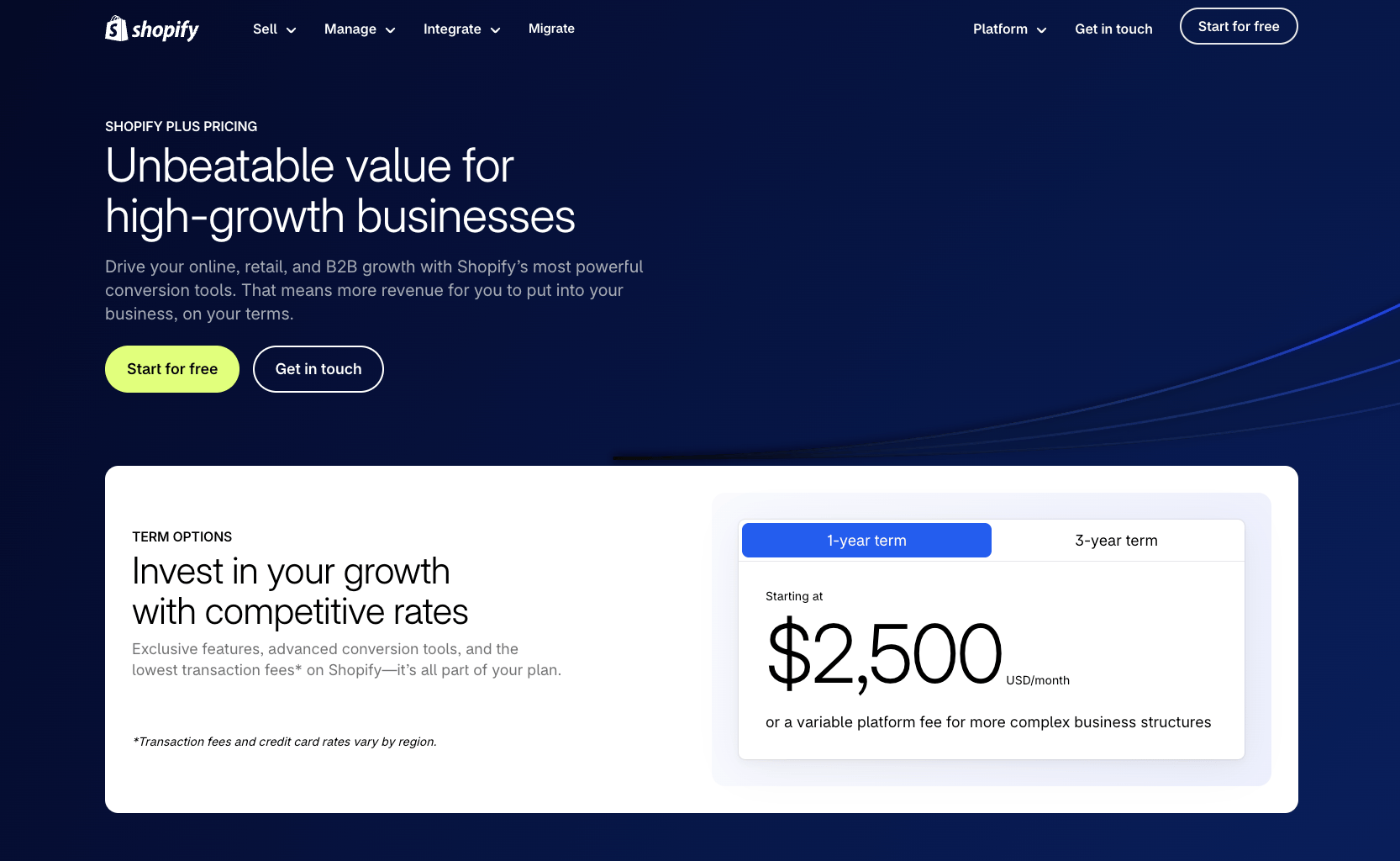
Shopify Plus starts at about $2,300 a month on a 3-year term in the US; a 1-year term starts at $2,500. In Europe it starts at €2,100 a month on a 3-year term or €2,250 on a 1-year term. Higher-volume or more complex businesses move to a variable platform fee based on revenue and business model, which Shopify quotes individually.
What the price includes on top of Advanced:
- unlimited staff accounts and up to 200 inventory locations,
- 9 expansion stores for other brands, markets or a separate B2B store (more cost €250 a month each in Europe),
- checkout customisation with Checkout Extensibility and Shopify Functions,
- B2B price lists per company and location, deposits and partial payments,
- POS Pro included for 20 locations,
- the lowest third-party transaction fee (0.2%) and negotiable card rates,
- priority support.
When Plus pays off. Check three things, in this order:
- Your fees. On a third-party gateway, Plus beats Advanced on Shopify's own fees from about $475,000 a month (0.4 p.p. lower transaction fee against about $1,900 more in subscription). The $600,000 example above is already cheaper on Plus. With Shopify Payments, it depends on the card rate you negotiate.
- Your store count. If you'd otherwise run separate Advanced stores for other brands, markets or a B2B channel, each one costs $399 a month plus its own apps. Plus includes 9 expansion stores.
- Your B2B price structure. Native B2B works on every plan, but price lists per company and location, deposits and partial payments need Plus. For brands with dozens of trade accounts on negotiated prices, this is usually the deciding feature.
Read more in Shopify Plus vs Advanced and on our Shopify Plus development page.
How to choose your Shopify plan
- Estimate monthly online sales for the next 12 months, not just today's.
- Decide how you'll take payments. Shopify Payments where possible; if you must use another provider, the break-even points drop a lot.
- Count the people who need their own login.
- List the must-have features: B2B checkout, several stores, custom checkout logic.
- Add apps, development and migration to get the real yearly cost.
- Check the numbers in our Shopify plan calculator, or talk to us if you are weighing Advanced against Plus.
How to save money on Shopify
- Switch to yearly billing once you are sure about the plan: about 25% off Basic, Grow and Advanced.
- Use Shopify Payments wherever it's available. It removes Shopify's extra transaction fee, and Shop Pay usually lifts checkout conversion too.
- Start with a free theme and invest in design once you know what your customers need.
- Review your apps every quarter. Remove what no longer drives revenue or saves time, and check whether one custom app could replace several subscriptions.
- Re-check your plan when sales change. The break-even points above move with your volume and payment mix.
- On Plus, negotiate the contract term and card rates; a 3-year term is the cheapest monthly price.
Shopify pricing FAQ
How much does Shopify cost per month?
$39 on Basic, $105 on Grow and $399 on Advanced when billed monthly in the US ($29, $79 and $299 billed yearly). Shopify Plus starts at about $2,300 a month. Payment processing, apps and development come on top.
Does Shopify take a percentage of sales?
With Shopify Payments you pay only card processing (in the US from 2.9% + 30¢ on Basic down to 2.5% + 30¢ on Advanced). With another payment provider, Shopify adds a transaction fee of 2%, 1%, 0.6% or 0.2% depending on the plan.
Can I avoid Shopify transaction fees?
Yes, by using Shopify Payments, where it's available in your country. Then you pay card rates only.
Is Shopify cheaper than WooCommerce or Magento?
The licence is only part of it. Self-hosted platforms add hosting, security, updates and developer time, so for most growing brands Shopify has the lower total cost. See our comparisons of Shopify and Magento and our migration services.
Do I need Shopify Plus for B2B?
Not anymore. Since April 2026, native B2B works on every plan; Plus adds price lists per company, deposits and partial payments, and expansion stores. See B2B on Shopify.
Is yearly billing worth it?
If you are sure about the plan, yes: it saves about 25% on Basic, Grow and Advanced.
Can I change plans later?
Yes. You can upgrade or downgrade the standard plans at any time; Plus contracts run for the agreed term.
How much does Shopify cost in Europe?
Prices are set per country and currency. In Poland, for example, Basic is PLN 109 a month and Plus starts at €2,100 a month on a 3-year term. Check the pricing page for your country.
Is there a free Shopify plan?
No permanent free plan for a full online store. Shopify offers 3 days free, then $1 a month for the first 3 months (€1 in the euro area, £1 in the UK). The free Agentic plan only covers selling through AI channels.
How many staff accounts do I get?
None extra on Basic, 5 on Grow, 15 on Advanced and unlimited on Plus. Staff accounts are one of the most common reasons to move from Basic to Grow.