
Mateusz Kasprzak, OPTISOFA: how to sell furniture online – own delivery fleet, renders and entering Germany
Listen to how the Polish brand OPTISOFA successfully moved its sales to the online world!
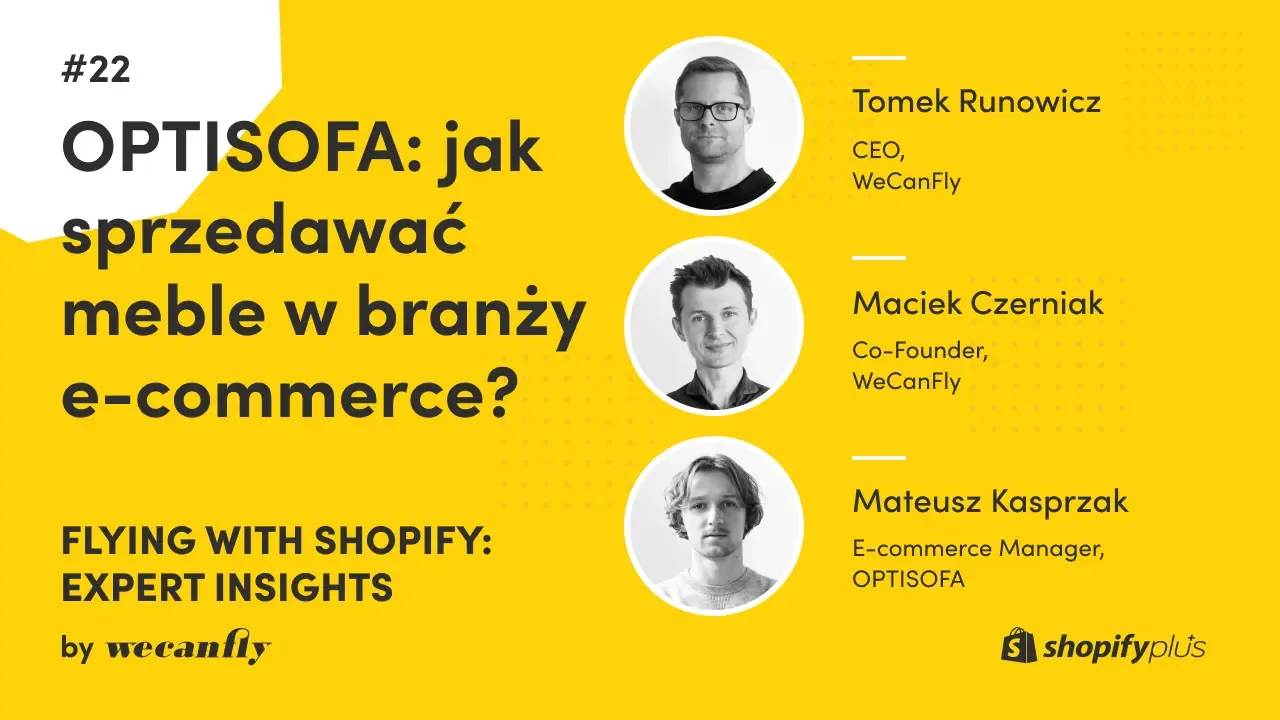
Episode in Polish, English subtitles available. Below: an edited English translation of the full conversation.
Mateusz Kasprzak, e-commerce manager of OPTISOFA, a family-owned Polish sofa manufacturer that was 33 years old at the time of recording, tells Tomek Runowicz and Maciek Czerniak how an experimental store that cost PLN 4,000 grew into the channel that, at the time of recording, brought in practically 100% of the company's revenue. He talks about building an in-house delivery fleet after a failed partnership with a logistics company (eight out of ten deliveries went wrong), about renders and free fabric samples instead of heavy ad spend, made-to-measure furniture, returns, and entering Germany and Austria. The episode is for furniture brands and manufacturers who want to sell large, expensive products online.
Key takeaways
- The store started as Mateusz's experiment while he was at university, with no targets and no one holding him to account: a local developer built the first version on his own system for PLN 4,000, it took a year to a year and a half, and for the first year the store sold practically nothing. Mateusz noticed the first order (two sofas) three weeks after it came in, thanks to a PayU payout email, and delivered the furniture himself. Product photos were also used in printed catalogs, so the start cost almost nothing. (5:38, 7:14, 8:32, 9:28)
- The move online was gradual, because contracts with retail chains couldn't be terminated. At one or two orders a week (after about a year) the company made two decisions: a new store on WooCommerce, ready in a month or two, and a new ERP system for production. In 2020, at the start of the pandemic, OPTISOFA stopped selling through brick-and-mortar stores. At the time of recording, practically 100% of revenue came from online channels, about 50–60% of it from the brand's own e-commerce and the rest from marketplaces, including sales in the UK. (11:29, 14:37, 15:11)
- Logistics shaped the business model. An external logistics company failed to deliver properly in practically eight out of ten cases (damaged sofas, wrong delivery dates, one fitter showing up instead of the two-person crew OPTISOFA paid for), so after about six months OPTISOFA invested in its own fleet and drivers. At the time of recording it delivered itself in Poland, Germany and Austria, drove full truckloads to a marketplace warehouse in the UK, and planned France and Spain with a logistics partner. It only opens a new market once it knows delivery won't ruin its reviews. (18:41, 21:55, 23:54, 52:22)
- Instead of a big ad budget: good descriptions (fabrics, fillings, construction), renders of every product in every fabric, because "you can't reproduce 100, 200 or 500 photos in the same way" (translated from Polish), a configurator, and free fabric samples sent out from the very first store. The fear that customers wouldn't buy a sofa they couldn't touch turned out to be unfounded: with a good description, seat firmness wasn't a problem. (17:28, 26:27)
- In Mateusz's view, a showroom is more about image and letting people touch the product than a sales channel. When a Warsaw location where OPTISOFA displayed its furniture closed, online sales didn't drop, and in Germany and Austria sales grew with no physical presence at all. (29:55)
- Customers choose made-to-order furniture: products from stock fell from nearly 60% of store sales to 5–10%, because shoppers associated them with imports or "second-rate goods". Configuration covers the legs and about 60 fabrics, never the dimensions, and every product can be returned, including configured ones, for a full refund. For selling abroad with a delivery partner, the company switched its focus to fixed sofas shipped in a box instead of sofa beds, which need assembly and are easier to damage. (36:33, 38:21, 40:24, 41:15)
- Returns are data for improvements: when reports in the store show that a fabric or model is often sent back, OPTISOFA withdraws it right away, and one model sold for several years is already in its tenth version. Abroad, marketing is drastically more expensive; the German site, chat and helpline are in German, but Instagram and the newsletter run in English. Google ads were mostly product (Shopping) campaigns, with the company moving to display and video. About 10 people ran e-commerce (9 on the own store, 1 on the marketplace). (31:11, 32:40, 33:53, 42:33, 46:10)
State as of November 2026: the new store for foreign markets that Mateusz mentions (31:11) is the headless Shopify store we built in 2023, when we moved OPTISOFA from WooCommerce to Shopify Advanced. When a redesign was due, the store went back to a custom Shopify theme (Liquid): we designed and built the new store in 2025, launched in 2026. Why the brand went back to a theme is explained in our examples of brands using headless Shopify.
Guest
At the time of recording, Mateusz Kasprzak was the e-commerce manager of OPTISOFA, a family-owned sofa manufacturer founded by his father and uncle. After taking over the company, he worked across production, sales and controlling before focusing on e-commerce. He built the brand's online channel from its very first store and led the team that ran online sales in Poland, Germany and Austria.
Hosts
Tomek Runowicz and Maciek Czerniak run wecanfly, a Shopify Premier Partner agency that helps established brands with complex migrations to Shopify Plus. For OPTISOFA, we moved the store from WooCommerce to Shopify, designed it from scratch and implemented a 3D and AR configurator by Mimeeq (case study). If you're planning a similar move, see our WooCommerce to Shopify migration services.
More on selling furniture online: Best practices for great UX in the home and decor industry, which quotes this conversation, 7 brilliant furniture configurators and How to handle furniture logistics in e-commerce. Mirosław Mikołajczak, CEO of Selsey, talks about selling furniture across Europe in the episode Selsey: from Groupon to 2 million parcels and 8 markets.
Transcript
This transcript is based on the recording of this episode. We edited it for readability: we corrected transcription errors, punctuation, and merged sentences that were cut off mid-flow. We did not change the content, order, or meaning of anything said. Any errors or inaccuracies are our responsibility alone — not our guests'. If you spot something that needs correcting, email us.
Episode recorded in Polish, published 16 January 2024; figures and plans (including the official opening of the new factory on 13 January) refer to the time of recording.
Who is Mateusz Kasprzak?
Tomek: Hi! Welcome to another episode. Today we've prepared a dose of very practical information about running e-commerce, all thanks to our guest: Mateusz Kasprzak, e-commerce manager of the OPTISOFA brand. He'll tell us how, a few years ago, he joined the family business, decided to build an online channel and started selling furniture on the internet. Enjoy the conversation. Hi, Mateusz.
Mateusz: Hi, hi.
Tomek: I'm glad you found the time and agreed to talk to us today. We'd like to ask you about the success you've achieved as e-commerce manager in the company you joined, because it's your family's furniture manufacturing business. But before we get into the detailed, very practical conversation, could you introduce yourself more fully? In the intro I only mentioned your role in the company in a few words.
Mateusz: Sure. Hi! Thanks for the invitation. In short: my title is e-commerce manager. It's a family business, so a few years ago, when I took over the company, I naturally dealt with everything, as is usually the case in family businesses: production, a bit of sales, a bit of controlling. My path went in such a way that I became the e-commerce manager, and right now my main job is e-commerce. I have a team, and that's what I do every day.
How did OPTISOFA start, and where did the idea of selling online come from?
Tomek: Right. I remember, Mateusz, when we first met, when our cooperation was only just beginning. That was almost two years ago, and I have to say I was really taken by the story you told: how you joined the company and got your way. OPTISOFA's business model until then was classic manufacturing and selling mainly through physical stores and branches. You bet on the online channel and wanted to convince your family that it was a good idea, which at first wasn't obvious at all. Maybe let's start with you telling us more about the history of the company itself, how it was founded and how it grew, and then move smoothly to the moment you launched the new online sales channel.
Mateusz: Sure. The company is 33 years old now, so that's quite a history. My dad founded it with my uncle in a garage, actually in the family home. They started in the garage, making furniture, and since it was the 1990s, a good time for any company that made anything, if you took root well, things moved forward naturally. Back then we didn't sell as OPTISOFA at all, but as a company that simply had our surname in its name. The company grew, we employed quite a lot of people and sold through various channels, but mainly through retail chains, which changed over the years depending on how the market shaped things and what was right for us as a business.
Mateusz: And that brings me smoothly to opening the e-commerce channel, because, as you said, it was quite interesting for us. I was still studying at the time and wondering which career path to choose. I was always drawn to the family business, because the topic came up at home from morning till night, practically my whole life. I kept thinking and thinking and came up with the idea: hey, maybe we could start selling online. At the time we were starting to sell to our trading partners, who were also moving into online channels; we met them at the furniture fairs we attended. They also tried to convince us that it was worth being on their online stores. I thought, well, why not.
Mateusz: The company was doing well then, there were no problems: we were selling and producing. Our main problem at the time was actually production capacity. So I got quite a big vote of confidence from my dad and my uncle. It could be my experimental project, which wasn't held to any targets, in which I invested very little money and which I could test by trial and error. At the same time I was a full-time student and trying to do something online, and at some point it turned out to be a good direction and maybe worth making more professional and doing much more properly.
The first store: a year without sales, then the first order
Tomek: Did you start with your own store or with selling on marketplaces?
Mateusz: Basically at the same time, only on marketplaces we were just starting to sell back then. I'm trying to remember exactly how it went; let's say it was around the same time. But in the store I really didn't sell anything for the first year. It wasn't like some stores do now, where they go online with everything done very professionally, with full market research: we launch and start selling. With us, I came up with something in my head and found a local IT guy who had a store system he'd written himself. He built that store for a year or a year and a half, quite a long time. We added the first products, and after a while the first orders started coming in. It wasn't very professional, but it worked. And I guess it had to work, because I was doing it more out of passion and the wish to try something new.
Maciek: That's what I wanted to ask: what made you keep this project going for so long? The statistics say that most e-commerce businesses that don't sell fold within the first 120 days. Most companies that sold nothing for a year would probably have some costs and give up. I'm wondering how it was for you. Didn't you have, I assume…
Mateusz: No. First of all, I had no constraints and no pressure for it to work. As I said, the company was doing well and selling large volumes to retail chains, so nothing was forced. We were only just building that e-commerce and everything was created on the fly. We didn't have a project or a plan from A to Z; I learned as I went how it could be done, how to show the products we had online. At the same time, photo shoots were happening. We spent practically nothing on advertising, we tried to handle it organically, so there were practically no costs. The material created for the internet was used anyway in print, for example in catalogs, which the business needed anyway. So, no costs. I still remember that the first store cost 4,000 zlotys. I can say that here too.
Maciek: Good price.
Mateusz: Times have changed a lot. It wasn't very functional. But I can tell you a fun fact: the first order that came from the store…
Maciek: That's exactly what I wanted to ask about. I have to.
Mateusz: Yes. I remember exactly which city it was and which products. Two sofas, and I saw the order three weeks after it came in. We had the store and payments set up, but it was a bit of a side project, and as I said, I was a full-time student. I think we were even sitting in a restaurant, I'm looking at my phone, going through emails, and I catch a notification from PayU that there's a payout. Payouts came every two weeks or so, I think. I think: "Oh wow, what's this?" I log in, and someone had ordered furniture. A very interesting experience. And I think that's when I started to believe it was a good direction after all and that it might be worth doing it much more properly, by the book, so to speak.
Maciek: Did you manage to deliver that first order, and the customer wasn't angry?
Mateusz: Yes, we produced it very quickly, because our delivery time back then was about six weeks; that's our standard time, five or six weeks. I drove it there myself, because at the beginning I ran the whole store one hundred percent on my own. I mean I even delivered the furniture and carried it in for customers. That's how it was.
Maciek: How long were you on your own? When did the first person join your team?
Mateusz: I think after about half a year, I don't remember the exact date. We put a lot of weight on family values, so the first person who started working here was my fiancée at the time, now my wife. She was the first to join the team, really to join me. I also used the resources of the company's sales department, which had sometimes helped with various things before.
How do you convince a family business to go online?
Tomek: Mateusz, when the vision that online sales was a good direction took root and you became sure of it, I assume the next step was convincing the rest of the family to invest in online sales. But also the changes the company itself had to go through, an internal digital transformation, so to speak: from a very physical company with a fairly traditional business model to one open to the online channel. Can you tell us, first, whether you really had to convince your family for a long time, and second, which I think is very important for people watching who may be in a similar situation: what did the company's transformation look like, to start serving the online channel seriously?
Mateusz: So. Did I have to convince them for long? A bit, yes, but not in the sense of explaining that it was worth it, because the whole management board knew it was worth it and that it was the direction of the future. The bigger problem was that we were producing for retail chains, and the contracts with them are such that you can't terminate them in any way; playing with contracts like that is simply dangerous, I'd put it that way. So we had to do it naturally: we couldn't bet everything on one card and suddenly start selling online, we had to gradually shift sales from the traditional channel to the online one.
Mateusz: To properly convince everyone and free up money for a bigger investment took, I think, about a year. During that year we were already selling, one or two orders a week were coming in. When customers appeared, phone calls and emails started, and everything worked not once a year but regularly, we were one hundred percent sure we were going in this direction and growing the way we should, meaning digitizing the company.
Mateusz: That was a breakthrough moment for us, when we made a few decisions. First: that first store had to be done more properly, but also faster. We don't have time to build it for another year, we act right away as we should. Second: to digitize the part of the business that handles production. I want to stress that we are first and foremost a manufacturer, not a retailer, so production and all the processes inside the company are extremely important and have always been the most important thing for us. We invested in an ERP system to manage the whole business. We already had such a program, but it didn't meet all our needs. At the same time we invested in an online store, which we built on WooCommerce on WordPress: a fast and fairly cheap solution at the time. After a month or two we had a new site on a new engine.
Mateusz: Everything was supposed to be great. We started investing in Google advertising and in all the online channels where we advertise now. And the first problems and challenges appeared, technological ones too, which we had to respond to. We started having problems with the helpline, with the email inbox, with things that you'd think shouldn't be a problem.
How much of the business is online today?
Tomek: Can you tell us, so we get a sense of scale, what the ratio is between e-commerce revenue and the rest of your sales? Is it a significant share?
Mateusz: Right now practically 100% of the whole company's revenue comes from the online sales channel. Our own e-commerce is, I think, somewhere around 50–60% at the moment. It keeps changing. That's because in countries such as Poland, Germany or Austria we now sell only through our own e-commerce channels, whereas in England, for example, it's easier for us to do it through a marketplace. Hence the…
Tomek: So, Mateusz, you've moved away from brick-and-mortar sales completely?
Mateusz: Yes, we moved away from brick-and-mortar sales in 2020, so the start of the pandemic was key for us. But it wasn't a carefully thought-through decision, it happened on the fly, so to speak. There was a need. We were very well prepared for the pandemic, although of course nobody expected it. We had a ready e-commerce store with ready products, good renders and a basic fabric configurator. We also already had our own transport; maybe questions about that will come later, I want to get to it. When the pandemic came, brick-and-mortar stores were closed. The cost of production materials went up dramatically, and it turned out that what we were making for retail chains and stores was no longer profitable. Online, we have so much freedom that we can adjust prices. With respect for the customer, of course, but when prices of everything go up sharply from every side, we have to react simply to stay afloat.
How do you sell a sofa the customer can't touch?
Tomek: Right. Mateusz, you've raised a question that belongs to the next part of our conversation, and I think it's an extremely important one. You're mainly a manufacturer, but we're here to talk about selling furniture online, so items that are definitely not small, non-standard, with their own specifics as an e-commerce sector. Can you tell us what's non-standard about selling products you can't send to a parcel locker or with a regular courier? What are the specifics and how do you deal with the challenges? Especially since, as you've said, you don't sell only in Poland.
Mateusz: Yes. I'll tell you this: at first it was very hard for me to get my head around. How do you sell a product like a sofa when you don't want to sell something cheap and low quality, but a nice, designer, high-quality product that is also super comfortable? I was wondering how to do it. Especially since, when we sold in stores, we had quite a lot of returns from customers because the product didn't meet expectations: it was uncomfortable, too firm or too soft. If it goes wrong even when someone can touch the sofa in a store, how do you sell it online? And listen, it turned out not to be so scary at all. Customers who buy online and read a good description really don't have a problem with whether the sofa is too firm or too soft. That was the first challenge, and it turned out the problem was in my head and wasn't really a problem. Maybe I went off on a tangent. And the second thing: you also asked about parcel lockers…
Logistics: why does OPTISOFA run its own fleet?
Tomek: Logistics, yes.
Mateusz: Transport and logistics, yes. From the very beginning, when we bet on e-commerce and started selling under our own brand, putting our name on the products we make and sell, we've wanted to do something of quality. We never went into serial mass production of a cheap product with fast courier shipping. We work to a somewhat different standard, which in my opinion is harder but more rewarding. It's also nicer to go to work where you do something you believe in.
Mateusz: Let me go back in time a bit. For the first year, I delivered the furniture myself. That was simply the easiest way to prove the project made sense without tying up the company's money and capital. At some point it got so troublesome that weekly trips were out of the question, so we had to think about what next. We then signed a contract with a logistics company that was supposed to deliver our products to customers all over Poland and assemble them on site. That turned out to be one big flop, because practically eight out of ten deliveries weren't carried out the way they should have been. Sofas were damaged, very often they arrived at a different time slot than the one we'd given the customer, sometimes on completely different days. The fitters, and we paid for a two-person crew, would show up alone, refuse to carry the sofa in, or argue in front of the customer that assembling the sofa wasn't part of their standard service. It was simply a horrible experience.
Mateusz: I mention our standards because we want to do something of quality. In theory we could have been happy about it, because for every such delivery we filed a claim and, this may sound ugly, the compensation was higher than the delivery cost we paid. Of course this came with very high customer dissatisfaction. It went on for half a year or a few months and we said: no, this can't go on. We want to do it properly and sell in a way that makes the customer happy with the product and the service, from visiting the site and ordering all the way to delivery, and remember us fondly. We decided to invest. That was our first big investment: in our own fleet of vehicles and our own, let's call it, logistics department that delivers the products itself. The decision meant, first, a considerable investment, and second, a risk that it might not work out. But we invested in the fleet, hired our first drivers, and it turned out to be spot on.
Poland, Germany, Austria: how to choose the next markets?
Tomek: And do you deliver only within Poland, or further afield?
Mateusz: We drive ourselves within Poland, Austria and Germany. We're growing the e-commerce channel; maybe it's not popular in the age of startups, but we do it in a somewhat organic way that is safe for us. Right now we've moved into a new factory, which officially opens on 13 January, so I don't know when people will be watching this. We have the production capacity to increase production a lot, and an e-commerce store strong enough that we could enter any country we want. But we don't, precisely because of logistics. We don't want a false start where we enter a market and logistics turns it into a flop. I mean customer feedback, reviews and the whole perception of us as a company, because we care about that a lot.
Mateusz: That's why we're in Poland, six months ago we entered Germany, and Austria was the natural next step. We keep selling on these markets and keep increasing sales. Austria turned out to be a great market for us: it's not too big, but it's very absorptive, as it turns out. In the coming months we'll open more countries: the closer ones will be served by our own logistics, and for countries such as France or Spain we're looking for, or negotiating with, a partner who will handle deliveries for us.
Tomek: Right. You mentioned earlier that besides the countries where you're available with your online store, you also sell through marketplaces. How do you organize logistics there?
Mateusz: That's on the marketplace's side. We bring full truckloads to England, also with our own fleet; our drivers simply drive there. These are whole trucks of furniture delivered straight to the warehouse, and the marketplace takes care of the rest. We also have a plan for the future: not to close that channel, because it's good for us in terms of security, meaning having several legs to stand on, but also to develop our own e-commerce in the UK.
When did you start building the OPTISOFA brand?
Maciek: Right. I wanted to ask when you consciously started investing in brand awareness and your own brand. When did that happen? You mentioned that at the beginning the company simply had a surname in its name, so I'm curious when you decided to consciously build the brand.
Mateusz: It started at the same time as selling online, because the first e-commerce store ran under the OPTISOFA brand, so it was somewhat natural. But the milestone was 2020, when the pandemic started and we went 100% into online sales. From then on it was serious work, and that's how we've worked since. We also did a small rebrand then: we changed our logo and adapted it a bit to current times. The OPTISOFA brand itself has existed for, I think, close to 20 or twenty-something years as a trade name, with an earlier logo, although we sold under the company name with the surname. It was always in the background, but there had never been an idea of how to use it. There was only the idea of creating a great brand. And it came about naturally.
Content over advertising: renders, descriptions and free fabric samples
Maciek: I'd like to go back to the topic Tomek started: practical tips and the specifics of buying furniture online. You mentioned it's important to build realistic customer expectations, whether through a detailed, precise description or through high-quality renders. Looking back, are there other things in online sales that worked well for you? Any conclusions or lessons you've drawn?
Mateusz: Yes. From the beginning our direction was that the content on the site, the descriptions and the whole site should be high quality. There are often stores with a large product base, with average descriptions, that invest a lot in advertising. We decided it would be safer to deliver great content in a nice, clear way for the customer and invest a bit less in advertising. But once we win a customer, we want them to stay on the site, read all the information they're interested in and, in the end, make a purchase decision.
Mateusz: It wasn't easy to do it that way. It meant very large investments, for example rendering all products in all fabrics. At first we only had a few products with photos that were still natural, meaning taken by a photographer. But the costs were high and the quality of those photos varied, because you can't reproduce 100, 200 or 500 photos in the same way, because the conditions simply change. So we bet on rendering and on a configurator, and we keep looking for solutions and ways to give the customer all the information about the product: its look, the quality of workmanship, the softness of the seat.
Mateusz: Already in the first store, still on that first custom-built engine, we decided to send customers free fabric samples. It's a tangible contact with us, a company that is online and back then was not known at all. The idea was to show the customer that the product is nicely presented and, for someone interested in it, probably beautiful, but also that it really exists, that the company and the brand really exist, that you can touch the texture and see the parcel we prepare with real care. And basically for free, so customers started using it. We keep looking for solutions like that. I'll keep coming back to this: it's about showing the customer as well as possible what the product is, how it's made, what standard and quality it has. Descriptions of fabrics, fillings and the construction of the furniture: all of that is extremely important to us.
Do showrooms drive online sales?
Maciek: Those fabrics and free samples remind me of the showrooms where you're present. You have your own showrooms, you're in various shopping centers and display your furniture there. Do you see an impact of your offline presence on online sales, or is it hard to measure?
Mateusz: It's hard to measure, but recently we had a kind of forced experiment. We were in one location in Warsaw, where we have quite a lot of customers, and that location simply closed. Something went wrong and it disappeared from the map of Warsaw. For a while we weren't in any location in Warsaw, and our sales didn't drop at all. I'd even say online sales got stronger during that period. Personally, I don't run data analyses on how it works, because it's hard to measure, but I think it's more a matter of image and of being able to touch the product than something strongly correlated with sales. Especially since in countries like Germany or Austria we have no physical presence at all, and sales there keep growing too. Customers have no problem with it.
Do customers in Germany buy differently?
Tomek: Would you say German customers have different expectations than Polish ones? Do you do anything differently in any of the markets?
Mateusz: Do we do things differently? I don't think so. For a company entering those markets, it's certainly a marketing challenge. The decision to take that step and to start working with you was the moment when we decided that Poland is, for us… Because: we had a store engine, an online store that sold successfully in Poland, but we needed something that would let us enter other markets. And that was the next challenge: okay, we have to change something, we have to do it so that we can sell abroad too. That's when we invested in another store. We entered those markets, and the only difference I see is marketing costs. On foreign markets they are drastically higher. Why? Probably the euro, salaries and competition. When entering foreign markets, six months ago, in June 2023, we also had to switch all our marketing communication to English. That was quite a big challenge for us too, especially since Poland is still our biggest market for now, but somehow customers don't mind.
Tomek: Right. And for Germany, is everything in English as well?
Mateusz: No. For Germany we have a German-language site. We have a chat that we run in German, and a helpline too. We have a colleague in the office who serves customers in German. But that's only an add-on; what I mean is that all of the company's communication is in English.
Tomek: Right.
Mateusz: We decided we wouldn't do it for each market in its own language; instead, for example, we run Instagram or the newsletter internationally from the start, in English.
Instagram, Google Ads and an in-house studio
Tomek: Okay. Mateusz, you said that when entering the German and Austrian markets you invest a large part of the budget in marketing. Can you tell us which marketing channels you rely on most and which are the most important for you?
Mateusz: Right now we rely mainly on Instagram. But we don't really boost all the posts; Instagram is more about image. Everything else is the Google channel, meaning all kinds of Google ads.
Tomek: Ads.
Mateusz: Yes, Google Ads. Until now it was mainly product (Shopping) campaigns, that's no secret. Now we're increasingly betting on display ads. We'll also do video, so in the future you'll see that kind of content from us. That's linked to our growth, because as a manufacturer we were until recently in our previous location, where we simply had no space to create that kind of material. Doing a shoot or a video in a rented space means several days away from day-to-day business for us. Here we now have the space, the possibilities and nice room sets, so it'll be easier now.
Tomek: I imagine that taking a few trucks of sofas to a photo shoot can be quite a challenge.
Mateusz: You know what? Yes. Logistically it's still fine, because we have free delivery everywhere. But a big problem is finding a space that suits us 100%, and rearranging it. When creating material, we don't want to show products in it, I won't say from competitors, because there are certainly no sofas there, but for example decorations that customers sometimes ask about: "Where is that from? Why isn't it yours?" or "Is it yours, and can you sell it to us?" So it was a big challenge to find such a space and an owner who wouldn't mind letting us do it. We managed somehow, and now we'll have a studio in our own space where we can do this and reach customers that way.
Mateusz: Moving on: we really want to focus on transparency and openness. We'll show customers everything from the inside: how and where the furniture is made. In the new space we'll have an "Office of Lab", a space where the furniture and various furniture components will be on display. We'll also have a series of training sessions with architects and customers, who will be able to come, go onto the production floor and see it.
Made to measure instead of furniture from stock
Maciek: Why that decision? Do you feel that's what the market expects, that customers are aware and need this information?
Mateusz: Yes, definitely. We see it from our customers. Very often they tell us they're happy that it's a product we make ourselves, manufactured in Poland. I don't know exactly how that affects customers' purchase decisions on foreign markets, but in Poland it definitely matters a lot that it isn't a product imported from somewhere in the East, but made by us, with our technology and to our standard.
Mateusz: We also had a tab on the site, which is now dying a natural death, with products from stock. We produced for stock so that we could ship quickly, but sales of those products naturally started to melt away, and made-to-measure products, meaning ones from the configurator that customers can choose themselves, started selling much more often. We got feedback that if something is in stock, maybe it's sourced from someone else or it's second-rate goods. So we bet on quality and made to measure: something from the configurator, made directly for the customer, who knows that the product is made from start to finish specially for them, to their order, personalized, with a label saying it's theirs.
What trends do you see in selling furniture online?
Maciek: Over the last few years, have you noticed customers' expectations or habits changing significantly? Can you single out any trends in your industry?
Mateusz: I'd say that products made to the customer's special order definitely excite customers much more than a ready-made sofa off the shelf. I see it in the sales charts and in how it has changed over time. There were periods when products from stock made up nearly 60% of sales in the store, and later that fell to 5%, maybe 10%. So we decided the direction is to make very personalized products, specially for the customer. We're introducing that mode now.
Mateusz: Foreign markets partly forced it too. When we started selling in the store, we mainly sold sofa beds. That was our flagship product, which requires assembly, and that's mostly what sold. But with the decision to expand into other markets, not with our own transport but with a partner, we had to find a product that wouldn't require so much involvement from fitters, that would be easier to ship and harder to damage in transport, and that would also reach a somewhat different customer. We then bet on sofas without a sleeping function, so-called fixed products, which are shipped in a box: you unpack them and they're ready to use. That's also a trend I've noticed in recent years: the share of sofa beds in sales is shrinking and the share of fixed sofas is growing. For us that's great, because it's much easier to coordinate and make.
Maciek: Surely fewer damages and defective products, and probably fewer returns too.
Mateusz: Yes. Such a product is physically much lighter, so it's easier to carry. It falls less often, and when it does, there's less damage. It also doesn't have the angular, rigid board components that sofa beds have, so even if it falls, it cushions the impact.
Returns: can you send back a sofa from the configurator?
Maciek: While we're at it, I wanted to ask about your returns policy. I assume configurable, made-to-order products can't be returned. But the ones that arrive in a box…
Mateusz: No. All our products can be returned.
Maciek: All of them?
Mateusz: Yes.
Maciek: Okay.
Mateusz: All our products can be returned. We never change dimensions. The only configuration we offer is changing the legs, meaning whether they're metal or wooden, possibly their color, and the fabrics, of which we currently have about 60 on offer. A customer who configures any product in any fabric and with any legs can return it to us, and we refund the full amount.
Maciek: Okay. Do you have a high return rate?
Mateusz: No, it's not much. I won't say exactly how much, but it's not much, and we keep working to keep the rate as low as possible. That's all thanks to a well-prepared site, good descriptions and good contact with the customer, but above all the quality of the content we provide. Online, you can sometimes embellish something or show it differently, but that won't hold up. Later it creates costs, returns and so on for us, so it simply doesn't pay.
The tenth version of the same sofa: how to use returns
Maciek: You can see the product holds up, if only from your online reviews, which are, I'd say, unusually high.
Mateusz: If a product is often returned by customers, and we get the reports in our online store engine, we withdraw it immediately. For example, if a fabric is faulty or doesn't meet customers' expectations, we withdraw it right away. We don't wait a week, two or three weeks. We have the freedom to decide, so we can do it. We had a product that was often returned because of an uncomfortable seat, because we'd made it to a slightly different standard. We immediately roll out further improvements, a new version. And sometimes a product we've been selling for several years is actually in its tenth version. From the outside it looks the same, but the whole inside changes, so customers perceive it differently.
Mateusz: We care about this a lot and listen to our customers very often. We don't try to be smarter than the customer; we try to listen. If a customer is unhappy with a product, we collect that feedback and improve it so we don't make the same mistake in the future. Because returns like that were usually caused by our mistakes. Another part of returns are cases where customers simply didn't match the style or don't like how it looks, and sometimes, as in any company, there are screw-ups, meaning we drop the ball on something. That's standard; you can't avoid it if you do anything at all. So that's how it is.
Maciek: Sounds like the kaizen philosophy: continuous improvement.
Tomek: It all sounds, it might seem, very logical and simple. If someone points something out to you, you look at it and make changes, instead of insisting that the customer is wrong. You may simply have missed something at the production stage or in the very idea for the product.
Mateusz: You asked earlier for some advice. This is my advice for everyone who runs e-commerce or any business: don't keep admiring yourself, keep looking for places and things you can improve. And really, everything can be improved. It happened that we launched something online, I talked about that great time when everything could be an experiment, and it didn't work. We threw it out right away, and nobody cried: "Oh dear, I worked on this for half a year, or two or three months, I spent so many hours on it, it has to work." No. If it doesn't work on the market, it doesn't work. We throw it out and move on. I recommend everyone apply this; it will certainly be better for everyone. Don't try to force happiness on the world.
What does the e-commerce team look like?
Tomek: Mateusz, we only touched on this briefly and superficially when we talked about who joined your team. You say the online store is now practically 60% of your sales, and online overall is 100%. What does your team look like today? How many people work on the sales channels? Not production or logistics, of course, but running the stores, marketplaces, ads and customer service.
Mateusz: About 10 people work on it. We do a lot in-house, but we outsource some things to external companies. If we can, we use that, but about 10 people handle everything day to day. Our own channel is about nine people, and one person handles the marketplace. That's the split.
Tomek: Right.
Mateusz: Marketplaces need a somewhat different approach; the sales there work differently. There, you basically add products, production makes them, we ship them out and that's it. Our own e-commerce is much more complicated, and even more so if we want to do it in good quality and with care for every detail.
What challenges does a furniture manufacturer face?
Tomek: One more question, if I may, because I think a lot of people have heard about this already, and you mentioned it during our conversation: the materials you produce from have become much more expensive lately. Are there any other challenges specific to your industry that you face every day? Proverbial obstacles you have to overcome and reckon with? I'm asking partly on behalf of people who may be considering this industry as a business idea and a way to start selling online. How would you describe its specifics?
Mateusz: I think the barrier to entry keeps rising. It's getting harder and harder to enter this industry, because we now have our entire production digitized, and developing the technology is extremely difficult. Now it's about searching for new technologies, new ways of using raw materials, new solutions in furniture functionality. Our technology department works on that all the time.
Mateusz: And the second challenge, I think, applies not only to us as a furniture manufacturer but to most manufacturing companies: suppliers who often let you down. By "often" I mean once a month, so not every day, because we have great suppliers. But it happens that they also have their own suppliers and sometimes the supply chain fails, and sometimes our customer isn't interested in that. The customer says: "But I have to get the sofa tomorrow, because guests are coming." And we say: "We're sorry, but there's nothing more we can do, because our fabric supplier in Belgium didn't send us the fabric and can't do anything either; they can't make the plane go faster."
Maciek: The furniture industry is particularly tough, especially in Poland, where we're a powerhouse on a European and global scale. But the statistics say that two years ago about 500 furniture companies in Poland went under, and last year was probably not much better.
Mateusz: Yes. You can divide these companies into those that make a nice designer product, like us: a small company focused on quality, service, the overall experience, design and the brand. But there are also lots of Polish companies that practically nobody has heard of, which employ a few thousand people each and mass-produce furniture for export. That's also a business idea, but with that kind of product it's certainly harder to break through in e-commerce. These are cheap mass-market products from chain stores like Castorama or wherever, which people buy in bulk without thinking about what brand they are or whether there's an idea, a passion or a vision behind them. You just buy it, put it in the room and don't think about it.
Maciek: Or how those materials were sourced and so on.
A factory with a screen at every workstation
Mateusz: Yes. I also wanted to mention this as a manufacturer, because besides e-commerce we've digitized everything, and anyone can come and see it. Practically every workstation on the production floor has a computer with a system that tells the worker what to do step by step, with instructions. Every upholsterer and every seamstress has a touch screen above them where they get instructions on what to do next. So every customer who orders a product from us can be sure that whether they order it today or in two or three days, it will be made exactly the same way, to the same standards and specifications. All components are made on CNC machines, so there's no manual work, I mean no cottage-industry approach where it turns out one way one time and another way the next. Everything is repeatable and identical. The quality holds up, you can see it in the reviews: mishaps are rather rare with us, and when they happen, it's often not our fault, for example it's Poczta Polska's (the Polish Post's) fault: the samples don't reach the customer, or we send them but they don't arrive. Something like that.
Maciek: Right.
Plans: the new factory, France, Spain, Switzerland
Tomek: Mateusz, we're slowly approaching the end of our conversation. Can you lift the veil a little on your strategy for the near future? What are your growth plans? Where do you want to be present? Keep exploring Europe, or maybe you're preparing completely new products?
Mateusz: Yes. Now we have a period of further growth, because the previous year and a half was very much focused on production. That's all done the way it should be. We're in a new location, ready to increase production up to five times. We have the production capacity secured and the workstations prepared, and now it's really just about hiring people and selling. As for e-commerce, we're entering new markets. To be honest, we've been saying "any day now" for several months, but we want to enter. We're still working out a few details: France with a delivery partner, Spain also with a partner, Switzerland with our own transport. If these countries show us it's a good direction and that entering with this delivery partner will be successful, we'll enter the whole of Europe, really without any limits. Nothing is holding us back now, if transport works out. I mean: if there's no negative feedback and returns, damage or assembly problems don't kill us, then yes. We don't want to do something short-lived, but rather build a long-term business and feel good in each market.
Maciek: It's amazing how critical transport is for this industry.
Mateusz: Yes. Transport and assembly too. These products are bulky, and we have to deliver them with small vans that fit in cities and get into narrow streets. Such a van takes, for example, 14 customers' orders, which is a big limitation for us. It also creates costs that could be reduced if a truck could take much more, or if a logistics company did it, with cross-docking warehouses in different parts of Europe or even Poland. We can't afford that yet, because we don't want to get into something where costs become so high that the product price has to be pushed up just to, say, deliver more per day. Everything has to be connected and consistent, not done for its own sake.
Tomek: That's really what we wish you, Mateusz, because what you've said sounds very optimistic: as a company you're ready for expansion and little is stopping you from being available not only in neighboring countries but from starting to sell across Europe, and doing it successfully. We'll definitely keep our fingers crossed. I don't know about you, Maciek, but I really, really enjoyed this episode. Not least, Mateusz, because I see your company, and you as its representative, as a textbook, well-organized example of how to grow an e-commerce business wisely, stay modest while doing it and, as you said, listen to what your customers tell you. The recipe may seem very simple, but in practice it's certainly not easy to implement and requires a huge amount of work, which you put in every day. Mateusz, thank you so much for finding the time for us and for being very honest and open, because you didn't answer a single question with "unfortunately I can't tell you that" or "I can't reveal that secret". Thank you very much for that.
Beds, mattresses and the factory opening
Mateusz: Thank you very much. I can still add something to the last question, because one part slipped my mind. We made sofas, but almost a year and a half ago we also started selling beds successfully, and the natural next step is mattresses, which customers very often ask us about. So mattresses will appear in our range any day now. We've been developing the technology for three or four months, because we want to do it well and properly. There will also be accessories that customers keep asking us for, because they see them in our room sets or now in the showroom in the new location. The product base will definitely grow, but calmly, without any hype, just…
Tomek: Organically.
Mateusz: Well-refined products, organically, in small numbers, but nicely put together and nicely presented. That's all from me. I'd also like to thank you very much for the invitation. It was a real pleasure.
Tomek: We're very glad. We're keeping our fingers crossed for the opening of the new factory. I'm sure everything will go smoothly.
Mateusz: Exactly. Everyone's invited. We're already producing there and we've settled in, but there has to be an official moment when, after 33 years, you open a big new space. Probably with an official ribbon-cutting by the management board.
Tomek: Great.
Mateusz: If you feel like it, you're welcome to come and visit.
Tomek: We were waiting for that sentence, so expect us, we'll definitely visit you. Mateusz, once again, many thanks. And thank you, too, for watching another episode. I hope that, like us, you've taken away a lot of useful information about how to run and grow e-commerce wisely in the furniture industry, which may not be easy, but, as Mateusz has shown, can be done successfully. Many thanks. Take care.