

Yohan Loyer: How conversational commerce & AI redefine the future of CX?
How to turn customer service into a growth engine?
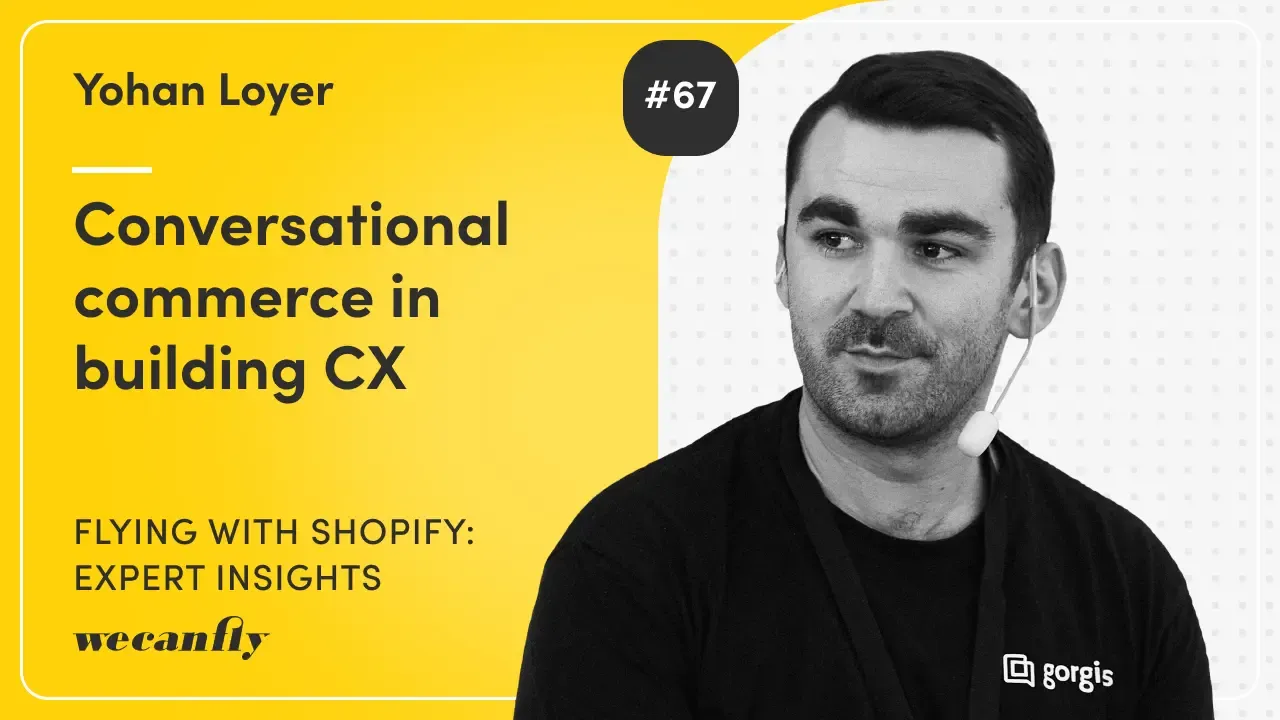
Yohan Loyer, in charge of agency partnerships at Gorgias at the time of recording, talks with Matt and Tomasz from wecanfly about turning customer support from a cost centre into a revenue channel with automation and conversational AI. The conversation was recorded in English in autumn 2025, a few weeks after OpenAI announced shopping in ChatGPT, and we've added dated 2026 notes on what has changed since in conversational and agentic commerce. It is aimed at Shopify brand owners and e-commerce and CX leads who want to know what to automate, what to keep human, and how AI chat affects conversion. One figure from the conversation: with brands using Gorgias Shopping Assistant, shoppers who chat with the AI convert 75% more often than those waiting for a human, and their average order value is 30% higher.
Key takeaways
- "Where is my order" questions make up around a third of the requests e-commerce brands get on average; in Yohan's worked example, automating half of them removes 20% of all tickets, so a five-person support team can move one person to live chat instead of cutting headcount. (11:07)
- According to Yohan, shoppers who interact with a brand's chat are 300% more likely to convert, yet many brands have no chat on their website because the team is too busy answering "where is my order" emails. (12:40)
- The top 25% of Gorgias customers using AI automate over 60% of their customer support; Yohan stresses this is not a target, but proof it can be done without hurting the customer experience. (27:29)
- According to the figures Yohan quotes, for 75% of consumers fast first response time is the number one criterion for a good customer experience; consistency across channels (about 55%) and knowledgeable staff come next. (14:17)
- Yohan cites data that 32% of consumers are likely to stop buying from a brand after one negative experience and 92% after two; in Yohan's view fast, personalised support is already a must-have in the US but still a strong competitive advantage in Europe. (24:12)
- Gorgias Shopping Assistant (released less than six months before the recording) is trained on Shopify product data and product pages plus brand instructions, e.g. not promoting a low-stock bestseller, or offering a free gift to carts between 50 and 99 euros to push them over 100; North American brands tend to offer discounts or bundles early, European brands stay more educational. (55:36)
- On ChatGPT checkout: Yohan expects cheap commodities such as low-cost jewellery or fashion to be bought directly in the chat, while high-ticket items like furniture will still be researched on the brand's website, so the main opportunity is being findable in ChatGPT, Gemini and Perplexity. (47:21)
- Asked whether Gorgias Shopping Assistant can be queried for strategy the way merchants use Shopify Sidekick, Yohan says not yet: in autumn 2025 it suggested which questions start chats and wrote chat campaign copy, and proactive chat triggers raised the number of chats by 25% on average. (58:27, 59:26, 61:21)
What has changed since the recording (2026 update)
As of 8 November 2026, three things Yohan and the hosts discussed have moved on:
- AI chats became a Shopify sales channel. Shopify announced Agentic Storefronts in its Winter '26 Edition on 10 December 2025: products are set up once in the Shopify admin and reach ChatGPT, Perplexity and Microsoft Copilot through Shopify Catalog, which structures product data so AI can understand it (shopify.com/news). Shopify's Help Center now also lists Google AI Mode and Gemini and Meta (help.shopify.com).
- Checkout in ChatGPT happens on the store's own checkout. According to Shopify's Help Center, ChatGPT users complete the purchase on the store's online checkout, opened in ChatGPT's in-app browser. In Google AI Mode and Gemini, Microsoft Copilot and Meta, shoppers can pay in a Shopify-powered direct checkout if the merchant turns it on (help.shopify.com). In June 2026 Shopify listed ChatGPT as live for merchants selling to US buyers and Copilot Checkout as powered by UCP, the open protocol Shopify co-developed with Google (shopify.com/blog). Stores not on Shopify can join through the Agentic plan, which has no monthly fee and is also available in Poland (shopify.com/pl/pricing).
- Shopify's own assistants caught up with the features Yohan described. Shopify Inbox is now listed on the Shopify App Store as "an AI sales associate for your online store" that answers shoppers from the store's catalog, inventory and policies (apps.shopify.com/inbox). Sidekick can write and run code to forecast, compare or summarise store data, build Shopify Flow workflows and present changes for review before applying them (help.shopify.com).
Yohan's main point holds: being found in AI assistants matters more than whether the last click happens inside the chat. What we change in product data and store setup for AI channels is covered in our episode Agentic commerce: 15x more orders from AI channels and in Agentic commerce and GEO: how to prepare your store for AI-driven sales.
Guest
Yohan Loyer was in charge of agency partnerships at Gorgias at the time of recording (autumn 2025). He had been at Gorgias for almost five years, starting on the customer side as a customer success manager, after earlier work in the CRM space at Salesforce; in total he had spent almost ten years in tech. He speaks at e-commerce conferences across Europe. Yohan Loyer on LinkedIn
Hosts
Tomek Runowicz and Maciek Czerniak run wecanfly, a Shopify Premier Partner agency and official Klaviyo partner that helps established brands with complex migrations to Shopify Plus. Today we work with AI agents built into processes and guardrails based on experience from many projects, and every change is approved by an experienced person on our team. We prepare stores to sell through ChatGPT, Gemini and Copilot as part of agentic commerce for Shopify.
Yohan's example of sending support conversations to Klaviyo flows and segments connects to two of our episodes: Best Klaviyo flows for e-commerce and RFM analysis in Shopify, where we show how to find the VIP customers he suggests answering first.
Transcript
This transcript is based on the recording of this episode. We edited it for readability: we corrected transcription errors, punctuation, and merged sentences that were cut off mid-flow. We did not change the content, order, or meaning of anything said. Any errors or inaccuracies are our responsibility alone — not our guests'. If you spot something that needs correcting, email us.
Recorded in English in autumn 2025 and published on 18 November 2025, so figures and Gorgias and Shopify product details reflect that time; where something has changed, we add a dated 2026 update. Figures quoted by Yohan are Gorgias data and studies he cited on air. We leave out the teaser at the start of the video.
Football first: what is it like to support France?
Tomasz: We have one question first, because we are all football fans. What is it like to support a team that can win every championship? As you know, Polish fans are not in such a favourable position.
Yohan: First of all, you have a legendary player, Lewandowski, playing for you right now, and you should be very happy and thankful to see him play. But I do feel very spoiled and thankful that my country's team has been really good for the past years, and I'm so happy to witness Kylian Mbappé playing. I'm not going to lie, it feels great to know the team can go very far, but we also have a lot of haters. Which is okay.
Matt: Did you prefer the Zidane team, when he was a player, or the team now?
Yohan: Zidane is always going to be number one, at least for the time being. I followed the Platinis and the generations before, and I think Mbappé is number two in the history of French football players. He's only 26 and already the second-best goal scorer, only five goals away from Giroud, so he's going to be the best goal scorer in the history of the French national team at 27, with probably ten years in front of him. Football is also very different now. Before, every team had its own style of play and some very unique players. Now players are a lot more formatted: you always have a big, strong number nine up front, like Lewandowski or Haaland, and fewer technical players. So I think our team is even better now, but football was better to watch back then. This makes me want to do a podcast about football instead.
Matt: That's what we have to do, guys: a football podcast, or a comparison between football and e-commerce and Shopify.
Who is Yohan Loyer?
Tomasz: There is a connection, because in both cases we want to outline what has changed. But first, Yohan, it's a rule in our podcast that guests introduce themselves. The floor is yours.
Yohan: Thank you very much for having me. My name is Yohan and I'm in charge of agency partnerships at Gorgias. Very shortly, it has historically been the number one customer support solution for e-commerce brands, especially on Shopify, and now there's a very big focus on conversational AI and helping brands generate more revenue through customer support. I've been working in tech for almost ten years, mostly in the CRM space: at Salesforce before, and over the past five years at Gorgias. Before partnerships I was a customer success manager working directly with customers, so my career has always been about people helping people. Over the past years I've been focusing on how e-commerce brands can generate more revenue through customer support and build better relationships with customers and prospects, which leads to more sales and a higher customer lifetime value.
What has changed in e-commerce customer experience?
Matt: You've been in the trenches for many years, so let's start with an easy question. From your point of view, what has changed in e-commerce?
Yohan: Things are changing faster than ever before, and it's impossible for me not to talk about AI, conversational AI specifically. A big trend is brands using AI in their day-to-day operations, and on our side mostly to interact with their customers. Acquisition costs keep rising for e-commerce brands, fixed costs keep rising too, and we're not sure what will happen with US tariffs or potential world conflicts. So brands are mindful of how they spend their money. They want to do more with less, or more with the same resources, and many are turning to AI for that. At Gorgias I see brands keen to handle some customer conversations automatically with AI, to be more efficient and get back faster to the customers who really need a human. But probably the most important aspect is that conversational AI can drive more conversions and higher average order values, and help with satisfaction and retention. Over time that improves customer lifetime value, reduces the cost of acquisition and makes you a leaner, more profitable business.
Is customer support a cost or a revenue channel?
Matt: When we talk to our customers, we definitely see rising acquisition costs. Everyone is getting cost-aware and trying to cut costs, and I believe a lot of merchants still see customer experience or customer support as a cost, not an opportunity. What's your take on this?
Yohan: That's why I enjoy working at Gorgias: I've seen first-hand how customer support can change a business and become a revenue channel. A lot of brands don't think of it that way simply because they haven't spent much time on it. As they should, they're focused on acquisition and conversion. But to have a stable, growing business, retention and repeat customers matter too, and customer experience matters even pre-sales: in your ads, your emails, a website that's easy to navigate. When we think of customer support, we think of "where is my order?" and "can I change my shipping address?". That's a big part of it, but now you can automate much of it with AI: the questions that are repetitive, low-value and time-consuming for the team.
Yohan: "Where is my order" is around a third of the requests e-commerce brands get on average. Say a company has 40% of these questions, and we can automate 50% of that. Then we automate 20% of their tickets. I'm throwing out random numbers to make it easier to picture, but if they have five people in support, they now need only four. I'm not saying fire that person. They can answer chat tickets instead. A lot of brands don't have chat on the website because the team is too busy with "where is my order" emails. If you put someone on chat, conversions improve, because someone who interacts with a brand's chat is 300% more likely to convert. The team can also focus on pre-sales questions, VIP customers, or someone who was unhappy and may never buy again, and turn them into a champion of the brand.
Yohan: To put it simply, we see at Gorgias a direct correlation between the automation of customer support and the revenue generated by customer support. If you automate more, your team spends time on the conversations that matter, and you reply much faster. In 2025 I should not have to email a brand to ask where my order is and wait over a day for an answer, which still happens a lot. With conversational AI and ChatGPT, we now expect instant answers. And first response time is the number one criterion for a good customer experience according to consumers themselves: for 75% of consumers, a fast response is what matters most.
What else do customers expect?
Matt: And what are the next criteria, if you could name a few?
Yohan: The second one, I know, was consistency across channels, I believe for 55% of people. Especially the younger generations expect an answer whatever the channel: email, chat, but also Facebook and Instagram. The third one is knowledgeable staff, so that whoever answers actually knows the products and the customer's needs.
How does Gorgias connect data from the rest of the e-commerce stack?
Tomasz: Yohan, this is the right moment to explain how Gorgias aggregates data, since you mentioned consistency of knowledge and the data used for automations. How does it fit into the e-commerce ecosystem? Could you explain in simple words how it works?
Yohan: Your tools need to be interconnected and use data across all touchpoints and stages of the customer lifecycle. The goal of Gorgias is to help brands generate revenue through customer support. First, we help support teams get back to customers quicker and in a personalised way, and for that they need all the information about the customer reaching out. That's why we have native integrations with most well-known e-commerce tools: Shopify, obviously, other platforms like BigCommerce and Magento, and tools like Klaviyo, Yotpo and Judge.me. Any tool with an API, or that can connect through an HTTP integration, can be connected to Gorgias, so the support team has all the customer information right in Gorgias.
Yohan: You can also perform actions without switching tabs. If someone wants to change their shipping address, we can edit it in Shopify directly from Gorgias. If someone has a subscription, we can pause or cancel it from Gorgias. It also works the other way. In Klaviyo, you can use Gorgias information in your flows and segments. Say someone asks support for a discount code, or asks about a product before its launch date. We send that to Klaviyo, so if they then don't order at launch or don't use the code, you can send them an email based on that conversation. So your support team has the full context: is this a VIP customer? Are they in the loyalty programme? Did they leave a negative review last week? Did they contact us on two channels at the same time about the same topic? That lets you help them in the most personalised way, as fast as possible.
Which brands get customer experience right?
Matt: And as a result customers are satisfied and become loyal. When did you last have a great customer experience, online or offline?
Yohan: The truth, and the reason a tool like Gorgias exists, is that most of the time the experience with a brand is not that great: using the chat, finding how to contact support, then getting a timely, personalised, satisfactory answer. Probably 98% of people listening don't have a great experience with brands most of the time. Thankfully this is changing, especially in the US, because the market is so competitive. To name a few: Hello Tushy, who sell Japanese-style toilets you can install at home, and whose head of CX is doing an amazing job; Glamnetic, who sell beauty products like nails and Caitlyn Minimalist. They're all Gorgias customers, which is why I know they're doing a good job.
Yohan: They really put the customer first. Their customers have questions before buying, on the website and after buying, so first: how can they find the answers on their own? If I'm not mistaken, something like 88% of people would rather find the answer themselves through self-service than ask the support team. So have a good help centre, and make it very clear how to contact the team if needed. For me, and I have high standards from working at Gorgias, a good experience means an answer within minutes if it can be automated. If not, a quick confirmation that my question was received and someone will get back to me. Ideally an AI says: "Thank you for asking about returning your order. Your order was placed less than two weeks ago, which qualifies for a return under our policy. Here's the link to the return portal. I'm also forwarding your inquiry to our support team, and they'll get back to you as soon as possible if you need." That alone is much better than what happens in 99% of cases. A chatbot can be very frustrating; in 95% of cases we just want to speak to a human after all. But getting a quick answer is, for me, the number one criterion. When something goes wrong with an order, or you're ready to buy and don't get an answer for a day or two, that's something you cannot afford anymore in 2025.
Yohan: I have a stat to back this up: 32% of consumers are likely to completely stop buying from a brand after one negative experience, and this goes up to 92% after two. So above all, you cannot afford a negative experience. In the US, answering quickly and in a personalised way is common and no longer much of a competitive advantage; you simply need to do it. But in Europe it's still a very strong competitive advantage, because 99% of brands don't do it yet.
Tomasz: I fully agree. We always look across the ocean, because they are usually two or three years ahead of us, and we can apply that knowledge to become leaders in our industries too.
How can AI turn customer support into revenue?
Tomasz: We all know AI has reshaped the e-commerce experience. What are the most exciting ways to use it to bring real revenue, not just answer customers' questions? How can Gorgias help?
Yohan: There are two sides. There's the customer-facing side, an AI agent answering customer inquiries. And there's AI in the back end: understanding who is reaching out about what and on which channel, which inquiries are pre-sales questions from customers likely to buy, and analysing what people ask to find gaps in the help centre. But the most concrete part is the customer-facing side. At Gorgias, our AI agent has two skills: customer support skills, and sales skills, which we call Shopping Assistant. In 2025, coming into 2026, most brands are focusing on operational efficiency, on customer experience, because it helps with conversion, average order value and lifetime value, and, as any brand that isn't a non-profit, on driving more sales. AI can help with all of these.
The customer support side of the AI agent
Yohan: It depends on the brand, but the top 25% of Gorgias customers using AI automate over 60% of their customer support. I'm not saying this is the goal; I'm saying it's possible without sacrificing the customer experience. You automate the easy questions whose answers are in the FAQ, on product pages or in tracking information. With AI you reply much faster, 24/7, in any language, with all the context about the customer and the brand. There's a direct correlation between first response time and customer satisfaction, and between satisfaction and the number of repeat buyers. And a repeat buyer spends on average 68% more than a first-time buyer. So if you automate more, you get faster responses, better customer satisfaction and more repeat buyers. They spend more, they improve the conversion rate because they come back and buy, and their higher lifetime value helps reduce the cost of acquisition. Overall, more revenue.
The pre-sales side: Shopping Assistant
Yohan: But the most exciting, impactful and concrete side is pre-sales, with Shopping Assistant. A lot of the time people don't buy because they're missing information about the product, or they don't trust the brand. Say I'm based in Poland and want to buy from a UK or US website. I don't know if they ship to Poland and can't find it in the FAQ, so I don't buy. But if I can ask a shopping assistant, "Do you ship to Poland? What's the return policy? Is there a minimum order value?" and get my answer within five seconds, I'm way more likely to convert. You already spend so much on acquisition to get people to the website, so you need to convert as many as you can.
Yohan: And we're proving it works. People who interact with the chat are 300% more likely to buy than people who don't. With the brands using Shopping Assistant at Gorgias, we've seen on average a 75% increase in chat conversion rate: someone interacting with the shopping assistant in chat, rather than waiting for a human, has 75% more chance of converting. And the average order value increase we see when shoppers interact with the shopping assistant is 30%. People need answers fast, especially now that we all use ChatGPT. I no longer have the patience to search on Google, scroll past the ads, find a website with the right information and read through it. I just ask ChatGPT. Consumer expectations towards e-commerce brands will shift the same way, and conversational AI is a great way to meet them without adding much cost.
What is conversational commerce? The PSG shirt example
Matt: For someone who doesn't know what conversational commerce is, could you walk us through a customer journey? Let's say I'm from Poland and want to buy a Kylian Mbappé shirt from the Paris Saint-Germain store.
Yohan: That will be difficult, because it's probably going to be a very old shirt.
Matt: Because he's at Real Madrid now.
Yohan: Exactly, an expert question to check the audience is paying attention. Very simply, conversational AI means that instead of typing something and browsing for the answer manually, you have a conversation, as with ChatGPT. Historically we haven't really seen that in e-commerce. Either you had a chat on the website and, ideally, got connected to a real person quickly, or you had a chatbot based on flows: "Do you have a pre-sales or post-sales question? Are you a B2B or B2C customer?" Depending on what you clicked, you got different answers.
Yohan: If you ask a conversational AI, "Do you ship to Poland? I'd like an Mbappé shirt," it will think and look at the data. It might say: "We don't have an Mbappé jersey because he no longer plays for us, or maybe there's one from an old collection. But Dembélé won the Ballon d'Or and he's our star player right now. Maybe you'd like a Dembélé shirt?" You can keep asking about sizing or shipping times to Poland. The AI can also suggest: "If you buy the shorts with the shirt, you get the socks for free." As a brand you have real control over how it behaves: super chatty, very focused on sales and discounts, or more educational, explaining why a product is good and asking qualifying questions. You can train it the way you'd train a human. The end goal is that someone has all the answers they need to buy from you.
Matt: The agent could also build trust by showing reviews from Polish customers, right?
Yohan: That could be a use case. Or you might know Polish customers worry about payment methods, like cash on delivery, so you tell the AI agent: "When you get a question from a Polish customer, keep in mind X, Y and Z." Brands want a personalised experience at scale, even as they grow. At the start, the founder does customer support, it's very personal, and they get feedback on why people buy or don't buy and what to fix in the funnel or logistics. As you grow, the founder focuses on other things, and when you sell different products in different countries, it's very hard to scale that personal touch, because you need to train people. Humans have bad days, too much work, they get sick. Or you hire two or three students or interns for Q4 who leave in two months and don't know the brand well. With AI you can feed in all the context about your customers, brand and products, and really scale personalisation.
Can small e-commerce brands compete with big ones using AI?
Tomasz: I'm glad you mentioned smaller brands. Listeners might think these changes will first be applied by huge e-commerce brands. Should small e-commerce businesses already focus on automation and AI? Can they compete with big brands this way?
Yohan: First, technology now lets any small brand provide an experience at the level big brands could offer several years ago only because they had lots of people and money for tools. A help desk or an AI agent is pretty affordable now, and literally any brand of any size can use AI. So there's no excuse for smaller brands anymore. Second, as a small brand you have less time and fewer resources, so you want to spend time on what has the most impact, and at some point customer support might not be that thing. Random example: you're a founder spending two hours a day on customer questions. If you cut that by 50% and save an hour a day, thanks to some automations or just having all channels in one place, with templates that pull tracking information from Shopify or your logistics tool, you don't have to look up the customer in Shopify, find the order and copy-paste the tracking number. Whether you use AI or not, that's already a win in my book.
Yohan: So it's not a question of size, it's a question of mindset and choice. You can focus on customer experience from the start, keep it a priority as you grow and make it a competitive advantage. Or you can invest in other things, but then you'll probably lose sales opportunities, product feedback and chances to turn customers into champions. And a tool like Gorgias is quick to set up. That sounds like a cliché, and it depends: a company with hundreds of employees, complex processes and custom integrations can take weeks. But for a small business with fairly simple processes, it's worth spending a few hours, because it will save a lot of time going forward.
Will shoppers buy directly in ChatGPT?
Matt: Back to conversational commerce for a second. OpenAI announced that you can now buy directly in the chat, connected to Shopify and Etsy. Will this become a new channel for every brand, or are there industries or products where it makes no sense?
Yohan: I see it as an additional revenue channel and a way for consumers to find what they want quickly, not something that will replace websites. Some people, men for example, and I'm only saying that because I'm a man, usually know what we want and want to go straight to the point with our list of requirements. So I could use ChatGPT to find it fast. The big opportunity for brands right now is to make sure they're easy to find on ChatGPT, Gemini, Perplexity and similar tools, because more and more people will use them for research. Will people buy through them? Obviously yes; we're starting from zero. Personally, for the next few years I'm definitely not buying anything directly in ChatGPT. I'd rather go to the brand's website and see what the experience is like. So brands need to be findable there and have a smooth checkout if someone does buy, but the opportunity is more about being found.
Yohan: To answer your question: commodities and cheap products, like cheap jewellery or cheap fashion, could be bought directly in ChatGPT. For something more high-ticket, like furniture, people will spend a lot more time on the website. But being found through ChatGPT, which is most likely a very qualified audience, is where brands should focus.
2026 update (as of 8 November 2026): the in-chat checkout Matt mentions is not how Shopify stores sell in ChatGPT today. According to Shopify's Help Center, ChatGPT users complete the purchase on the store's own online checkout, opened in ChatGPT's in-app browser, while Google AI Mode and Gemini, Microsoft Copilot and Meta can use a Shopify-powered direct checkout if the merchant turns it on (help.shopify.com). Products reach these channels through Shopify Catalog, announced with Agentic Storefronts on 10 December 2025 (shopify.com/news).
What happens to branding when shopping moves into LLMs?
Tomasz: I feel the same about which products fit buying directly in ChatGPT. What happens to branding and customer support when people move their shopping into LLMs? How is Gorgias preparing for this acquisition channel?
Yohan: By the time this episode is released it should be live, so I can talk about it: we've just finished redesigning our chat to look and feel even more conversational and more embedded in the brand's website. I don't know the future, and I might not be the number one expert, but in my opinion branding will be even more important, because asking things in ChatGPT will be so commoditised; it's always the ChatGPT interface. You might then click through to the brand's website to compare, see the reviews or see what the brand stands for. At least for the next few years, I think people will trust a brand's own website more. Brands will have a strong opportunity to show what emotions, colours and feelings they want people to have. Do they want to be a fun brand that's part of your daily life, the expert in their category, a lifestyle brand or a specialist brand?
Yohan: That's the direction we're taking at Gorgias. The new chat will be much more visually personalised to the brand. People will see their cart and past orders in the chat, and buy and check out directly from it. Say I'm looking for a dress for a wedding, the recommendations are too colourful, so I ask for something more toned down, click a product, look at the pictures and description, and buy from the chat. It replicates what I think ChatGPT and Shopify are working on in ChatGPT, but on the brand's website, with the brand's tone of voice, words, emojis and colours, so I'm buying not only because I like the product but because I like interacting with this brand.
2026 update: Shopify's free Shopify Inbox app is now listed on the Shopify App Store as "an AI sales associate for your online store": it answers shopper questions and recommends products from the store's catalog, inventory and policies, and the merchant sets its tone and rules (apps.shopify.com/inbox, checked 8 November 2026).
Matt: That's really cool. I think the main benefit of this "Gorgias GPT" versus ChatGPT is that you control the whole process, including what happens after the sale. Your own agent can contact the customer, try to upsell and re-engage them, and I don't think ChatGPT will have any interest in doing that.
Yohan: At least it's probably not their focus for the next couple of years. We never know, because it moves so fast.
Matt: Most likely they'll start to integrate some kind of ads, a way to promote things in ChatGPT.
Yohan: That's definitely coming at some point; the question is when and how. Right now ChatGPT is based on the information it pulls and a bit of SEO work, so, like Google, you wouldn't trust it 100%, but for most people it still feels like a source you can somewhat trust. If results are affected by people paying to be at the top, I think that will be a big breaking point. Personally, if I knew the results were biased because people were bidding to be in them, I'd use ChatGPT much less for buying and just use it for research and tasks.
Yohan: What brands definitely want is to control the experience people have with them directly. That could mean the AI agent recognising a VIP customer and passing them straight to the team as priority number one, with an SLA of answering VIP customers within five minutes. Or telling the AI agent: "We sell to teenage girls; use the kind of words and emojis they like to feel close to them. But if we're talking to an adult buying for their child, be more educational and ask why this would be a great gift." You can adapt the tone of voice and behaviour of the AI agent based on different data points, and that's what brands are looking for.
How is the shopping assistant trained?
Matt: One more question about the shopping assistant. What does it base its recommendations on? How is it trained?
Yohan: Taking Shopify as the example, it's trained on the Shopify product information and on the product pages. Then you guide it. If you're low on stock of a bestseller, it doesn't need to push it, because people buy it anyway, so you tell it not to promote that product. If you have leftovers of a small product from last year, you can tell it: "When someone has between 50 and 99 euros or dollars in their cart, tell them that for orders over 100 they get this free gift." Ideally it asks qualifying questions, like "Is it for you or for someone else?". Then you choose how aggressive it should be. It can propose a discount code or a bundle quite quickly, which a lot of brands in North America do, or stay educational and friendly and only push for a sale if the person really seems to need that extra discount, which is what most brands in Europe would typically do. In the end, it's about answering the questions people have, usually about the products, shipping, the brand or where products are made. That information is on the website or in internal documents the brand can upload to the shopping assistant.
Can you ask the shopping assistant for strategy, like Shopify Sidekick?
Tomasz: As you know, Shopify has Sidekick, an assistant for merchants. Can the Gorgias shopping assistant work similarly, as an agent you have internal discussions with? Since it knows my products, stock levels and pricing policy, could I ask it what promotion to run? Or do I have to instruct it, for example: "We have old inventory in the warehouse, try to sell it"?
Yohan: Great question. For context, Shopping Assistant was released less than six months ago, so it's fairly new. Over the past three years: in 2023 Gorgias was the help desk everybody knows, centralising channels, with macros, automations and information from different tools. Last year we focused on the AI agent for customer support. This year it's about sales and conversions with Shopping Assistant. So right now you can't ask it, "Based on our last 100 interactions, conversion rates and traffic sources, what's the trend?" But I think that's where we'll go, and customers will ask for it. They're already saving time with the support AI agent and seeing an uplift in conversion and average order value with Shopping Assistant. The next step is very precise scenarios based on the visitor's country, maybe their age from a quiz, data stored in Klaviyo, or whether it's their third visit rather than their first.
Yohan: What it does today is use AI and data analysis to suggest which topics are most likely to start a conversation. We know chat improves conversion and average order value, so the question now is how to start more chat conversations on your website. Last time I checked, we have three ways to proactively start a chat, and on average we're increasing the number of chats by 25%. We trigger the chat based on visitor data points, and we use prompts: say you've been on a bikini product page for ten seconds, the bubble appears with the three questions most commonly asked on that page. We also use AI to write the copy for chat campaigns to get more engagement. But you can't yet query Gorgias for data and strategies. It does seem like the natural next step, which is probably why you asked.
Tomasz: Exactly. So the answer is: not yet, but definitely in the near future, as a natural direction for its development.
2026 update: on the merchant side, Shopify Sidekick now answers the kind of question Tomasz asks. It can write and run its own code to forecast, compare or summarise store data, build Shopify Flow workflows, follow instructions saved as skills, and it presents changes for review before applying them (help.shopify.com). We go through the Sidekick changes in our episodes on Shopify Editions Winter 2026 and Shopify Editions Spring 2026.
Yohan: I can't commit to it being on the roadmap or released soon, but it seems like the next step. As always, it depends on customer feedback. Every piece of feedback goes into a tool where we rank requests, and we prioritise by the number of requests and the potential impact. This could help not only with adoption of Shopping Assistant but with the ROI you get from it, because you'd make well-informed decisions about the specific scenarios you want to improve.
The main takeaway: reply to your customers faster
Tomasz: Yohan, as we're coming to the end, what's the main takeaway you'd like merchants to remember?
Yohan: I understand that customer support and customer experience are not the sexiest part of the business, no question about that. But they definitely shouldn't be overlooked. In almost five years at Gorgias, I've seen a lot of brands take customer support from a secondary function, seen as a cost centre, and turn it into a real revenue channel with conversion targets. In Gorgias you can track how many support conversations end in a conversion in Shopify. Support teams have conversion targets, and some even give a financial incentive to the agent who made the most sales in the month. The culture is shifting, and with AI it's shifting completely. An agent who answered "where is my order" questions all day won't be needed for that anymore, because we can fully automate it, and it's a better experience for customers and cheaper for the brand. Those people will become more like sales advisers, recommending the right products and answering chats quickly, like staff in a retail store: they might help with your service questions, but they're really there to help you buy.
Yohan: Customer support is almost the only time you interact with customers and prospects in a way that's mutually accepted: they actually want, or need, to talk to you. So reply quickly, in a personalised way, and try to take the conversation to conversion. You can only do that if you automate the inquiries that don't add value for your team or your customers. And six months or a year from now, ask yourselves: how much did we spend on customer support, and how much revenue did our support team generate? That's the long answer. The short answer: reply to your customers faster. If you reply faster, they'll be happier, more satisfied and more likely to buy.
A great customer experience at the Camp Nou store
Matt: We started with football, so let me end with football. In February, I think, I took my son to a Barcelona game, and we went to a Barcelona store, actually about three of them, but the one at Camp Nou was amazing. The Spanish staff were speaking Polish, guys. They had really nice Polish vocabulary, and we felt at home and taken care of. We'd just walked in and they asked, "Where are you from?" "Poland." "Okay, here's the Lewandowski jersey." They guided us the entire time, and my son was super pumped. The fact that I'm talking about it nearly a year later shows how this builds brand advocacy and trust. And I'm never buying anything from the Real Madrid store. That's my take on how a great customer experience can grow a brand.
Yohan: Absolutely. Now I have a good image of Barcelona, because they took care of your son and personalised the experience, even for a Polish visitor, who is probably not their most typical customer. Not only do you remember it, we're talking about it right now. It's easy to hear about negative experiences; you don't always hear about positive ones, but they have a ripple effect. As a brand you need to find those moments of delight that turn customers into champions and brand advocates: the people who recommend you, join your loyalty programme and newsletter, leave reviews and post about you on social media. Of course it starts with a great product. But it's also the experience with your brand, and that's how you really grow customer lifetime value. That's why I talked about repeat buyers: they bring the most revenue to your brand, again and again.
Yohan: To finish: there's a very strong opportunity for brands, especially in Europe, to gain a competitive advantage with great customer experience and support. If I ask whether you remember a great experience with a brand, maybe one comes to mind. If I ask about a negative one, probably many more do. The opportunity is to be top of mind as the brand that will help me if I have a question or an issue. That's not the norm in Europe yet, so there's a real advantage in leading before it becomes the norm in two or three years, as in the US, where replying quickly and in a personalised way is no longer a competitive advantage but a must-have.
Tomasz: Amen to that. Yohan, thank you very much once again for a really fruitful discussion. I hope we'll see you in person soon, maybe at a conference; we know you travel all over Europe speaking on stage. And you're always welcome in Poland. As we discussed at our last meeting, I've been to France and my experience wasn't as good as it should have been, but next time I hope you'll guide me to the right places.
Yohan: Absolutely. I'm not that surprised, knowing how French people are. Next time you're around, let me know. And if anyone in the audience goes to the south of France, feel free to message me on LinkedIn; I'm happy to be your guide. Thank you for having me. My goal would be to record another episode with you, in person, with a testimonial from a Polish brand using Gorgias. I'm putting it out there to manifest it.
Matt: We've been recommending Gorgias for years and already have a few customers in common, so I think we can make it happen, especially after Black Friday and Cyber Monday, to review how things went and what the impact was. That could be an interesting follow-up episode.
Yohan: Absolutely. We have a deal.
Tomasz: Thank you, Yohan.
Yohan: Thank you very much. I hope this was useful.