

Pola Kudryk: How is The Odder Side developing a love brand on Shopify Plus?
How to build a brand that customers will love?
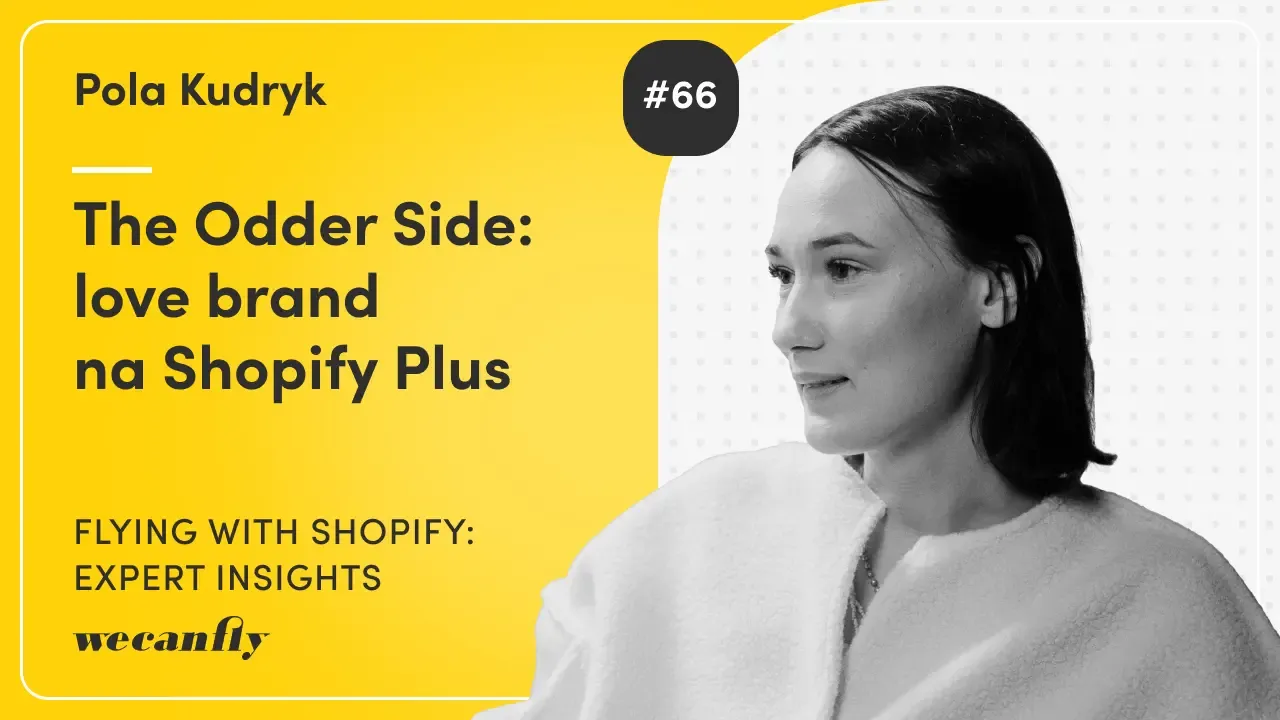
Episode in Polish, English subtitles available. Below: an edited English translation of the full conversation.
Pola Kudryk, digital marketing manager at The Odder Side, tells Tomek Runowicz and Maciek Czerniak how a brand that started with fashion fairs and a showroom in one founder's flat had, at the time of recording, six brick-and-mortar stores in Poland and one in Amsterdam, and shipped orders worldwide. They talk about how the pandemic and a platform that kept going down forced the move to Shopify, what multiple currencies, local payment methods and Shopify Payments did for international sales, and how The Odder Side builds a love brand: a loyalty club, events, a newsletter written like a letter and a customer survey. The episode is for owners and managers of fashion brands that sell both online and in physical stores.
Key takeaways
- The Odder Side is 11 years old. At the time of recording it had six brick-and-mortar stores in Poland and one in Amsterdam, and it ships parcels worldwide online. The company has grown from four or five people in the office to about 70–80 people in Poland and abroad. Everything is made in Poland, in Polish sewing workshops that have worked with the brand for years. (7:06, 13:47, 35:27)
- International sales started on day one, together with the online store, and the brand has communicated in English from the start. Agencies still advise it to switch its ads to Polish, but the founders are sticking with English. (10:25, 34:46, 34:54, 35:27)
- The lockdown in Poland was announced the day before a new collection launch, so all the stock went online. The previous platform couldn't handle the traffic: the site went down at collection launches, taking other stores on the same platform down with it. Instead of pushing products, the team ran Instagram lives (a Mary Komasa concert, yoga, chats with staff) watched by thousands. (14:40, 18:18, 19:13)
- They chose Shopify by looking at where the brands they follow sell. The first question was: will Shopify handle our traffic? The first collection on Shopify launched without an outage. During the migration the company had no developer and no e-commerce team: Pola learned the platform in six months while an ERP rollout ran in parallel. If they were starting from scratch, they would start on Shopify. (18:18, 19:13, 21:28, 23:53, 52:15)
- After the migration came multiple currencies first (the previous platform only allowed prices in złoty), then versions of the site tailored to each country, e.g. for the Netherlands: product descriptions, photos and payment methods. Content in many languages is handled with Translate & Adapt instead of a PIM, newsletters with Klaviyo. (25:57, 28:00, 31:32)
- According to Pola, international sales rose clearly after Shopify Payments went live. Traffic is mostly mobile, and customers mainly pay with Google Pay and Apple Pay. The team plans a test where customers see only their preferred payment method. (36:26, 36:56, 38:10)
- The loyalty club runs online on Yotpo: points convert into money off an order, and tiers bring a birthday gift, early access to the closed site at collection launches (with a password) and priority shipping. A customer survey revealed, among other things, problems with choosing sizes, so the new collection got a new size chart and references to technical models. Plans: connecting online with offline (the brand is waiting for Shopify POS in Poland and testing it in Amsterdam) and more stores in Poland and abroad. (34:09, 39:43, 43:35, 48:36, 54:14)
Guest
Pola Kudryk is digital marketing manager at The Odder Side, a Polish fashion brand founded by Justyna and Brygida. She has been with the company for more than eight years: she started in the brand's second brick-and-mortar store, in Wrocław, and later moved to the office in Warsaw. During the move to Shopify she was the only e-commerce person on the team. The Odder Side's marketing is now run entirely in-house.
The Odder Side is a wecanfly client. We moved the brand's store to Shopify Plus and keep developing it together with The Odder Side team: read The Odder Side case study. More about our Shopify migration services and how we work with fashion brands.
Hosts
Tomek Runowicz and Maciek Czerniak run wecanfly, a Shopify Premier Partner agency that helps established brands with complex migrations to Shopify Plus.
Transcript
This transcript is based on the recording of this episode. We edited it for readability: we corrected transcription errors, punctuation, and merged sentences that were cut off mid-flow. We did not change the content, order, or meaning of anything said. Any errors or inaccuracies are our responsibility alone — not our guests'. If you spot something that needs correcting, email us.
Released on 4 November 2025, so The Odder Side's numbers and plans reflect that time; we skip the teaser at the start of the video.
Eight years at The Odder Side: from a store in Wrocław to the office in Warsaw
Tomek: Hi, and welcome to Flying with Shopify. Today we have an episode with our guest, Pola Kudryk, digital marketing manager at The Odder Side. We'll talk about what's behind this brand's success. Enjoy the episode. Hi, Pola.
Pola: Hi, guys.
Maciek: Hi.
Tomek: We're glad you let us talk you into it, especially into coming to see us in Wrocław, in the studio, so we get to talk to you a bit more in person. I hope you'll lift the veil a little today, and maybe on things that aren't quite a secret, on what you actually did with The Odder Side to get where you are today. And we know from certain sources that this isn't your last word.
Pola: No. And thank you very much for the invitation and for letting me come to Wrocław and walk through my journey at The Odder Side. It's a nice experience. Thanks.
Tomek: Great, we're very happy. As usual, in episodes where we talk to our clients about their success story, we start with how it all began. But before we get there, could you tell us a bit more about yourself, your role and your experience, and then about where The Odder Side is today? We'll do it in reverse order.
Maciek: And then we'll come back to the other side.
Tomek: And then we'll come back to the other side.
Pola: Okay. I've been with the company for more than eight years. I think I've gone through my whole career path there. You can go further, but everything that's happened in my career has been connected with The Odder Side, which has been an amazing journey and growth. In fact, my growth has also been The Odder Side's growth. I started out working in a brick-and-mortar store, the brand's second store in Poland, in Wrocław. I was still at university, so it was a bit of a part-time job, but I knew it would last longer, because from day one I believed in this brand and knew it would be big. It was already present on the Polish market then, and even more so now. I grew together with The Odder Side.
Maciek: And why did you believe in the brand straight away?
Pola: Back then it was still a very small company. The founders, Justyna and Brygida, ran it themselves, with maybe one extra person to help. My job interview for the store was with one of the founders; I talked to Brygida. I think it was because of how that conversation went and that relationship that I simply believed in the girls. That's why I believed in it.
Maciek: You could say they didn't just hire you, they literally won you over.
Pola: Yes. And I think that's still a very important part of the company's growth today. The people who work at The Odder Side really believe in it. There are no random people there who just come in to work and leave. We have lots of stories of people changing roles within the company, we recruit people from our stores, and the girls want to invest in discovering gems like that.
Maciek: Gems. And has the company culture changed in all the years you've been there, or has it stayed the way it was at the start?
Pola: It must have changed a bit, because at the start the relationships were very close; there were very few of us. When I changed roles, moved to Warsaw and started working in The Odder Side office, there were four people there plus the girls, Justyna and Brygida. Naturally, the relationships were, I'd say, more casual. As more people joined, including people from outside, it had to become more professional. But what has definitely stayed is the relationships: how the girls treat us and how we treat each other. I know it sounds awful, but we're like a family. We all really like each other, at work and outside it, and there's no one who treats it as just, you know, nine to five and goodbye. It's a very committed team of great people, and now also great specialists. It's amazing to be part of that success.
The Odder Side today: stores in Poland and Amsterdam, shipping worldwide
Tomek: I feel we're starting to touch on what's behind this brand's success, but let's hold off on that for now. As I announced, tell us what The Odder Side looks like today. If you can, give us some numbers that show your scale. So that those who don't know you, though I assume there aren't many of them, can hear how successful you are today. Because what we've said so far is not the end, God forbid.
Pola: Yes. You know what, I always have to do a check and step out of thinking that The Odder Side is a brand with one store. Because as of today we have six brick-and-mortar stores in Poland and one abroad, in Amsterdam, and online we ship parcels all over the world. The scale of the business keeps growing; it's a really big brand. From four or five people in the office, we've grown to, I think, about 70 to 80 people in Poland and abroad, because we also work with people abroad: we have graphic designers abroad and the store in Amsterdam. It's quite a big company.
Where does the name The Odder Side come from?
Maciek: Let's go back in time a little, to the beginning. I'm very curious whether the name comes from the Red Hot Chili Peppers song, but maybe let's start with where the idea for the brand came from. Do you know the story? Could you share it?
Pola: I know the story. It's the question everyone asks, so I'm laughing, but the name doesn't come from the Red Hot Chili Peppers. It combines a lot of things. First, at the start the girls wanted to make clothes upside down, with the seams on the outside, and that's where "odder" came from. Then they thought it was a bit "odd", a bit strange. And our signature, when the girls were starting the brand, was low backs and drawing attention to them. And all of that simply came together in the name.
Tomek: Now it makes sense.
Pola: And you thought it was from the song?
Maciek: Yes, I was convinced it was the Red Hot.
Tomek: Not me. I thought it was more of a philosophy of doing certain things a bit the other way round, differently. But I wouldn't go as far as to say that behind it there's…
Pola: What's also interesting is that everyone pronounces the name differently. Some say The Odder Side, some say Odder Side. For example, when we talk to people abroad, everyone thinks it's "other" and writes "otherside", but it's "odd" with two d's.
Maciek: Interesting. All right, so the idea for the brand came from the girls wanting to do something new, something different?
Pola: I listened to and watched your podcast, and I don't remember who, I think it was Paweł Tkaczyk, said that companies always write on their "about us" page that they made a brand because they couldn't find clothes for themselves. But for the girls it was a bit like that: in everyday life they couldn't find things for themselves, so they decided to make them. And that's how The Odder Side was born.
Tomek: And then it turned out that there were more women like the founders who wanted to wear…
Pola: Exactly. Now I'm wondering whether we have that written on our "about us" page. I need to check. I think we do.
Tomek: Okay.
The beginnings: fairs, a showroom in a flat and the store on Rozbrat
Maciek: Since you joined a bit later, you probably don't remember the first sale and the first customer.
Pola: No, but I know the story. The girls started, I'd say, very offline, because back then Poland had big fashion fairs for Polish brands, at the National Stadium, at the Palace of Culture, and they always exhibited there. So more offline than online. Justyna always says that everyone advised her the opposite: "Go online, don't invest in offline, it makes no sense." But Justyna and Brygida really wanted a place to meet the brand, where you could see the clothes in person. The girls always stress, too, that the online store launched together with the brand, and from day one it shipped and was meant to ship abroad. It was ready for that. From the start they knew they wanted it to be a success and a brand that ships abroad, with nothing standing in the way, technically either. On top of that, from day one there was, as I'd call it today, a store in Justyna's flat: customers simply came to her flat, which served as a showroom. Later the girls moved a bit further down, and that's where our first brick-and-mortar store opened, on Rozbrat Street in Warsaw. Lots of customers remember it today. We still have customers who used to come to Rozbrat back then.
A product that stays, and making everything in Poland
Tomek: Yes. We'll talk about the customers in a moment, because I think you're unique in that respect. Some brands have not so much customers as devotees. We've seen it with our own clients, for example during the pandemic, when physical stores were closed and suddenly, on social media and in contact with customers, it turned out they were ready to go to great lengths to stay with the brand. I think you're a similar example, but more on that in a moment. One more thing from the history of your growth, which we'll probably move on to smoothly. Fashion brands, as you say, have collections that change and evolve all the time. But do you have a product that has stayed the same all this time? An evergreen that always sells or always brings in new customers, that you've never moved away from or don't want to?
Pola: Yes, it's the T-shirt with the low back, and the long-sleeve. Of course it has changed in terms of quality; it's evolved over the years. We've had different colours, prints and so on. Now it comes in white and black, and it's still with us. I still see people in the office wearing it. It's a kind of product system.
Tomek: And if I can ask, since you mentioned the girls wanted to make the clothes one way or another: you're not so much a distributor as, above all, a manufacturer.
Pola: Yes, we manufacture.
Tomek: Do you make the clothes in Poland?
Pola: Yes, we make everything in Poland, and it's a very important aspect the girls want to take care of and don't want to give up. All production takes place in Poland, in Polish sewing workshops that have been with us for years. So yes, we make everything in Poland.
The pandemic: stores closed the day before a collection launch
Tomek: That's a great, smooth transition to how your path to where you are today looked. Could you try to put in order the most important steps, in your view, those milestones that took you higher and higher? Significant leaps: you introduced something and reached the next level thanks to it. Can you somehow…
Pola: I can. Of course I can. One such milestone at The Odder Side was the pandemic. At first it was a very big challenge for us, because we have brick-and-mortar stores. The lockdown in Poland was announced the day before the launch of our new collection. All the clothes were ready in the stores, waiting for customers, and so were all the staff. And everything closed. What now? It was a very stressful moment, and we didn't know how it would develop. No one knew what would happen, how long it would last, or whether we'd reopen the stores. We thought it might last two days, not that long. And it was a milestone, because we had to close the stores and move everything online. The whole collection, all the stock, ended up online. And then we ran into another problem, because the platform our online store was on couldn't handle the traffic. Suddenly everyone moved online, and everyone wanted to shop. It was surprising; I don't think anyone could have predicted it at the time. We thought it would be the opposite: that people would be stressed, that with all the rhetoric around the pandemic, when no one knew what was next, it wouldn't be a time when people wanted to buy clothes at all. That was a huge surprise for us. And our online store was completely unprepared to take all that traffic, to handle our warehouse, everything. It was a moment when we had to, first, somehow survive and deal with the situation day by day, and second, sit down and think about what next, how to meet our customers' expectations. Because that's when The Odder Side grew a lot. And it was amazing, because as a team, and here I'm coming back to the team again, we focused not on pushing products and selling, but moved to Instagram, online. We did lives with customers. Justyna presented the collection to customers at her home. I remember we had a concert by Mary Komasa on Instagram Live, we did yoga. Now I remember, there was also a live where the girls connected with the staff and we just chatted. One of my colleagues, Mikołaj, played the guitar for our customers. There were thousands of people on those lives. All of them on our page. It was a very big milestone for The Odder Side and, I think, for many Polish brands. And when it all started to drag on, we had to decide what next, because we knew our site simply couldn't cope. That's when we decided we had to get out.
Tomek: Wow.
Why Shopify?
Maciek: And that's when you chose Shopify.
Pola: Yes. I've thought back on it, and it was a very simple choice. We thought about where the brands we follow and like sell. They were often foreign brands, and I remember we said back then: "If Tesla sells cars on Shopify, we're going there." I remember the first and most important question, which I think we asked both you and Shopify: whether Shopify could handle our traffic. Because there were times when a new collection went live, people came to the site and the site went down. And amazingly, it went down not only for us, but for all the stores hosted there.
Maciek: Yes.
Pola: There was a guy in customer service, I remember. I called him every time. When I think about how that cooperation went, I can't believe we were there. I must have repressed it. But we were. I'd say: "Your servers keep going down. What can we do? We can't afford this, we'll lose money." And he'd say: "No, I'm switching the server over now, everything will be fine. There's definitely no chance it'll happen again. I promise. Just let me know when there'll be more traffic. If you know traffic will be higher, please let me know." So I'd always call and say: "There'll be more traffic, because of the new collection." And the same thing again. It never happened that one of our collections went live and the site coped. With us it was literally like this, you know: we moved to Shopify, first collection, people came in and nothing happened. They're shopping, everything works. I remember Justyna asking me: "Are there few people on the site?" And I say: "No, the same number."
Tomek: Amazing. I'll share something personal. I remember being in your office back then, when we were building the store for you and switching you over, and I remember that question too. I think it was Justyna: on the one hand she asked me whether Shopify would definitely cope, and on the other she said she believed in it from what she'd seen with other brands, that it's a technology that definitely… "I don't have a choice, I don't feel I have a choice. I'm going for it." You could really feel it. For us back then it was super easy that we didn't have to convince you of all the things that were obvious to us. I still remember that meeting precisely because I walk in to see the girls, who aren't technical, because that's not what they do, and they talk about technology as if it were their daily bread: "Yes, we've seen it, we've talked to people, we can see how other brands work on it. We want to go for it."
Migrating without an in-house developer, and rolling out an ERP
Maciek: Was the switch stressful for you?
Pola: Very. It was very stressful, but because we don't have an in-house developer. We don't have someone who'll say: "Girls, I'll take care of it." At that point it was just me. We didn't have an e-commerce team to keep it under control. It was me, and I had to learn all the ins and outs in six months to more or less get what was going on. So it was very stressful. On top of that, connecting it all with the systems we had, accounting, warehouse. Very stressful, but there was never a single second when we regretted it and said: "No, we shouldn't have done this." I think it was a step that had to be taken, and as you say, there was no alternative. There was a moment when we considered our own store, building something of our own. But as I said, we're not technical. It's not something we want to deal with. We believe it should be easy and pleasant, and our focus should be elsewhere. Not on technical things, and not on me having to call some guy at seven in the morning to tell him there'll be a lot of traffic on the site. I believed it couldn't be like that. Justyna always told me too: "Pola, I can't believe this is how brands operate, that this is how it works."
Tomek: That actually sounds like part of Shopify's philosophy: "Focus on your business, the technology is on our side."
Pola: Exactly.
Tomek: I think you're a great example of that. To this day you don't have a strictly technical person who'd carry, say, even the communication with an external agency, because the technology itself gives you what you need from it, which is stability. All right, so: you chose Shopify, you migrated. You said it was very stressful. I remember you also had an ERP rollout on top of it. I said to the team back then: "Damn, the girls are really jumping in at the deep end, because they have to migrate the company's two most important processes at once and then integrate them nicely with each other."
Pola: And it was like this: Monika, our brand manager, and I simply split it. She'd handle the ERP, I'd handle Shopify and the switchover. But what did we know about it? Very little at that stage. I won't talk about that ERP. It was a nightmare.
Tomek: Oh, unfortunately you're not the only ones. It's a hard topic in general, and if different issues come up along the way, I assume it's not easy. But fine, you've switched over. We're talking not about today, but about that time. You're on the new platform and enjoying the luxury of a site that doesn't go down.
Pola: Yes.
After the migration: multiple currencies, a store tailored to each country and local payments
Tomek: So I assume there's a lot of enthusiasm inside. But at some point the first dust settles and you go back to regular work, which is developing the platform further. In episodes about switching platforms, we often focus on the migration process itself. I won't hide it, because it's not easy and causes a lot of stress, but we've covered it a bit in our episodes so far. Could you tell us what happened after you migrated, how you worked on development afterwards? Because let's be honest, between the site that saw the light of day three years ago and today's site, there's also a road you've travelled. I think that will further explain your success, because these are ideas that keep coming up. Let's talk about the most interesting things, in your view, that you introduced in that time and that delivered results. What does that road look like?
Pola: Yes, we keep working on the site with you, because there's that meme, "website is never done", and it's always a work in progress. Always a million ideas. But at the start we took on something that really helped us grow the brand: multiple currencies. We already had customers abroad back then, and we really wanted to grow foreign markets. On the previous platform we couldn't set prices in any currency other than the złoty. From today's perspective that's crazy. How are you supposed to scale a business without that option? So every new feature made us so happy. What's the obstacle now? None. We definitely used multi-currency; it was super important for us. What else? Tailoring the site to each country we target. For example, we have a store in the Netherlands, and the site has to look different for a Dutch customer: from product descriptions, to photos, to payment methods. Also the fact that we can use payment methods that are familiar in a given market. Shopify gave us that too. Before, we had Przelewy24, and good luck. Justyna always tells me: "Pola, when someone from the Netherlands comes in and sees the name Przelewy24, they think it's some kind of scam." That name. They later changed it to P24, which is better, but I still think…
Tomek: It doesn't have that kind of recognition.
Apps instead of three weeks of waiting
Pola: Exactly. The customer has to see a payment method they trust and use every day. So having payment methods matched to each market was great too, and it helped us grow in that market. Then all the extra apps on Shopify. I feel a bit like I'm on an iPhone there: I need something, I type it in, and I have it. And I always think it's very fast. We can implement our ideas very quickly. When I look at how we worked before: we'd come up with a great idea, I'd contact that guy by phone and tell him, "We want to do this", and "this" was, for example, adding Instagram to the site. And he'd say to me: "Of course, Zapier here, something else there. Three weeks." And I'd say: "Excuse me? What three weeks?" Here it's three clicks and you have Instagram on the site. Very simple things like that. We really have a million ideas, and at this stage we no longer do it ourselves. We come to you, to Kamil specifically, and the girls say: "Listen, Kamil, we want a playlist on the site. We have a playlist in the stores and we want it on the site too." And Kamil doesn't tell us "three weeks", he says: "Okay, tonight then, fine."
Tomek: And do you call him at seven in the morning too?
Pola: I was just wondering whether I should tell you about that. But yes.
Tomek: Oh!
Pola: It happens, but in really critical situations. For example, when we have sales and the girls need to finish something. Maybe not at seven, more the other way, at eleven at night. The three of us are sitting there and Daria, our e-commerce specialist, says: "So who's texting Kamil?" I say: "Daria, I'm not texting Kamil at this hour." And she says: "I will." And he's always there for us. An amazing person.
Tomek: Wow. Well, Kamil, that's a glowing review for you. There you go.
Maciek: That'll get cut.
Pola: Kamil really is great. How do I see Kamil? He's actually an outside person, he doesn't work with us in-house, but for me he's part of my e-commerce team. In general I'm in favour of having everything in-house, because I see a big difference in how we work now. Before, we worked with various external partners, and you're probably the only partner where I feel your team is part of our team. That's great.
Maciek: Great, it's very nice to hear that. I understand you used other agencies for marketing before, and the strategy was to bring all of it in-house.
Pola: Yes. We now do all our marketing in-house.
Favourite apps: Translate & Adapt, Klaviyo, Back in Stock
Maciek: Okay. I wanted to ask about one more thing from what you said earlier. You mentioned apps. Could you share with other Shopify merchants your favourite solutions that you'd recommend?
Pola: Yes. When it comes to foreign markets and product management, we're not yet a company that should have a PIM. I'm not a big fan of it in general. There's an app, I think it's called Translate & Adapt, and we use it a lot to manage products, because of all the descriptions in different languages and so on. It's a great app for managing products across many markets. We also love Klaviyo for newsletters and email marketing. What else do we have that's great? I don't know the names, because I don't use them day to day; the girls handle that. There are great apps for promotions, for all the discounts. There's also a great app called, I think, Back in Stock, but I'm not sure. The idea is that when a product sells out and comes back, the customer gets notified. That was a big problem for us too. Now we try not to let it happen that someone wants to buy something from The Odder Side and can't because it's sold out. But it does happen, so it's great that the customer then gets a message that the product is back and they can buy it. Then all the solutions for cross-selling in the cart. We also have lots of features on the site that make it look good, because how it looks and how the customer feels on it is very important to us. As I mentioned, we have the playlist that plays in our boutiques, and it's meant to be on the site too. I love that feature. I know that from your perspective it's probably a nice extra, but for me it's great, because that's exactly omnichannel: the customer has the same experience online and offline. That's very important to us, and we really want to take care of it.
Omnichannel and waiting for Shopify POS
Maciek: Since we've touched on omnichannel: can customers order products online and pick them up offline?
Pola: Yes, in all our stores you can order online and pick up offline. But for us to really talk about omnichannel, we're waiting for Shopify POS.
Maciek: POS. They're not promising anything yet.
Pola: I've heard it's coming soon. We're already ahead of the future. Because we have a store in Amsterdam, we can test it there. We're already working on it so that we know what's what, and so that when POS comes to Poland, we'll have it in our stores within two days.
Selling abroad from day one, and communicating in English
Maciek: Two clicks and it'll work. That's amazing. I think selling in many markets will interest a lot of e-commerce owners and managers. When did you start thinking about going beyond Poland? Did international sales come right away?
Pola: It was day one.
Maciek: Day one.
Pola: Day one.
Maciek: Okay. And the strategy from the start was that you sell worldwide?
Pola: Yes, for the girls, the brand's owners, it was very important. I think it still is. That's why many agencies that contact us recommend switching to Polish, in our ads. But we have everything in English. From day one we've communicated in English, and I think that will never change.
Maciek: That's valuable advice, especially for new brands, because if you start that way, making the switch later is much easier.
Pola: Yes. And also to trust yourself that the decision was made consciously and for a reason. Because to this day, at least once a week, I meet someone who tells me we have to speak Polish. That our ads, our Instagram have to be in Polish. Sometimes I already think, "Maybe so," but then Justyna comes along and says: "No, we'll speak English." It's been with us from day one. Recently I think it was Brygida who said that when we came out with it 11 years ago, because The Odder Side is 11 years old, and started speaking English, it was strange back then. Not now.
Shopify Payments, Apple Pay and Google Pay
Maciek: That's true. I assume you now also use Shopify Payments.
Pola: Yes, that was something we'd been waiting for too.
Maciek: Did you notice a boost in international sales after that?
Pola: Yes. Yes. In general, the ease of payment after introducing Shopify Payments, and the fact that the customer no longer gets lost at checkout. Since implementing Shopify Payments, I see a big increase in sales abroad.
Maciek: Okay. And while we're on payments, sorry, Tomek, one more question, because I'm curious: do one-click payments like Apple Pay account for a big share of your checkout?
Pola: Yes. Traffic on our site is mostly mobile, and people mostly pay with Google Pay and Apple Pay.
Maciek: Okay.
Pola: I remember that on our previous… God, they're going to hate me.
Maciek: No names were mentioned, relax.
Pola: I think it's easy to guess. I'd say: Apple Pay. "No, it can't be done, madam, it can't be done." And I'd say: "Then how are we supposed to, you know, sell abroad? Everyone pays with Apple Pay! We want Apple Pay." I think Poland is probably catching up a lot in e-commerce now, but it was quite far behind.
Maciek: I always say this: in payments we had a lot of local providers or operators. Because of that, it was probably a bit harder for foreign ones to break into the awareness of people who'd got used to the standard methods. Today, as you say, we're in a different place. I'd even say Poland sets trends here, because BLIK still isn't really available abroad, and it's us Poles who promote it.
Pola: One more thing on payments, because we recently had a meeting, partly about payments, partly about apps. Daria told me we're going to test a solution where the customer gets a suggested payment method based on how they pay, and only their preferred method is shown, so they don't face chaos and pay the way they always do. I think that'll be great.
Maciek: I'm curious about that experiment, because it really reduces, I don't know how to put it, the friction of choosing.
Love brand: a loyalty club and events for customers
Tomek: Mhm. Exactly. Pola, let's move on to your customers. In my opinion you're truly exceptional here, and your customers even more so. Tell us more about how you look after them. You mentioned the playlist on the site, the same one as in the stores, so customers feel good. You also mentioned how you responded to the pandemic: with lives where you told customers what was going on with you and how it all works, so you engaged with them a lot. I assume customers have been your top priority from the start, but what do they get from you day to day? How do you look after them? You've really turned them, gosh, I won't say into a church, but into devotees of your brand.
Pola: I think we're a love brand. As you say, from day one it was very important to us that we're not so much selling a product as winning over a customer. That we want to build a relationship with the customer, and The Odder Side is built on that. That's our measure of success. What do we do? Really, everything we do, we do for the customer. For example, we've just very recently opened an online loyalty club for our customers. We saw the need much earlier, because we really have returning, loyal customers who spend a lot with us. We felt that, on top of what we already do, we had to do something for them, to reward them in a structured way, because before it was just that we always remembered them, for example we tried to remember birthdays. So we opened a loyalty club and used Yotpo. It works really well with Shopify. For now it's online only, because we don't have POS, but that's a very big goal for me. I think it's the first thing we need to do: connect the customer, because we have customers who buy both here and there, so we'd like the quality of service to be the same in both places. I think Jeff Bezos said this. I don't want to quote him, but I think what he said captures what we do really well: that we're a bit like the host, and our customers are invited to our party, and we try to make sure the customer doesn't feel we want to sell them something. And it's very sincere. We organise events for our customers. All our stores are places to meet the brand. It's in our strategy: we regularly organise events, face self-massage workshops. We also use our locations to organise yoga classes or invite customers to the cinema. Once a year we also have an event called Sunset to Sunrise, by the sea. We organise our own concert there and invite customers.
Tomek: And does that colleague play the guitar?
Pola: No. Although that could be an idea for next year. But I don't know if he'd agree, because since then he hasn't wanted to play the guitar. In general, great performers play there, really big names, and we invite our customers. We also try to make our customers… "make" is a very bad word, but they're ambassadors of our brand, and we attach great importance to that. I think much more than to influencer collaborations and paid things. We simply try to take care of the customer as well as we can. I still believe we have a lot to do in this area, but it's something we focus on a lot, and it's in our strategy too. The customer is at the centre of everything we do.
Maciek: Okay. I wanted to ask more about the loyalty programme itself, because it comes with a few challenges. Sometimes you can launch one and actually lose on it. What rules did you set? Points, some tiers?
Pola: Yes, it's points that you exchange for real money, which you can then use on an order. But not only that. When creating the club, it was very important to me that it wasn't just points you swap for a discount on your order and goodbye. The programme has several tiers, and depending on how much you spend, how long you've been with us and so on, you get different benefits. You get a birthday gift. Two tiers of our programme, for example, get early access to the site. When a new collection goes live, the site is closed. They get a special password, come in and can shop calmly, without worrying that sizes will sell out. They also get priority shipping: when they place an order, their orders are fulfilled first, so everything happens quickly. There are lots of things in it for them that kind of say: thanks for being here.
Maciek: Okay.
Tomek: Great.
Instagram, ads and a newsletter written like a letter
Maciek: Since we're on loyalty programmes and marketing communication: everything you do to build the community is probably hard to measure. It's certainly hard to translate directly and calculate ROI from it. But I'm wondering how effective the measurable channels are for you. Is it mainly social, Google Ads? Can you tell us about it?
Pola: Yes. We're a brand that was born on Instagram, and that's where our main traffic comes from. It's the main place where our customers are, and from there people go to the site. Of course we also have Google Ads, Meta Ads, all those things. But what's interesting, and probably my favourite channel, with really unusual results, is the newsletter. We've been sending newsletters since day one, and we run each channel a bit differently. We keep it consistent, but the newsletter is a slightly longer form of talking to the customer, and we try to make it read like a letter. When I get a newsletter from The Odder Side, I'm super excited, even though I've probably already seen some text and so on.
Maciek: You don't write them yourself?
Tomek: I was just about to ask, but I take it you don't.
Pola: No, but sometimes I do. And I'm still excited, because it's always beautiful and there's always some content, some value in it. We also try to cover topics on our customers' minds, so the longer conversations with customers happen through the newsletter. For example, we recently ran a survey among our customers. We asked questions about every area of the brand, and it turned out great. We were all surprised how many people wanted to take part. The scale was unprecedented; it even overwhelmed us. And that's the value: how many things that bother our customers, or that we could do better, we hadn't seen before. After the survey we sent a newsletter telling them what would happen next, so customers knew we were responding to their comments. We split them into those that need attention very quickly and those that are about development. For example, the loyalty club. It turned out both good and not, because on the one hand we launched it online but not offline, so offline customers were a bit annoyed with us. But we explained that it comes down to technical aspects we can't get around, and that we'll do it as soon as possible. We offered an alternative, so our brick-and-mortar stores now also have some way of rewarding customers. And we get a very big return from newsletters. The open rate is incredible, and at every audit, because we try to do them, the first thing I hear is that something is wrong.
Maciek: That it's too high. No one believes it.
Pola: That's really how it is. Everyone tells me: "No, first we have to sort this out with your developer," and then Kamil comes in and says: "Everything's fine."
What did the customer survey teach them?
Maciek: Could you share another insight from the survey? What surprised you the most?
Pola: We split it into different…
Maciek: Areas, right.
Pola: I'll tell you how we approached it. The initiative came from the e-commerce team. As always. We went around the company, department by department, and asked what they wanted to know, what would be valuable for them. We put those questions to people, and they answered. One insight, for example, was our sizing, when it comes to online. We had a big problem with customers not knowing which size to buy; there were often exchanges, and they couldn't find their way around our size range. We knew we had to deal with it as soon as possible. Already in the new collection, which actually came out yesterday, there's a new size chart and references to the technical models, meaning body shapes. We've done everything we could for now to help customers find their way around the sizing. That definitely came out of the survey. There were even lots of obvious things you don't notice when you work with them every day. For example, some information was missing, or customers wrote that a packshot or photo was missing for a specific product. Amazing. Our customers are kind of creating this brand with us. Great.
Maciek: That's how it sounds. It's great you shared the information about the survey and the insights, because in our view it's the best source of that kind of knowledge. However closely you and the whole team look at the store, it's really hard to arrive at many of these suggestions, ideas or observations. You get used to certain things and take them as normal. And customers… We see the same in surveys our other clients run: I don't think it has ever happened that someone got the survey results and said, "Nothing new, we already knew all this." Everyone is equally surprised, but for some reason e-commerce brands are, I think, sometimes a bit afraid of it.
Pola: We were very scared. Very scared, but the survey surprised us.
Maciek: And were you more afraid of getting no answers, or of what you'd see in them?
Pola: More of what we'd see.
Maciek: Okay.
Pola: Because we're very critical of everything we do. It was nice to see. Afterwards we made a presentation of the survey results for the whole company. And it really turned out very positive for us, because besides the open fields where customers could write requests, complaints and comments, it was, you know, a survey, so there was also a satisfaction score. It's nice to see, because you see it in black and white that you're doing well. And for each department: products, the quality of materials, our site and how easy it is to use, all the shipping options we offer, payment methods. Someone simply said, "You're doing this well," and that's always nice.
What would they do differently if starting from scratch?
Maciek: A question comes to mind. Could you say what could be done differently, faster or smarter, if The Odder Side had to start from scratch today, to get to where you are now?
Pola: Start on Shopify.
Maciek: Okay. That wasn't the point of the question, but nice to hear.
Pola: No, seriously. I think the platform we were on really held back our growth at the time. Really a lot. And you just didn't feel like coming up with anything new, moving forward with it. You know, even a survey like this one: we also had to run it in connection with Shopify. There really weren't any options there. The site kept shutting down. You lost the will to do anything. I think technology is a bit like your home. It has to stand on very solid foundations, and you have to trust it. I think that was the only thing we could have done differently. Although if we'd known back then, we probably would have done it, right?
Maciek: You can always tell yourself: "If I'd known then what I know now, it probably would have been different." But from what you're saying, it really does sound like technology was the only obstacle. And since you say you kept growing in that time anyway, it sounds like an oxymoron in a situation where…
Pola: I think it came from our customers wanting those things so badly that they did everything to get them. There were situations where customers called: "The payments aren't working, can I make a bank transfer?"
Maciek: Exactly.
Pola: "Please give me the account number." So our customers forgave us a lot when it comes to our platform back then. And I think now we have to make it up to them with Shopify and all these conveniences.
Plans: online together with offline, and new brick-and-mortar stores
Maciek: Okay. To wrap up, it'd be nice to talk a bit about what's ahead of you: your plans for the future and maybe the challenges you're dealing with now.
Pola: The plan for the future, as I've mentioned a few times, is connecting offline with online and providing the same experience in both our channels. That's very important to me, and we'll be thinking a lot now about how to do it even better. And definitely opening new brick-and-mortar locations, both in Poland and abroad.
Tomek: That's exactly what I wanted to ask about, because it interests me. You mentioned you already have six boutiques, one of them abroad, in the Netherlands. Do you feel a physical presence gives you an advantage in a given market, and do you want to continue that trend, opening where The Odder Side is already popular enough, because I assume that's how you look at countries? Or will it stay at a few locations while you focus on e-commerce?
Pola: We definitely have to scale e-commerce. That's one path. But the second: we keep thinking that we have to open brick-and-mortar locations, because we know it's important to our customers. They want to come, see the clothes in person, feel the brand, see what it's all about, because it's a different experience. Whatever we do, online you can't touch the fabric. And we have a very strong focus on quality, on fabrics. It's all amazing, and it gains even more when you see it in person. So I think physical locations are on our growth map too. We'll definitely be opening more brick-and-mortar stores.
Maciek: I'm thinking. That's probably also an interesting tip for founders of new brands: a physical location from day one is worth considering. The question is whether you'd have built such a base of followers, or devotees, without that flat.
Pola: Justyna's?
Maciek: Yes.
Pola: I'm a fan of brick-and-mortar stores. Despite my job, I don't like shopping online. I have to feel it, talk to someone, see the things. That's important to me, and I think there are still quite a few people who want to see things in person and feel the brand. Because that's something we're good at too: letting people into our world and showing it to them.
Wrapping up
Tomek: Great. I'll say this: that's a really beautiful sentence to sum up today's meeting. You've let us into the world of The Odder Side a little.
Pola: And have you been to our store in Wrocław?
Maciek: So many times!
Tomek: Oh ho ho, come on.
Pola: On which street?
Tomek: Absolutely. Yes.
Pola: You're welcome to visit.
Tomek: We know where your store is. I think that experience is still ahead of us.
Pola: Okay.
Tomek: Thank you very much, Pola, for today's conversation. Really great, interesting things. You've proven, and I think it came through in every sentence, that success comes down to people, a great idea and great consistency in carrying it out. Because as you said, the culture changed only because there were enough more people. It had to become a bit more professional, but what's in your DNA, I think, has stayed.
Pola: Yes.
Tomek: Great. Thank you very much for today.
Pola: Thank you very much.
Tomek: Thanks, Maciek. And thank you, too, for watching another episode. We hope you enjoyed it as much as we did. Do watch our next episodes.
More episodes
All episodes Episode #65
Joanna Kwiatkowska, Kubota: B2B sales, brand building and slides by the kilogram
Learn more Episode #64
Robert Stolarczyk: Data as an advantage in e-commerce
Learn more Episode #63
Karol Dziedzic: Google Ads for e-commerce – Performance Max without assets, ROAS and choosing a specialist
Learn more