
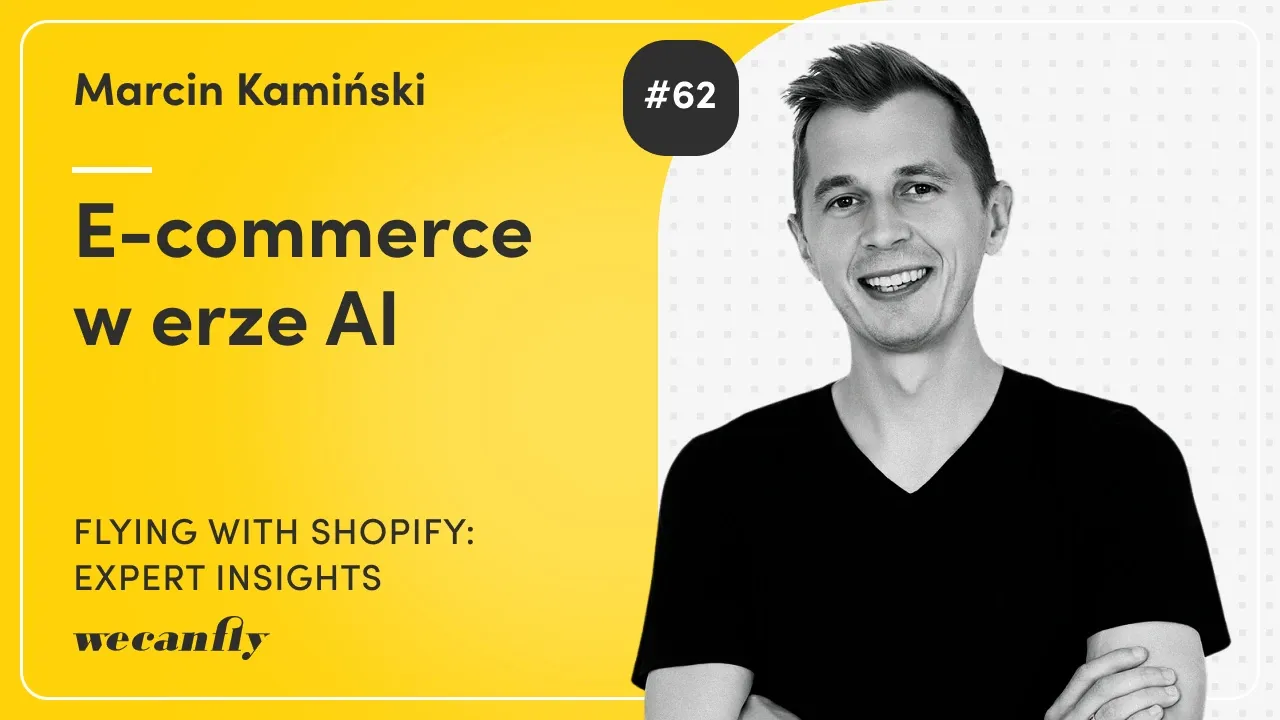
Marcin Kamiński: e-commerce in the age of AI, agent traffic and store visibility in LLMs
How to be visible in Google and LLMs?
Episode in Polish, English subtitles available. Below: an edited English translation of the full conversation.
Marcin Kamiński, CEO of the Polish SEO agency Top Online and creator of the YOSA.AI, EmbedBase and Agent Monitor tools, explains to Tomek Runowicz and Maciek Czerniak what agent traffic is and why stores are losing organic traffic but not necessarily sales: in his measurement, every click-through from ChatGPT or AI Overviews was matched by about 400 visits from AI bots. They talk about how to write content that LLMs choose, about categories built for specific searches, about backlinks, and about what Shopify is building for shopping through AI agents. The episode is for e-commerce owners and managers who see their Google traffic falling and want to know what to do about it.
Key takeaways
- According to Marcin, traffic hasn't disappeared; agents have taken it over: in one period his measurement showed 7 visits from ChatGPT and AI Overviews and 2,800 visits from AI bots (ChatGPT, Gemini and others), 400 times more. Google Analytics won't show this, because it measures browser traffic; bot visits only show up on the server side. (9:20, 18:04, 18:15, 1:07:48)
- In Marcin's view, the traffic that's disappearing comes mainly from informational queries, the top of the funnel. Many of his agency's clients kept the same number of orders or saw more, and one large store was up 50% at the time of recording despite the traffic drop. Purchase queries may be next, once an agent, for example ChatGPT connected to Shopify, starts buying on the customer's behalf. (19:21, 19:42, 20:35, 21:26)
- Marcin describes an AI agent as a new form of application: an LLM that decides on actions, tools, a system prompt, and short-term memory (the thread's context) plus long-term memory (for example a vector database). Instead of clicking "Add product", you can ask an agent to add products from an Excel file and write meta tags from the titles. (12:31, 15:08, 15:21)
- To be visible in LLMs, answer specific questions. ChatGPT and AI Overviews work with fragments of content, so one general article about robots.txt is worth splitting into 5–20 answers, such as "where do I find robots.txt in Shopify". Marcin chooses the page type (article, category or product page) based on the top three results in Google. (26:25, 26:42, 31:18)
- The SEO workflow at Marcin's agency has four steps: topic research (for example 5,000 questions around a few general queries, with 100 picked to start with), analysis of intent and page type, content creation, and monitoring. Separate files and markup "for LLMs" made no difference in the tests Marcin knew of at the time of recording. (32:35, 33:14, 35:24, 39:55)
- Instead of buying backlinks (one link for 500 zloty), Marcin creates new pages in the store: for a client selling dresses, about 200 categories built for specific searches, such as colourful dresses for a wedding, which he says Allegro, Poland's largest marketplace, has done since 2014. He suggests starting with a test of 10 such categories and checking visibility in Google Search Console. That's also how we approach Shopify SEO optimization. (46:39, 47:14, 50:36, 51:05, 53:12)
- Technical SEO is getting simpler, Marcin says, because platforms now do for the store what once required logging in over FTP. Maciek describes what Shopify is preparing for shopping through AI agents: Shopify Catalog, Universal Cart and Checkout Kit. The hosts expect simple, repeat purchases to be the first to go through agents. More on how we implement agentic commerce on Shopify. (42:11, 42:44, 43:22, 44:36)
Guest
Marcin Kamiński is the CEO of the Polish SEO agency Top Online. At the time of recording he was launching three products related to AI agents: YOSA.AI (an AI agent for doing SEO yourself), EmbedBase.com (turning a website into a vector database) and Agent Monitor (server-side measurement of AI bot and agent traffic, then an MVP). He worked on neural networks back at university and has run three online stores of his own. He collects information about his projects on marcinkaminski.ai and is most active on LinkedIn.
Hosts
Tomek Runowicz and Maciek Czerniak run wecanfly, a Shopify Premier Partner agency that helps established brands with complex migrations to Shopify Plus.
How to prepare a store for selling through AI assistants is covered in our guide Agentic Commerce and GEO: how to prepare your store for AI-driven sales, and we come back to the topic in the episode Agentic commerce: 15x more orders from AI channels.
Transcript
This transcript is based on the recording of this episode. We edited it for readability: we corrected transcription errors, punctuation, and merged sentences that were cut off mid-flow. We did not change the content, order, or meaning of anything said. Any errors or inaccuracies are our responsibility alone — not our guests'. If you spot something that needs correcting, email us.
Episode recorded in Polish before its release on 9 September 2025, so AI Overviews, AI Mode and Marcin's tools are described as they stood then; the teaser at the start of the video is not repeated here.
The guest: from an SEO agency to AI agent products
Tomek: Hi, welcome back to the Flying with Shopify channel. We talked about SEO many months ago, but a lot has happened since, and ubiquitous AI has seriously reshaped the way people find online stores and websites in Google. So today we want to talk about what to do to keep our e-commerce visible in Google, but above all in LLMs. Our guest is Marcin Kamiński, founder and CEO of Top Online, and more. Marcin, before we get to the topic, could you expand on your bio and tell us what else you do? I know you've created several products and several companies.
Marcin: You make money, in short.
Tomek: Yes. If you could tell us all about it, we'd be grateful.
Marcin: In one big nutshell. It's a real pleasure to be invited. I'm the CEO of an SEO agency, as I liked to say until now, but not only that any more, because I've finally got my own products. I told you before the recording that I'd been waiting a long time to invest in a product of my own and try to build one. There are three, connected with each other and with what I believe our future, all of ours, will be about: agent traffic, a new layer of the internet, as I call it. The first is YOSA, that is YOSA AI, our AI agent for SEO. A project in its infancy, but I think it has a big future: it's meant to help you, or you, do SEO yourself, for your online store for example. The second product is EmbedBase.com, which turns a website into a vector database, or into an AI agent. All my thinking about AI and the future of the internet as we know it ends with this: every website will be turned into an AI agent. Gradually. First as a knowledge base, then every tool on the site will be offered through an agent. Agents will be able to talk to each other, and so on. EmbedBase lets you turn a website into a vector database in a few clicks. It works together with YOSA, because we have a YOSA–EmbedBase integration, so the two agents, or services, talk to each other while writing content. EmbedBase turns the site into a vector database, something you can search very quickly. When we write to YOSA, "YOSA, write me an article", she goes to EmbedBase, meaning to our website, finds the most interesting fragments and writes the article based on them. So she uses our brain, our knowledge base, because we assume that everything we want to say goes into the content on our website. You can use it in many ways, which we may talk about today. The third service is, in my view, the most interesting and maybe the one with the biggest future: a monitor of agent traffic, Agent Monitor. Maybe on Monday or Tuesday we're letting the first users in. It's an MVP. So I've ended up with not one product but three. Interestingly, this year I launched more products than in probably the last 10 years, because I'd been waiting all along for exactly this moment.
Maciek: You really were waiting.
Marcin: I had to wait a long time.
From neural networks at university to AI agents
Maciek: I liked the post you put on LinkedIn recently about what credentials you have to talk about AI. Suddenly there are a lot of AI experts, but in your case the background really is there: first the education you mentioned, then experience with automation, and now these products. You're also very active online, you talk about it a lot and educate people, at conferences too, it seems.
Marcin: I try to pass on what I know in the most practical way possible. I don't feel like an AI specialist, but if you think about it, it's hard to point to an AI specialist today, because they're only just emerging, educating themselves, learning. My path started at university with neural networks. When I was writing my first program to recognise road signs, I'd never have said it would come in handy 20 years later, or that it could be useful to anyone. I thought it was more of a curiosity, and to be honest I hated writing it and puzzling it all out. Neural networks were a hard subject; most people had real trouble writing a program like that. But that's when it started. 20 years later…
Maciek: Here we are.
Marcin: …I can try to put it to use. I always say that to make something, you have to be able to imagine it. To code an online store, for example, you have to imagine how it should work, how functionality comes out of code. University, and then practice as a programmer, gave me the ability to imagine it today. I play a game of chess: every day I read the news and every day I have to play the game again, to try to predict the future and understand, for example, what agent traffic is. Few people understand it. Touching on SEO already: people complain that part of the traffic disappeared from the internet after AI arrived. But it didn't disappear; it's being generated by AI agents, robots, bots in general. Someone who has never programmed or worked on the back end can't imagine that there's something besides a human click: that a robot can visit our website, download the HTML source code, understand it and do something with it. And Google Analytics doesn't measure that. It doesn't measure bot or agent traffic, only human traffic. OK, it measures agent traffic, but only from browser-based agents. What makes Agent Monitor different is that we study agent traffic on the server side, what happens on the server.
Human traffic, agent traffic and bots
Maciek: Let's sort this out for less technical people. If someone clicks a result in Google search and lands in our e-commerce store, that's human traffic. And if someone is looking for a product and Google suggests it in an AI Overview, the AI-generated answer, is that already bot traffic?
Marcin: You could say so. Take Google with AI Mode, which we'll soon have in Poland too, or ChatGPT. People know ChatGPT well by now, so I often use it as an example. When we ask ChatGPT something, it very often visits various websites, looks for information there and brings it back to us.
Maciek: Right.
Marcin: We don't care that it's going through those sites, but it is. And those sites need to have that information. The difference is that agent traffic is much bigger than human traffic. Why? Because we visit one page, and in the same time a robot visits 100 or 1,000 pages. Agents, or the people building agents, use that scalability.
Maciek: So we need to make a distinction: there's human traffic, agent traffic and traffic from bots, the learning ones, and those are different things, right?
Marcin: Yes.
What an AI agent is
Maciek: Maybe it would help to explain to people who don't understand what an AI agent is, what the concept is about.
Marcin: Sure, although when we talk about agent traffic, we mean all bot traffic, let's generalise. Whether it's a bot that wants to harm us, because those exist too and roam the internet looking for vulnerabilities, or an AI agent, for measurement it doesn't matter. We study all bots and try to diagnose whether the traffic is AI-related or not. More and more bots simply identify themselves, for example as "ChatGPT-User". Then we know it's a bot sent by a user: we typed a query, the bot went off, found the information and came back with it. And what is an AI agent? In short, it's a new form of application, not necessarily with an interface. It has several components. It has a brain, an LLM, which decides, for example, which actions to take. It has actions it can perform, meaning tools. It has a system prompt and memory, short-term and long-term. Short-term memory is nothing more than context, for example the thread we have with ChatGPT, plus any attached files. Long-term memory is exactly something like EmbedBase: the agent goes off, finds information, for example fragments of a website, and adds them to our thread. We humans don't see it, but that's roughly what memory looks like for AI agents. The big names in tech, like the CEO of Google or the CEO of Microsoft, talk about this difference: AI agents work directly on databases, on data. Today every CRM is clicks: we tell the algorithm what to do, and it's tailored strictly to specific steps. An agent, thanks to the LLM, can simply make a decision. We only tell it what we want, and it decides which actions to use, whether to reach into long-term memory or whether short-term memory is enough. It's a fast-developing area. A lot of people still hate on AI agents, because they've only been developing strongly for two years, and I'm not surprised people say they don't work, because often they really don't yet. If someone asked me, "Marcin, which AI agents do you use every day?", I'd say a few at most, and ones I built myself. Maybe I use more, but I don't even know it, because they work in the background and make decisions where someone used to have to program everything. I suspect it'll be similar in e-commerce. What's the difference between an agent and a normal store admin panel? Today we add a product by clicking "Add product" and filling in the title, meta tags, description, photos and so on. But if we have our database in Excel or something else, we can write to the agent: "Add all the products from this file", and it will know what the title is. We can even tell it: "Based on the title, prepare the right meta tags." It decides by itself which actions to take, what the title is, what the description is, and builds the meta tags from them. That's the difference between an agent and the interfaces we rely on today. In my view, and in the view of the big names in tech, agents will gradually take over the market for ordinary applications, meaning SaaS. As I like to say: from SaaS we're not going to the woods, we're going to AaaS, agent as a service.
Why e-commerce is losing organic traffic
Maciek: Let's move on to something that has probably hit most e-commerce businesses: the drop in traffic. We roughly know what's causing it. On the one hand it's agent traffic, but above all, I think, a change in habits: people prefer to search in LLMs, in ChatGPT and similar tools. On top of that there's AI Overview. Do you see any other reasons?
Marcin: So why are we seeing traffic drops at all? Certainly because Google introduced AI Overview, and AI Mode is coming to Poland soon. Robots do things for us and bring us information, so there are fewer click-throughs to websites.
Maciek: So we treat the answer we get as verified.
Marcin: Very often, yes.
Maciek: And we don't dig deeper.
Marcin: We don't dig deeper. If we ask for product recommendations, say inline skates for quiet riding around the city, we'll get a perfectly matched product. If not now, then soon. That's exactly why we talk about agent traffic, because someone has to bring us that information. In theory we see drops in clicks, but someone is walking around our website. Recently I shared a statistic: click-throughs, people coming from ChatGPT or AI Overviews for example, numbered seven in a given period, and bot visits 2,800, and that's AI bots only, ChatGPT, Gemini and so on. 2,800, that's 400 times more. That's the gap. Because a lot of our clients really do have traffic drops, but no drops in conversions, for example.
Does lower traffic mean lower sales?
Tomek: That's exactly what I wanted to ask about, because you see clients who surely come to you with this, and you see it in the reports. As an SEO agency you probably often have to explain where the drop comes from. A client used to traditional methods looks at their rankings, keywords and reports and suddenly sees big drops. But do sales and conversions fall with them? You started to say not necessarily. How does it look across your wider pool of clients? Do organic drops automatically translate into lower revenue and conversions?
Marcin: Actually, not quite. It's not true that conversions fall as traffic and the number of visits go down. Our clients' order numbers are often the same as before, or higher. I talk regularly with several clients, quite big stores, leaders in their markets. Two days ago one of them told me they're up 50%, even though they'd already booked a meeting about the traffic drop. So we've booked the meeting and will talk about why traffic fell, because they have questions, but they're happy with the results.
Maciek: I wouldn't expect a drop in conversion here, because it doesn't depend on the traffic itself, maybe a bit on its quality. But then where is the drop in organic revenue attributed? That's what I'm wondering.
Tomek: That's interesting too, because the report you explain to the client has some revenue attribution. Where do you attribute agent traffic? How do you even identify it? Where does that money come from?
Marcin: Let's start with the fact that the traffic disappearing today comes mainly from informational queries. That's very important. The top of the funnel. But soon it may also affect queries that convert. Why? Today we ask ChatGPT: "Which inline skates would you recommend?" But soon, because Shopify has already signed some deals, I believe…
Maciek: They already have it in the API, they're already building it.
Marcin: Exactly. Soon we'll say, "OK, I want to buy these," and we won't even visit the online store; ChatGPT, together with Shopify, will deliver the skates to my parcel locker the next day, and I won't know which store I ordered from. I'll see it in the email. So today we have a traffic drop on informational queries. A "drop" in quotation marks, because I keep explaining that it's not a physical drop. We need to understand that it's the agent walking around those websites for us, because we just ask ChatGPT and it delivers the information. Soon it will visit websites not only to gather information but also to make purchases, because we'll order or confirm the purchase. Further into the future we'll probably top up ChatGPT with 1,000 dollars, it will use that money, and it will ask us: "Shall I pay those bills today?" Notice that we're turning the passive internet into an active one, an internet that does things for us. Instead of the passive one, where I have to go to Google, ask the search engine, click through everything myself and find the information, we're moving to an active internet, where we just say what we want to achieve and it tries to deliver it. As far as I know, the next step will be Google trying to predict our moves. Even now, when I'm heading back, it will suggest where to drive: home or the office. That one is simple, but predictions will come in more and more strongly.
Purchases an agent will make for us
Tomek: I think it will work fastest for products we buy regularly, repeat purchases.
Marcin: The agent can work out, for example, that you're about to run out of the collagen you drink.
Tomek: Exactly.
Marcin: Exactly. Or toothpaste. It'll learn that you buy it every so often and order it for you by itself. To sum up: today we're a bit worried about traffic, but it doesn't affect conversions. But soon… My son doesn't type anything into Google. He talks, he talks to the phone. I don't do that yet, but the next generations do. Google will adapt its search engine and its products, and so will OpenAI with ChatGPT. Everyone will adapt their products not to us but to the generation that will soon be the consumers.
Tomek: That generation doesn't really use Google any more; it uses TikTok to search for information.
Marcin: Exactly. I heard that recently too and was surprised how often they search there. As for SEO: as long as there's indexing, SEO will have value. In my view SEO ends when indexing ends, when agents can talk to each other in real time. But that's the distant future, maybe 10 or 20 years away. Everything is probably heading towards delivering information to us as fast as possible. But as long as there's indexing, SEO matters. So what do you do today with informational queries so you don't lose out, whether a human or a robot is reading? That may interest your listeners. You definitely need to produce content that ChatGPT or Gemini reads.
How to be visible in LLMs: answer specific questions
Tomek: Before we get there: I'm more interested in what to do to be visible in LLMs with what we have now.
Marcin: That's the answer to that question. I'll tell you how I'd go about it myself and how I'm preparing to do it at a larger scale, on my own websites and on our clients' websites. We're educating them in that direction. Say you have an article about what robots.txt is. ChatGPT doesn't come along and ask what robots.txt is; it knows the user has Shopify, so it asks: where do I find robots.txt in Shopify? We have a great article that we put our knowledge and energy into, filling a gap on the internet. But we can split that article into five, 10 or 20. It's not about writing more articles, it's about answering questions. If you analyse AI Overviews and ChatGPT, everything is based on vector databases, which means fragments, snippets. That's why answers to specific questions are often taken into account by ChatGPT: it looks for specific answers to specific questions. My advice: create more and more content. I wondered whether it will still pay to create content, because most people have wondered about that. Whenever people got a tool that let them produce more and faster, for example assembly lines for physical goods, something that replaces people or helps them but makes production easier and faster, we ended up with more and more products, not fewer. They're not of worse quality because of it, because we have a choice: lower quality, higher quality or handmade. It's similar with content on the internet. In every case I've considered, it will almost always pay to create content, as long as it has value and doesn't just duplicate what's already out there, like news. News outlets are complaining a lot today, and I'm not surprised. I wouldn't want to be in their shoes, because if the official Premier League website announces a transfer, purely hypothetically, and 100 sites copy it, where will ChatGPT get the information? From the official source, obviously.
Tomek: And the rest doesn't matter.
Marcin: For online stores, products are the greatest value, and that's what we should write about, answering questions about the products and what they're for.
Less padding: user intent
Tomek: You've partly answered a question that came to mind: keep producing content, because that's logical, the agent has to get its content from somewhere. But classic SEO was always based on keywords, on phrases connected to our store and product. You're saying, as I read it, that we should write content like a discussion: what question might a customer ask, and how do we answer it in the content. Should the approach to writing content change compared with what it was? Or will LLMs manage anyway, pick out the fragment, as you said, whether it's a question and answer or not, and aggregate the data on that basis?
Marcin: Less padding. SEO used to be about padding, that's how it was. You made the longest possible page with as much content as possible. Even today some queries show very long pages that are impossible to read. That's how the algorithms were built, and SEO specialists made pages for them because it worked. Today it's different, because all the research, ours, Senuto's or anyone else's, shows that you have to give specific answers to specific questions. What counts is meeting user intent. What does that mean, and how do you check whether you meet it? We type a query into Google, a product or a specific piece of information, for example "where do I find robots.txt in Shopify", and look at the top three results: are they articles, products or something else? If they're articles, we know we should most likely write an article. It's an informational query, and the user's intent is most likely to find out X. But sometimes, for example when you ask how to do email marketing well, Google recommends tools as well as information. So the user's intent isn't only to learn how to do it best but also which tools to use. Then there are several things we should deliver, which is why it's worth checking the intent when writing content.
The SEO workflow with YOSA: questions, analysis, content, monitoring
Marcin: With YOSA, for example. How do we approach it at the agency? Today we're only just starting with this new approach, we call it "SEO by YOSA", but soon we'll base practically the whole agency on one workflow. I can describe it in short, because anyone can do it. We look for questions, and we use YOSA for that, because she analyses user intent for us.
Maciek: Where does she look for those questions?
Marcin: Topic research. We're still working on it; for now she does a basic one. The point is to find as many questions as possible for the queries we care about. We give her, say, two or three general queries like "running shoes" or "rugs", because we have a rug store, and the goal is for YOSA to do huge research, find, say, 5,000 questions and tell us: "You should start with these 100."
Maciek: Will she look for them in Google Search Console, for example, in your data, or in publicly available data?
Marcin: In publicly available places, rather. She'll analyse content and use LLMs for it. First she'll do keyword research, most likely a very good one, and then topic research based on it. That's what I call it: topics for writing content. Today we're mostly talking about informational queries, because we still have a bit of time on the converting ones.
Maciek: Let's stick with the running shoes.
Marcin: So we have the topic research, we have 1,000 queries, and YOSA tells us: "You should start with these 100." By the way, she doesn't say that yet, but she will soon, so nobody goes to YOSA, types it in and finds she doesn't do what I'm describing here. Topic research is the first step. The second: once we have the query or topic, we write to YOSA: "I want to write an article, I want to rank for the query XYZ", say "running shoes for a five-year-old".
Maciek: For an ultramarathon.
Marcin: For example. YOSA will then go to Google, analyse the results and those pages, tell us what the intent is and outline the whole content: what we should include for it to meet that intent and, most importantly, whether we should create an article, a category in the online store, or maybe a product page. Those are different types of pages, and it's very important, because if we create an article and the intent is transactional or comparative, we won't get the result we want. So the second step is analysis, the third is creating the content, and the last is monitoring. That's it. Today, apart from technical things, nothing more is needed when it comes to building content for informational queries. You have to take care of value and substance.
Text or video? Recycling podcast content
Maciek: Will the content format still be so important? It was always said that we start with text, and then it's good if content starts being produced as video, because it's better received. When writing content for intent, does that matter? Do we produce more video with the right intent, or is plain text completely enough, because agents handle it better, for example?
Marcin: I think you have to do everything. Maybe "everything" is the wrong word, but if we're comfortable with video and have a YouTube channel, we can turn it into a series of articles and attract other visitors that way. And when we ask ChatGPT how to change a light bulb or the oil in a motorbike, besides text it also suggests ready-made YouTube videos. There's no clear-cut answer here, I'm sorry. I'd do what I feel best at. If you're comfortable with podcasts, do podcasts, but think about recycling the content. Let me give you an example of why we came up with EmbedBase and why it exists. Take your podcast, all the episodes, and transcribe them. How many episodes do you have now? A lot, right?
Tomek: Almost 60.
Marcin: Wow, look how much content that is, how many words spoken across 60 episodes. Imagine we transcribe them, put the transcripts into EmbedBase, they get turned into vectors, and we ask a question. EmbedBase is free, so you can go in and test it. We ask, for example: what's the future of SEO, or what workflow could I use in SEO? Because I talked about it, you have it in the transcript, and you'll get a great answer for your website. If you create 100, 200, 300, 500 valuable answers like that, it helps. It's not about spamming, it's about doing it well. The technology we have today helps us create valuable content. That's how I'd see it, not that whatever ChatGPT spits out goes onto the website. That's spam. But what I just described you could use to do good SEO and build valuable pages connected with the podcast. I know it's a lot of work and you may not do it now, because you have other things on your plate. But if I were in your place and wanted to start doing SEO tomorrow, that's roughly how I'd do it.
Tomek: A very concrete tip.
Schema, FAQ, files for LLMs and bots training models
Maciek: I'm wondering what else an e-commerce owner can do. In SEO there was always markup, schema.org, metadata. Can we do something like that for LLMs too? I read opinions that you should add FAQs to pages, for example, or that there are equivalents of robots.txt files. Is it worth paying attention to, or is it just talk?
Marcin: For now, all the tests show that it's ignored or simply doesn't work, so there's no such thing. We can use a special file to block robots if we don't want them visiting, but according to research they also very often ignore it. Cloudflare, which also studies agent and bot traffic, even urges people to block the bots they don't want. If we know the IP and the name, we have that option. An interesting piece of information from the tests I run on our Agent Monitor: on our website we get at least several hundred visits a day from bots that download data to train their language models. We supply it to them unknowingly. People don't realise how much of this goes through their websites, collects information and learns from it, trains its LLMs on it. Back to the question: my approach is that you have to choose a good platform. If you don't choose a good e-commerce platform that thinks about the future, makes product management convenient and, since we're talking about SEO today, takes care of SEO, you have a problem. If you choose Shopify, for example, you don't have that problem, because Shopify is a very future-proof, very modern platform. The fact that they're now entering various partnerships and seizing the moment shows it too.
Shopify and shopping through agents
Maciek: Yes. I don't know if you watched the recent preview of what Shopify is planning or already building in agentic commerce. They explained it really well with three components. Shopify Catalog has access to all the products in all Shopify stores, so it has them indexed. The second is Universal Cart: talking to an agent, you can search for products across all available stores and build a cart from products in different stores. You click pay, and that's the third component, Checkout Kit: you can process the purchase without going to any of those stores. I think it'll be an interesting solution. Another interesting thread is whether all brands and industries should be worried about it. I don't think all our shopping will happen in this agent mode. Repeat purchases and simple things will probably come first.
Marcin: Simple products.
Maciek: Simple products.
Marcin: But then Shopify is turning into a bit of a marketplace, isn't it? If it's going to have all the products from all the stores.
Maciek: It's trying a bit, it's another attempt, because they also have the Shop app, which works on a similar principle. It really is a challenge to Amazon. Still, I think it's a better distribution of ownership.
SEO is getting simpler
Marcin: Exactly, most likely. Interesting. We can see Shopify taking steps towards the future, not leaving users to their fate and thinking about its customers. That's my point: first we have to choose a good platform. I also want to point out that technical SEO is getting simpler. A lot of specialists will argue with me, but I think it's much simpler. Why? 10 years ago we had to log in over FTP to implement meta tags. And today? Often nothing, because most platforms do it for us, by default. It used to be hard, and only someone with technical skills could do it. Today anyone can, and soon practically every self-respecting platform will do it for us. Google often doesn't even use the human-written meta description, it generates its own for the specific query. So I think SEO is getting simpler, and that works against agencies like mine and against freelancers, because we have fewer and fewer things to physically do.
Maciek: PPC is going the same way, all the Google Ads campaigns and Performance Max.
Marcin: Of course.
Backlinks: why Marcin doesn't buy them
Maciek: From your observations, or from how you read the future: we've said that producing reliable, specific, substantive content will still matter, and I think we all agree on that. But what about backlinks, which we always used in classic SEO to raise a domain's value? Maybe not today, but do you feel they'll matter less in the future, because agents will recognise on their own where content is better and where it's worse?
Marcin: I'm smiling because, I don't know if you know, but you've hit on a backlink hater. I'm a bit of a controversial figure in the SEO world, because a lot of specialists disagree with me. Still, I don't really buy backlinks. Our agency doesn't buy backlinks.
Maciek: You're challenging a dogma here.
Marcin: A little, yes.
Maciek: Please expand on that.
Marcin: I don't want to go too deep; I'll just say why we don't buy them and why I think you shouldn't buy backlinks. First, it doesn't pay off. It's better to create a few, a dozen or a few dozen new pages that will give you far more benefit than to buy one link for 500 zloty whose effect on a given query you can't even measure. And you usually buy a link for a specific query. You can argue that it raises the site's authority, but I think valuable content raises it much more. If we buy backlinks for a dropshipping store and not for the manufacturer, who wins? The manufacturer, because it has more value. So I always say: focus on your own website and stop there, instead of going outside and starting with buying backlinks. First create value that people will want to buy, read and so on. Only when you've really taken care of all the value on your website should you look at what you can do outside it. That's my approach. I respect people who see it completely differently. I had three online stores, never bought links and was always at the top. So we don't rely on links; in my view it simply doesn't pay off. It's better to help the user by creating valuable content. Let me give you an example. We have a client in self-publishing. Sometimes clients themselves suggest, "Hey, maybe we should buy some links?", and we say, "Maybe let's create valuable content instead, for example a self-publisher academy?", because their business is built on self-publishing. At first it was a no, but Krzysiek and Ewa, warm greetings to them, really lovely people, agreed, and we built them that self-publisher academy. It brought them huge value and traffic, and since then they trust us much more.
Maciek: That's a nice case too.
Marcin: I prefer to build value. I'd rather spend my own or the client's money on building value than on…
What content for a dress store? Categories built for searches
Maciek: OK, let's say I have a lifestyle product, I sell dresses. What content should I create around it?
Marcin: You mean so that it's unique too?
Maciek: No, because with specialist equipment, bikes for example, I don't have a problem with that.
Marcin: What are the dresses for? What occasions? What colours do they come in?
Maciek: And articles about that?
Marcin: Maybe not articles. If you want to rank for informational queries, you write articles, but if you want to rank for more product-related, sales queries, it's enough to create collections or categories. For example colourful dresses for a wedding, colourful dresses for an 18th birthday, colourful dresses for some other occasion. We've had several clients selling dresses, and for one of them we created quite a lot of categories, around 200.
Maciek: Were those virtual categories showing the same products?
Marcin: Yes, but built for searches. On the home page there was a normal menu with the 10 main categories.
Maciek: So it worked for SEO and it'll work for LLMs too?
Marcin: Exactly. What's more, Allegro is a great example; it has worked like this since 2014, if not longer. In their case it may be a bit like programmatic SEO, but it's worth copying them. If we type a long, very precise query into a search engine, for example "colourful socks with red polka dots", I'm absolutely convinced they'll be in the top 10. Type in a million other queries, whatever you like, as long as they're precise and make sense, and they'll be in the top 10. Why? If we open the page Google suggests, we'll see they index everything users type into their search box, and you could say they turn it into categories. They take a product listing like "colourful socks with red polka dots"; if they have 100 such products, they display them and make a category out of it. Believe me, it has worked since 2014, because that's when I opened my first store and started creating categories like that. It always worked very well. I'm talking about categories, but they can be collections or anything else. As long as there's indexing, it will be worth expanding your website and store with extra valuable pages. Someone might ask whether that's valuable. For Google it is, and for the user too. If someone searches for colourful socks with red polka dots, they want exactly those socks, not others. So there is value in it: a specific answer to a specific question, in e-commerce form. You see, we're building on products here. I suggest testing such categories: if someone from e-commerce is listening, create 10 categories strictly for specific keywords and check whether people come. Google Search Console will show whether your visibility in the SERPs has gone up. Besides that, you can write articles, but not run-of-the-mill ones like yet another chicken soup recipe for a cookware store. Maybe work with an influencer who creates outfits or sets from our products, and we describe them? More inspirational, but at the same time an answer to a specific question, like how to dress for an 18th birthday party or whether white socks with red polka dots go with a black suit. You can find questions like that in many places online, and we have to answer users' questions. I think that's the best way to create valuable content, whether it's a product listing, an article or a mini article, for example an influencer's set with a short note from us, or an ultra-modern AI chicken soup recipe. If it's valuable to someone, why not?
How quickly do results come?
Tomek: One more question that comes to mind. Since SEO is evolving so much, because agents search hundreds and thousands of pages at large scale and much faster than people, does someone starting out still have to reckon with a fairly long wait for results, regardless of how much content they produce? It was always like that. With backlinks, which you're not a fan of, you also couldn't overdo it at once, so that Google wouldn't penalise you for an unnatural profile. Content you could always produce. But since agents are combing through our websites, is there a chance results will come much faster, because they work faster and our content gets more exposure?
Marcin: Exactly. 10 years ago backlinks were the way, because the internet worked much more slowly. When we launched a website or a new page or wrote an article, you had to wait many days, sometimes even weeks, for it to be indexed. Today a new article is in the search engine the next day, often after just two hours. All of that has changed. The only reason I can see to still use backlinks is to artificially pump up a site's authority. I'd rather write a great article so that it gets cited. Make the article clever, with statistics, because people like quoting statistics, or run a study and publish it on the website. If I want links that badly, someone will cite me and so link to me. That's how a natural link profile is built, and it will never be penalised. Besides, I think all SEO specialists, even those who were still talking about backlinks yesterday, are now focused on ChatGPT, AI Overviews and soon AI Mode. Nobody thinks about backlinks any more, only about what content to write to appear in ChatGPT. There will be a fight for agent traffic. That's the new reality in SEO: not what to do to be in the search engine, but what to do to be chosen by LLMs.
The search engine that agents use
Marcin: One thing worth pointing out, which many people don't see: search engines are being used more, not less. People searching less is one thing, but the other is that agents use search engines. When we ask ChatGPT or Gemini something, they go to a search engine and use it. Many years ago I already had this thought, and it's partly happening: Google will be a provider of results, but not necessarily on its own site. ChatGPT, for example, uses Bing. How many people use Bing directly? How many times did you go to Bing in the past year? Probably not once, right?
Tomek: Probably not.
Marcin: But you use ChatGPT, and ChatGPT uses Bing. They probably have their own solutions too, but from the start it used Bing. So I have to tell you: you use Bing. Same with search engines in general. For example, I built myself a simple AI agent that adds notes for me. When I'm driving, I can use my voice to add a quick thought, add or close a task, ask what tasks I have today, send someone an email, but also search for something online. So I don't go to Google; I talk to an agent I threw together in n8n, and it uses Google. It's hard to grasp all this, this new reality, and adoption will take time, a few years in my view. My son will surely get it. He probably already understands how it works better than I do, because he's constantly…
Tomek: It's definitely more natural for him.
Marcin: Exactly.
Ads in AI channels, Reddit and Wikipedia
Tomek: My observations are exactly the same. I wonder which way it will go, but my bet is that sooner or later something like Google Ads will appear in agent mode, and you'll simply be able to buy that visibility there.
Marcin: Yes. I often say agent traffic is the biggest blue ocean I've ever seen. If a new layer of the internet is emerging, there will be a fight for ads there too, and soon for conversions. Only when someone boasts online that their sales jumped, that they had x and in a short time have two or three times x, will people start wondering: "How? You have the same number of human visitors on your website." But it's agents that will start recommending their store. Think about it: Wikipedia and Reddit are reportedly at the top; knowledge from those sources is used very often.
Tomek: ChatGPT was trained on Reddit data.
Marcin: Yes, and it's often cited. I recently read in some research, I think about AI Overview, that Google very often cites Wikipedia, Reddit and so on as sources.
Tomek: And that brings back the question of authority you mentioned: the artificial kind built with backlinks versus what's genuinely credible, data from people or Wikipedia.
Marcin: The researchers drew that conclusion, not me, but I agree with it, and it confirms what I've been telling you. Reddit means specific answers to questions. There's a question, there's an answer: how do I do this? You can do it this way or that way. Maybe Stack Overflow will come back to life thanks to this.
Tomek: Or Elektroda, the Polish electronics forum. It never died.
Marcin: Maybe the sites that are struggling now, like Stack Overflow, will come back thanks to agent traffic, although in this case I doubt it.
Tomek: I wouldn't buy the stock.
Marcin: Me neither. No chance there.
Summary: what to do when organic traffic drops
Tomek: Let me try to sum up. From what you've said, first, the changes are undeniable and they await both clients and agencies like yours: adapting to new ways of searching that aren't necessarily performed by a human. Second, and this is encouraging, we still have to work on good, specific, substantive content, and the era of padding and artificially lengthening content just so robots read it better is ending. Third, you have to choose the platform for your e-commerce well, so that you're technically up to date, don't fall behind and don't carry technical baggage. Would you add anything? I mean tips both for those just starting and for those experiencing an organic traffic drop and feeling uneasy. The clients I talk to aren't necessarily terrified of falling sales, because sales don't always fall, sometimes results are even better. But there's this fear that my main traffic leg, organic, is suddenly collapsing. What would you tell these people so they can look at these changes more calmly, or take an active part in them?
Marcin: First, you summed it up brilliantly, I certainly couldn't have done it better, chapeau bas. You have a very good short-term memory; in an hour you gathered our whole thread.
Tomek: And long-term? Some money he should pay back… he wouldn't dare.
Marcin: No, long-term? I don't know what you're talking about.
Tomek: He doesn't remember.
Marcin: My tip would be the one I'd give myself and that I give myself every day: focus on value and keep looking for it. That's the most important thing. Don't copy patterns; ask yourself whether what I'm producing, a product, content or anything else, will be valuable to someone. Don't focus only on short-term gains, look long term. I know it's hard to look long term today, because it's hard to predict what will happen in six months, what changes will come, how they'll affect the economy, e-commerce, everything. But that's all the more reason to ask whether what we do is valuable to someone, whether it will be useful and how to keep improving it. At our company I like to say: let's talk about how we live, not about how to live. That forces us to produce value, because only then can we talk about it. Today, for example, I talked about my digital products. I believe that as adoption of such solutions grows, they'll become more and more valuable, so I assume they'll be valuable to someone. Whether someone else will come along and crush my solution, I don't know. But if I thought that someone was about to come and do something better, or that Google would do it…
The traffic Google Analytics doesn't see
Maciek: Google Analytics will probably start showing bot traffic, won't it?
Marcin: It can't, because it works on the browser side, and that's the catch. Unless they publish something you'd implement on the server side, but I don't want to give them ideas.
Maciek: You mean they don't even see it?
Marcin: They don't. That's why there's this gap.
Maciek: Right, they don't, because it's installed…
Marcin: That's why there's this gap. It's a problem not only for our industry but for everyone, because nobody sees agent traffic, so nobody can understand it. Besides value, my second piece of advice is exactly that: agent traffic. Take an interest in it and try to understand it. When we understand a solution, it's easier to predict the near future, for your listeners probably the e-commerce one. So educate yourself, because if you invest, it's best to invest in your knowledge too. Today that's probably very important: keep learning, keep developing and stay up to date. That's it. Above all, I'd stress value.
Leads from ChatGPT and who pays for crawling
Maciek: I don't think there's anything to be afraid of. Looking at our own experience and the leads coming into our agency, their number is roughly the same, about 50–70 inquiries a month. The only thing that's changed is that for a few months now most of them have come to us from ChatGPT. Before, it was Google.
Marcin: Exactly, that's right. Install Agent Monitor once I send it to you and you'll see what the traffic is and how big the difference is, because, as I told you, it can be 400 times bigger. I'm curious how it looks on other websites, especially big e-commerce stores, because we have a few clients with really huge traffic, and I'm curious about the scale of agent traffic there. I'm also curious about one thing: what will people do when they see some bot visiting their website a few hundred or a few thousand times a day, downloading their data, their articles, their intellectual property, you could say, and training its LLMs, its large language models, on that value? If that reaches global awareness, will everyone allow it? What will happen? Cloudflare is already announcing it will introduce some kind of payments for this. New business models will certainly emerge.
Maciek: Yes, of course.
Marcin: I'm curious how it will…
Maciek: It'll be the same story as with newspapers in the past. The Washington Post sued Google for publishing their news for free. Now Disney is suing Midjourney, and so on. Same story.
Marcin: Exactly. And I'm curious how those stories will end. Disney knows how to gather evidence. A big company knows how to get it: server logs and so on. But the average Joe probably doesn't. And how will he find out? Thanks to tools like Agent Monitor, he can find out that a bot visits a few thousand times a day. Hello, maybe there should be a fee, since my traffic has gone down? I expect that in six months, a year or two we may hear stories like that, and it will have to be reconciled somehow. Because after all, we're the ones producing the value.
Maciek: And someone is using it.
Marcin: Yes.
Maciek: That's absolutely…
Marcin: On our hard work.
Maciek: On our hard work, on our knowledge. But that's an issue for AI as a whole. There's constant talk about legislation, regulation, putting a framework around it. I think that's definitely still ahead of us.
Where to find Marcin
Maciek: Marcin, thank you very much above all for sharing really interesting things with us, which may even have contradicted some dogmas of the industry you represent. It was great to hear. At the end we always ask our guests where it's easiest to meet them and get in touch. I assume people may have questions both about your knowledge and about the products you mentioned. Some are still in development, but some, as you say, are working better and better. Tell us where to find you, in person or online, whichever you prefer.
Marcin: Best on LinkedIn, because that's where I'm most active. It's a platform I've simply come to like, and that's where I post the most. You can also find information about me on marcinkaminski.ai, which I've only just set up. It's still in its infancy, but since I'll have several projects, I had to gather everything in one place, and I'll be sharing interesting materials there too; there are already a few. But for questions, LinkedIn. I'm happy to talk about agents.
Maciek: We'll link the tool in the episode description.
Marcin: Sure. About agents. And the security services will surely be the first to get in touch.
Maciek: Agent Tomek.
Marcin: Agent Tomek.
Maciek: OK. Thank you very much once again. And thank you all for watching another episode. We hope you found it as interesting as we did. Subscribe to our channel and watch the next episodes. Thanks a lot.
Marcin: Thanks.